
Author: admin

Is $155,600 a working-class salary? More and more Americans say yes.

Worker wearing protective gear uses an angle grinder on metal as bright sparks fly in a workshop.
Some define the working class as blue-collar roles.
  • More Americans view themselves as working class, especially middle-income earners.
  • A new survey from Pew finds that workers with a savings net and bills paid still feel working-class.
  • Political views also affect working-class identity, with Republicans more likely to use the label.

A majority of Americans hear themselves in Dolly Parton’s “9-to-5.”

Sixty percent of Americans identify as working class, according to a Pew Research analysis of a January 2026 survey. That’s up from 54% in 2024.

And the label, historically applied to lower-earning workers, resonates across earnings levels. Middle-income families, who make between $51,900 to $155,600 depending on family size and location, identify especially with the term “working class.” More surprisingly, half of high-income families, who earn more than $155,600, identify that way.
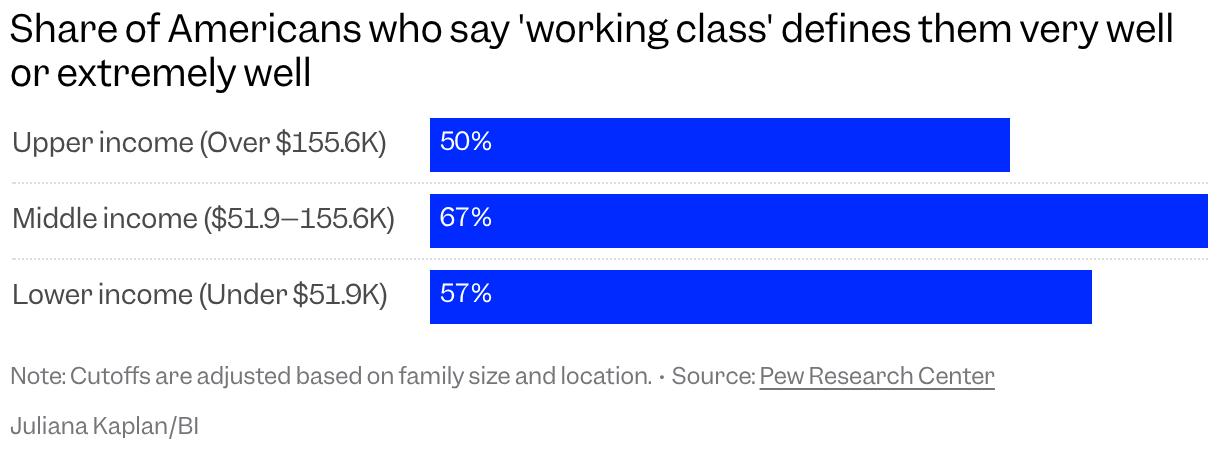
Grouped Bars

That could be because the term itself is ambiguous: As the analysis notes, there’s no one clear definition of working class. Some equate the working class with lower earners, while others see them as workers without a bachelor’s degree, or those explicitly working in blue-collar fields like construction and agriculture.

The Pew findings come as middle-earning or financially comfortable Americans don’t feel well-off, even while their pay has grown. Median weekly earnings increased 8.4% from the first quarter of 2024 through the first quarter of 2026, outpacing the 5.5% inflation in prices over that time.

The middle third of earners used to feel similarly about their savings and spending as higher-earners did. Those two groups have increasingly drifted apart, with sentiment among the middle earners tracking more closely with the lowest earners. That’s reflected in how they’re spending, too: In 2024, Morning Consult found that middle-income consumers were spending more like their lower-income counterparts. The increased identification with the working class also dovetails with a shrinking middle class, which has fallen from 61% of the population in 1971 to 51% in 2023.

Some of the growing disconnect might be because of inflation. High prices generally make people feel bad about their economic prospects, and over the past few months, inflation has outpaced wage growth. Financial stress also correlates with identifying as working-class. Even still, half of those who reported a baseline of financial comfort — bills paid, expenses met, months of emergency savings — identified with the term working-class.

Your political leanings might also play a role in working-class identification, especially as affordability messaging takes center stage in America. Steven Shepard, the associate director of political research at Pew and one of the report’s authors, said, “If you hold most of these other things equal, that Republicans are just more likely to say that that term describes them than Democrats.” Upper-income Republicans are far more likely to see themselves as working class than their Democratic counterparts.

On the other side of the political spectrum, progressive politicians have homed in on this newly expanded working class. New York City Mayor Zohran Mamdani campaigned on an affordability platform meant to ease costs for the working class, which he told The New York Times is the “one majority in this country.”

“If you have to work to pay your bills, I think that that is one definition of being a part of the working class,” Mamdani said.

Read the original article on Business Insider

JetBlue unveiled its new domestic first-class seat with more space, Bluetooth, and customizable cocktails. Take a look.

JetBlue new first class.
JetBlue unveiled its new first-class seat.
  • JetBlue Airways’ new first-class seat, BlueFirst, will start flying later this year.
  • The large recliner sports the usual premium perks, like priority boarding and more legroom.
  • Passengers can use the seatback’s “Mixologist Mode” to order custom alcoholic drinks.

JetBlue Airways is doubling down on premium, and its planes are about to look very different.

On Tuesday, the airline officially unveiled the details of its highly anticipated first-class cabin: BlueFirst.

The new cabin, which has Bluetooth connectivity, extra space, and enhanced meals and entertainment, will be equipped on Airbus A220, A320, and A321 aircraft, and service is expected to start “later this year.”

JetBlue did not disclose the inaugural route, but said BlueFirst will be available “in all markets where JetBlue flies and is not currently served with Mint [business class].” This will be a departure from its historically all-economy domestic planes and bring JetBlue more in line with mainline competitors like Delta and United.

Complementing its Mint cabin and new airport lounges, BlueFirst is the latest sign of JetBlue’s — and the broader airline industry’s — laser focus on premium demand.

High-dollar premium cabins have become increasingly important to airlines’ bottom lines as travelers continue paying up for better experiences. JetBlue reported a 13% year-over-year increase in premium revenue per available seat mile in the second quarter, outpacing Main Cabin’s 11% growth.

JetBlue isn’t alone. Delta Air Lines reported a 17% year-over-year increase in premium revenue in Q2, while United’s premium revenue rose by about 16%.

This premium shift comes as JetBlue continues to claw back to profitability, having not posted a full-year net profit since the COVID-19 pandemic. It had been counting on now-failed deals with Spirit Airlines and American Airlines to grow, but both ultimately collapsed. It’s also dealt with engine-related aircraft groundings and numerous route and city cuts.

Still, JetBlue has carved out a stronghold in Fort Lauderdale after Spirit’s collapse, is adding more leisure-focused routes, and is teaming up with United to share customers and expand its reach.

BlueFirst could help JetBlue build on that momentum. Here’s a closer look.

BlueFirst resembles traditional domestic first-class.
Rendering of JetBlue first class.
JetBlue’s new BlueFirst.

The large foam-lined recliners are configured in a 2×2 layout and feature headrests, a 13.3-inch seatback screen, and USB-A, USB-C, and 110VAC charging ports.

The up to 7 inches of extra legroom and up to 5 inches of recline are standard, and passengers on overnight flights also get a blanket and a “snooze kit.”

JetBlue CEO Joanna Geraghty said that “premium should feel special, not stuffy,” and that BlueFirst will offer new innovative elements: “Domestic first class has become easy to predict. We think it’s time for a fresh take.”

Passengers can use Bluetooth headphones.
A view of the seatback screen in BlueFirst.
There is also a small center table for more space.

Passengers can ditch wired headphones for Bluetooth in BlueFirst. More airlines, like United and Spain’s Iberia, have also added the feature to their planes.

Flyers can also connect to JetBlue’s free WiFi. The airline plans to begin introducing Amazon Leo’s faster, low Earth orbit satellite technology on a portion of its fleet in 2027.

The seatback screen will offer “Mixologist Mode.”
A JetBlue plane being catered,
A JetBlue plane being catered at JFK.

JetBlue said the BlueFirst seatback screens have a “Mixologist Mode” that lets customers customize their cocktails. They can choose their spirit, mixer, and flavorings, and the order is sent to the flight attendants.

On flights longer than 899 miles, first-class flyers will be served a bento-style box with an entrée, a side, and a dessert. JetBlue said the choices include sweet-and-savory crepes or sesame noodles with beef or tofu, among others.

Premium snack brands like Sockerbit, Tosi, Wholesome Bakery, Pop Daddy Snacks, and Cape Cod Chips will be available on every flight.

“Traditional first-class food and beverage can feel stuck in the past,” Geraghty said. “BlueFirst is our way of refreshing the experience for today’s traveler.”

First-class flyers get Group 1 boarding and other premium perks.
A short line of people boarding in JetBlue's priority lane.
People boarding in JetBlue’s priority lane.

In addition to being among the first to board, BlueFirst ticket holders also get dedicated overhead bin space, priority check-in, and expedited security at over 30 airports.

BlueFirst has a discount option.
Screenshot of JetBlue's new fare structure.
JetBlue’s new base fare structure also covers Main and EvenMore.

JetBlue is rolling out three distinctive fare tiers for BlueFirst: “flex,” “standard,” and “base.” Standard and flex both include a seat selection, two free bags, and no change or cancel fees, but flex offers refunds for eligible cancellations rather than travel credit.

Base is the discount option that strips away perks like free seat selection in exchange for a lower price. This “basic first class” strategy is similar to what Delta and United are doing across their cabins to entice more people to book premium cabins.

JetBlue’s president, Marty St. George, has said the goal of the new fare structure is to create more choice for customers by letting them “be able to book what’s right for them.”

First-class passengers won’t get lounge access.
The first level of the JetBlue JFK lounge.

As part of its JetForward initiative, JetBlue has opened two “BlueHouse” airport lounges at New York-JFK and Boston.

Mint business-class passengers get free access, but first-class passengers can’t enter unless they have another qualifying entry, such as being a Mosaic 4 loyalty member (the highest tier of JetBlue’s status ladder) or holding the JetBlue Premier credit card.

The new seat will be equipped on three different plane types.
JetBlue A320.
JetBlue has an all-Airbus fleet.

JetBlue said its Airbus A220 and A320 aircraft will have 12 BlueFirst seats, while the stretched A321 will have 16. Once the renovations are complete, every JetBlue plane will have a premium section.

“From creating your own cocktail and ordering right from your seatback screen, to a thoughtfully crafted seat that offers responsive comfort, we’re making the experience more personal, modern, and fun,” Geraghty said.

Read the original article on Business Insider

Ukraine’s ousted pro-tech defense minister is launching a new company backed by Palantir’s Alex Karp

Mykhailo Fedorov with a microphone and Alex Karp speaking on a blue stage.
Mykhailo Fedorov and Palantir CEO Alex Karp
  • Mykhailo Fedorov is launching a defense tech startup after his ouster this summer.
  • Palantir CEO Alex Karp will be the new company’s first lead investor.
  • Fedorov says the company will turn Ukraine’s wartime tech lessons into new capabilities.

Mykhailo Fedorov, who helped drive rapid innovation in battlefield technology, particularly drones, before being ousted as Ukraine’s defense minister this summer, is launching a defense tech company.

The new company will focus on developing defense technologies intended to strengthen Ukraine and support partners, Fedorov said in a release, promising “more details to come.”

While much remains unclear about what the company will do, its first lead investor will be Alex Karp, the CEO of Palantir, an American AI, data, and operational intelligence company.

In a statement, Fedorov said Ukraine would be the company’s priority.

“During the full-scale war, our team gained unique experience working with defense technologies in Ukraine and seeing firsthand how technology is transforming modern warfare,” he said. Now, he and his team intend to leverage that in a new venture.

In a video made with Fedorov at Palantir’s Washington office, Karp said of Fedorov and his team that “you and your colleagues are launching a company that I think will be defining for the world, bringing your knowledge and acumen about the art of war.”

Before becoming defense minister in January, Fedorov served as minister for digital transformation, a role in which he was celebrated for a Silicon Valley-style approach to delivering major changes intended to better prepare Ukraine for an evolving fight.

His time in Ukraine’s defense ministry coincided with tech-driven successes in combat, including a mid-range drone strike campaign that has devastated Russian logistics and the expansion of its deep-strike campaign targeting Russia’s military and industry.

Fedorov’s sudden departure in July, six months into the job, came as a shock to Ukrainian service members and industry figures alike. His push for radical changes within the armed forces, he said at the time, created significant friction with senior military leaders.

After his dismissal, Fedorov spoke critically about Gen. Oleksandr Syrskyi, Kyiv’s commander in chief at the time, accusing him of blocking every initiative he and his team put forward, creating a rift. “Instead of figuring out how to defeat Russia asymmetrically, he figured out how to split the country,” he said of Syrskyi.

In public statements following Fedorov’s departure, Syrskyi thanked him for his work and said he hoped that he would see “continued success as part of the Ukrainian team.”

Ukraine replaced Fedorov with Yevhenii Khmara, and later, it replaced Syrskyi with Maj. Gen. Mykhailo Drapatyi, whom Ukrainian troops rallied around as a strong choice for the role.

Read the original article on Business Insider

US Navy backlogs could leave over a dozen submarines sitting idle for years, costing $3 billion, watchdog says

The USS Pasadena submarine sails in icy Arctic waters. A group of men stand on top of it and on ice nearby.
The USS Pasadena entered idle status in January 2025 but isn’t scheduled for decommissioning until November 2028.
  • The Navy’s maintenance problems are creating a growing backlog of submarines awaiting decommissioning.
  • 15 subs could spend 14,000 days idle through 2030, costing the Navy more than $3 billion.
  • The GAO says the Navy hasn’t fully evaluated options that could reduce the backlog.

Severe backlogs could leave over a dozen US Navy attack submarines awaiting decommissioning sitting idle for more than 14,000 days through the end of the decade, and cost the sea service over $3 billion, according to a new watchdog report.

Navy maintenance delays have already cost the sea service billions of dollars and sidelined active attack submarines for thousands of operational days, affecting fleet readiness.

A new report from the Government Accountability Office, a congressional watchdog, said: “Over the last 10 years, the US Navy has lost more than 15,000 operational days due to maintenance delays and idle time on active attack submarines. These delays resulted in an estimated $3.4 billion in costs to sustain crews and submarines that provided no operational capability.”

Idle time for active submarines refers to the period when a vessel is no longer certified to operate but has yet to enter maintenance. The Navy may still end up paying out hundreds of thousands of dollars a day for submarines to sit pier-side.

A related backlog for inactive subs is expected to be another substantial cost burden.

“Without mitigation, 15 attack submarines will enter inactive idle time from fiscal year 2026 through fiscal year 2030,” the new GAO report said, “during which time the Navy could incur more than 14,000 days of inactive idle time and $3.1 billion in costs to operate and support these inactive submarines.”

A submarine sits in the water at a shipyard.
Public yards are stretched thin for maintenance and repairs of submarines.

The report cited the Los Angeles-class sub USS Pasadena as an example. The vessel, which entered inactive idle status on January 1, 2025, is not scheduled for decommissioning until November 15, 2028, due to limited shipyard capacity.

The Navy told the GAO that it will use the Pasadena as a training platform while it waits for decommissioning; however, the delay will cost the service over $300 million, the GAO said.

The Navy’s nuclear-powered submarines undergo their most extensive maintenance, repairs, and decommissioning at four public shipyards, though some depot-level work can be done at two private yards. The Navy and shipbuilders are pursuing several efforts to revitalize yards, including increasing capacity and investing in the workforce and infrastructure.

Earlier this month, President Donald Trump issued an executive order directing the Navy and the Department of Defense to establish a fifth public yard as part of a larger “plan to increase nuclear-powered submarine and aircraft carrier readiness.”

The Navy told the GAO that it’s considering alternative options in the meantime, including defueling the nuclear reactors of attack submarines while the vessels are pier-side rather than waiting until they reach a shipyard. “However, officials were unable to provide documentation of detailed analyses conducted on the feasibility and cost-effectiveness of this option,” the GAO added.

The Navy is also looking into using floating dry docks for defueling, but the GAO said that option also needs further study. Other proposed alternatives include transferring inactive crews to active vessels and extending the service lives of submarines to avoid decommissioning backlogs, although “these service life extensions are still pending approval,” the report said.

Read the original article on Business Insider

I’ve traveled to all 50 states. These are the 7 most overrated tourist attractions in the US.

Emily taking a selfie in front of the Southernmost Point in Key West, Florida, with the ocean in the background.
I wouldn’t plan trips around some of the major US tourist attractions.
  • I’ve visited all 50 states and most major US tourist attractions — some of which I found overrated.
  • I wouldn’t plan trips around the Four Corners Monument or Mount Rushmore.
  • I’d also recommend avoiding Salem, Massachusetts, in October due to the immense crowds.

I love visiting kitschy or unique tourist landmarks on a road trip or weekend getaway. In fact, after visiting all 50 states solo, I’ve enjoyed my short visits to nearly all the major tourist attractions in the United States.

However, in retrospect, I’ve found some to be overhyped and not places I’d plan an entire trip around.

Here are the seven tourist attractions I think are overrated.

The Las Vegas Strip is near the top of my list of overrated destinations.
A view of the Las Vegas strip at night with lit-up buildings and cars roaming the streets.

Although the Las Vegas Strip is a sight unlike any other, its artificiality puts it near the top of my list of overrated tourist destinations.

Despite that, I’ve enjoyed my time on the nearby Fremont Street and in the surrounding natural areas near the city, such as the Red Rock Canyon National Conservation Area.

The Four Corners Monument doesn’t offer much beyond a photo opportunity.
The Four Corners Monument, showing the borders of Colorado, Utah, Arizona, and New Mexico meeting.

For geography enthusiasts, the Four Corners Monument — where visitors can stand in Colorado, Utah, Arizona, and New Mexico simultaneously — is likely a bucket-list attraction.

However, although the quick stop makes for a fun photo opportunity, there’s not much more to do in this relatively remote area.

It’s worth visiting this unique attraction once, but I’d much rather stick to the nearby Monument Valley Navajo Tribal Park, known for its tall sandstone buttes.

South Dakota’s Black Hills region offers more than just Mount Rushmore.
A view of Mount Rushmore with an American flag in front of it.

Like most spots on this list, I’d revisit Mount Rushmore if I were in the Black Hills area of South Dakota, but I wouldn’t center an entire trip around it.

The monument is impressive, but in its immediate vicinity, there isn’t much more to do than hike a couple of very short trails.

I’d instead plan a trip around the entire Black Hills Region, with stops at Crazy Horse Memorial, Custer State Park, and Badlands National Park.

In New Orleans, I’d recommend visiting Frenchmen Street over Bourbon Street.
Emily taking a selfie on Bourbon Street in New Orleans.

New Orleans is one of my all-time favorite cities, and the iconic French Quarter neighborhood is always a must-see when visiting. Despite that, I don’t recommend a trip to the city just to see Bourbon Street.

Although it can be interesting to walk along in the morning or pop in quickly at night, the overwhelming crowds of tourists do not, in my opinion, best represent the city or its culture.

If I want to escape the hustle and bustle of the French Quarter, I prefer the more low-key Frenchmen Street — which some tour guides call a “local’s Bourbon Street.”

Although Frenchmen Street has become more popular over the years, I still don’t find it as overwhelming as Bourbon Street.

I wouldn’t visit Times Square more than once on a New York City trip.
Crowds of people gathered in New York City's Times Square.

Similar to the Las Vegas Strip, Times Square is one of the most iconic US landmarks. Although I’d visit if I were nearby, there are so many other spots in New York City that I prefer.

In my opinion, spending time walking around smaller neighborhoods in Manhattan or Brooklyn gives visitors a much better understanding of the local culture.

For those looking for a more touristy experience, I recommend checking out The High Line, which offers great views of Manhattan, or Little Island, which is an artificial island within Hudson River Park.

The line for photos at the Southernmost Point of the US in Key West, Florida, is often extraordinarily long.
Emily taking a selfie in front of the Southernmost Point in Key West, Florida, with the ocean in the background.

Key West, Florida, is one of my favorite cities in the US. Despite all the city has to offer, many visitors first make a beeline for the Southernmost Point.

As the title implies, it’s a simple monument that marks the southernmost point of the US, just 90 miles north of Cuba. Although I visited the point and thought it was a fun photo opportunity, the line for pictures was extraordinarily long.

There are many other places in the area where I’d rather spend that time, with Key West’s exciting culture, museums, history, food, and excellent outdoor-recreation opportunities.

I recommend avoiding Salem, Massachusetts, in October.
Crowds of people gathered at a Halloween marketplace in Salem, Massachusetts.

I first visited Salem, Massachusetts, on a whim while traveling nearby one October. However, I didn’t realize the city is inundated with visitors throughout the entire month — not just on Halloween.

Infamous for the Salem Witch Trials, the city has become a tourist destination for lovers of everything spooky, especially as Halloween approaches.

Most of my visit was spent finding a parking spot, with the hoards of crowds limiting the appeal for me.

I’d love to visit outside October and recommend only spooky-season fanatics plan a trip during that time frame.

This story was originally published on September 26, 2024, and most recently updated on August 31, 2026.

Read the original article on Business Insider

Good Good after the ad scandal: How the golf YouTubers can move forward

Garrett Clark was in a controversial Good Good ad.
Garrett Clark was a key figure in a controversial Good Good ad.
  • YouTube golf channel Good Good has seen severe fallout from an ad, which critics called anti-women.
  • Creator-economy insiders say there’s a path to recovery, but it’s a long road.
  • Good Good could double down on its core audience and use humor to redeem itself.

Good Good has seen major fallout from an ad with Callaway that critics say promoted violence against women — but creator economy insiders say there’s a road to recovery.

Last week, Callaway cut ties with Good Good, Dick’s Sporting Goods pulled its products from shelves, and the YouTube golf group stepped back from its title sponsorship of a fall PGA Tour event. A person close to Good Good said two people from marketing were fired.

So, just how bad is the situation?

“We’re going to remember this for years,” said Joe Perello, CEO of Props, a creator marketing company. “They have a long road ahead of them to establish relationships with big manufacturers like Callaway and retailers.” He added that other up-and-coming golf brands are waiting to take Good Good’s place.

The diversified business that had made Good Good a creator success story — and helped it raise $45 million last year — also exposed it to outside partners who didn’t have the appetite to weather bad news.

There could be other shoes still to drop, said Chris Erwin, founder of RockWater, an M&A and strategy advisory firm for the creator economy. For example, Good Good has a partnership with Dude Perfect, aimed at gaining a foothold with younger viewers, that could be at risk.

Still, Erwin and others said all isn’t lost for the brand. Good Good has a war chest, more than 2 million subscribers, and — ironically — a fresh wave of attention after the scandal. It also has a new president, who could help steady the ship.

The channel could double down on its core audience with paid subscriptions, direct-sold products, and live events while it recovers.

“It’s a moment to show who they are,” Erwin said. “If they do that, and advertising comes back, it could be a better business.”

Good Good had a brand-friendly image and had rolled out a campaign, “There’s More to Golf,” earlier this year to promote inclusivity and reach new audiences. This ad scandal could severely hamper its efforts to grow its female viewership. Zappi, a consumer market research company, found a sharp gender divide in its ad scoring, with women at least twice as likely as men to feel negatively toward Good Good and Callaway after seeing the promo.

Good Good could shift its branding and adopt a more “outlaw” persona. Or, it could use humor to redeem itself, Perello said.

Self-deprecating humor is “the fastest pathway back to redemption,” he said. “My advice would be, make hay of this and put yourself at the butt of the joke.”

What about the rest of the creator economy?

Creator economy insiders said influencer marketing is too entrenched in the CMO playbook for companies to hit pause because of a single incident like the Good Good backlash.

That said, it could cause some marketers to ensure they have ad-approval systems in place to prevent a similar situation from happening to them.

“It could prompt some brands and their agencies to reassess where they draw the line between creative freedom and oversight, with greater scrutiny of creators and more checks around creative sign-off,” said Ben Woods, head of creator economy at Enders Analysis.

There has been a push-and-pull for years between brands and creators over how much control each should have.

Ultimately, that could mean influencer marketing gets a bit more boring — at least temporarily — as some marketers tighten up the freedom they give creators.

“Creator content will become less authentic,” Perello said. “There’ll be an overcorrection.”

No one who spoke with Business Insider expected it to have any lasting damage on the rise of influencer marketing, however. US advertisers are expected to spend $44 billion on creator marketing in 2026 — up about 18% from 2025, according to a report from the Interactive Advertising Bureau.

Read the original article on Business Insider