Number One Observatory Circle is the official residence of the US vice president.
Pablo Martinez Monsivais, File/AP
The vice president’s official residence is on the grounds of the US Naval Observatory.
Different vice presidents have added amenities such as a pool, a jogging track, and a garden.
The residence may be haunted — Walter Mondale’s daughter once said she saw a ghost in her bedroom.
Vice President JD Vance and his wife, second lady Usha Vance, moved into the vice president’s official residence at Number One Observatory Circle with their three children upon taking office in 2025. They’re expecting their fourth child, a boy, in July.
The 9,150-square-foot historic home features personal touches and luxury features added by vice presidents over the years, including a swimming pool, a running track, and, most recently, a large chicken coop that reflects the mansion’s architectural style. It’s also been home to a few ghost stories.
Here’s a closer look at the vice president’s residence.
The vice president’s official residence is located on the grounds of the United States Naval Observatory in Washington, DC.
This is a satellite image of the United States Naval Observatory in Washington D.C. United States, one of the oldest scientific agencies in the US with a mission to produce positioning, navigation and timing for the US Navy and the US Department of Defense. Collected on April 2, 2012.
DigitalGlobe/Getty Images
Established in 1830, the US Naval Observatory is one of the oldest scientific agencies in the US, where scientists collect astronomical data for accurate navigation, according to the official website of the Commander, Naval Meteorology and Oceanography Command.
The movements of planets and stars are used to accurately provide positioning, navigation, and timing for the Navy and Department of Defense.
Measuring 9,150 square feet, Number One Observatory Circle contains 33 rooms.
Number One Observatory Circle is the official residence of the US Vice President.
Pablo Martinez Monsivais, File/AP
The home features six bedrooms, a dining room, a garden room, a study, and an attic.
The home was built in 1893 for the Naval Observatory’s superintendent and began housing its chief of naval operations in 1923.
Winter view of Number One Observatory Circle, the US Vice President’s official residence, in snow, Washington DC, January 17, 1977.
U S News & World Report Collection/Thomas O’Halloran/PhotoQuest/Getty Images
Vice presidents used to live in their own homes until Congress devoted funds to refurbishing the home for vice presidential use in 1974, according to the White House.
Number One Observatory Circle became the official vice presidential residence in 1974.
1/14/1975- Washington, DC: Mansion on the grounds of the Naval Observatory in NW section of the Capital will soon become home for U.S. Vice President Nelson Rockefeller and family. Known by U.S. Navy as “Admiral’s House,” it was formerly home of the Chief of Naval Operations.
Bettmann/Contributor/Getty Images
President Gerald Ford’s vice president, Nelson Rockefeller, hosted events at the home but didn’t live there.
In 1977, Vice President Walter Mondale, who served under President Jimmy Carter, became the first vice president to live in the residence full-time.
Mondale’s daughter, Eleanor, once called the Secret Service when she said she saw a ghost in her bedroom.
Walter Mondale and Eleanor Mondale during Sighting at Jimmy’s Restaurant at Jimmy Restaurant in Los Angeles, California, United States.
Ron Galella, Ltd./Ron Galella Collection via Getty Images
Eleanor Mondale wrote in a 1998 issue of Swing magazine that the Secret Service was less than pleased when they found out she had reported a ghost sighting, rather than an intruder.
“I was so scared, I fainted,” she wrote, Deseret News reported. “Upon coming to, I phoned the Secret Service Command Post. I whispered that there was a man in my room and hung up. Minutes later, two agents busted into the room, guns drawn. When I told them the ‘man’ was actually a ghost, they requested that I NEVER DO THAT AGAIN!”
Vice presidents can redecorate the home according to their tastes.
WASHINGTON, DC — CIRCA 1983: U.S. Vice President George H.W. Bush and Mrs. Barbara Bush at the Vice President’s residence circa 1983 in in Washington, DC.
David Hume Kennerly/Getty Images
Money for maintaining the home, as well as for additions or renovations, comes from private funds or donations to the Vice President’s Residence Foundation, which was founded in 1991.
Dick and Lynne Cheney decorated the residence in neutral colors.
This photo provided by the White House shows Vice President Dick Cheney bidding farewell to Vice President-elect Joe Biden, Thursday, Nov. 13, 2008, following their visit at the Vice President’s Residence at the U.S. Naval Observatory in Washington.
David Bohrer/White House/AP Photo
They enlisted interior designer Frank Babb Randolph to help with the transformation.
The Bidens added pops of color throughout the house, such as “Biden blue” walls in the dining room.
WASHINGTON, DC – OCTOBER 28: At the Vice President’s residence the dining room is painted Biden blue and photographed October 28, 2016 in Washington, DC.
Katherine Frey/The Washington Post via Getty Images
Interior designer Victoria Hagan worked with the Bidens to add touches such as green wallpaper to the library and “daffodil yellow” walls in the living room.
The Bidens’ favorite room in the home was the Solarium.
WASHINGTON, DC – OCTOBER 28: Joe and Jill Biden’s favorite room in the Vice President’s residence is the Solarium photographed October 28, 2016 in Washington, DC. Every Vice President since Walter Mondale has lived with their families on the grounds of the United States Naval Observatory.
Katherine Frey/The Washington Post via Getty Images
“I love to go in that room and sit on the couch and grade papers or have meetings,” Jill Biden told The Washington Post in 2017. “Often, they put a round table in there and we would have dinner or lunch.”
Vice presidents have also added amenities over the years, such as a jogging track, exercise room, and horseshoe pit.
U.S. President George H. Bush, along with an unidentified aide and agent jog at the vice president’s residence in Washington, Wednesday, March 27, 1992. On Thursday, the President will head up to Bethesda Naval Medical Center for his annual check-up.
Barry Thumma/AP Photo
George H.W. Bush installed a quarter-mile jogging track at the residence, and he liked it so much that he continued running there even after he became president.
The house features a pool added by Dan Quayle.
The Quayle family had the pool installed when they lived at the Vice President’s residence which is still open October 28, 2016 in Washington, DC.
Katherine Frey/The Washington Post via Getty Images
Biden told reporters in 2010 that “no one can say a negative thing about Dan Quayle” because he added the pool to the vice president’s residence.
“He’s my favorite vice president,” Biden said. “And my granddaughters love it.”
Joe Biden surprised Jill Biden with a tree swing on the grounds of the residence for Valentine’s Day in 2010.
WASHINGTON, DC – OCTOBER 28: Vice President Joe Biden surprised his wife, Jill, with a tree swing with a commemorative plaque on a tree on the grounds of the Vice President’s residence on Valentine’s day in 2010 that is photographed October 28, 2016 in Washington, DC.
Katherine Frey/The Washington Post via Getty Images
The commemorative plaque reads “Joe loves Jill. Valentine’s Day 2010.”
Jill Biden added the Family Heritage Garden where stones memorialize all the home’s previous occupants and their family members, including pets.
Dr. Jill Biden helped create the Family Heritage Garden of the Vice President where all occupants and their family members, including pets, are memorialized on the stone pavers around a fountain as seen October 28, 2016 in Washington, DC. A fiberglass replica of a bronze dog by artist Charles Parks is on loan and wears Champs collar. Champ is the Biden’s dog. October 28, 2016.
Katherine Frey/The Washington Post via Getty Images
The garden also features a bronze sculpture of the Bidens’ dog Champ, who died at age 13.
When the Pences moved into the residence, Karen Pence installed a beehive to raise awareness of the declining honeybee population.
U.S. Department of Agriculture (USDA) Secretary Sonny Perdue and his wife Mary joined Mrs. Karen Pence to unveil a bee hive on the Vice President’s residential grounds in Washington, D.C., June 6, 2017.
Preston Keres/USDA
Karen Pence previously kept bees at the Indiana governor’s residence, unveiling a hive there in 2014. The hive she added to the vice presidential residence in 2017 held 20,000 bees.
“All types of pollinators, such as bees, butterflies, birds, and bats, are critical to providing our nation’s food, fiber, fuel, and medicine,” Pence said at the unveiling.
Kamala Harris and Doug Emhoff, who is Jewish, became the first residents to affix a mezuzah to the door of the home.
US Vice President Kamala Harris (2R) and Second Gentleman Doug Emhoff (R) greet Philippine President Ferdinand Marcos Jr. (2L) and his wife Louise Araneta-Marcos (L) as they arrive for brunch at the Vice President’s residence in Washington, DC, on May 2, 2023.
SAUL LOEB/AFP via Getty Images
In November 2021, the second couple put a white mezuzah — a small scroll of Hebrew text from the Torah in a decorative case — on the right side of the doorway of their residence.
When they affixed the object, which marks the space as sacred and holy, Emhoff’s parents came to the ceremony, Harris told Vanity Fair.
“My mother-in-law, Barbara, is very pleased and proud of her son,” she said.
Harris and Emhoff also planted a pomegranate tree on the grounds to mark the first anniversary of the October 7 attacks in Israel.
WASHINGTON, DC – OCTOBER 7: Vice President Kamala Harris speaks as Second Gentleman Doug Emhoff looks on before they plant a pomegranate tree at the Vice President’s residence at the U.S. Naval Observatory on October 7, 2024 in Washington, DC. The Second couple marked the one-year anniversary of the October 7 attacks in Israel by planting a memorial tree, a tradition done by second families on the grounds of the Vice President ‘s residence.
Kent Nishimura/Getty Images
“For years to come, this pomegranate tree will stand here, spreading its roots and growing stronger to remind future vice presidents of the United States, their families, and all who pass through these grounds not only of the horror of October 7, but of the strength and endurance of the Jewish people,” Harris said in her speech before planting the tree. “It will remind us all not to abandon the goal of peace, dignity, and security for all, and it will remind us all to always have faith.”
There’s rumored to be a secure bunker underneath the residence.
The residence on Nov. 11, 2000, when Vice President Al Gore was secluded awaiting developments in the Florida recount.
J Scott Applewhite/AP Photo
When loud blasts and construction noises were heard at Number One Observatory Circle in 2002, neighbors complained and received letters that read, “Due to its sensitive nature in support of national security and homeland defense, project-specific information is classified and cannot be released.”
The letter sparked rumors that a secure bunker was being built after the attacks of September 11, 2001.
A spokesperson for the US Navy told the BBC in 2002 that the construction was “an infrastructure and utility upgrade.”
Newsweek’s Eleanor Clift reported in 2009 that Biden revealed the existence of the bunker at an annual Gridiron Club dinner, but Biden’s spokeswoman told Fox News that his comments were not reported accurately.
“What the vice president described in his comments was not — as some press reports have suggested — an underground facility, but rather, an upstairs workspace in the residence, which he understood was frequently used by Vice President Cheney and his aides,” the spokeswoman said. “That workspace was converted into an upstairs guestroom when the Bidens moved into the residence. There was no disclosure of classified information.”
Vice presidents have more freedom of movement at their residence than presidents do in the White House.
Vice President Joe Biden and Dr. Jill Biden host a barbeque for wounded service members from Walter Reed Army Medical Center outpatients and their families at the Vice President’s residence at the Naval Observatory in Washington, Tuesday, May 25, 2010. The service members currently reside at the Mologne House, which offers housing for patients and their families while they undergo rehabilitation and treatment.
Charles Dharapak/AP Photo
Presidents can’t just walk out of the White House whenever they want. At One Observatory Circle, though, vice presidents have more space and privacy to live normal lives.
At a CNN town hall in 2021, Biden likened the White House to a “gilded cage.”
“The vice president’s residence was totally different,” he said. “You’re on 80 acres, overlooking the rest of the city. And you can walk out, and there’s a swimming pool. You can walk off a porch in the summer and jump in a pool, and go into work. You can ride a bicycle around and never leave the property and work out. But the White House is very different.”
Harris occasionally hosted gatherings at the official residence.
US Vice President Kamala Harris speaking during a breakfast meeting she hosted at her official residence in Washington DC, attended by Taoiseach Leo Varadkar as part of his visit to the US for St Patrick’s Day. Picture date: Friday March 15, 2024.
Niall Carson/PA Images via Getty Images
Harris welcomed Irish Prime Minister Leo Varadkar to the residence for a St. Patrick’s Day breakfast in 2023.
In January 2025, JD Vance and Usha Vance moved into the residence with their three young children: Ewan, Vivek, and Mirabel.
US Vice President JD Vance and Second Lady Usha Vance arrive to greet the Taoiseach of Ireland Micheál Martin and his wife Mary O’Shea for a St. Patrick’s Day breakfast at the Vice President’s residence in the US Naval Observatory in Washington, DC on March 17, 2026. The Irish prime minister arrived in the United States March 13 for an annual St Patrick’s Day trip under pressure to talk tough to US President Donald Trump amid the Iran war. (Photo by
ROBERTO SCHMIDT/POOL/AFP via Getty Images
The Vances are the first vice presidential family to live at the residence with children since the Gore family in 1993.
They also hosted Irish Prime Minister Micheál Martin and his wife, Mary O’Shea, for a St. Patrick’s Day breakfast in 2026.
In June 2026, the Vances added a chicken coop to the property.
A new chicken coop at the vice president’s residence.
Office of the Vice President
Designed by Carolina Coops, the structure was designed to match the architecture of the Naval Observatory. It was not built with taxpayer funds, a source familiar with the matter told Business Insider.
The chicks will supply the vice president’s residence with fresh eggs. Vance joked during a 2024 campaign trail visit to a grocery store that his young children “actually eat about 14 eggs every single morning.”
Meta’s spokesperson confirmed outage issues on Friday morning.
Beata Zawrzel/NurPhoto via Getty Images
Widespread outages plagued Facebook and Instagram Friday morning.
A Meta spokesperson confirmed platform issues in a post on X and later said: “We’re coming back.”
Outage reports on third-party website DownDetector have since fallen.
Facebook and Instagram suffered from widespread outages for hours on Friday before the service began to come back online.
Outage reports spiked throughout the morning on the third-party website DownDetector.com before the disruption appeared to ease.
“We’re aware people are currently having trouble accessing our services,” Meta’s communication director, Andy Stone, said in a 10:11 a.m. ET post on X. “We’re working on it.”
Facebook and Instagram users reported outage issues on DownDetector.com on Friday.
DownDetector
At the time,Meta’s systems dashboard page also showed “high disruptions” for its Facebook Ads Manager, Messenger API, Messenger platform, and WhatsApp Business Platform.
Just before noon EST, Stone said in another update: “We’re coming back, though it may take a bit of time for everything to be fully back to normal.”
Users were quick to take to X to complain about the disruptions amid the outage.
“This is the third time Facebook has gone down this week. Every time, it takes Instagram, WhatsApp, and Messenger down with it,” one user said.
Another added, “Anybody else just been logged out of Facebook messenger and can’t log back in? Unknown error.”
FACEBOOK IS DOWN INSTAGRAM IS DOWN META ADS MANAGER IS DOWN QUICK EVERYONE GO OUTSIDE AND TOUCH GRASS
Elon Musk’s companies have been swapping IP and cash. It’s led to rumors of potential mega mergers.
Spencer Platt/Getty Images
The companies led by Elon Musk have become increasingly intertwined in the past couple of years.
These firms have shared employees and purchased batteries, software, and vehicles from each other.
SpaceX is expected to contribute to Tesla’s coming Roadster, for example, and xAI’s Grok is in Teslas and Optimus demo bots.
For years, the sprawling companies in Elon Musk’s business empire have worked closely together.
Tesla, SpaceX, The Boring Company, et al. have behaved like pieces of a shared ecosystem inside Elon Inc. — buying one another’s products, investing billions across company lines, sharing software and materials, and moving employees between ventures.
Now, the overlap is leading to consolidation. In the past year alone, Musk’s empire has already consolidated from six major companies to four after his xAI acquired social network X and SpaceX acquired xAI.
Those tie-ups are fueling a bigger acquisition question: Is he eyeing a mega-merger between aerospace company SpaceX and electric carmaker Tesla?
“That might make Elon’s life a little easier, actually,” she said. “There’s no question that there’s synergies between Tesla and SpaceX in our futures, definitely, there’s a convergence of a kind of what we’re all trying to accomplish in the future.”
That merger would be the most dramatic step yet, collapsing two of Musk’s best-known companies into a single corporate giant.
Even without a deal, his companies are already increasingly intertwined. Here’s how:
Tesla and SpaceX are buying from each other
SpaceX is lending rocket-boosting tech to Tesla’s upcoming hyper-powered sports car, Musk said.
Joe Raedle/Getty Images
SpaceX is a major customer of Tesla’s energy business.
In SpaceX’s S-1 securities filing, the rocket and AI company unveiled that it spent $697 million on Tesla Megapack battery products across 2024 and 2025.
SpaceX is also giving some technology back to Tesla. Musk has said that the carmaker’s long-awaited next-generation Roadster will be a “Tesla/SpaceX collab” and feature SpaceX-built cold-gas thrusters. The hyper-powered sports car’s launch event has been repeatedly delayed after Musk penciled an unveil in for April 1.
“It’s gonna be really cool, and it’s gonna have some rocket technology in it,” he said during a 2024 sit-down with Don Lemon.
Tesla’s AI ambitions are increasingly tied to xAI
Tesla wants to build out its AI software, including its self-driving ambitions. CEO Elon Musk said a $2 billion investment in his software company would help.
Jay Janner/The Austin American-Statesman via Getty Images
Tesla’s January earnings disclosed that it had agreed to invest $2 billion in xAI, with a related “framework agreement” to explore additional collaboration opportunities.
Tesla has already integrated xAI’s Grok into its vehicles, allowing drivers to chat with the AI and use it to add and edit navigation destinations.
Videos have shown early versions of Tesla’s in-development Optimus robot using xAI’s Grok AI chatbot for its voice.
Elon’s Tesla Optimus 🤖🔥 is here! Dawn of the physical Agentforce revolution, tackling human work for $200K–$500K. Productivity game-changer! Congrats @elonmusk, and thank you for always being so kind to me! 🚀 #Tesla#Optimuspic.twitter.com/bA5IYIylE1
SpaceX and The Boring Company have bought Tesla vehicles
A Tesla entering the Hawthorne Tunnel, made by Elon Musk’s Boring Co.
Robyn Beck/Pool via REUTERS
Aside from full-blown investments or acquisitions, the most visible example of Musk’s companies coordinating might be Tesla’s vehicle sales to his tunnel-building startup.
The Boring Company, which operates tunnels in Las Vegas and Texas, uses fleets of Tesla vehicles to transport passengers through its underground systems. The tunnel builder has also constructed tunnels around Tesla’s Gigafactory in Austin.
Shortly after acquiring Twitter, Elon Musk brought Tesla engineers into the offices to work on its code base.
Photo by -/Twitter account of Elon Musk/AFP via Getty Images
Musk has repeatedly drawn on employees from one company to support others in his portfolio.
In 2022, about a month after Musk bought Twitter — now known as X — he sent roughly 50 Tesla employees to the social-media company’s headquarters to help overhaul its code-review systems, according to court filings.
Musk later argued in court that the Tesla employees had “volunteered” to do the work and that their temporary reassignment should not concern Tesla’s board.
Executives share overlapping functions on several of Musk’s companies, too, according to org charts obtained by Business Insider.
For example, Charlie Kuehmann, the vice president of materials and engineering at Tesla, also holds the same title at SpaceX.
It’s all par for the course for ‘Elon Inc.’
The growing web of internal deals has fueled discussion among investors and analysts about whether Musk’s companies are evolving into something closer to a single, vertically integrated enterprise.
And it’s not clear if it’ll stop at SpaceX combining with xAI.
“In Tesla’s case, an important factor to consider is that investors are buying into Elon Musk’s vision for the future as much as they are buying into an automaker or clean energy company,” Lou Whiteman, a contributing analyst at The Motley Fool, told Business Insider in January.
“Since this group of companies, public and private, combine to represent Elon Musk’s full vision of the future, I’d bet that many investors are happy to see Tesla involved in all aspects of ‘Elon Inc.'”
Companies need electricians, welders, and plumbers to build data centers.
Jim West/UCG/Universal Images Group via Getty Images
AI infrastructure growth is exposing a major shortage of skilled blue-collar workers.
Google, Meta, and other tech giants are investing in programs to prepare Americans for construction jobs.
Tech firms need electricians, welders, and plumbers to build data centers, despite community backlash.
The AI race has a blue-collar problem. Big Tech wants to fix it.
Days after Meta said it was launching a $250 million program to train Americans for data center construction jobs, Google announced a similar initiative.
The search engine giant on Thursday said it is investing $50 million in skilled-trades training programs across the US in fields critical to building AI and energy infrastructure.
They are tailored for aspiring construction workers, electricians, plumbers, pipe fitters, welders, and other laborers. Some training program partnerships are already underway, a Google spokesperson said.
The moves follow efforts unveiled earlier this year by Oracle and Microsoft to expand existing initiatives aimed at building a pipeline of workers to support the AI boom. Together, they underscore a shortage of tradespeople capable of building the data centers essential to powering AI ambitions — and Big Tech’s increasing role in tackling it.
“The constraint on growth isn’t hiring more engineers. It’s building physical infrastructure,” said Tulane University business professor Rob Lalka. “Silicon Valley’s white-collar executives won’t succeed without blue-collar workers across America.”
The construction industry needs an estimated 349,000 new workers this year to meet demand elevated by AI, according to Associated Builders and Contractors, a trade group.
Since tech companies are more accustomed to training workers to use keyboards than bulldozers, they are partnering with organizations such as the International Training Institute for the sheet metal and air conditioning industry to achieve their goals. That has made the likes of Meta and Google highly appealing to proponents of long-standing programs designed to expand the ranks of hard-hat talent.
“We welcome the support of industry leaders like Google to create good, family-sustaining jobs and meet the growing energy needs of our economy,” saidKenneth Cooper, international president of the International Brotherhood of Electrical Workers, in a statement.
Big Tech’s push to build more data centers, however, has also attracted foes.
Some critics point to the vast number of layoffs that tech companies have linked to AI, while residents across the US have been protesting such projects in their communities in recent months. A May Gallup poll found that seven out of 10 Americans oppose living near a data center.
In 2025, permits were issued for 176 new data centers across 34 states — the most new permits in one year since the first was issued in 1976, Business Insider previously reported.
Arthur Hutton and Ken Bianco in their respective facilities in Savannah, Georgia
Jan Klauth
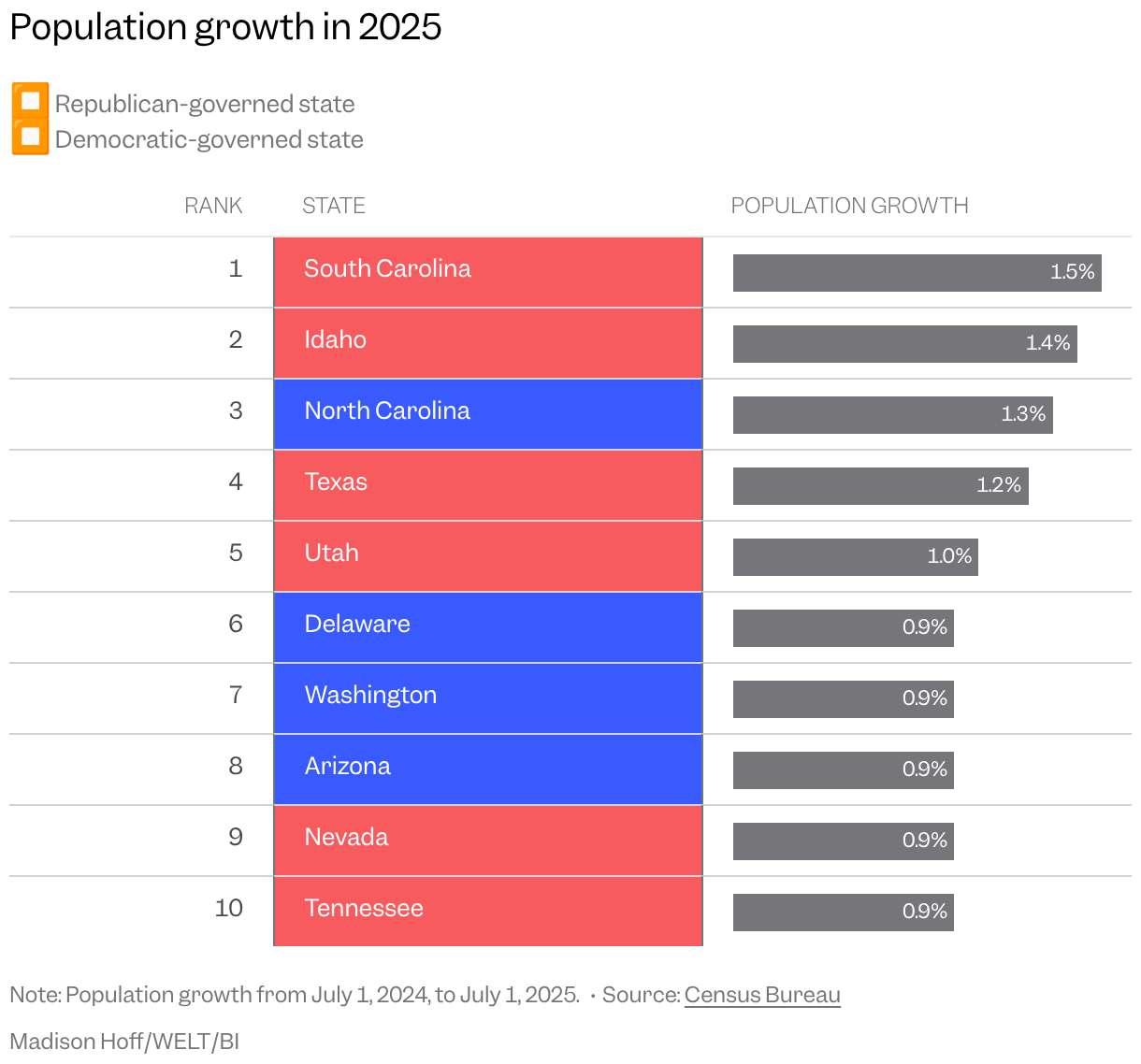
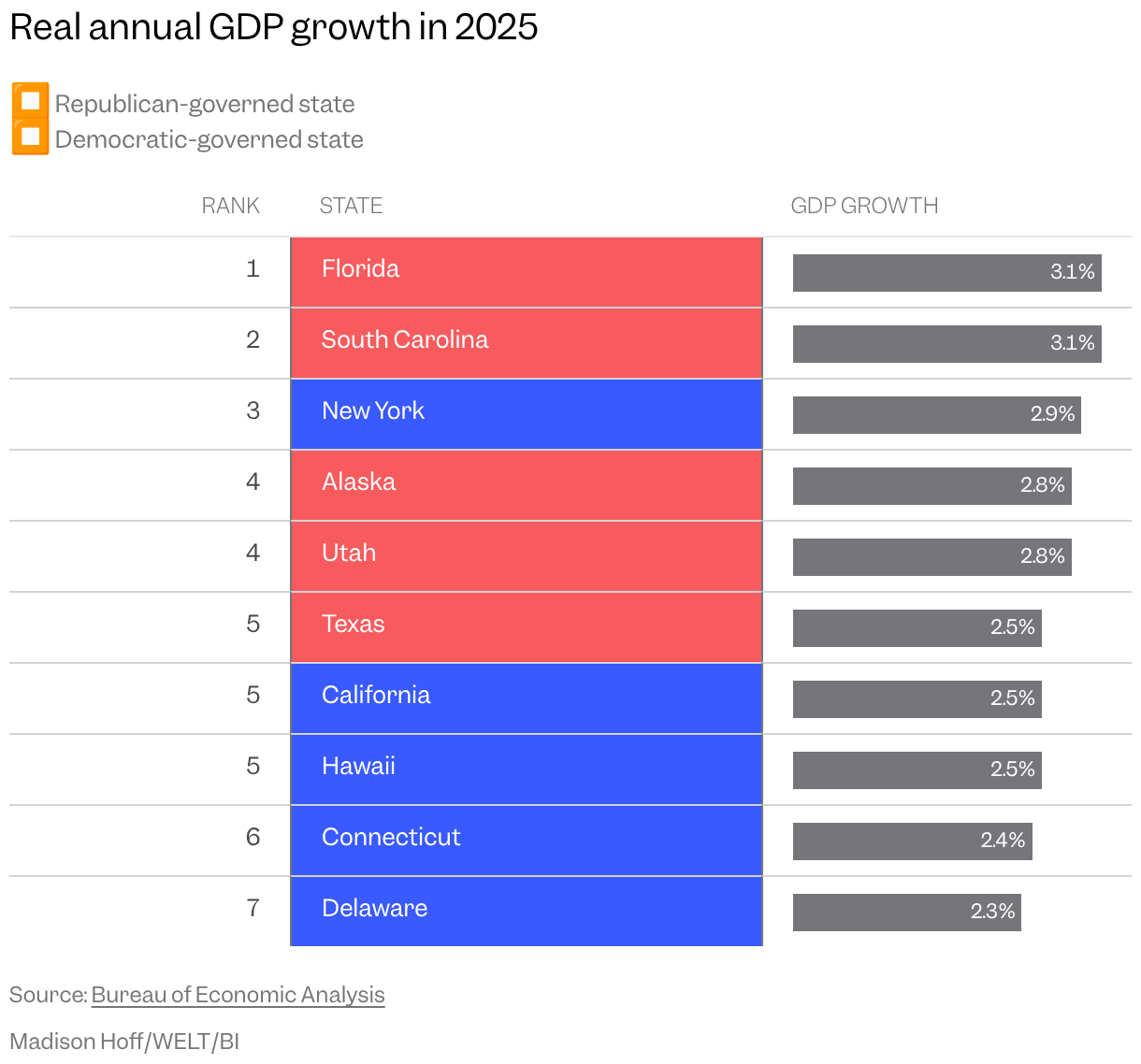
Five Southern states ranked among the US’ leaders in both economic and population growth in 2025.
A mix of low taxes, limited business regulation, and fast-tracked infrastructure projects is driving the boom.
This story was originally published on WELT, and reporter Jan Klauth traveled from Germany to meet the business leaders moving south.
Ken Bianco lets out a brief laugh when he hears the question. Open a factory in California — where most of his customers are? “Absolutely not,” says JCB’s vice president of commercial operations, slicing the air with his hand as if swatting away a bothersome fly. “California has become too slow,” he says. “Everything takes too long there — it’s simply not business-friendly.”
Bianco is standing in the lobby of construction and industrial equipment manufacturer JCB. To his left sits a model of the world’s fastest diesel engine, to his right a backhoe loader painted with a flame motif. When the company, founded in Britain in 1945, planned its first US plant in 2001, one thing was clear: it would head south. “Georgia welcomed us with incredible incentives,” Bianco recalls. Today, the firm’s North American headquarters stands here, complete with 500,000 square feet of production space, and a second large plant is currently under construction in the “Lone Star State” of Texas.
That Republican-governed states in the American South are attracting so much investment is no coincidence. A look at the data reveals a pattern. Georgia, Florida, South Carolina, Utah, and Texas ranked among the country’s leaders in both economic and population growth in 2025.
While US GDP as a whole rose by 2.1% last year, Florida and South Carolina recorded gains of just over 3%, according to the Bureau of Economic Analysis — the highest rate of any state. Utah comes in just below that, with Texas also above the national average.
The trend of recent years is clear: While liberal metropolitan regions such as San Francisco, Boston, and New York remain the centers of finance, Big Tech, and research, industry is shifting ever more strongly into the Southern states. Manufacturing firms in particular are increasingly drawn to places where Republicans hold power. According to a report by CBRE, one of the nation’s largest real estate brokerage firms, 725 companies relocated their headquarters between 2018 and 2025. Increasingly, they left high-tax states like California or New York for Republican states like Florida or Texas.
Economies of powerhouse states like New York and California are still growing too, driven above all by the tech boom. But the stronger momentum is currently elsewhere, as the population figures show. While New York’s headcount is stagnating, California has been losing residents for several years — and the list of big-name companies turning their backs on the “Golden State” is growing steadily longer.
South Carolina, by contrast, is currently the nation’s fastest-growing state in percentage terms. Texas, according to the US Census Bureau, is gaining the most residents in absolute numbers: In the past 15 years alone, nearly 7 million people have moved there. Often overlooked, Utah is also buoyed by a young, growing population, while Florida leads the field in immigration from abroad.
Behind these numbers lie millions of individual decisions. Taken together, however, they point to a clear conclusion: in the first year of “Trump 2.0”, it is above all Republican-governed states that are attracting industrial investment and people. There is no shortage of examples.
Take billionaire investor Kenneth Griffin, who — spooked by New York’s mayor Zohran Mamdani’s tax plans — has declared he would rather invest in Miami than in New York. Or the software engineers from Tesla or Oracle who have left overheated Silicon Valley for Austin, drawn by a mix of tech jobs, leafy suburbs, and low income taxes. Or the fast-growing cohort of retirees selling their homes in the Midwest to enjoy the Florida sun. It is the industrial sector in particular that is fueling the upswing in the South, while the former “workbench of America” — the so-called Rust Belt — continues to bleed out.
One of the companies on a growth track is JCB, which operates its largest US plant just outside the port city of Savannah. “Twenty-five years ago, this was just an acre,” Bianco recalls. Today, the factory alone turns out more than 20 excavators a day, and soon that number is expected to rise to 30 — the order books are full. The plant employs 560 workers in production and around 200 in administration.
Its success also has to do with America’s military build-up under Donald Trump. In its commercials, JCB presents itself as a problem-solver that makes heavy equipment for construction sites. But the company has long since moved into the booming military business, which people here euphemistically refer to as “defense”.
Construction and industrial equipment manufacturer JCB in Savannah, Georgia
Jan Klauth
During the plant visit in Georgia, press officers monitor every step the visitors take and repeatedly urge them not to take photos — the highest level of security applies in the military area. In terms of the US Army, Georgia has another strategic advantage: the state is home to the country’s largest infantry presence, meaning the armed forces, a major client, are effectively on the doorstep.
Republican-governed states tend to have one thing in common: in most cases, they have been traditionally “red” for decades. Especially in Texas and Florida, some politicians see themselves, with pride, as the antithesis to the “blue” coastal metropolises; talk of “blue state bullshit” that they want to keep at arm’s length is commonplace. The relentless culture war that has been raging in the US for years has only intensified since Donald Trump returned to the White House.
In reality, though, the reasons why industrial companies prefer to invest in the Republican South are rather prosaic. Governors and local politicians promise to keep taxes low, limit the rules imposed on business, and fast-track infrastructure projects. In practice, that means fewer requirements, quicker permits, and more projects. Big-name developers who might wait years for a building permit in California or the Northeast encounter municipalities here that actively court investors.
Few examples show this as clearly as the corporate empire Elon Musk has moved from California to Texas. In the southwest of the Lone Star State, SpaceX rockets now shoot into the sky, and the company boasts the highest stock market valuation in history, while just outside the capital, Austin, the world’s richest man has, within a few short years, built an entire “corporate town” around his companies, Tesla, The Boring Company, and X.
Texas is, overall, a special case. The oil and gas business is benefiting from Trump’s policy of giving fossil fuels more room again; at the same time, tech clusters are springing up along the highways around Austin, Dallas, and Houston, where start-ups sit side by side with branch offices of corporations that have shifted activities from expensive coastal regions to the Sun Belt.
Cities like Austin are long past being the cheap alternative for hipsters from San Francisco; they have themselves become pricey metropolises plagued by traffic jams, housing shortages, and rising homelessness numbers. Yet compared with many coastal cities, a house with a garden remains within reach — and above all, the tax burden is lower.
Perhaps the most visible consequence of the investment boom is the construction spree. Around cities like Houston, Miami, or Atlanta, one new suburban development after another is going up. On the outskirts of hubs such as Savannah or Laredo, Texas — the largest freight gateway on the Mexican border — cranes are erecting new logistics centers almost weekly.
On top of this comes a second, hugely capital-intensive trend: the boom in data centers. With space at traditional locations such as the Bay Area or greater Seattle exhausted and expensive, investors have shifted their focus to places where land and energy are cheap, and politics are on their side. Alongside Democratic-run Virginia, that means above all rural regions in states like Texas and Georgia. One key reason: with power supplies tight, some operators are building their own gas plants right next to the data centers. Projects like these are approved far more quickly in Texas than in California.
And there is another reason companies are increasingly turning away from the “Golden State” when making new investment decisions — one that is often glossed over: risk management. What sounds like something out of a Western movie has, in fact, become a major factor in supply-chain planning. In recent years, train robberies on the West Coast have reached shocking levels. At the peak, around 90 containers a day were being looted in the Los Angeles area alone.
“Companies from South Korea, China, or Japan now prefer to send their containers to the Port of Savannah rather than Los Angeles,” says Arthur Hutton, who oversees operations at a recently opened logistics center near the Savannah docks. As Hutton walks through the halls, a major shipment has just arrived: pianos from Japanese manufacturer Yamaha and paper rolls from China. And indeed, evaluations by the US Department of Transportation show that California has lost market share to Atlantic ports — even though the route from Asia is longer and therefore more expensive.
One other reason for the shift in investment that companies don’t mention publicly: Workers are less often unionized in the Southern states. Take the logistics center, dominated by Amazon, in Savannah, for instance: None of the staff is part of any union, Hutton says.
California still boasts the largest economic output of any US state, thanks to Silicon Valley and Hollywood. But alongside Austin in Texas, other states are vying for tech supremacy. One is Utah, governed by Republicans continuously since 1985. The region around Salt Lake City has developed in recent years into a tech hub often referred to as the “Silicon Slopes”. Software firms, start-ups, and service providers leaving the pricey West Coast find here a blend of good pay, relatively modest living costs, and spectacular scenery.
South Carolina, Alabama, and Georgia, meanwhile, stand for the industrial South and have attracted major automotive plants and suppliers in recent years — from Europe, Asia, and other parts of the US. In addition to ports such as Savannah and Charleston, one reason is that unions are less powerful here than in the coastal metropolises — certainly a strong argument in the location decisions of German carmakers like Mercedes and BMW.
While these corporations in Germany are mainly making headlines for job cuts and the car industry at home is in crisis, the US is still seen as a growth market. Mercedes is investing $7 billion in the American market this year alone; BMW is putting in at least $1.7 billion. The “red South” continues to grow — helped along by money from Europe.
This story originally appeared on WELT and is courtesy of the Axel Springer Global Reporters Network, which harnesses the resources of the company’s newsrooms to publish ambitious scoops, investigations, interviews, opinion pieces, and analysis. It allows journalists — including those from POLITICO, Business Insider, WELT, BILD, Onet, and Fakt — to collaborate on major stories for an international audience of hundreds of millions across platforms.
I bought the Amtrak USA Rail Pass, and there are a few things I wish I had known beforehand.
Malia Yoshioka
I purchased Amtrak’s USA Rail Pass, which allowed me to take 10 trips for $499.
Although I thought the pass was a great value, there are a few things I wish I knew ahead of time.
For example, long trips provide the best value, but sleeper-car upgrades aren’t available.
I took my first long train ride when I was 18, heading upstate from New York City. I can still remember the view of the gold, rust, and deep-red leaves out the window.
I grew up in Hawaii, where there are no trains or fall foliage, so the experience felt completely new to me. That trip stayed with me, and now, I try to travel by train whenever possible.
Last year, I traveled through the East Coast and Midwest by rail, and by the time I reached Chicago, I finally decided to give Amtrak’s $499 USA Rail Pass a try.
With 10 rides to use within 30 days, I traveled through 11 states in a single month. Here are eight things I wish I knew before buying the pass.
Long trips provide the best value
When using the USA Rail Pass, I like to book long trips to get the most value for my money.
Malia Yoshioka
The pass allows riders to book 10 “segments” on almost any Amtrak route. A segment refers to one time that you board and disembark, regardless of the distance traveled.
In other words, a short regional train counts the same as a multi-day route that crosses several states. So, I learned I was better off booking long trips to really get my money’s worth.
However, if a trip requires a transfer, that counts as two segments, so choosing the most direct route helps to stretch the pass further.
Plus, long rides in coach can often run passengers hundreds of dollars if booked individually, so even a few rides might cover the cost of the pass.
Sleeper-car upgrades aren’t available when using the pass
I’ll be honest — there have been times when I wished I had a private room so I could stretch out or have a little more privacy on the train.
But one of the tradeoffs with the USA Rail Pass is that I’m placed in a coach seat for every segment and don’t have the option to upgrade to a sleeper car.
Luckily, the seats on Amtrak (which are typically about 23 inches wide) recline, have a decent amount of legroom, and are generally quite comfortable. However, the only downside is they don’t lie flat.
So, when going on multiple long-distance trips with the pass, I recommend taking a break between rides to stay at a hotel.
I can save money by packing my own snacks
I come prepared with lots of snacks.
Malia Yoshioka
Dining-car meals are included for passengers traveling in roomettes and sleeper cars, but unfortunately, they are not included for coach passengers traveling with the USA Rail Pass.
Although I can sometimes request a dining-car reservation if there’s space, it’s first-come-first-served and can fill up quickly. Plus, the additional cost adds up quickly.
As a coach passenger, I do get access to the café car, which serves coffee, snacks, sodas, salads, and a few reheated items like breakfast sandwiches or mac and cheese.
However, I usually pack my own food to keep costs down. Although the staff cannot reheat or refrigerate anything for me, they sometimes give me hot water if I ask nicely.
So, I bring things like powdered soups, oatmeal packets, tea, and snacks that keep well at room temperature.
Even though the baggage policy is generous, it’s important to pack light and keep essentials on hand
All passengers can bring two carry-ons and a personal item with them.
Malia Yoshioka
All passengers, regardless of ticket type or class, can bring two carry-ons and a personal item with them on the train. However, I recommend packing light to allow yourself enough time to get on and off the train quickly.
In order to keep myself organized, I also like to pack a smaller bag in my carry-on that includes anything I’ll want easy access to during the trip.
For example, I carry extra layers of clothing in case I get cold, a neck pillow, a light blanket, earphones, an eye mask, earplugs, and hygiene products.
The WiFi isn’t always reliable
While on long-distance routes, I’ve noticed that Amtrak’s WiFi often becomes unavailable. I’ve sometimes been able to use my phone’s hotspot, but even so, I’ve encountered long stretches without any cell service at all.
Now that I’m a seasoned traveler, I like to plan ahead by downloading movies, music, books, or maps before my trip.
However, I’ve also found that train travel is a good excuse to disconnect. I like to journal or sketch, write a postcard to a loved one, or simply daydream.
The Sightseer Lounge offers the best views
I love spending time in the Sightseer Lounge.
Malia Yoshioka
Certain trains come equipped with a Sightseer Lounge, which offers beautiful views of the country from large windows. The louge, which includes a mixture of booths, single, and double chairs, is my favorite spot on any train that has one.
As a frequent traveler, I’ve seen the glow of golden hour over a field of wheat, the soft rise of mountain ranges, and canyons filled with rivers and patches of fall color.
In my opinion, sights like these are what make rail travel truly special.
This story was originally published on February 4, 2026, and most recently updated on June 11, 2026.