Author: admin

New York’s tax on wealthy second-home owners is going into effect. Here’s how the pied-à-terre tax will work.

Gov. Kathy Hochul and New York Mayor Zohran Mamdani arrive for a press conference at Staten Island University Hospital Community Park on April 27, 2026 in New York City.
New York Governor Kathy Hochul and Mayor Zohran Mamdani joined forces to tax multimillion-dollar second homes.
  • A plan to tax multimillion-dollar second homes in New York City has officially passed.
  • Gov. Hochul and Mayor Mamdani’s new tax on properties worth over $5 million aims to raise $500 million.
  • Citadel CEO Ken Griffin, whose property was singled out by Mayor Zohran Mamdani, has criticized the move.

The long-awaited tax on billionaires’ second homes in New York City is now official.

A joint proposal from Gov. Kathy Hochul and Mayor Zohran Mamdani to tax multimillion-dollar second homes has been incorporated into New York’s state budget, which was passed Wednesday, two months after it was initially due. That pied-à-terre tax targets homes worth over $5 million whose owners don’t live in New York City — focusing on the ultrawealthy who own crash pads or vacation homes in the city, but may not pay city or state income taxes.

It’s one avenue lawmakers are taking to plug budget shortfalls, and a victory for Mamdani’s tax-the-rich agenda; while Hochul has squashed increasing income or corporate taxes on higher earners, the new levy will target those wealthy enough to maintain a multimillion-dollar second residence in one of the most expensive cities in the world. Hochul and Mamdani estimated the tax could raise $500 million, although the total revenue could end up coming in lower.

The tax, currently set to apply through 2031 when it will be up again for legislative renewal, will increase depending on how much a property costs. Single-family homes worth between $5 million and $15 million will be subject to a 0.8% surcharge, and those between $15 million and $25 million will be subject to 1.05%. Properties worth $25 million or more will face a 1.3% levy. In its first two years, the tax will rely on Department of Finance “assessed values” to determine which homes will face a new charge, while the city and state work out a new valuation system.

“The assessed value for a $5 million property is hardly ever five million,” said Jonathan Miller, a renowned real estate appraiser. “You significantly reduce the pool, so you’ve got to lower the threshold to some arbitrary number like a million dollars.”

The tax will fall on co-ops and condos that are currently valued at $1 million or more by the DOF. The state said the lower cutoff is a result of assessed values typically being far below what they would actually sell for. The initial rates for those will be 4%, 5.25%, and 6%, depending on the condo’s market value, during those first two years of implementation. After that initial onramp period, the city will develop a new assessment system, and surcharges will be applied at those 1.3% or lower rates.

To determine who’s subject to the tax and what counts as a second home, the Department of Finance will consider if the home was occupied for the majority of a calendar year by a covered owner. Homeowners will be notified by August 30 that they’ll be expected to pay, and they will have a chance to submit proof that the unit is actually a primary residence.

The tax is estimated to fall on around 10,000 properties, one of which Mamdani targeted when he unveiled the tax last month. In the video announcement, Mamdani stood in front of a limestone tower on Central Park South, where Citadel CEO Ken Griffin bought a penthouse for $238 million in 2019.

The directness of the move ruffled Griffin, who also owns multiple apartments in a Park Avenue coop.

“Mamdani has made it very clear, New York does not welcome success,” the Citadel chief said earlier this month at the Milken conference in Los Angeles. He floated abandoning a planned New York office for Citadel, adding that he would “double down” on Miami.

Prominent business people, including investors Bill Ackman and Jason Calacanis, have derided the tax, which would likely affect dozens of billionaires, from Jeff Bezos to Michael Dell.

Read the original article on Business Insider

Fareed Zakaria told Bard grads we’re asking the wrong question about AI

Fareed Zakaria, dressed in a navy suit with a blue tie, talks onstage.
Journalist Fareed Zakaria is the latest commencement speaker to receive booes while talking about AI. But he took a different tack from the other speakers.
  • CNN host Fareed Zakaria told Bard grads that humans can still do a lot that AI doesn’t grasp.
  • The address comes as other commencement speakers keep receiving loud boos while talking about AI.
  • Zakaria joked that AI had become the “two most provocative letters” in English.

Fareed Zakaria says he thinks humans still have a competitive advantage over AI.

During his commencement speech at Bard College in New York, the CNN host and Washington Post columnist said artificial intelligence is advancing with “astonishing speed and power.” Still, he argued that the rise of AI should prompt people to think less about competing with machines and more about what makes human intelligence distinct.

“So people naturally ask: ‘What will be left for human beings to do?'” he said. “But, perhaps that’s the wrong question. The better question is, ‘What does AI tell us about all the things we humans already do — and that are distinctive and irreplacable?'”

@fareedzakaria

From my commencement speech at Bard College

♬ original sound – fareedzakaria

Zakaria’s speech came as mentions of AI keep drawing loud protests at college commencement speeches. Former Google CEO Eric Schmidt was booed while talking about AI and automation at the University of Arizona, while real-estate executive Gloria Caulfield was loudly jeered for bringing up the technology during her speech at the University of Central Florida.

Those viral responses helped Zakaria pre-empt the audience.

“At this point, I need to give you a trigger warning,” he told graduates early in the speech. “So I should warn you that I am about to utter the two most provocative letters in the English language today: AI.”

The mention of artificial intelligence drew jeers from the crowd.

“Feel free to get the booing out of the way,” he said.

Zakaria framed the rest of his speech around another two-letter initialism: HI, or human intelligence.

He pointed to the human brain, which he said weighs about three pounds and runs on roughly 20 watts of power — less energy than a laptop charger. AI systems, by contrast, can require data centers that consume enough electricity to power entire cities, he said. Human intelligence, Zakaria argued, is more efficient.

It is also better suited to the messy work of being human: reading emotions, understanding context, forming relationships, making art, and finding meaning in lived experience.

“A machine can write a sad poem, but it cannot weep at a funeral,” he said. “The more powerful AI becomes, the more we may rediscover how much we value the distinctly human.”

Read the original article on Business Insider

The tokenmaxxing backlash has begun

Uber COO Andrew Macdonald.
  • Uber’s COO went viral after saying rising AI costs haven’t led to proportional productivity gains.
  • Others now say the same thing as tech companies blow through their AI budgets early.
  • Tokenmaxxing is the practice of burning through as many AI tokens as possible.

Silicon Valley’s debate over tokenmaxxing is reaching new heights.

Uber COO Andrew Macdonald said in an interview released last week that he hasn’t observed direct productivity improvements from increased AI token usage.

“That link is not there yet, right?” Macdonald said in comments that went viral, racking up over 2 million views on X. “I think maybe implicitly there is more that is getting shipped, but it’s very hard to draw a line between one of those stats and, ‘OK, now we’re actually producing 25% more useful consumer features.'”

AI tokens are the basic building blocks processed by AI chatbots, making up roughly ¾ of a word each. “Tokenmaxxing” refers to using as many tokens as possible to boost productivity — and show off.

Macdonald’s remark struck a nerve because companies across the US are aggressively adopting AI internally. Meta now calls some employees “AI builders” and expects them to work in AI-native “pods.” Corporate giants like Disney and JPMorgan track employees’ use of AI. Visa rewards teams that build faster with AI and has bragged that its monthly token spend is almost 2 trillion.

As corporations race to embrace AI, an increasing number of tech professionals say it’s leading to massive waste. The AI push has sparked concerns about companies blowing through their budgets early. Uber used up its annual AI budget in the first four months of the year, the Information reported.

“Pretty sure 50% of internal token spend is completely useless, but right now it’s hard to know which 50%,” posted Akshat Bubna, cofounder and CTO of AI startup Modal, on X.

“Tokens got burned for millions of dollars without any real significant ROI to show for it,” engineering manager Karthik Hariharan posted, referring to return on investment.

The issue is only getting worse, Google CEO Sundar Pichai recently said. At Google’s flagship developer conference, I/O, last week, Pichai said he’s heard from chief information officers that they’re “so concerned about how much their companies are blowing through budgets.”

“I think the problem is going to get worse as we go through the year,” Pichai added.

The tokenmaxxing debate has also led to concerns that the AI bubble is about to pop. On Monday, famed “Big Short” investor Michael Burry called tokenmaxxing a “crazy, rushed, temporary phase” and said that Nvidia stock has a high risk of an “aggressive” fall.

Tokenmaxxing has its defenders, though.

Garry Tan, the CEO of fabled San Francisco investment firm Y Combinator, has embraced the term, saying, “we’ve been tokenmaxxing longer than most people.”

There’s also a balanced way to take advantage of AI’s benefits without spending too much, according to a report from engineering intelligence company Jellyfish.

The report found that the top 10% of Claude Code users consumed about 10 times as many AI tokens as the median developer and produced only about twice the output.

To resolve this, companies should not reward or penalize raw token consumption. Instead, they should make sure costs are tied to concrete metrics, such as pull requests — how developers propose code changes to shared projects — the report said.

Read the original article on Business Insider

I put an AirTag on my 8-year-old’s bike. It backfired and taught me an important parenting lesson.

Family photo
The author started tracking her with AirTags.
  • My 8-year-old found the AirTag I secretly hid on his bike and felt deeply betrayed.
  • Tracking his location eased my anxiety, but damaged the trust we had carefully built.
  • I realized I was letting parenting fear undermine my son’s growing independence.

My oldest is 8 and super responsible, so I’ve started giving him a bit more independence. Things like riding his bike to one of the two parks within a block of our house or staying home alone for a few minutes while I go to a neighbor’s house.

But giving him more freedom also comes with more anxiety on my part. As a mom, I’ve struggled with not knowing exactly where he was enjoying his new independence without me. Since we’re anti-devices for kids under 16, I figured out a new way to track him — a small AirTag placed in an inconspicuous spot on his bike.

As expected, it didn’t take him long to find it, and when he did, he was irate. “You don’t trust me!” he’d yelled, incensed and embarrassed. Then I realized something: while knowing his location helped alleviate my anxiety, it undercut his newfound freedom.

Here’s what I learned from this experience, and how I’d do things differently next time.

It undermined trust

Since he was a responsible kid, I had always given him a bit more freedom than a normal 7 or 8-year-old. I could tell him to come back in 15 minutes for dinner or to leave for practice, and nine times out of 10 he would show up, right on time. He usually made good decisions, always looked before he crossed the street, and knew not to talk to strange adults.

He had earned my trust with a history of good decision-making, and tracking him without his permission had damaged that hard-earned trust.

I let anxiety win

Years ago, I read Kim Brooks’ “Small Animals: Parenthood in the Age of Fear,” and without being dramatic, it totally changed my view on parenting.

The book is based on the premise that anxiety and fear have taken over modern parenting, and that as parents, we’re worrying about all the wrong things. For example, statistically speaking, the chances of your child getting abducted are actually quite low. Kids are getting much less freedom in the real world than they used to, which undermines their independence and autonomy, Brooks writes.

In the end, I’m disappointed in myself for letting anxiety win over and giving in to the urge to know where he is at all times. Because logically speaking, letting him venture out into the world as a responsible 8-year-old in a relatively safe neighborhood isn’t inherently dangerous.

It gives a false sense of security

AirTags aren’t meant to track people. That’s because they use other people’s Apple devices to estimate a location. So in my case, if my son were riding his bike to a park and there was no one around with an iPhone, it wouldn’t give an accurate location.

Plus, the AirTag was on his bike, so it wasn’t actually tracking him. Meaning that if he left his bike and went somewhere else, I’d have a false sense of security thinking he was in the same place as his bike, which may or may not be true.

What I’d do differently next time

If I had it to do again, I would have been honest with him and told him about the AirTag. I would have explained to him why I wanted to know where he was, and that it wasn’t because I didn’t trust him. That an AirTag actually gave him more freedom, not less.

I also think I need to do a better job separating my anxiety from inherent risk. Giving kids limits is fine, but we can’t do so at the expense of their growth, development, and right to exist in the world independent of their parents.

And we will eventually explore other options as he gets older to keep him safe while still giving him freedom. Whether that’s a watch or a kids’ phone without internet, I’m not sure. What I do know? Letting go in parenthood is never easy.

Read the original article on Business Insider

‘The G-shaped economy’: A market vet says the driving economic force in the US is old vs young

Crowds gather beneath billboards in Times Square in Manhattan
  • Economists often describe the economy as K-shaped, but one market vet sees it taking a different form.
  • Ed Yardeni says the US economy is G-shaped, describing a dynamic between boomers and younger Americans.
  • Baby boomers are increasingly propping up growth, spending liberally and helping their children and grandkids.

We may have to thank the baby boomers for the strength of the US economy.

The economy is often said to be in the midst of a K-shaped divergence, a dynamic in which the top earners account for most of the growth and spending, while lower-earning Americans face greater economic pressure.

But, according to Ed Yardeni, a longtime market vet and the president of Yardeni Research, the driving force behind the US economy more likely lies in the spending habits of older Americans specifically, who are doing well enough to both prop up the economy and extend financial help to their younger kids and relatives.

In a note to clients on Tuesday, Yardeni called it the “G-shaped” economy, flicking at the idea that much of the boomers spending is directed toward grandchildren and adult children.

“Our alternative is the ‘G-shaped’ economy, in which older Americans, who tend to be among the wealthiest households, provide financial support to their younger adult children and grandchildren,” Yardeni said. “While Baby Boomers are thriving, younger generations are confronting an affordability crisis.”

Here are the signs he sees that baby boomers are a major pillar of support for the economy.

Heavy spending

First, boomers are known to be the wealthiest generation. The cohort, which is typically defined by people born between 1946 and 1964, is holding onto around $89.6 trillion in assets, or half of all US household wealth, according to Fed data.

Boomers have also been some of the economy’s biggest spenders in recent years. The generation recorded an average annual expenditure of $69,303 in 2023, the most recent available year according to the Bureau of Labor Statistics.

“Baby boomers don’t stop spending when they retire,” Yardeni said. “For the wealthiest generation in history, retirement means more time for spending on goods and services. The spending data already confirms that Baby Boomers are actively driving consumption growth across major categories.”

The group’s spending habits likely contributed to US recreational spending reaching a record high in March, Yardeni said, citing his analysis of LSEG data.

Boomers are also spending more on their homes, he added, with house-related spending recently hitting a record. The generation owns around a third of all US housing wealth, according to an analysis from the National Association of Homebuilders.

Retirees also appear to be driving the travel boom in the US. Total travel spending is expected to grow to $1.37 trillion this year, per the US Travel Association.

Jobs growth

There’s also evidence that the healthcare needs of baby boomers are fueling job growth in that corner of the market, Yardeni said. Healthcare has been one of the few major bright spots in the job market in recent years.

The private education and healthcare sectors gained 618,000 jobs in the year leading up to April, according to the Bureau of Labor Statistics, while all other sectors lost a combined 367,000 jobs.

Financial and housing-related help

One 2026 survey found that 70% of millennials and Gen Zers said they borrowed money from a family member for basic expenses.

Younger Americans are also increasingly living with older Americans. Around 18% of adults aged 25 to 34 were living in a parent’s home last year, according to a study from the Pew Research Center.

“Boomers are not just spending their own wealth; they are also transferring a significant portion of it to the younger generations who are struggling. Those transfers help provide a floor to aggregate consumption from below even as spending by Baby Boomers drives it from above,” Yardeni said.

Read the original article on Business Insider

MWC 2026 signals a split IoT connectivity market shaped by AI, NTN and eSIM orchestration

MWC 2026 signals a split IoT connectivity market shaped by AI, NTN and eSIM orchestration

By Marc Kavinsky, Lead Editor at IoT Business News.

IoT Analytics’ review of MWC Barcelona 2026 highlights seven connectivity themes that are directly relevant to IoT device makers, operators and industrial adopters. The findings point less to a single technology transition than to a more segmented market in which AI compute, satellite integration, eSIM orchestration and security obligations are reshaping deployment choices.

The most important message from MWC 2026 for IoT professionals may be that connectivity roadmaps are becoming harder to simplify. The industry is not moving neatly from one generation to the next. Instead, cellular IoT, satellite, edge AI, eSIM and security are converging unevenly, with different technologies advancing at different speeds depending on geography, network maturity and device constraints.

That is the context for IoT Analytics’ latest MWC 2026 event analysis, based on activity at the Barcelona show, which took place from March 2 to 5 and drew nearly 105,000 visitors from more than 200 countries, alongside 2,900 exhibitors, sponsors and partners.

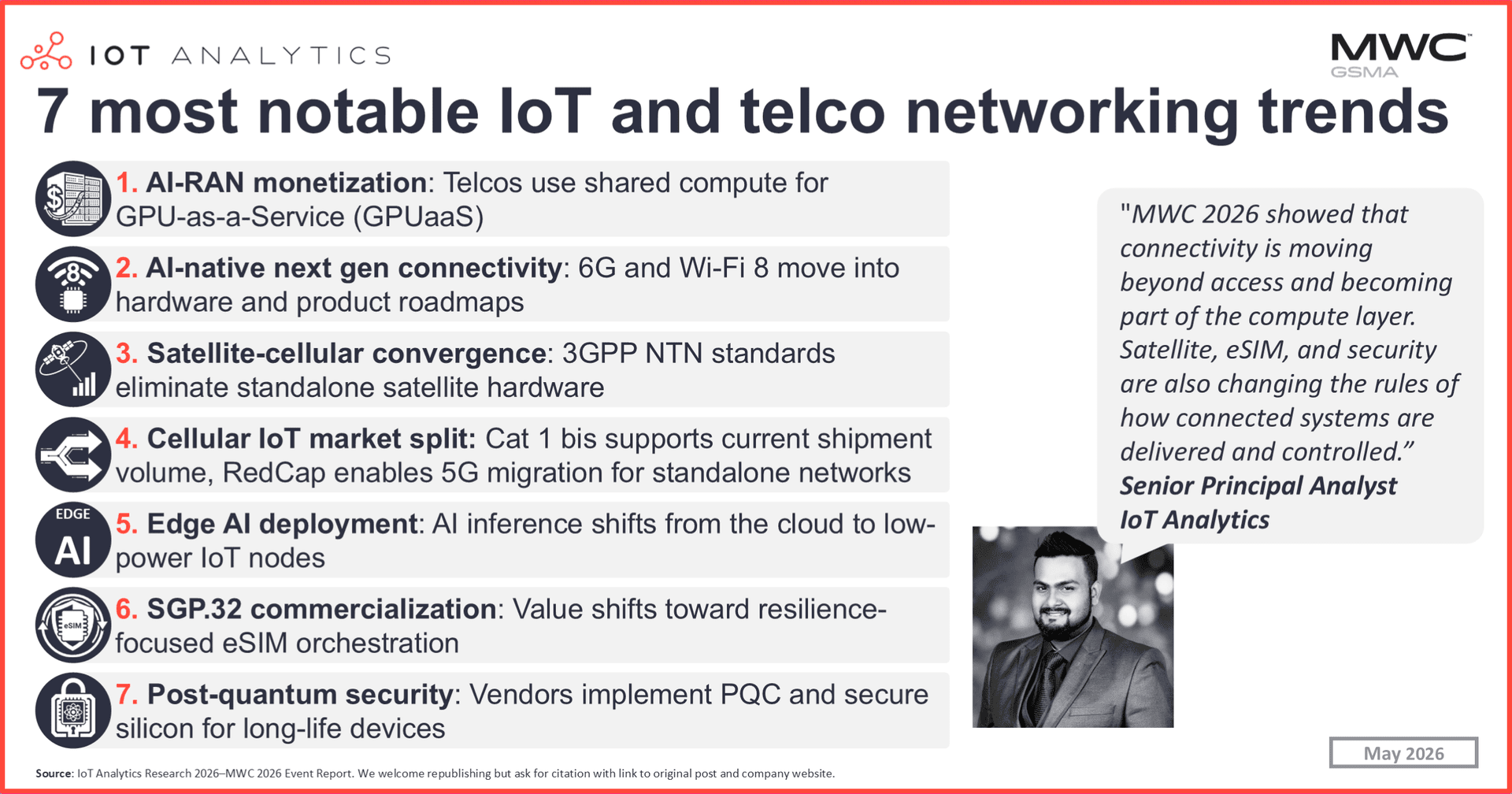
IoT Analytics: 7 most notable iot and telco networking trends

AI-RAN becomes a business model discussion

One of the clearest shifts was the repositioning of AI-RAN. Rather than presenting AI in the radio access network only as an optimization tool, several vendors framed shared compute infrastructure as a way for operators to monetize capacity beyond connectivity. Fujitsu, for example, positioned AI-RAN around shared GPU resources that could support GPU-as-a-Service or AI services when not consumed by RAN workloads.

This matters because it changes the investment logic for operators. If AI-RAN infrastructure can support both network processing and enterprise inference workloads, telcos may seek to justify future network spending through compute revenue as well as subscriber revenue. The practical constraint is equally clear: operators will need sufficient demand density and operational sophistication to turn spare compute into a service, which will not apply uniformly across markets.

Cellular IoT is splitting rather than upgrading in one direction

For IoT device makers, the cellular module picture presented at MWC was notably fragmented. Cat 1 bis is being treated as a near-term volume technology, while RedCap and eRedCap are positioned as the 5G migration path where 5G standalone networks and suitable use cases exist. Nordic Semiconductor’s Cat 1 bis module launch, Quectel’s RedCap module activity and Sequans’ migration positioning all point to a market that is dividing by deployment reality rather than following a clean standards ladder.

A concrete implication for OEMs is that module selection is now a regional network availability decision as much as a technical one. A product designed for broad coverage and long life may still favor Cat 1 bis, while a device intended for markets with mature 5G standalone infrastructure may have a clearer path toward RedCap. That trade-off affects bill of materials, certification planning, power budgets and lifecycle support.

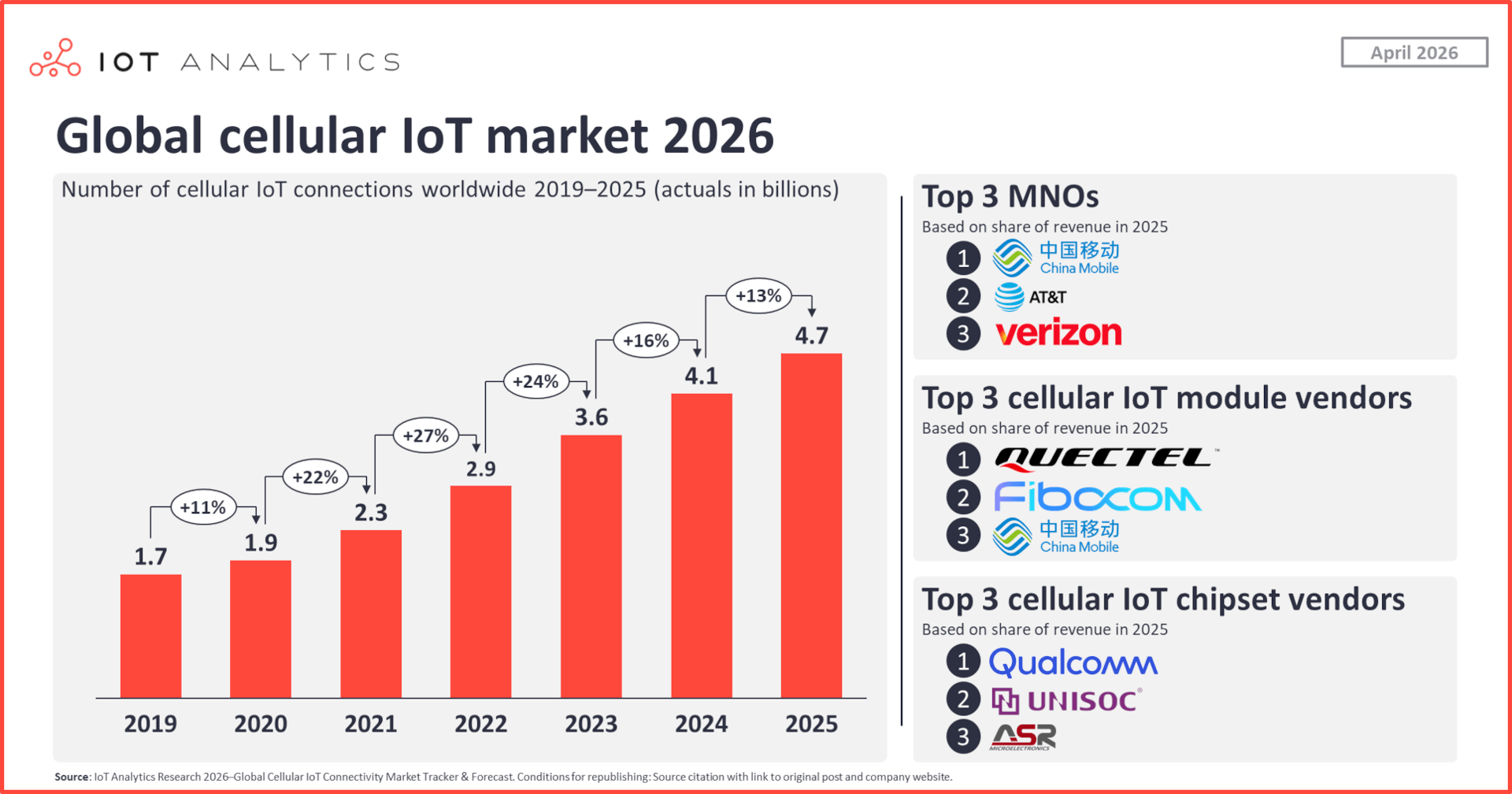
graphic: global cellular IoT market 2026

Satellite IoT moves closer to cellular workflows

Satellite connectivity was another major theme, but the notable development was not simply more satellite coverage claims. The more specific change is the integration of non-terrestrial network technology into cellular standards, modules, SIM workflows and operator partnerships. SpaceX discussed second-generation Starlink plans using 3GPP 5G NR-NTN for satellite-to-user links, while Deutsche Telekom, Vodafone, AST SpaceMobile, Orange, Telefónica and others were associated with satellite-to-mobile or multi-orbit connectivity initiatives.

On the device side, Nordic Semiconductor’s nRF9151 added 3GPP-compliant GEO and LEO NTN support alongside LTE-M and NB-IoT. For system integrators and enterprises, this points to a more manageable architecture than separate proprietary satellite hardware, although coverage, service availability and cost will still need careful validation for remote asset tracking, fleet monitoring and safety-related use cases.

Edge AI reaches low-power nodes

MWC also showed AI moving into lower-power IoT endpoints rather than remaining confined to gateways, cloud platforms or high-end edge servers. SG Wireless demonstrated TinyML over LTE-M for local person detection, sending metadata rather than raw video. Nordic linked on-device inference to cellular IoT and NTN modules, while Semtech’s approach kept intelligence in the device or partner MCU with LoRa connectivity.

The deployment logic is straightforward: when connectivity is constrained, expensive or intermittent, local inference can reduce traffic and cloud dependency. This is particularly relevant for battery-powered and remote devices, where transmitting raw sensor data may be less attractive than processing events locally and sending only what matters.

SGP.32 moves into commercial use, but orchestration is the real layer

SGP.32 was another area where MWC showed commercialization rather than only standards discussion. Tele2 IoT, IDEMIA Secure Transactions and Cisco announced a commercial end-to-end SGP.32 IoT solution, while IDEMIA disclosed more than 15 commercial deployments and 40 proofs of concept. Other companies including Telit Cinterion, Emnify and Soracom showed demos, pre-order activity or customer testing.

The distinction from typical eSIM announcements is important. The value is not just the ability to download or switch profiles; it is the orchestration layer that determines when and why profile changes should occur across fleets, operators and regions. For connectivity providers, this shifts differentiation from SIM supply toward policy, automation, compliance and operational control.

Security planning moves toward long-life device risk

Security discussions at MWC included post-quantum cryptography, secure silicon and compliance readiness. ICTK introduced PQC physical unclonable function security chips for USIM and eSIM, Thales linked hybrid PQC to eSIM-related security flows, and Pairpoint and Lantronix signed an MoU around PQC protection for existing industrial IoT routers and gateways.

This is distinct from routine cybersecurity messaging because the focus is on devices that may remain deployed for 10 to 15 years. For industrial players and infrastructure operators, the relevant question is not only whether today’s encryption works, but whether devices shipped now can be maintained against future cryptographic and regulatory requirements, including secure update and remediation workflows.

Taken together, the IoT Analytics findings suggest that MWC 2026 was less about a single headline technology than about architectural convergence. Connectivity, compute, identity and security are becoming interdependent design choices. For IoT buyers, that means procurement decisions will increasingly need to account for network maturity, silicon roadmaps, satellite fallback, eSIM control and long-term security obligations from the start of a project.

Recap of key trends identified at MWC 2026 by IoT Analytics:
  • Telcos are using AI-RAN to explore shared compute infrastructure
  • Vendors are moving 6G and Wi-Fi 8 future talk into AI-native connectivity roadmaps
  • Mobile operators are integrating satellite and NTN technologies into cellular and IoT connectivity workflows
  • Module vendors are splitting cellular IoT into Cat 1 bis volume now and RedCap/eRedCap migration next
  • Vendors positioning edge AI at low-power IoT nodes
  • Companies are commercializing SGP.32, but value is shifting to eSIM orchestration
  • Vendors are moving IoT security toward post-quantum readiness and secure silicon

The post MWC 2026 signals a split IoT connectivity market shaped by AI, NTN and eSIM orchestration appeared first on IoT Business News.