
JPMorgan’s analytics boss lifts the lid on how America’s biggest bank is schooling 300,000 workers on AI

View of the Park Avenue entrance to new JPMorgan Chase Headquarters.
JPMorgan Chase is teaching every employee to use AI.
  • JPMorgan Chase is proactively rolling out AI technologies across the bank.
  • The mass rollout will affect different workers in different ways, its chief analytics officer said.
  • Derek Waldron told McKinsey how the bank is training engineers, data scientists, and more.

America’s biggest bank wants every member of its more than 300,000-strong workforce to be an expert on how to juice AI.

The bank, with its $18 billion technology budget, has invested extensively in AI development. Now, it’s turning its attention to a firmwide training push. The goal? To educate its worldwide workforce on how to make AI work for every single employee — not a one-size-fits-all approach, Derek Waldron, chief analytics officer at JPMorgan Chase, said in an interview with McKinsey about the bank’s AI adoption strategy.

“Training needs are varied, just like AI applications. The best way to approach this is segment by segment,” Waldron said in the interview, which was published on the consulting firm’s website this week. Everyone from rank-and-file workers to company leaders will have to learn new skills, Waldron continued.

That being said, JPMorgan launched an internal training program for beginners, “AI Made Easy,” he said, adding that “tens of thousands” had already taken the course. The firm has created modules to educate users on how to conduct thorough research with AI or get the most out of several different data sets.

It’s not just the managed who may need to change their ways — it’s the managers, too. Waldron predicted that CEOs and business leaders will have to adopt new approaches as the tech’s reach becomes more widespread. “Value from gen AI won’t come just from giving people tools; business leaders must lead cross-functional teams through transformation in the age of AI,” he said.

A multi-pronged strategy — from town halls to communications from managers to marketing campaigns on screens across the bank’s offices — is helping to get people comfortable, he said.

What training looks like

Teaching people about AI comes down to two main layers, Waldron explained. Step one: What can AI large language models do and not do? And step two: How do you formulate the right questions?

“Once there’s familiarity with capabilities,” he said, “we move into how to construct good prompts, with frameworks and examples and constraints.” Then, things get more sophisticated: “how to pivot the persona of an LLM from maker to checker, or how to use two LLMs to debate a concept to get more creative.”

This transition is a companywide endeavor, with workers often teaching one another.

“Many teams quickly set up prompt libraries, ‘prompt of the week’ emails, and social channels to share power-user innovations,” he said, adding: “If we get the technology into employees’ hands — with change management and training — they’ll be best positioned to innovate and put it to good use.”

Everyone will have to make changes

Waldron also offered insight into how some technical roles are learning new skills.

“Software engineers need to be upskilled to build scalable AI systems based on agents and LLM components,” he said, adding: “Another population is technologists, who will increasingly want to build sophisticated applications using agentic or gen AI. That skill set is something that needs to be trained.”

Agentic AI is drawing significant focus from Wall Street and Silicon Valley. The notion that semi-autonomous digital “agents” could orchestrate end-to-end projects independently has been polarizing in some quarters. But at a conference last week, Teresa Heitsenrether — JPMorgan’s chief data and analytics officer, to whom Waldron reports — said she thought managing battalions of digital agents would give early-career workers a taste of being a boss earlier than they might get otherwise.

For data scientists, Waldron said that tech advances meant the days of building standard models were over. Third-party providers tend to handle this now, he said, letting in-house data scientists evaluate and enhance ready-made models and “apply their skills to designing, evaluating, and optimizing systems.”

In other words — the fun stuff.
Read the original article on Business Insider

Why Nvidia is worth $5 trillion: Inside a $35 billion, 1 gigawatt AI data center.

OpenAI's Stargate data center project in Texas
OpenAI’s Stargate data center project in Texas
  • AI data centers are measured in gigawatts of power these days.
  • Wall Street analysts have been getting their arms around the cost of these beasts lately.
  • Nvidia dominates spending on giant AI data centers, according to new analyst estimates this week.

If you want to know why Nvidia is valued at $5 trillion, take a look at the data and chart below. They show how this tech giant is scooping up a huge portion of the AI spending boom.

As AI enters its industrial phase, the world’s most advanced data centers now measure their scale not in square footage or servers, but in gigawatts of computing capacity. Wall Street has begun to measure the cost of these gigawatts, and predict which companies might benefit from the spending spree.

TD Cowen analysts put this in context, writing in a research note this week that 1 gigawatt is roughly the output of a nuclear reactor. That’s the new baseline for next-generation AI data centers, such as xAI’s Colossus 2 in Memphis, Meta’s Prometheus in Ohio and Hyperion in Louisiana, OpenAI’s Stargate, and Amazon’s Mount Rainier project in Indiana.

These sprawling structures require huge amounts of electricity, and combine that with capital and silicon to churn out intelligence. It’s an expensive process.

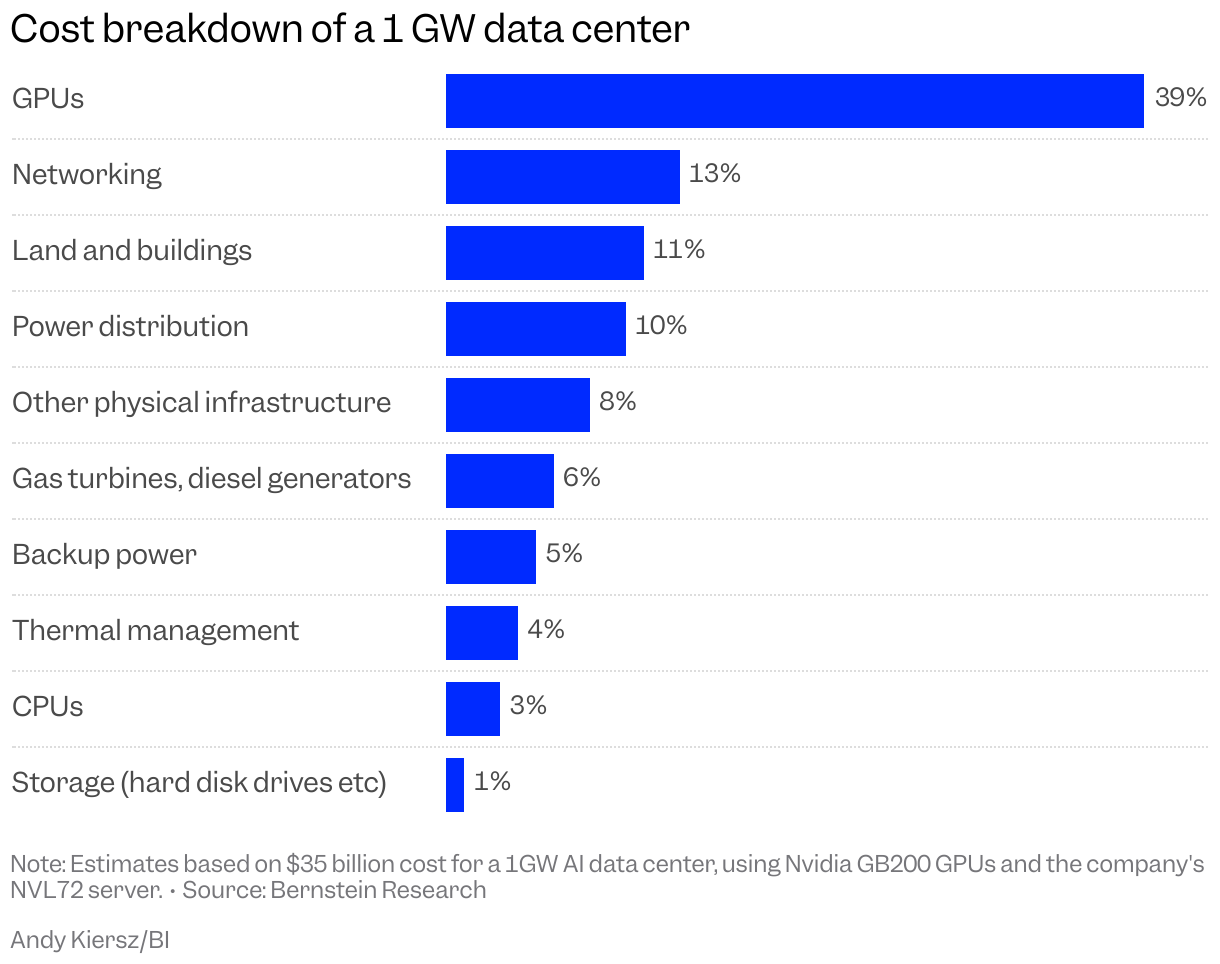
According to new analysis from Bernstein Research, 1 gigawatt of AI data center capacity costs about $35 billion. That may sound extreme, but it represents the new economic foundation of AI. Each gigawatt of data center capacity is not just a measure of power, but a proxy for an emerging industrial ecosystem spanning semiconductors, networking gear, power systems, construction, and energy generation.

Here’s what makes up the $35 billion gigawatt (GW), and which companies stand to gain, according to Bernstein and TD Cowen estimates this week.

Bar Chart

GPUs

The single biggest cost driver in an AI data center is the compute itself. Bernstein estimates that roughly 39% of total spending is devoted to GPUs, dominated by GB200 and other upcoming AI chips from the company, such as the Rubin series.

With Nvidia’s 70% gross profit margins, Bernstein calculates that the company captures nearly 30% of total AI data center spending as profit. No wonder this company is worth almost $5 trillion.

TD Cowen’s data shows that each gigawatt translates to more than 1 million GPU dies, the core brain of these AI chips. Nvidia’s foundry partner, TSMC, earns $1.3 billion per GW from manufacturing many of these components, these analysts estimated.

Other chipmakers such as AMD and Intel are trying to catch up, while hyperscalers including Google, Amazon, and Microsoft are investing in AI ASICs, custom accelerators that could reduce total system costs. Even so, GPUs remain the economic center of gravity, according to Bernstein and TD Cowen analysts.

Networking

Next in line are the arteries connecting those GPUs together. Bernstein estimates 13% of data center costs go to networking equipment such as high-speed switches and optical interconnects.

Arista Networks, Broadcom, and Marvell are positioned to benefit as switch vendors and chip designers. Arista’s high margins mean its profit share is proportionally greater than its revenue share.

Meanwhile, component makers including Amphenol and Luxshare gain from cabling and connectors, while optical transceiver makers such as InnoLight, Eoptolink, and Coherent stand to profit, too, according to Bernstein analysts.

Power and Cooling Infrastructure

The physical infrastructure around compute racks, generators, transformers, and uninterruptible power supplies, accounts for another big part of the costs of a 1 GW AI datacenter. Power distribution alone takes up nearly 10% of spending, according to Bernstein.

Eaton, Schneider Electric, ABB, and Vertiv are major players here. Vertiv also has an opportunity in thermal management, which makes up about 4% of total spend, split between air and liquid cooling systems, Bernstein estimates.

Real Estate, Electricity, and Labor

Land and buildings make up about 10% of upfront costs. But once the lights go on, operational costs are surprisingly small. It costs about $1.3 billion in electricity to run a 1 GW AI data center for a year. Personnel costs are also negligible, with huge data centers reportedly operating with 8 to 10 people who get paid $30,000 to $80,000 per year each, according to Bernstein.

The bottleneck, however, is shifting toward power availability. Siemens Energy, GE Vernova, and Mitsubishi Heavy now report surging orders for turbines and grid infrastructure as hyperscalers fight to secure reliable electricity at scale.

Sign up for BI’s Tech Memo newsletter here. Reach out to me via email at abarr@businessinsider.com.

Read the original article on Business Insider

Newark Liberty International Airport hit with ground delay over staffing issues

Newark runway
Newark issued a ground stop on Thursday.
  • Newark Liberty International Airport issued a ground stop on Wednesday, citing staffing issues.
  • The ground stop was later updated to a ground delay.
  • The government shutdown has led to widespread flight disruptions this month.

A ground stop was briefly issued at Newark Liberty International Airport on Wednesday, with the Federal Aviation Administration citing staffing issues.

The ground stop was updated to a ground delay shortly after, with an average delay time of 40 minutes, an FAA advisory said.

Airports around the country have experienced flight disruptions since the government shutdown began on October 1, with many citing staffing shortages.

The FAA, the National Air Traffic Controllers Association, and the Department of Transportation did not immediately respond to requests for comments.

Transportation Secretary Sean Duffy told Fox Business on October 8 that prior to the shutdown, around 5% of flight delays were caused by staffing issues. After the shutdown, staffing shortages accounted for 53% of delays, he said.

Airports that have experienced significant delays this month include Nashville International, Chicago O’Hare, and Dallas-Fort Worth, among others.

The National Air Traffic Controllers Association previously told Business Insider that the delays during the shutdown highlighted the need to address the existing air traffic controller shortage by increasing training and hiring.

“It is normal for a few air traffic controllers to call in sick on any given day, and this is the latest example of how fragile our aviation system is in the midst of a national shortage of these critical safety professionals,” the NATCA said.

Read the original article on Business Insider

Meta Q3 earnings updates: Investors want updates on AI and capex, with the stock up 27% in 2025

Meta CEO Mark Zuckerberg speaks on stage in front of a screen that says Meta Connect 2025
Meta CEO Mark Zuckerberg speaks at the 2025 Meta Connect conference in Menlo Park, California, on September 17, 2025.

It’s earnings day for Meta.

The social media giant is one of “hyperscalers” at the heart of Wall Street’s AI trade, and updates on its AI ambitions will likely be the highlight of its third-quarter report after the bell on Wednesday.

Wall Street expects revenue of $49.5 billion, and investors will be waiting to hear more on its plans for capex and how it will monetize AI. Meta recently invested $14 billion in Scale AI with the goal of reaching AI “superintelligence.”

Overall, Wall Street analysts remain bullish on the social media company, looking for positive updates on the trajectory of AI, but also ad spend, Instagram Reels, and devices.

Meta’s earnings will be released shortly after the closing bell, with the analyst call scheduled for 4:30 p.m. ET.

What a Forrester VP will be listening for
Mark Zuckerberg at T-Mobile Arena
Mark Zuckerberg attends the UFC 320 event at T-Mobile Arena on October 04, 2025 in Las Vegas, Nevada.

Forrester VP and Research Director Mike Proulx told Business Insider that Meta’s third quarter was “flooded with feature updates, device announcements, and operational moves,” with AI as the common thread. “Of particular note is the launch of Meta Ray-Ban Display glasses, which effectively launched a new computing platform,” Proulx said. “During the earnings call, I’ll be listening for an update on sales. I suspect these glasses will mostly attract early tech-curious adopters, and that demos will far outpace actual purchases.”

He added that Reels’ prominence on Instagram continues to grow as the app edges closer to TikTok, and that advertisers are unlikely to pull back spending despite Meta losing brand-safety accreditation from the Media Rating Council, given the platform’s reach and performance.

What is Meta’s TBD crew building?

Meta has quietly assembled one of the most expensive AI teams in Silicon Valley under its Meta Superintelligence Labs division, hiring top researchers from DeepMind and OpenAI and spending billions on infrastructure. Yet the elite unit responsible for building next-generation AI models — literally named TBD — remains a black box. Investors will be listening closely for any clues from Zuckerberg on what, exactly, it’s building.

Meta has suggested its new Ray-Ban Displays are selling well
Meta Ray-Ban smart glasses in a display case
The Meta Ray-Ban smart glasses

In September, the company debuted its new Ray-Ban Displays at the Connect conference. The glasses come with a built-in screen that displays text messages, maps, and captions over the real world.

The Displays went on sale in late September. Within days, CTO Andrew Bosworth posted on Threads that the glasses were sold out and demos were booked up through November at “almost every store.”

Expect further questions on the analyst call about the sales mix between the screen-free Meta Ray-Ban AI glasses and the more expensive Ray-Ban Displays.

Meta and OpenAI’s rival AI feeds

In September, Meta released its new short-form AI video feed, Vibes. Some tech founders and execs quickly roasted it as “AI slop.” Days later, OpenAI released its new video generation model, Sora 2. Its own short-form Sora app quickly topped the App Store charts.

OpenAI has said that 1 million people downloaded the Sora app within five days, while Similarweb data indicates that the Meta AI app’s downloads surged by 100,000 after the Vibes feed launched. We might get some further data points on Vibes engagement among Meta’s users on the earnings call.

Meta’s changing head count
Illustration of Meta, Instagram and Facebook logos
The Meta employee made the comments in a Blind post on Wednesday

Meta has faced some dramatic changes to its headcount in the past few months. After doling out big contracts to staff up its superintelligence unit, Meta cut 600 jobs from it. Meta also cut staff in its risk division as the company automated its review process, per a memo viewed by Business Insider.

These cuts come after January’s broader layoffs, when Meta cut 5% of its workforce — roughly 3,600 employees — that the company labeled “low performers.”

It’ll be interesting to see if Zuckerberg or CFO Susan Li talks about plans for future head count growth — or if they anticipate head count to remain flat or decrease in the coming quarters.

Keep track: How many times AI is mentioned vs. the metaverse

When Facebook rebranded to Meta in 2021, Zuckerberg declared a “very long-term bet” on the metaverse. The company then spent billions on projects like Horizon. The fervor has since quieted, though the company announced a new AI feature to build 3D worlds with text at its September Meta Connect event.

On Monday, Meta CTO Andrew Bosworth told employees the company was reshuffling its metaverse unit in a memo viewed by Business Insider. “The priority of the metaverse work remains unchanged, and it continues to be a companywide priority,” he wrote.

Listen for any changes to the AI capex number for 2025
Mark Zuckerberg
Meta CEO Mark Zuckerberg may soon be asked to relive one of the worst moments in his company’s history.

Mark Zuckerberg said Meta could spend up to $72 billion this year on AI infrastructure. Will Zuck raise that number even higher? It’s possible, but if all this AI capex spend is really hurting Meta’s free cash flow and margins, investors might start feeling uneasy.

That’s why they’ll be laser-focused on Meta’s advertising business, which still makes up most of the company’s earnings. If ad numbers are healthy — and right now, expectations from Wall Street are high — then Zuck probably has more runway for his AI bets.

DA Davidson is eyeing comparisons with Alphabet

Tech analysts at DA Davidson wrote ahead of Meta’s earnings that they’re watching for how Meta does compared to its Magnificent Seven peer Alphabet, which also reports results on Wednesday.

“We expect META to continue outgrowing Google’s ad revenue, though growth may decelerate on tougher comps (including elections),” the firm said in a client note. “We do not expect growth at Google to decelerate significantly, though we are monitoring OpenAI closely, as we believe the likely introduction of advertising around ChatGPT may create a headwind for Google Search advertising growth.”

DA Davidson has an $825 price target and a “Buy” rating on Meta stock.

CFRA sees Meta meeting high expectations, thinks capex will remain lofty
A visitor stands by a sign posted in front of Meta headquarters
A visitor stands by a sign posted in front of Meta headquarters on January 29, 2025 in Menlo Park, California.

CFRA analysts think Meta earnings will deliver.

“Ahead of Q3 2025 results on October 29, we believe consensus views are well aligned with reality, as META’s AI investments allow it to outpace the broader digital ad market,” CFRA said in a note. “We currently see META posting a growth pace of about 21%-22% in Q3.”

Expect Meta’s AI spending plans to stay elevated, in the $66-72 billion range for 2025, the firm said.

CFRA rates the stock a “Buy” and has an $880 price target for the stock, representing potential upside of 16%.

Meta is a top pick for JPMorgan, with analysts bullish on AI strategy and superintelligence

JPMorgan’s Doug Annuth wrote that he’s bullish on the social media company’s AI push ahead of earnings. After a big round of layoffs in Meta’s AI unit, there’s a lot of anticipation for updates on the superintelligence strategy.

“We’re bullish on AI Ad improvements, Reels, & Video. META continues to execute well across its AI strategy & push toward personal superintelligence prioritizing ads, engagement, business messaging, Meta AI, & AI Devices.”

The bank has an $875 price target on the stock, implying 15% upside.

BofA says AI outlook will be ‘critical’ for sentiment
A woman wears the Meta Quest 3 headset
A woman wears the Meta Quest 3, the standalone mixed-reality headset, on March 5, 2025.

Bank of America analysts say they’re watching what Meta says about AI, and that a disappointing update on monetization or future ambitions could sour investor sentiment.

They also said that they’ll be looking at comparisons with Alphabet, which also reports results on Wednesday.

“Meta will report concurrently with Alphabet & we think investors will focus on revenue growth differentials & relative margin performance,” Bank of America analysts wrote.

The bank continued: “Meta should compare well, we expect 23% y/y growth vs 13% for Google properties in 3Q, with Meta possibly accelerating on AI driven improvements in targeting, deeper CRM integrations, video model unification & growing advertiser adoption of Gen-AI-powered creative tools.”

The bank has a $900 price target on Meta stock, a 19% increase from current levels.

Wall Street is predicting Q3 revenue of $49.5 billion and EPS of $6.72

THIRD QUARTER

  • Revenue estimate $49.57 billion
  • Advertising rev. estimate $48.57 billion
  • Family of Apps revenue estimate $49.02 billion
  • Reality Labs revenue estimate $317 million
  • Other revenue estimate $597 million
  • Operating income estimate $19.47 billion
  • Family of Apps operating income estimate $24.77 billion
  • Reality Labs operating loss estimate $5.18 billion
  • Operating margin estimate 39.3%
  • EPS estimate $6.72
  • Ad impressions estimate +10.8%
  • Average price per ad estimate +10.5%
  • Average Family service users per day estimate 3.48 billion

    FOURTH QUARTER

  • Revenue estimate $57.35 billion
  • Capital expenditure estimate $21.13 billion

    YEAR

  • Total expenses estimate $115.63 billion
  • Capital expenditure estimate $69.29 billion

Source: Bloomberg

Read the original article on Business Insider

GM lays off about 1,750 employees amid ‘slower near-term EV adoption’ and ‘evolving regulatory environment’

The General Motors headquarters in Detroit.
GM’s latest cuts were in response to “slower near-term EV adoption,” a spokesperson told Business Insider.
  • General Motors laid off roughly 1,750 workers and temporarily cut another 3,750.
  • The cuts were centered at Factory Zero in Detroit, but also affected facilities in Ohio and Tennessee.
  • A GM representative said the cuts were in response to “slower near-term EV adoption.”

General Motors is temporarily cutting about 5,500 roles as it makes changes to its EV strategy. Roughly 1,750 of those employees will be laid off indefinitely.

On Wednesday, GM confirmed that it was “rerating” its Factory Zero plant in Detroit, Michigan, to downsize from two shifts to one. Of the roughly 3,400 workers furloughed from the plant over the summer, 2,200 will return, while 1,200 will be placed on indefinite layoff.

The 2,200 workers will return on January 5, 2026.

“In response to slower near-term EV adoption and an evolving regulatory environment, General Motors is realigning EV capacity,” a GM representative wrote in a statement. “Despite these changes, GM remains committed to our U.S. manufacturing footprint.”

The Detroit News earlier reported on the layoffs.

GM also confirmed that it will shut down two Ultium Cells battery plants in Warren, Ohio, and Spring Hill, Tennessee, between January 5 and mid-2026.

700 workers in Spring Hill will be placed on temporary layoff, GM confirmed. 850 workers in Warren will be placed on temporary layoff, while 550 workers will be placed on indefinite layoff.

“Ultium Cells is adjusting production in response to recent changes in customer plant demand,” a GM representative wrote in a statement. “During the temporary pause Ultium Cells plans to make upgrades to both facilities to provide greater flexibility.”

GM has been rolling back its ambitious EV plan. In a regulatory filing earlier this month, the company said that it was taking $1.6 billion in charges as it adjusts its EV strategy amid expectations that demand for electric vehicles is slowing.

The company also laid off hundreds of workers last week while restructuring its design engineering team.

Read the original article on Business Insider

Laid-off Amazon employees are posting through it on social media

Amazon sign
  • Amazon is laying off 14,000 corporate employees.
  • Some workers who said they were laid off from Amazon shared their experiences online.
  • They turned to platforms like TikTok and LinkedIn with a mix of jokes and calls to action.

One woman is processing being laid off while on a tropical vacation. Another’s “get ready with me” video turned sour after she said she’d learned her fate.

With as many as 14,000 Amazon employees set to lose their jobs, some workers who said they were laid off by the e-commerce company are posting through it on social media. Several of them are sharing updates in real time as they process their feelings about the reductions.

The person who posted the “get ready with me” video, for example, had planned to take her followers along with her for a morning run when she said he learned she was affected by the cuts.

“I no longer have a job to go to after I go running,” the TikToker said in one of her videos.

@montanajoyce

Get ready with me to go to work!!! Except I got laid off this morning! Shoutout to you Amazon🤍🤍 I’m about to be poor so please donate to my charity link pinned to the comments!!!!! #amazon #layoffs #fyp

♬ original sound – Montana Joyce 💛💙

A few others are posting almost hourly updates on how they’re doing since the cuts were announced. One user, who said she’s on vacation in Mauritius, posted a video two hours after she said she learned she was laid off.

She said it was “divine intervention.”

“I’m not freaking out,” she said. “I’m also still very much in shock.”

Others don’t seem to be taking it so well. One TikTok creator who said she worked at Amazon told followers on Tuesday, when the company announced the layoffs, to place bets on whether she’d be affected. The next day, she said she’d been let go after more than eight years at the company.

Since then, her updates have been a mix of jokes, including telling her cats the news, and crying videos. One of her videos has gone viral, with nearly 200,000 views in less than 24 hours.

@samkochman

Amazon layoff breakdown begins

♬ original sound – zpeaknow

Some posts were bittersweet. One person who said their Amazon Games studio was affected said they would work with their team again “in a heartbeat.”

Others hit the ground running on LinkedIn, changing their status on the professional networking platform to “#OpenToWork” and asking connections for leads on open positions.

On Reddit, dozens of people have begun crowdsourcing a list of affected roles and divisions to determine which areas were hit the hardest.

Posting through the pain of being laid off isn’t a new concept. Many people, specifically Gen Zers, have gone viral in posts about losing their jobs. It’s all about validating their feelings about being fired and seeking human connection, one workplace researcher told Business Insider in 2024.

Amazon declined to comment on the social media posts.

This week, one woman said she was working in her “dream role” as a social media manager at Amazon before being laid off less than a month after celebrating her one-year anniversary in the position and a week before her birthday.

@leaistraveling

Today I was laid off at Amazon | Day 1 of LEA AFTER LAYOFF #amazon #layoffs #corporatelife

♬ Storytelling – Adriel

“I guess my present from Amazon came a little bit early,” she said in the clip.

Read the original article on Business Insider