
I bought my first investment property while still in college. Now I’m 24 and own 30 homes as a full-time landlord.

Person holding a snow shovel stands in a snowy driveway in front of a white house with a red door.
Lawrence Guerguis became a landlord at 21 years old. Now he owns more than 30 properties.
  • Lawrence Guerguis started his real estate career at age 21 and now owns over 30 properties.
  • Guerguis thought he wanted to be an investment banker in college, but switched to real estate.
  • He moved to Ohio after college to be a hands-on landlord, but now manages his properties from California.

This as-told-to essay is based on a conversation with Lawrence Guerguis, a 24-year-old based in Orange County, California, who started investing in real estate in the Midwest while still in college. The following has been edited for length and clarity.

I always thought I’d go into investment banking and work on Wall Street. During my sophomore year of college at the University of San Diego, I homed in on finance as my major.

One weekend during my junior year, I went out to the bars. We went out to this pizza spot that my friends and I usually go to, and I ran into this guy who was sitting there acting a little odd.

I was like, “Hey, is everything all right?” He turned to me and said, “Dude, I only have two weeks of the year to have a good time. Just leave me alone.”

I asked what he did, and he said he worked in investment banking, so I sat and talked with him for like an hour. He asked me if I loved money, and I said no. Money’s great and all, but I don’t love it.

He was like, “Well, I love money, and this is why I do investment banking. I don’t even have the time to spend the kind of money that I make. I make great money and all that, but my lifestyle is pretty rough.”

The next day, I went to my academic advisor and added a real estate major.

I was like, “We’re not doing investment banking.” That’s not what I want to live for. I don’t want to live for money. I want to live for freedom and have a purpose.

Person standing on a grassy front lawn in front of a small white house with black shutters and a red door.
Guerguis thought he wanted to work on Wall Street, but always had a passion for real estate.

I’ve always had a passion for real estate. I love houses — I used to go to open houses for fun in college just to check them out. So even if I went down the investment banking or finance route, I knew I could get into real estate.

But after that conversation with that guy, I completely shut down finance. I thought, “I’m going to go all-in on figuring out what we’re going to do with real estate.”

I sold my car to finance my first investment

My junior year, I had a hand-me-down car, and I was like, “I’m at this university, and I really don’t need it.” So I sold it.

I got $16,000 from that sale, and my dad was like, “We can get another car.”

He didn’t know what I wanted to do at the time.

I started looking for a property to buy. Obviously, I couldn’t get anything in San Diego or Orange County for $16,000.

So I was like, “All right, we’re going to have to start looking elsewhere.” I looked at different Midwestern states, and I ended up coming to a pretty interesting town in Illinois. There, $15,000 covered the down payment on a property, and the extra $1,000 covered a couple of months of the mortgage. I was like, “Let’s do it.”

I knew it was a risk, but I was 21 at the time, so worst case scenario, I’m in some debt, but I’m sure I’ll figure it out. I pulled the trigger on that house.

I didn’t have a W-2 income — I never have — so I couldn’t do a conventional loan. I did a typical Debt Service Coverage Ratio (DSCR) loan. A DSCR is a debt service coverage ratio, which pretty much sees if either the property’s current rent or expected rent will cover the mortgage payment — and the ratio needs to be 1.25.

For this house, just because it was so cheap, my payment was around $400, and the HUD rent for that ZIP code was about $1,300 — well over 2.0.

I thought, “I’m going to need a tenant that doesn’t miss rent,” which is a pretty crazy ask. I then stumbled across Section 8, and, thankfully, my first tenant worked out. My screening was awful — I don’t even think I did a screening that first time — I kind of just went with the flow, and thankfully that one worked.

Once I got that first house junior year, and cash was flowing, I was like, “I think this is what I want to do in real estate.”

Before that, I thought I just wanted to work in real estate and own houses. But once I owned the house and got that first Section 8 tenant, I was like, “OK, this is my niche.”

That first house was a pretty ballsy decision, but I knew that if I wanted to get into real estate at some point, I needed to either make a move soon or make a mistake soon.

I’m making passive income now, but I got my hands dirty at first

When I graduated from college in May 2024, I packed all my clothes into a checked bag, my PC and cables — not even the keyboard and mouse — into a carry-on, and moved across the country to Ohio not knowing anyone there. There, I started buying more properties and managing them.

I was in Cleveland for two years, and the first year and a half, I was doing everything on my own.

I was painting these houses, I was doing flooring and ripping out carpet. I was figuring it out: I had YouTube open on my phone, looking up how to take off a toilet and put it back on.

A smiling person in a black Patagonia pullover sits inside a white bathtub with marble-patterned tile walls.
Guerguis during a renovation of one of his properties.

I didn’t have too much experience in construction; I couldn’t tell you the difference between PEX and PVC plumbing.

Now, I know all that stuff. And I have over 30 properties.

That first year and a half, I was an investor and a landlord. I was doing all the screenings, the tenant showings, all the communication, everything.

At the year and a half mark, I started my own property management group. I’m still a landlord, I still go over screenings, but I have people who do repairs for me, who do the showings for me. I don’t necessarily need to be there.

It’s become passive, and I’ve been back in California since June. I’ve done phone calls and sent a couple of emails, but it’s not like a traditional job.

Honestly, I kind of like how hectic it is being a landlord.

I like moving. I like doing stuff. I know some people say landlording is rough — and that really just depends on your screening criteria — but I knew that it was something that came with owning property and becoming an investor.

For me, taking on that responsibility of becoming a landlord was worth more than sitting at a desk. Thank God I’ve made a living.
Read the original article on Business Insider

We moved abroad when our kids were 5 and 7. Keeping them close to their grandparents became a priority.

Grandparents and kids at train station
The author moved from the US to London with her kids.
  • We moved to London when our kids were 5 and 7.
  • We prioritized visits and traveled around Europe with their grandparents.
  • Living far apart didn’t weaken their relationships — in some ways, it strengthened them.

We had just moved to New Jersey when we learned that we would have to move to London for my husband’s job.

Our children, aged 5 and 7, were the much-adored only grandchildren of my in-laws, who were retired and living in Texas. Our kids were also close with my mom and her partner, who lived in Hawaii. We saw all of them regularly, either when they visited us in New York City, where the kids were born, or when we traveled to see them.

Fortunately, neither my in-laws nor my mother ever made us feel guilty about our move to the UK. They knew that my husband’s job required it. Talking about it as a new adventure helped soften the blow for all of us, kids included. “We’ll come home for the holidays and in the summer, like we always do,” we promised. “And you can come visit us in England, too.”

My kids saw their grandparents

Luckily, we were able to keep those promises. We felt like we’d won the lottery arriving in Maui after weeks in a bleak, dark, freezing London winter (despite the 24-hour door-to-door journey). My mom bought leis to the airport to drape around the kids’ necks on our first visit, and soon the kids were learning to surf and devouring local treats like shaved ice with mochi.

Boy learning to surf
The author and her family traveled often to see the grandparents.

In Texas, the kids had old-fashioned Christmases at the grandparents’ house, complete with a tree lit with real candles, and a miniature light-up carousel in the room they shared. Our priority during those breaks was simply being together — whether playing board games, cooking, or going on outings to the Zoo and our favorite Mexican restaurant.

Probably the biggest upside to living in London was taking advantage of the kids’ frequent and long school breaks to plan travel with the grandparents. Since it’s easy and relatively cheap to travel most anywhere in Europe from London, we took my in-laws to Vienna, Budapest, the south of France, and the West Coast of Ireland. My mom loved Madrid and Barcelona. On a trip to the Cotswolds, her Japanese companion, a former Sumo wrestler, enjoyed the 400-year-old pubs and the local beer. My mom, an artist, was also always happy to spend days wandering through London museums like the Tate Modern and the Victoria & Albert Museum.

We were fortunate they were all healthy enough to take trips like this with the kids and us.

We talked on the phone often

In between those visits, we kept in touch with regular phone calls, texts, and letters. At least once a week, a card from my mother-in-law would arrive for each of the kids — the envelope covered with stickers, her beautiful handwriting instantly recognizable.

Looking back, those trips were priceless. We created so many memories, and certain experiences became fodder for future stories that no one got tired of hearing over and over again (like the time the roof of our rental van got wedged against the ceiling of a tiny parking garage in Provence). Hint: if this ever happens to you, release air from the tires to lower the van.

I think the thing that made living thousands of miles from the grandparents was having a setting the intention early on — living overseas was not going to interrupt the closeness of our kids’ relationships with them, and in fact was going to enhance it. Although all the travel involved a lot of energy and planning, it was well worth it.

Read the original article on Business Insider

Claude users are canceling their subscriptions, citing Anthropic’s new AI watermark

Dario Amodei
Dario Amodei, the CEO of Anthropic.
  • Anthropic has added a watermark to Claude-generated text that may survive some editing.
  • Some Claude users said they canceled their subscriptions, citing the watermark.
  • One developer said he’s worried an AI label on code shipped to clients could raise questions about authorship.

Anthropic’s move to watermark Claude-generated text is driving some users away from its AI assistant.

The AI lab said this week that some versions of Claude will embed an “imperceptible watermark” directly into their text output. It will travel with the content when it is copied and pasted and may survive some editing, Anthropic said, helping to distinguish AI-generated material from human writing.

Anthropic said watermarking does not change the meaning, quality, or readability of Claude’s response. Despite that, dozens of people have posted on X since Monday that they had canceled their Claude subscriptions, citing the watermark.

Business Insider spoke with four users who said they had canceled their Claude subscriptions. Some users, who shared confirmation of their cancellations with us, said they disliked the prospect of a persistent marker in their work and were worried about their AI use showing up in client work, such as coding.

While it’s too early to say what the impact could be for Anthropic — the company had 300,000 business customers as of September 2025, a number widely expected to have grown significantly since then — backlash to the watermark shows no sign of slowing.

Anthropic told Business Insider that it hasn’t seen a trend of an uptick in cancellations since it announced the watermark.

Why users say they’re canceling

Arturo Villarroya, who works in public policy, told Business Insider he canceled his Claude Max subscription — a service that starts at $100 a month — on Wednesday after becoming “uncomfortable” with Anthropic’s new watermarking plan. It has been applied globally to text from supported Claude models since August 2.

“I do use it for everything, mostly coding apps and tools,” he said of Claude, adding that he also used it as a support tool for sourcing, research, and corrections at work.

Villarroya said he’s worried a watermark could remain even when the underlying writing was original and Claude was used only to translate, check spelling, fix academic citations, or lightly summarize a passage.

He said its presence could create problems in academic and professional settings with strict rules on AI use. He added that he is switching to Cursor and Grok 4.6 for coding, and Grok Bot for work and personal organization.

Anthropic said in its blog that a detected watermark indicates Claude processed text, not that it was necessarily the original author. The company said marks can remain after Claude proofreads, translates, summarizes, or otherwise edits content.

That distinction did not ease concerns for some. Vladislav Rajtmajer, a freelance developer in the Czech Republic, told Business Insider he canceled his Claude Max subscription on Tuesday, citing the watermark as the main reason.

He said he uses AI for code reviews and translations, and worried an AI label on code shipped to clients could raise questions about authorship or trigger contract penalties.

He added that the watermark was a “signal to look at Chinese AI providers and learn to work with other models.”

‘They add the watermark anyway’

Richard Echols, an AI consultant in Georgia, also said he canceled his Claude Max subscription on Wednesday and that the watermark was a major factor in his decision.

He said he uses Claude to create documentation for businesses and worried the mark could appear when he had written the underlying material himself and used the chatbot only for edits.

“Even if you edit your own work that you wrote, they add the watermark anyway,” Echols said.

Anthropic said in its blog that a watermark shows that Claude processed text, not necessarily that it wrote it, and that the mark can remain after Claude has proofread, translated, or summarized content.

Stevan Bogosavljević, a senior software engineer in Montenegro, canceled his Claude Max subscription in July, citing what he views as declining service quality, limited access to Anthropic’s top models, and stronger alternatives. He said the watermark further validated his decision to cancel.

Having code attributed to Claude “definitely would be not desirable,” he said, as he would not want professionally shipped code to carry an invisible marker that could raise questions about authorship, compliance, or client policies.

The case for AI watermarks

Not everyone is against the use of AI watermarks, with some saying they improve transparency as more online content is generated by artificial intelligence. Others have said they could help prevent AI systems from being trained on a growing volume of AI-generated material, which can cause systems to degrade.

Aadit Sheth, cofounder of executive communications firm The Narrative Company, said on X on Tuesday that audiences should be able to tell whether the words they read reflect a person’s own thinking and that watermarks are one way to ensure that.

Anthropic isn’t the only AI lab to use watermarks: Google uses its SynthID technology to watermark AI-generated content, and OpenAI uses SynthID for supported images and audio.

Elon Musk’s social media platform X also adds a “Made with AI” tag on content it determines to be AI-generated or manipulated. The tag appeared on the resignation post of outgoing White House press secretary Karoline Leavitt on Wednesday, but later disappeared.

Anthropic said that it added the watermark in order to comply with the European Union’s AI Act, and that it plans to roll out a free application programming interface, or API, that will allow users and third parties to check text for Claude’s watermark themselves.

Santiago Alessandro Rivera Martínez, a software engineer and founder of the digital agency Directa, said Anthropic’s watermark reinforced his concerns of becoming too dependent on Claude. He said that had led him to cancel his subscription this week.

“When your workflow is built entirely around proprietary software, the provider can change the rules, features, restrictions, or conditions around that workflow later,” he said.

“I would rather have the AI layer of my work be portable and provider-agnostic,” he added.

Read the original article on Business Insider

VCs are investing more money in social media startups this year after a dismal 2025

A young woman lies on the bed with a smartphone in her hand
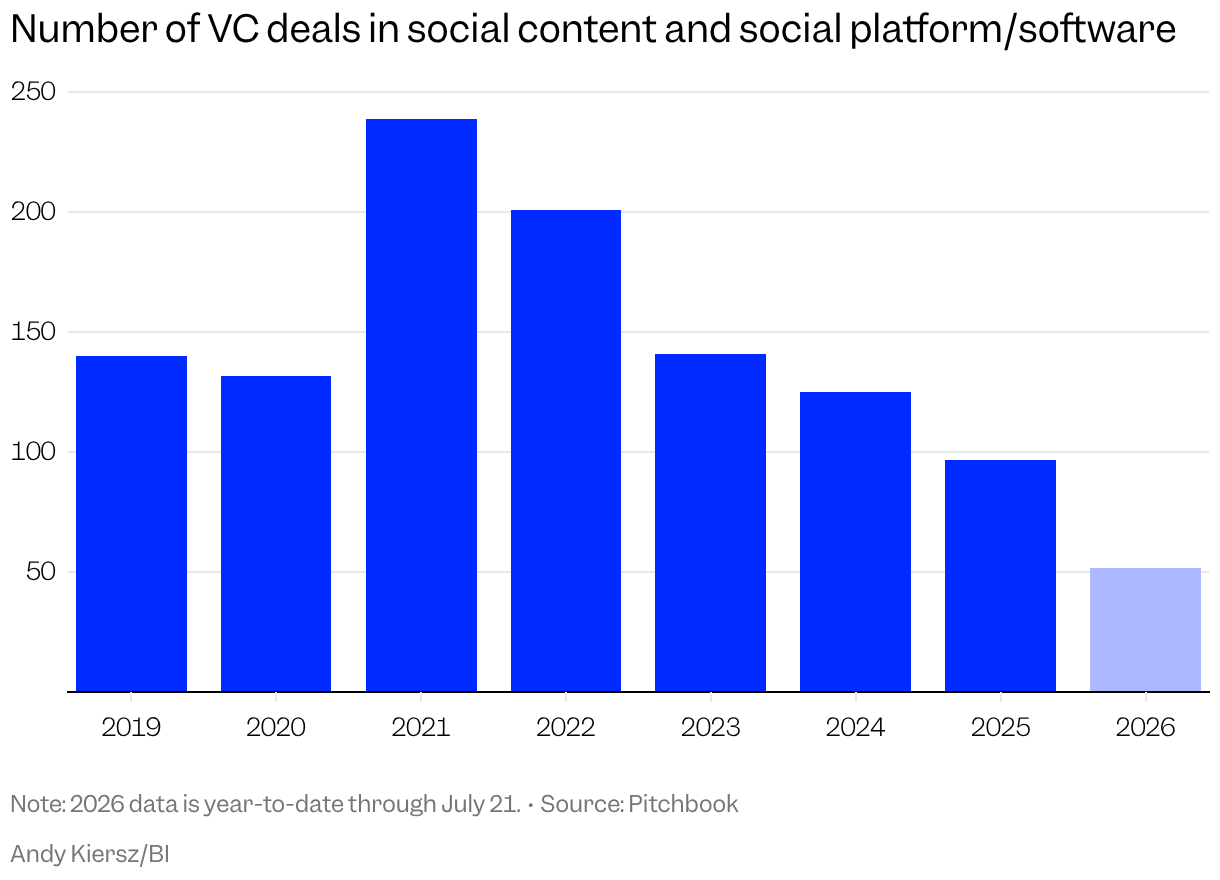
  • Since 2021, there has been a steady decline in venture capital deals in the social media category.
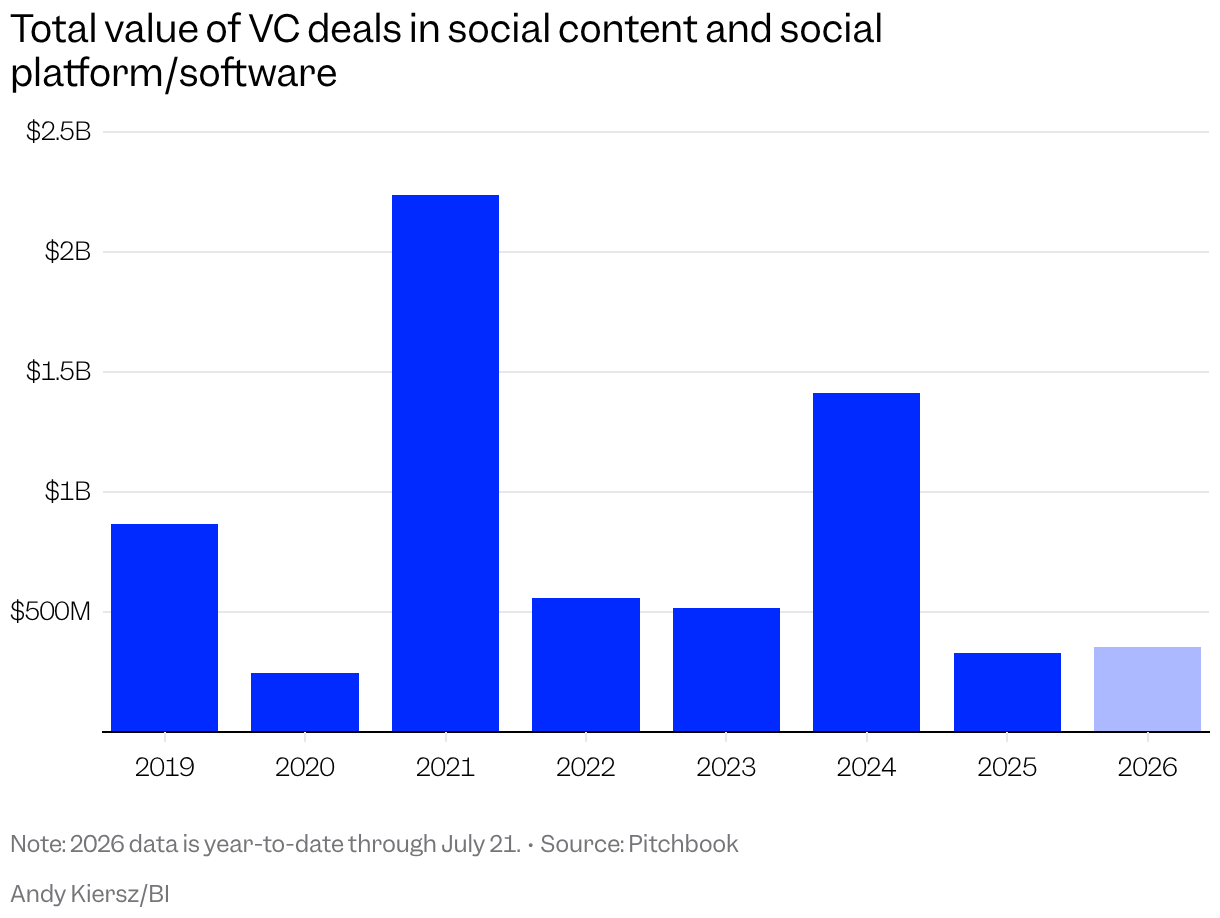
  • There’s been a rebound in overall deal value this year, driven by AI-powered social investments.
  • Two charts show how the investment landscape has changed.

It’s a tough environment for a founder trying to build the next-generation Facebook.

With more apps than ever and the mainstay social media giants dominating people’s screen time, the competition is fierce. Investors, meanwhile, are pining after flashy AI deals.

There was a peak in venture capital investment in social startups in 2021 — when apps like BeReal and Clubhouse were getting people excited for new challengers taking on Instagram and TikTok — according to PitchBook data, and the number of deals has declined each year since.

That 2021 peak saw 239 deals totaling $2.2 billion, per PitchBook’s data of US transactions. In 2025, PitchBook counted 97 deals totaling $330 million.

Column Chart

(To be fair, 2021 was an anomaly record year for venture capital across the board.)

So far in 2026, PitchBook counts more than 50 deals totaling $355 million in the space as of July 21 — already surpassing 2025 in dollar flow. If that pace continues, the category could welcome a slight rebound in investor interest.

Which startups are raising capital? There’s Fizz, an anonymous social app for Gen Z, which raised a strategic round of capital as it expands globally. There’s also Corner, a social mapping app that lets people save and share local spots (such as restaurants, bars, and shops), which is gearing up for a Series A.

Column Chart

Zooming out, consumer-social startups — broadly ranging from social media networks to dating apps to entertainment apps — were a fraction of the overall deals in 2025.

Across all venture capital deals in 2025, PitchBook estimates $513 billion in deal flow. AI and SaaS made up a bulk of this. Specifically, PitchBook counted more than 11,800 AI deals in 2025.

“Everyone fled consumer a couple years ago,” Rick Heitzmann, cofounder of FirstMark Capital, told Business Insider.

That’s left a remaining cohort of investors still on the hunt, though. Investors at firms like Menlo Ventures, Forerunner, and up-and-coming funds founded by VCs looking to go solo are backing social startups across sectors such as networking, dating, and AI.

There are plenty of startups racing to build social networks that feel more “AI native,” such as Eigen, which says it is developing a “mutual friend” that would turn AI agents into a tool for connecting people. The company announced a $15 million seed investment in April.

PitchBook’s data is limited, too, in how it classifies social startups. Some dating and social AI companion or chat startups, including Eigen, do not fall under PitchBook’s social category and are therefore excluded from this dataset.

As AI continues to renew investor interest in consumer social startups, a massive question, however, stands: What — if anything — will actually stick?

Read Business Insider’s list of 22 VC firms backing social startups.

Read the original article on Business Insider

Tech analyst Ben Thompson dismisses the ‘clearly absurd’ concept embedded in AI watermarking

Claude Code posters are seen during an Anthropic conference
Anthropic has divided some in tech with its plans to watermark output from its AI models, which it said was needed to comply with an EU AI regulation.
  • Tech analyst Ben Thompson says he doesn’t like AI watermarking.
  • Anthropic announced earlier this week that it would watermark content generated by its Claude tools.
  • Thompson of the popular “Stratechery” newsletter said the plan both goes too far and not far enough.

Tech analyst Ben Thompson says requiring AI companies to be transparent about the content their models produce is missing the mark.

Thompson tore into the European Union AI Act, which Anthropic cited as the reason it will add watermarks to content in Claude-generated files and text.

In his widely read “Stratechery” newsletter, Thompson said such AI transparency requirements are both overburdensome and unlikely to be strong enough.

“I am sympathetic to the impetus behind watermarking: wouldn’t it be better to know what is fake and what isn’t?” he wrote. “What, though, is ‘fake’? If an LLM states a true fact, and a human a fable, does it matter that the latter doesn’t have a watermark?”

Anthropic’s plan, which it announced earlier this week, has deeply divided the tech community. The AI giant said that Claude models launched after August 2 would support watermarking from the start and it is working to add such support to older AI models.

Thompson took particular issue with Anthropic adding a watermark even if Claude was used only for proofreading. The EU’s regulation allows for an editing exception, but technically speaking, Thompson said there was no way for Anthropic to distinguish such usage.

“I’m glad I never developed the habit of copy-and-pasting proof-reading runs (I use LLMs for proof-reading, but manually make every individual change in my text editor), but it hardly seems fair that anyone who wants to fix their grammar runs the risk of having their original content labeled as AI; the same frustration applies to translation,” he wrote.

OpenAI, which currently watermarks images and audio, has also pledged to expand the process to text output, though the exact details of their plan have not been released. OpenAI uses Google DeepMind’s SynthID to watermark images and audio.

Regulators are turning to watermarks, traditionally seen in visual media, to help society discern when content is AI-generated. Unlike visual watermarks, the provenance markers for AI text are not perceptible to the naked eye, but Anthropic and other AI companies have pledged to release tools that will essentially serve as AI checkers.

Under the EU regulations, AI companies are required to ensure “that the outputs of the AI system are marked in a machine-readable format and detectable as artificially generated or manipulated.” Anthropic, OpenAI, Google, Meta, and Microsoft have all signed the relevant section of the regulation. Notably, SpaceX has not. The transparency provision went into effect on August 2.

Anthropic did not indicate that it would only enforce watermarking in Europe. It remains to be seen whether other companies will extend watermarking to users everywhere.

Overall, Thompson said watermarking unfairly credits AI with ideation when such models are “(at least for now) a tool that is wielded by humans.”

“From this perspective, to insist on watermarking is no different than insisting that a ballpoint pen advertise itself as the author, a concept that is clearly absurd,” he wrote.

Read the original article on Business Insider

I visited the Obama Presidential Center, the most expensive presidential library in US history. Here are 15 things that surprised me most.

Author inside the Oval Office replica at the Obama Presidential Center
I visited the Obama Presidential Center during its opening week. It was different from what I expected.
  • The Obama Presidential Center opened in Chicago’s South Side this summer.
  • The $850 million center features a roughly 19-acre public campus and an immersive museum.
  • Former US President Barack Obama has the first-ever fully digital presidential library.

For over a decade, headlines have been written about the development of former US President Barack Obama‘s $850 million presidential center in Chicago — from how it would impact the surrounding community to its visually striking design.

Now, it’s open. Located on the city’s South Side, the sprawling 19.3-acre campus opened to the public on June 19.

I visited the Obama Presidential Center during its opening week, expecting an experience akin to those at other traditional US presidential libraries.

Instead, the Center challenged my assumptions through an immersive experience featuring massive art installations, interactive exhibits, and panoramic views of Chicago.

Here are some of the most surprising things I saw at the Obama Presidential Center.

Surprisingly, the Obama Presidential Center isn’t located near the usual Chicago tourist attractions.
View from the ground of the Obama Presidential Center in Chicago.

Your typical Chicago travel brochure might include sights from The Loop, the Chicago River, or the historic Grant Park, but the Obama Presidential Center isn’t located near typical tourist attractions like The Bean, the Chicago Theatre, or the Art Institute of Chicago.

Instead, the Presidential Center is located eight miles south of the city’s downtown, in the historic Jackson Park in the Woodlawn community. The over 551-acre park was the site of the 1893 World’s Columbian Exposition and is home to the Griffin Museum of Science and Industry.

While the center isn’t in the city’s downtown, it is only a three-minute walk from a train station that connects to the city in an under-20-minute ride.

The campus is surrounded by lush greenery and walking trails.
View from the Obama Presidential Center Sky Room.

The center has the breathing room to house its 19.3-acre campus. The surrounding parkland, residential streets, schools, and community institutions give the grounds a spacious, neighborhood-scale feel.

While I unfortunately visited during a gray, rainy week, I was amazed by how present the outdoors felt throughout the campus.

With almost 552 acres of surrounding parkland softening the landscape, I found that the center’s brutalist, 225-foot, granite-clad tower felt far less sterile than it does in pictures.

I especially enjoyed strolling along the surrounding paths and the Wetland Walk, which connects the campus with the larger park.

The campus includes a sports center, a playground, restaurants, and a public library.
Home Court at the Obama Presidential Center in chicago

Beyond the eight-story museum building, the campus is also home to two restaurants, a community garden, an auditorium, a public library, multiuse spaces, a media suite, conference rooms, a kids’ playground, and a 60,000-square-foot athletic center with a basketball court.

While I wouldn’t expect a basketball court to be part of a presidential library, the Home Court gives the campus a holistic feel.

It’s more like a community space rather than a tourist attraction.

Unlike other presidential libraries, the Obama Presidential Center does not house his records.
Inside the Obama Presidential Center in Chicago

The Barack Obama Presidential Library is the first all-digital presidential library administered by the National Archives and Records Administration.

The federal agency has legal and physical custody of the official presidential records and artifacts, which are kept at the agency’s College Park, Maryland, facility.

The Obama Presidential Center, which is privately operated through the Obama Foundation, serves as a physical, immersive interpretation of the presidency and displays selected NARA materials through a loan partnership.

The National Archives website says that the “vast majority” of the presidential records transferred to the federal agency from the Obama administration were “born digital,” including 300 million emails, which equals over a billion paper pages, as well as more than 3 million digital photographs, and 600 cubic feet of audiovisual material.

An 88-foot-tall video screen welcomes visitors as soon as they enter the museum.
View of the three-story visuals at the Obama Presidential Center in Chicago

When I entered the museum’s 225-foot tower, I was surprised to find a larger-than-life video display spanning all four museum exhibition levels. The installation features historic speeches, images, videos, songs, and poetry, guiding visitors through America’s civic history.

Visitors on the lower level can look up from the atrium, and those on the higher floors see the installation from balconies. Its scale means the image changes with the viewer’s position.

The display feels immersive and gigantic in its own dynamic way.

The museum covers a broad sweep of American history leading up to the Obama presidency.
Obama Presidential Center exhibit covering the civil rights movement.

It’s not just about the Obamas, like I previously thought. Surprisingly, the museum begins with a broader account of American history before introducing the Obama presidency. The first exhibition level traces the country’s democratic experiment and the movements that shaped the years leading to the 2008 election.

Through standout displays, the museum walks visitors through pivotal points in history, including emancipation, women’s suffrage, organized labor, and the rise of the Civil Rights Movement.

Before even mentioning the Obamas, the museum lays the groundwork of establishing the context of the America they were born into and all its historic nuances.

I was surprisingly moved by the personal keepsakes from the Obama family’s history on display.
Barack Obama family keepsakes at the Obama Presidential Center in Chicago

Two displays walk visitors through the family histories of Barack and Michelle Obama, detailing their closest relatives, earliest memories, and the communities in which they were raised.

I felt moved by personal objects on display, like Barack Obama’s elementary-school handprint art project and Michelle Obama’s family Bible, on which the former president took the oath of office in 2013.

As the museum moves into the beginnings of their joint family life, including videos in which Barack Obama discusses his wife’s role in his career, I took special notice of the couple’s wedding invitations on display, which felt especially intimate and personal to the Obamas.

I was amazed at the museum’s almost surgical look at the 2008 presidential campaign.
Obama 2008 campaign exhibit at the Obama Presidential Center.

One of the most expansive and educational exhibits at the Obama Presidential Center is “Yes We Can,” a detailed look at the 2008 campaign and Obama’s road to the White House.

The exhibit features various displays that trace his rise in local and national politics, using media headlines, insights, pictures, data, signs, and video to reconstruct the months leading up to the Democratic primaries.

I was particularly struck by the exhibit’s immersive experience and its detailed chronological panels showing how states voted and how Obama accumulated the delegates needed to secure the Democratic presidential nomination over Hillary Clinton.

Another thing that struck me throughout the museum and campus was the art.
Mural at the Obama Presidential Center in Chicago

More than 28 commissioned installations appear across the grounds, from outdoor sculptures to massive murals — and most are in spaces that are free to visit.

One of the most imposing works is Mark Bradford’s “City of the Big Shoulders,” a 38-foot-tall piece depicting the city of Chicago, which rises through the atrium near the museum exit and the lower-level café area.

Another one that grabbed my attention was Njideka Akunyili Crosby’s joint portrait of the former president and first lady located near the museum exit, which loosely reminded me of the former president’s iconic portrait at the Smithsonian’s National Portrait Gallery.

Some parts of the museum were more interactive than I expected.
Interactive display at the Obama Presidential Center in Chicago

I was amused by the museum’s many interactive displays and activities, which are spread throughout the galleries and allow visitors to engage more deeply with the content and themes.

The “Democracy 101” exhibit, located on the third level, particularly made me wish I were a child playing with all the interactive and moving parts.

Designed to give visitors a basic educational foundation in how the US government and democratic system work, the exhibit features interactive screens, objects, and even a light-up poll that asks visitors to assess American democracy. During my visit, a clear majority selected the response indicating that the system could be improved.

Physical artifacts from major moments in the presidency appear throughout the museum.
Barack Obama's domestic agenda on a notepad, on display at the Obama Presidential Center

Throughout the exhibits covering the eight years of the Obama presidency, several significant artifacts were on display, like the marriage certificate belonging to Jim Obergefell and John Arthur, the physical copy of the Affordable Care Act signed into law by the president, and an American flag signed by the military personnel who took part in the operation that killed Osama bin Laden.

Other personal items on display included Obama’s Nobel Peace Prize medal, a notepad on which the newly elected president handwrote priorities for his domestic agenda, and a selection of Michelle Obama’s most iconic dresses. The mix of policy documents and personal possessions gave the exhibit a human scale.

A personal favorite of mine — and of other visitors I spoke with — was the display of good-luck charms and small trinkets that Obama carried in his pockets during his presidency, including items like a small acorn and a bracelet given to the former president by a soldier deployed in Iraq. It felt more personal and intimate than I expected to see at the presidential center.

The Sky Room at the top of the eight-story building amused me with its views of Chicago.
View from the Obama Presidential Center Sky Room.

The last installation in the museum journey is the Nelson Mandela Sky Room, a viewing lounge at the top of the Center’s tower with panoramic views of Chicago’s South Side, Jackson Park, Lake Michigan, the Griffin Museum of Science and Industry, and the University of Chicago campus.

Visitors can access the Sky Room only via an express elevator that takes them from the fifth floor to the top floor. The elevator skips two levels, which a museum guide mentioned house administrative and utility facilities, as well as the offices of the former President and first lady.

The sudden transition from the mostly windowless galleries to the bright, panoramic room made the arrival feel almost cinematic.

The ceiling installation, Idris Khan’s “Sky of Hope,” displays thousands of hand-stamped words drawn from Obama’s 2015 “You Are America” speech, marking a reflective and inspiring end to the museum journey. The transition from the galleries to the sun-filled room felt like moving from the past toward the future. I saw many visitors sit down, take in the views, and appreciate the space.

Dining on the campus made it surprisingly easy to spend a full day exploring.
Restaurant at the Obama Presidential Center

The Center’s café had a sort of school-cafeteria feel, but the ample seating and a variety of food options made for a great break between exploring different sides of the campus.

I was impressed by the affordable prices of the fresh food. I ordered the $6 summer vegetable chicken soup and a $3 pasta salad. The costliest item in my lunch was the $7 juice from a local Chicago producer.

The campus also houses Tafari’s Kitchen, a full-service restaurant that serves lunch and dinner.

The local community was a bigger focus than I expected.
Visitors gather at the urban farm at the Obama Presidential Center in Chicago.

With a local community garden, a public library branch, and a children’s playground — which is a first on presidential library grounds — I thought that, beyond providing an enriching experience for visitors, the center aimed to become a centerpiece of the local community.

Overall, the experience went beyond that of just a museum or a library.
Visitors pose with statues of Barack and Michelle Obama at the Obama Presidential Center.

I had never visited a former US president’s presidential library, so I walked onto the Obama Presidential Center campus with no idea of what to expect.

Looking at pictures of some of the most recently built presidential libraries, like the George W. Bush Presidential Library and Museum in Dallas, which opened in 2013, I expected the towering structure to house the millions of records from the Obama presidency in a traditional library fashion and to include a research room where researchers can access open records.

Instead, the campus was far more dynamic than I expected, and used more than just records to tell the story of Obama’s presidency. Exhibits, art, films, landscapes, recreation, and public programming all contribute to its account of Obama’s presidency and make for an experience that combines a museum, a civic campus, and a living archive of the former president’s legacy.

Read the original article on Business Insider