
Author: admin

AI employees with apocalypse fears face a troubling question: Should they quit or stay?

CEO of Anthropic
Dario Amodei, CEO of Anthropic
  • Jacob Coxon’s Anthropic exit sparked debate over whether to push for AI safety from inside or out.
  • The resignation also drew scrutiny over its impact on Anthropic’s image and upcoming IPO.
  • AI workers’ stay-or-go conundrum has a World War II parallel, a tech historian says.

AI workers with apocalypse fears are facing a troubling, though not unprecedented, career dilemma.

Should they quit their jobs to avoid potentially helping make the doomsday scenario they envision a reality? Or, should they drive change for the better from within?

It’s a thorny predicament that came into focus this week when Jacob Coxon, a former OpenAI employee, said in an X post that he was resigning from Anthropic because the “people building AI earnestly believe that it could kill us all by the end of the decade.”

Soon after, Evan Hubinger, who leads Anthropic’s alignment stress-testing team, essentially backed Coxon, saying he believes there is a greater-than-10% chance AI could kill all humans within the next decade.

Why some workers stay

For AI workers worried that they’re contributing to mankind’s destruction, deciding whether to quit or stay put is more complicated than it may seem, said Jeremie Harris, CEO and cofounder of Gladstone AI, a Washington, DC-based safety and advisory company focused on national security risks and catastrophic threats from advanced AI. “I don’t particularly fault anyone for making either call,” he said.

Harris said his job involves regularly talking with staff at Anthropic and other top AI labs, and that in recent months he’s heard many express fears similar to those Coxon described. While quitting can be a moral response to building a dangerous technology, he said, Al labs could end up with few or no workers willing to press for change if resignations pile up.

“The people who are left are going to be the ones who are least concerned about safety,” Harris said, while “people who care arguably should be the ones in the seat.”

In response to Coxon’s announcement, Anthropic employee Anna Wang said on X that she works at the company because she thinks she “can do better at reducing risks from the inside.” She added that she respects and endorses others “who think that it’s better to do so from the outside.”

A spokesperson for Anthropic declined to comment after confirming Wang’s employment.

Coxon’s X post, which also sparked online debate over its impact on Anthropic’s image, the company’s coming IPO, and the possibility that this is all a strange publicity stunt, echoes concerns of a pending AI calamity previously made by Geoffrey Hinton, the computer scientist widely known as the “Godfather of AI,” xAI founder Elon Musk, and others.

The general public is apprehensive about AI, too. Some 52% of Americans are more concerned than excited about the use of the technology in daily life, according to a June study from the Pew Research Center. That’s up from 37% who said the same in 2021.

A dilemma with a history

For AI workers who truly believe their employer is creating an existential threat, Alex Wellerstein, a professor at Stevens Institute of Technology, said internal voices of reason have a poor track record of “overcoming preexisting institutional momentum.”

“If you stick around, you’re participating,” he said.

That tension is not new. Technology historian Matthew H. Hersch said the Manhattan Project, a World War II-era program to develop nuclear weapons, is a close parallel.

Ralph Austin Bard, then undersecretary of the US Navy, privately urged officials to warn Japan before using the atomic bomb and resigned weeks before Hiroshima, likely in protest of the decision not to do so, said Hersch, also a professor at Harvard University and a member of the School of Historical Studies at the Institute for Advanced Study.

Other Manhattan Project scientists also unsuccessfully pushed for a demonstration of the bomb before it was used in combat, some of whom were effectively barred from future defense work, he added.

“Whistleblowers can do tremendous good,” Hersch told Business Insider, “but are apt to be discredited or harassed into silence, and become unemployable in their industry.”
Read the original article on Business Insider

President Trump can’t decide if the affordability crisis is real or not

Donald Trump
Donald Trump called affordability “fake” at the Republican National Convention’s midterm convention.
  • Trump dismissed the affordability crisis as “fake,” despite his efforts to alleviate it.
  • The White House has pushed affordability measures, clashing with Trump’s statements ahead of midterms.
  • Trump wants credit for bringing prices down while rejecting that affordability remains a crisis.

President Donald Trump often refers to the affordability crisis as a hoax. His White House may not agree.

Trump called the crisis a “fake” Democrat-created issue on the first night of the Republican National Committee’s first-ever midterm convention this week in Dallas. But the remark sits awkwardly beside months of White House messaging that has treated affordability as one of Trump’s central economic promises.

In his speech, Trump blamed former President Joe Biden for runaway inflation and said affordability concerns were fake “because I’m bringing the prices way down.” In the same speech, he promised that every adult US citizen would receive a $5,000 dividend from tariff revenue if Republicans won the midterms — a form of stimulus which economists expect would further exacerbate inflation.

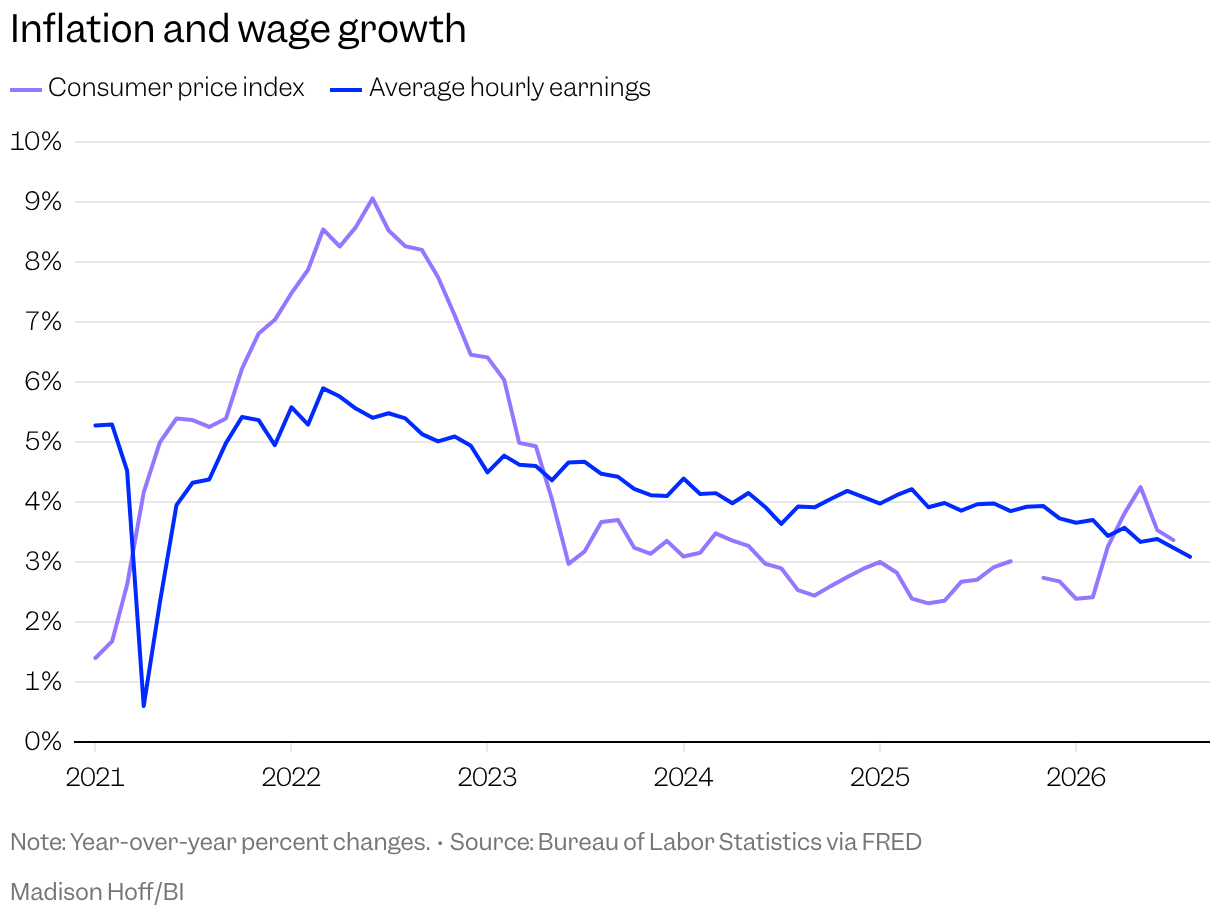
Trump claimed that “food prices and almost every other item are rapidly going down,” even as consumer prices have increased by 4.3% since January 2025, with groceries up 3.4% and gasoline up 31% amid the ongoing crisis in Iran. This isn’t the first time Trump has brushed off affordability concerns, as the administration has at times taken a deal-with-it stance on high prices.

Line chart with two lines showing inflation and wage growth since 2021

In November 2025, Trump told Fox News that Democrats “have this new word called ‘affordability,’ and [Republicans] don’t talk about it enough.” Days later, he called affordability a “con job,” adding that his party “did a great job on groceries and affordability,” and were “victors on affordability.”

By December, Trump was trying to have it both ways. In a speech in Pennsylvania, he said, “I have no higher priority than making America affordable again,” but also described affordability as Democrats’ “new word” and said, “they always have a hoax.”

The White House’s own messaging has told a different story Just a few days later in December, it acknowledged in a post that affordability is “finally trending in the right direction.” As part of the affordability push, the administration pledged to cap credit card interest rates at 10%, open “Trump accounts” that allot $1,000 to children born between 2025 and 2028, and ban institutional investors from purchasing single-family homes.

Trump’s State of the Union address also outlined ways to relieve pressure on US households, such as tax incentives for American-made cars and no tax on tips or overtime. In April, Trump signed an executive order expanding access to retirement savings by offering up to $1,000 in matching contributions for lower-income workers without employer-sponsored plans. A White House press release in August outlined how major retailers, energy companies, drug companies, and automakers have slashed prices on thousands of goods.

That mix of messages captures the tension in Trump’s economic pitch heading into the midterms: He wants credit for bringing prices down while rejecting the premise that affordability remains a crisis.

For voters still feeling squeezed, that may be a hard balance to sell.

Read the original article on Business Insider

Nvidia CEO Jensen Huang says cybersecurity is AI’s next blockbuster app

Jensen Huang speaks in Chapel Hill.
Nvidia CEO Jensen Huang.
  • Nvidia CEO Jensen Huang says cybersecurity will be AI’s next blockbuster app after coding.
  • Unlike coding assistants, AI cybersecurity systems run around the clock.
  • Nvidia has recently partnered with CrowdStrike, Cisco, and Palantir.

If coding was one of AI’s first big blockbuster apps, Nvidia CEO Jensen Huang predicts cybersecurity will be the next.

Speaking at a Goldman Sachs conference on Thursday, Huang said that companies will increasingly use AI to find software vulnerabilities and defend against cyberattacks.

Huang’s prediction comes as AI safety has become a hot debate in Silicon Valley. Researchers at companies like Anthropic have warned that increasingly powerful AI could pose existential threats if left unchecked — including by enabling more sophisticated cyberattacks.

Huang wasn’t asked about the debate or weighing in on it. Instead, he said that increasingly capable AI will make cybersecurity one of the biggest business opportunities for the technology industry.

Huang said that cybersecurity is a natural extension of coding.

“A derivative of coding is, of course, bug finding,” he said. “And a derivative of that, which is a very large market, is called cybersecurity.”

Unlike coding assistants that respond to prompts, Huang said AI-powered cybersecurity systems run continuously — meaning companies will pay to keep them going around the clock.

The comments come as Nvidia has been pushing deeper into cybersecurity. The company has recently announced partnerships with CrowdStrike, Cisco, and Palantir to build AI-powered cybersecurity tools.

Other AI giants are also betting on cybersecurity. OpenAI chief financial officer Sarah Friar said Tuesday at the conference that the company sees cybersecurity as a major “commercial opportunity.”

Have a tip? Contact this reporter via email at gweiss@businessinsider.com or Signal at @geoffweiss.25. Use a personal email address and a nonwork device; here’s our guide to sharing information securely.

Read the original article on Business Insider

8 of the best foods I ate at the US Open — and 3 I’d skip next time

Dobel Tequila Club tacos chilorio
Dobel Tequila Club tacos chilorio.
  • The US Open is known for its world-class tennis, people-watching, and, of course, its food.
  • I recently ate my way through nearly everything on offer at the US Open’s Food Village.
  • Some dishes stood out to me, but others aren’t worth the lines and hefty price tags.

Game, set, feast: These US Open food offerings are worth the trek to Queens.

I recently attended the US Open during Fan Week for a media preview of all the food on offer at this year’s tournament.

While there, I ate my way through nearly every dish on the menu and came away with a few favorites, including a $38 French dip sandwich that’s become almost as famous as the players themselves.

But they weren’t all champions — I also tried a few items that I don’t think are worth the long lines and hefty price tags.

Here are the eight best food items I tried at the US Open, and three I think could be skipped.

One of the best and simplest items I tried was the prosciutto pizza from San Matteo.
San Matteo NYC prosciutto pizza
San Matteo NYC prosciutto pizza.

Cost: $23

Offering a variety of Neapolitan-style pizzas, San Matteo has brought some of its favorite concoctions from its Upper East Side pizzeria to the US Open.

The prosciutto pizza, which is about the size of a personal pizza, features fresh mozzarella, truffle pâté, Rovagnati Parma ham, basil, and crushed black pepper. I thought the pizza was perfectly balanced, salty and sweet, and the dough was delightfully crispy.

It was also relatively affordable and a generous portion for the Food Village at the US Open.

However, I’d probably skip the pepperoni or margherita cheese pizzas from San Matteo.
San Matteo NYC pepperoni pizza
San Matteo NYC pepperoni pizza.

Cost: $22 (pepperoni) and $19 (margherita)

While I enjoyed both, I thought that they were a bit too simple for a special day out at the Open, especially compared to the more exciting prosciutto pizza or the variety of unique items on offer.

For kids attending, ordering a simpler pizza might be a perfect fit, but I recommend thinking a bit more outside the box with your concession orders.

One of my favorite items at the US Open was the OG Chicken Sando from Fuku.
Fuku OG Sando chicken sandwich
Fuku OG Sando chicken sandwich.

Cost: $19

It includes a crispy, habanero-brined fried chicken filet, Fuku Mayo, and pickles on a butter-toasted potato roll.

I thought the chicken was perfectly crispy, and I could really taste the slightly spicy kick of the brine. The pickles also had a nice crunch, and they were held together by the soft potato bun.

There are lots of chicken offerings at the US Open — including a $100 box of chicken nuggets and caviar — but I thought this was a relatively affordable option that tasted as good as it looked.

I also loved the tacos chilorio from Dobel Tequila Club.
Dobel Tequila Club tacos chilorio
Dobel Tequila Club tacos chilorio.

Cost: $29 for three

Available at one of the main full-service bars on the US Open grounds, these tacos were a surprising favorite for me, especially after trying other Mexican dishes from stands like Dos Toros and the higher-end restaurant Cosme.

These street tacos were downright addictive. Each was packed with shredded local braised beef, pasilla and guajillo chiles, white onions, and cilantro, creating a rich, smoky, deeply savory bite that had me wishing I’d ordered a second plate.

The classic hot pastrami sandwich on rye from Carnegie Deli was delicious, too.
Carnegie Deli hot pastrami sandwich on rye
Carnegie Deli hot pastrami sandwich on rye.

Cost: $30

The sandwich was piled high with thinly sliced hot pastrami and a smear of mustard. While you can find similar deli sandwiches across New York City, including at Katz’s Delicatessen, this one measured up to others I’ve had over my seven years living here.

It was salty, filling, and the meat melted in my mouth.

My one gripe, however, was that it was a bit much, especially on a hot day walking around the mostly outdoor tournament grounds. If I were to eat an entire sandwich, I’d no doubt have the meat sweats.

The most surprising menu item was the temomi ramen shrimp scampi from pastaRAMEN.
pastaRAMEN temomi ramen shrimp scampi
pastaRAMEN temomi ramen shrimp scampi.

Cost: $27

Made with ponzu-garlic shrimp and homemade breadcrumbs, the dish was rich and buttery without being gloopy or too stick-to-your-bones for a late-summer day. The shrimp were extremely tender and flavorful, and the ramen noodles clung to every drop of the garlicky sauce.

This was the most unique item I tried, and I’d go back to the US Open just to eat it again. I thought the $27 price tag was a touch steep, but definitely worth it for the amount of flavor in each bite.

Even if you’re craving seafood, I’d probably skip the Maine lobster roll from Red Hook Lobster Pound.
Red Hook Lobster Pound Maine lobster roll
Red Hook Lobster Pound Maine lobster roll.

Cost: $39

Made with succulent lobster meat and a light mayonnaise dressing, the roll retails for a whopping $39 in the Food Village. While I thought it was tasty, I wasn’t sure it was worth that price.

The roll was a little on the smaller side, and while it was a good deal compared to the pricing at RHLP’s stand-alone location in Red Hook, where a four-ounce lobster roll costs $41, I thought that, compared to some other items available at the Open, it just didn’t feel worth the money to me.

If I want a lobster roll, I want to be smelling sea air and kicking back by the water, not surrounded by people in a sports arena.

On the other hand, the sushi hand rolls from Morimoto impressed me.
Morimoto hand rolls
Morimoto hand rolls.

Cost: $42 for two handrolls

While $42 may seem like a high price to pay, I was blown away by the quality of the tuna and salmon inside — it might have been the freshest sushi I’ve eaten, which was a total shock considering we were at a sports event.

Speaking with a team member at Morimoto, I learned that their fresh tuna is flown in from Spain.

The handrolls were simple, but their portable, easy-to-eat format made them a great fit for the US Open.

My favorite item of the day was the French dip sandwich from Salt Hank’s.
Salt Hank's French dip sandwich
Salt Hank’s French dip sandwich.

Cost: $38

It’s become perhaps the most talked-about food item at the US Open for a reason.

The meaty sandwich is made with prime rib from New York City butcher Pat LaFrieda, sweet caramelized onions, gooey provolone, and horseradish aioli served on a baguette with housemade jus.

The sandwich was rich and messy in the best way, with tender prime rib and a soft-but-sturdy baguette that held up well against the deeply savory jus. The horseradish sauce added a slight kick at the end.

Surprisingly, the duck flautas and mole I tried from Cosme didn’t knock it out of the park for me.
Cosme mole
Cosme mole.

Cost: $42

The duck was tender, and the flautas had a satisfying crunch, but the dish felt slightly underseasoned overall.

I was also expecting the mole to bring more depth and richness, especially from a restaurant known for its bold, polished Mexican flavors. Instead, it tasted a little muted.

For me, the taste couldn’t justify the price tag, nor the fact that it’s only available inside Cosme’s more upscale sit-down restaurant at the Open.

Instead of spending time on a full meal that didn’t live up to the hype, I’d recommend sticking to the Food Village, where you can grab something quickly and keep watching the action.

Read the original article on Business Insider

We went status-symbol spotting at the US Open. Here’s what we found.

Three casually dressed people walk together on a crowded wooden pier near railings and streetlights.
US Open attendees made statements with high-end accessories and designer pieces.

Tennis fans are serving at this year’s US Open. We’re talking about their fashion, of course.

Attendees have been photographed walking throughout the USTA Billie Jean King National Tennis Center in New York for the past two weeks, wearing standout ensembles and luxury timepieces.

Here are the best fashion looks we spotted on the ground.

Bulgari watches are elevating simple outfits.
Person in sunglasses and pale sleeveless outfit walks through a crowded outdoor event holding a phone and quilted handbag.

An attendee wearing a white tank top and satin silver pants took her outfit to the next level with a Serpenti Tubogas watch, which costs upward of $7,400.

Blue jeans are out, and white jeans are in.
Two people in coordinated white Polo Tennis outfits walk on wet pavement, one looking at a smartphone.

A couple wore matching pairs with their Ralph Lauren shirts and baseball caps. They both also wore white sneakers.

Blue denim dresses and accessories are popular, though.
Two people walk on a wooden boardwalk wearing sunglasses and casual dressy outfits.

One attendee wore a denim dress and carried a denim tote, pairing the look with Adidas sneakers.

Her companion wore Nike sneakers with his trousers and blazer, keeping the look casual.

Alo continues to be the go-to athletic brand.
Person walks on a wet street wearing an ivory varsity jacket, black athletic outfit, and white sneakers.

A woman wore the brand’s sports bra and miniskirt set beneath a white letterman jacket, also from the brand.

Monochrome outfits are everywhere.
Two stylish spectators in black outfits pose outdoors at a US Open event with a branded shopping bag.

Another couple sported matching black outfits with standout accessories. A woman wore hers with white flats, while a man wore his version of the outfit with a colorful scarf.

Women are pairing their miniskirts with polo shirts.
Person wearing an all-white outfit and sunglasses walks on a wooden boardwalk near metal railings.

One woman wore her white miniskirt with a matching polo top, see-through flats, and a statement gold belt. She also wore metallic jewelry, sunglasses, and a Staud purse.

You can’t go wrong with US Open merchandise.
Person wearing a US OPEN cap walks through a rainy crowd carrying a small white shopping bag.

That’s especially true when it comes to baseball caps, which one man wore with a cream-colored top, plaid pants, and white sneakers.

There’s no better place to flash a Rolex.
Person in an olive shirt and light trousers walks through a crowded street wearing a wristwatch.

Specifically, the GMT-Master II in stainless steel and yellow gold was the watch of choice for one attendee. The watch sells on the secondhand market for more than $11,000.

The simpler your Rolex, the better.
Close-up of a person in a white shirt wearing rings, a bracelet, and a wristwatch while holding a blue strap.

Alongside an arm covered in gold jewelry, one attendee wore a silver Oyster Perpetual 31 watch, which costs $6,300.

Couples are coordinating their outfits.
Two people in white tops and dark trousers stand holding hands at an outdoor event entrance.

One duo wore statement white tops with oversize black trousers and leather shoes. Layered jewelry also played a part in both of their looks.

The baseball cap of choice comes from Celine.
Person in a white tennis-style outfit and beige logo cap looks at a smartphone while carrying a quilted handbag.

Multiple people were spotted wearing a $630 tan hat with Celine’s monogram across the front. One woman wore hers with a white miniskirt and a Chanel purse.

Strappy flats and Louis Vuitton bags are the accessories of choice.
A person in a teal outfit walks through a wet crowded street holding a phone and drink.

With a green miniskirt and matching sweater, one woman wore black flats that laced up her ankles. She completed the look with a small Louis Vuitton purse that featured the brand’s monogram in rainbow colors.

Trader Joe’s tote bags have made their way to the US Open.
Person in a pink button-down shirt and white pants walks on a wooden boardwalk among pedestrians.

One man carried the standard version of the buzzy grocery bag, adding a trendy touch to his classic outfit: a pink polo shirt, tan jeans, tortoise-shell sunglasses, and cream-colored sneakers.

The US Open is the place to show off Patek Philippe watches.
Cropped person in white pants holds a canvas tote bag while wearing a wristwatch outdoors.

One man wore a $71,643 World Time Flyback Chronograph timepiece with a steel dial and a brown leather bracelet.

The same goes for Vacheron Constantin timepieces.
Close-up of a chronograph wristwatch on a wrist beside black pants and a light gray long-sleeve shirt.

An Overseas Chronograph in steel was spotted at the US Open. The watch, which sells for more than $37,000, had a black leather strap and a stainless steel bezel.

Neutral shades and baby blue are having a moment.
A man and a companion walk outdoors through a crowd beneath a blue canopy.

Tan sets are especially popular right now. One man wore his with a white T-shirt and a brown belt. You might also spot tons of baby-blue polos. A woman sported a tiered version of the top over a ruffled skirt.

Both attendees completed their looks with dark sunglasses and sneakers.

Tiny Hermès belts are making big statements.
A spectator walks through a crowded outdoor event area carrying a white AMEX tote bag.

The $735 belts are often extremely thin with delicate, gold H-shaped buckles — so you might miss them. One attendee wore hers with a black skirt, white tank top, tan flats, and a plum-colored sweater tied around her shoulders.

Scarves are being worn as belts and bag accessories.
Person in sunglasses walks outdoors wearing a red top, cream skirt, red shoes, and carrying a yellow handbag.

A woman at the sporting event tied a colorful scarf around the handles of her yellow Prada purse, adding a contrast of color to her tan skirt, white sweater, and red top.

Polo Ralph Lauren, one of the event’s sponsors, is also a fashion status symbol.
Person in white Polo Ralph Lauren jacket and striped trousers walks on a wet boardwalk in an urban setting.

Attendees have been photographed wearing everything from the brand’s hats to its jackets and polo shirts. Some have even worn multiple at the same time.

Some attendees have added Polo sweaters over their shoulders to elevate their looks.
Three casually dressed people walk together on a crowded wooden pier near railings and streetlights.

A sweater on the shoulders adds a preppy twist to a US Open look. One group chose Polo sweaters with green-trimmed sleeves, adding a pop of color to their looks.

Accessories are also taking sweaters to the next level.
Two stylish attendees wearing sunglasses walk through a crowded outdoor event area, one holding a smartphone.

One attendee added large silver brooches to her cardigan to make it feel glitzier. Her hat, sunglasses, and neck scarf added to the ensemble.

Read the original article on Business Insider

I’m a divorced mom who takes my kids out to eat 4 times a month. It’s expensive, but worth it.

The author and her kids enjoy eating crab legs while out to dinner.
The author said going out to eat crab legs with her kids is one of her favorite activities.
  • I take my kids, 11 and 13, out to eat at least four times a month.
  • These meals out allow us to spend quality time together, without the distractions of our home.
  • I see these outings as a worthwhile — and necessary — expense to help us stay connected.

I adore the thought of my kids’ fingers covered in Zaddy sauce while eating a snow crab cluster, and their excitement as they bend the shell just right and devour a huge piece of meat after covering it with butter.

A night at Clawdaddy is one of my favorite dinners with my kids, 11 and 13. As a divorced mom, these meals out and the time we spend eating them together mean even more to me.

That’s why I never want to give them up, even if these nights out are getting more and more expensive.

I love having more time with my kids

My desire to frequently go out to eat with my kids comes from the limited time I have with them. They are with me every other week, so two weeks of the month, plus a Wednesday dinner when it isn’t my time.

I remember pleading for an extra Wednesday dinner during my divorce so that at least I could count on seeing my kids, who were 5 and 7 years old at the time, halfway through the week when I was apart from them.

For me, it meant there was always a dinner to plan or a reservation to make, and I looked forward to it. These dinners got me through the loneliness of adjusting to divorced motherhood.

Going out feels special

At first, going out to eat was a perfect way to adjust to this new chapter in our lives.

When the three of us shared a meal at a restaurant, I could feel the eyes of other diners on me, maybe wondering why I was alone having dinner with my young kids, but we just did our thing.

Sometimes it was the three of us sitting on the same side of the booth, and I loved it. I smiled as my kids pointed to what menu item they wanted to order, opened crayons, and I admired the drawing they were coloring. It felt special. We could be silly and laugh, and nothing mattered but us when we went out to eat. These dinners helped me feel more confident about being on my own that first year.

The author and her children dine at a hibachi restaurant.
The author said she is able to see a different side of her kids when they are away from the distractions of home.

Sometimes we would hit up Olive Garden, or choose BBQ and ice cream, or maybe we’d go to Benihana for a surprise treat. As the years have gone by, going out to eat has only gotten more and more enjoyable, especially because my kids finally want to explore new foods and restaurants.

I still keep an eye on expenses

Eating out can get costly, but we do our best to stay within our means.

We usually end up dining out of the house around four times a month. Because of this, I plan our grocery budget around these outings.

I’m also spending less on other activities with my kids. Now, instead of buying tickets for the zoo, trampoline park, arcade, or the children’s museums (plus the gift shop and snacks) like I did when they were younger, I spend about the same amount of money going out to eat. It’s a new — and fun — way to make memories.

The author and her kids enjoy a meal at a restaurant.
The author said she and her kids go out to eat at least four times a month, and she plans her grocery budget accordingly.

As my kids get older, I know these restaurant meals are a worthwhile investment. My kids have full schedules with long school days and extracurricular activities, and they are getting more independent, and want to spend time with their friends, so our limited time together can feel even more limited.

Our dinners are not just about food. We discuss life lessons, ups and downs I’ve lived through, and family stories. It’s easier to focus on all of that when I’m not busy prepping the meal, cleaning the dishes, or fighting with other distractions at home.

At the table, I’m full of gratitude, sitting with my favorite people. When the bill comes, it’s always worth every cent.

Read the original article on Business Insider