
Author: admin

After 3 years of living out West, I moved to North Carolina. It was the best decision I could’ve made for myself.

Mikala sits in a field of yellow flowers with her dog.
After years of living in big cities out West, I moved to Asheville, North Carolina.
  • After spending a few years living in big Western cities, I moved back East to be closer to family.
  • Now, I live in Asheville, North Carolina, and my quality of life has really improved.
  • Life in Asheville has made family, affordability, and everyday ease feel more accessible.

As a small-town girl from Forestville, New York, moving to Denver for my dream job after college felt electric. I enjoyed skiing (when I could justify the three-hour drive to my favorite slopes), hiking, and seeing many shows at Red Rocks Amphitheater.

But when the COVID-19 pandemic hit, the city’s shine quickly wore off. Hiking trails became more crowded, live music all but disappeared, and suddenly, I felt very alone on the other side of the country.

Visiting my family back East wasn’t easy without expensive flights or long days on the road, and I started to feel closed in, with no way to reset or reconnect.

After sticking things out in Denver for a few more months, I moved to Salt Lake City for work. At first, it felt like an upgrade: world-class skiing was just 30 minutes away, rugged desert trails were within reach, and there was a stunning mountain backdrop.

Eventually, though, I realized what mattered most to me was being close to my family.

So, after three years of living out West, I decided I was ready for a change and settled in Asheville, North Carolina — a city that still gives me proximity to nature but has made family, affordability, and everyday ease feel more accessible.

Since moving, my quality of life has really improved

Mikala hikes with her dog in the mountains on a fall day.
Living in Asheville means I still get to spend time in nature.

Now that I’m back on the East Coast, I don’t feel as cut off from my loved ones.

When I was living out West, the flights were so expensive that I only ended up seeing my family once a year for Christmas. Now, however, I can somewhat easily drive up to New York multiple times a year for birthdays, graduations, and other gatherings.

Being closer to my family hasn’t been the only perk of moving here, either. I’ve also found that the pace of life feels much more natural. There’s a collective ease here in the way people pause to chat, hold doors, and make everyday interactions feel more personal and less rushed.

Southern hospitality feels present in everyday interactions, especially when I go over to a friend’s house to sip tea on their porch.

The landscape seems to shape this rhythm, too. I can step onto a hiking trail or into a river within 15 minutes of leaving my house, and enjoy four distinct seasons — including mild winters — without the extremes of high-altitude living.

Now, my life feels much more balanced

A man and women pose with mountains in the background.
My partner and I are saving to buy a house.

At the end of the day, I don’t think Asheville is “better” than the other places I’ve lived. The Rockies and Appalachians both offer breathtaking landscapes, endless opportunities to get outside, and ways of living that aren’t found in other parts of the country.

However, moving to North Carolina has allowed me to better align my life with the things that are most important to me.

And a bonus? I’m finally able to save for my future in a way that felt impossible when I was living in bigger cities.

Now, I’m paying less than $2,000 a month for a three-bedroom, two-bathroom rental with a fenced-in backyard. Meanwhile, comparable options I saw in Denver and Salt Lake City could run at least $3,000.

This breathing room has allowed my partner and me to save money toward buying land and a home.

Overall, moving to North Carolina shifted more than just my address — it changed my relationship to affordability, time, family, and what “living well” actually means.
Read the original article on Business Insider

How Heathrow partnered with Salesforce to build a customer-service AI agent

Departures hall at London Heathrow Airport Terminal.
Heathrow is the UK’s busiest airport.
  • Heathrow’s AI assistant handles traveler inquiries via WhatsApp, reducing the need for phone calls.
  • Heathrow leveraged its longtime partnership with Salesforce to create the tool, called Hallie.
  • Hallie is set to expand to the airport’s website and app later this year.

Nearly 85 million travelers passed through Heathrow Airport in 2025. Amid the hustle and bustle, they had plenty of questions: How long will it take to get through security? Which Starbucks is closest to my departure gate? If my bag was left behind at security, how can I find it?

Peter Burns, Heathrow’s director of digital, e-commerce, and marketing, told Business Insider that he wanted to improve customer service at Europe’s busiest airport, where demand keeps increasing. “As we grow capacity, we have to find a technology solution,” he said. To do that, Heathrow spent the past three years deepening its longtime partnership with Salesforce, which started in 2009, Burns said.

Heathrow first implemented Salesforce’s generative and agentic AI products in 2023, with a focus on customer service applications. These initial tests led to the launch of Hallie, the airport’s customer service AI agent that lives on WhatsApp and answers nearly all traveler questions without human help, in March 2025, said Burns. Since finding earlier this year that Hallie significantly reduced the number of customer calls to the airport, Heathrow is looking to further implement the tool on its website and app.

Customer service has been a popular use case for generative AI across industries since the debut of ChatGPT in 2022, said Gartner Research Vice President Bern Elliot. Elliot told Business Insider that a company’s customer contact centers can act as AI incubators because their return-on-investment metrics — time saved, agent call volume, response times, and response quality, among others — are clearly defined.

“You don’t have to connect very many dots to get from what you deployed to what is the measurable improvement,” Elliot said. “It makes for a great starting place in your AI journey.”

However, infusing AI into customer service systems isn’t a straightforward process, said Elliot. AI systems should be trained on a company’s most up-to-date data; otherwise, large language models are more susceptible to giving incorrect responses. “Having AI-ready data is a huge issue,” Elliot said.

Burns — along with Salesforce’s senior vice president of solution engineering, Paul O’Sullivan — spoke with Business Insider about how Heathrow and Salesforce collaborated to navigate these data complexities and launch Hallie.

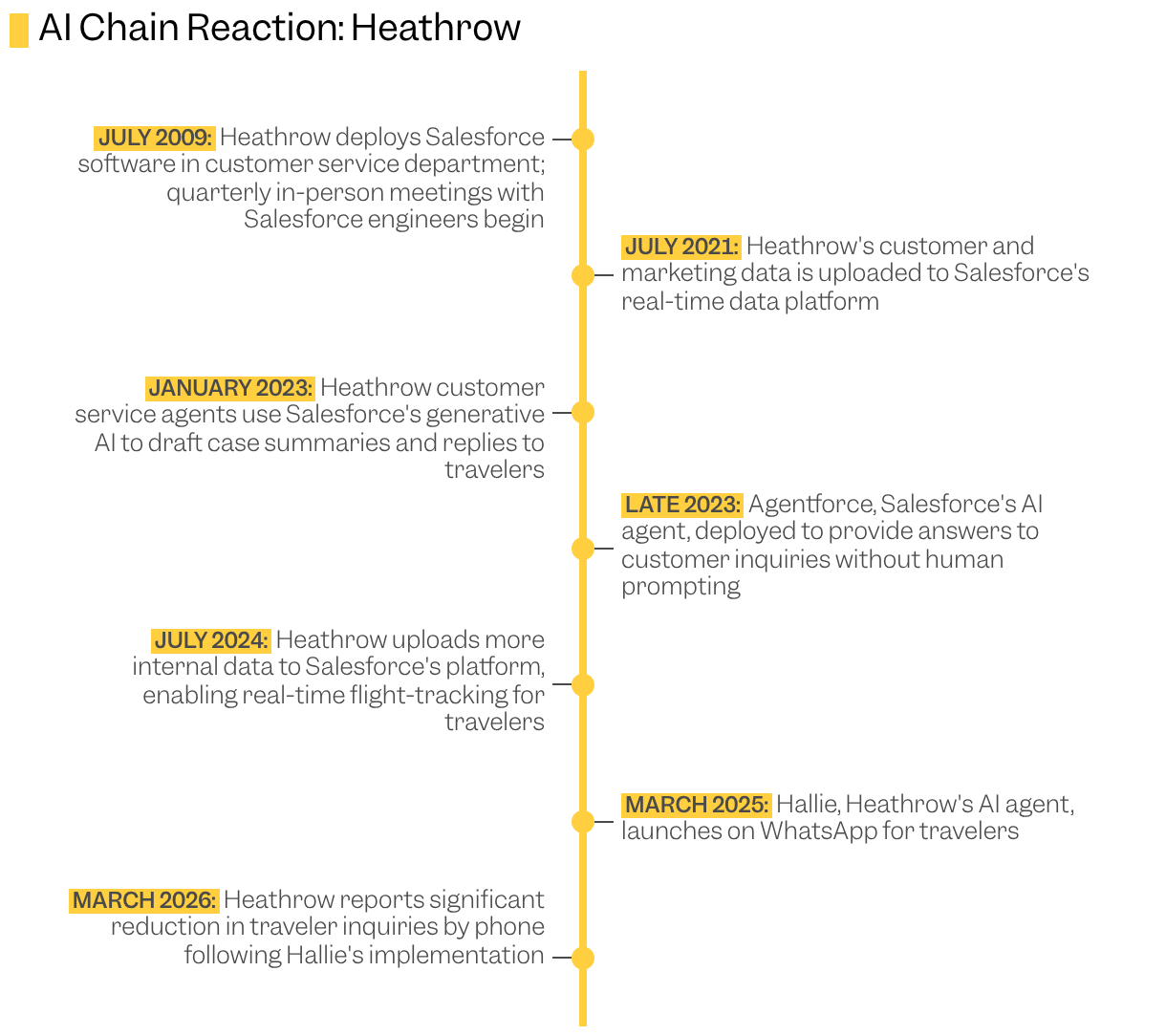
Timeline of key events in the use of AI at Heathrow

The tech

Though Heathrow’s initial Salesforce investments lacked AI capabilities, Burns said they were critical to creating a unified database that would later serve as the foundation for the airport’s customer service AI agents.

Heathrow’s relationship with Salesforce started in July 2009 when it deployed Salesforce Service Cloud, a platform that helps customer service agents manage inquiries across multiple channels. By July 2021, Heathrow’s customer and marketing data had been uploaded to Salesforce’s real-time data platform, giving airport employees in customer service, marketing, and e-commerce live views of passenger data.

Burns said Heathrow became an early adopter of Salesforce’s generative AI capabilities in 2023, largely because of the airport’s existing Salesforce product use. AI deployment began that January with two internal use cases: autonomously drafting replies to customer inquiries and creating case wrapups, the summaries that customer service agents prepare after helping someone. These two tests fed more information into Heathrow’s database, helping to continuously refine the quality of AI-drafted responses, Burns said.

By late 2023, Salesforce’s Agentforce — the software company’s autonomous AI platform that can complete customer service, sales, and marketing tasks automatically — was deployed in the airport’s contact center to assist human agents with two specific tasks: Writing responses to customer questions and, after a case was resolved, generating a summary. Previously, agents had to type out every response and case summary, Burns said.

He added that Heathrow worked closely with O’Sullivan and his team of UK-based engineers to test and improve the airport’s AI capabilities before Hallie’s launch. Salesforce has regularly met with Heathrow’s team since their partnership began in 2009, with in-person visits about once per quarter and regular virtual catch-ups every other week, O’Sullivan said. In recent years, their meetings have focused on observing contact agents’ workflows and identifying pain points where AI could be applied.

O’Sullivan told Business Insider that it is critical for executive leadership, product managers, engineers, and representatives from security, data, and cloud teams to be on the same page before deploying tools like Agentforce, since internal databases could be outdated and make the technology less useful. “The reality is these agents need to be exactly like you and I, and how we work, because we’re constantly learning,” he said.

At Heathrow, Agentforce pulls from the airport’s database of 500 articles outlining processes. However, some of the policies took several months to gather, update, and implement, Burns told Business Insider.

In July 2024, Heathrow added more of its internal data to Salesforce’s data platform, enabling the airport to provide customers with real-time flight-tracking data.

Heathrow’s unified data foundation, which brought together Heathrow customer data, airport maps, flight statuses, and advances in generative AI, led to the March 2025 launch of Heathrow’s AI agent Hallie. On WhatsApp, travelers can ask Hallie questions about upcoming flights, how to find specific airport amenities and terminals, and the length of the security line.

The outcome

Prior to the launch of Hallie, 70% of customer inquiries were handled by phone, said Burns. Thanks to the bot’s agentic capabilities, by March 2026, phone calls accounted for 10% of traveler inquiries.

Later this year, Hallie will expand beyond WhatsApp so customers can access the tool on Heathrow’s website and app, Burns added. The airport is also considering future rollouts for Hallie, like at kiosks throughout its terminals.

Still, Hallie’s guardrails are limited: it only scrapes data from Heathrow’s website and internal database, Burns said. “We aren’t letting the agent go out into the open web and pull out other information,” he said. This decision somewhat limits the AI agent’s outputs, as it cannot yet handle personalized questions like, “Where can I pick up my checked bags?”

Burns said it was important for Hallie to provide accurate responses, and added that external sources could have inaccurate or out-of-date information. Looking forward, Heathrow plans to add more functionality to Hallie so passengers can use the tool on platforms beyond WhatsApp, Burns said.

Read the original article on Business Insider

LIVE Q&A: Meet tech’s dealmakers backing the next big thing

Colorful graphic showing four people from the back and text reading "Top Seed Investors of 2026"
This is the sixth year of Business Insider’s Seed 100 list.
  • Business Insider will reveal our sixth annual Seed 100 list, celebrating the most successful early-stage investors.
  • The list makes it clear AI is changing seed investing, just like it’s changing everything else.
  • Find out who made the 2026 list and hear from two investors in a LIVE Q&A, Monday at 2:30 p.m. ET. Scroll down to watch.

Spotting young companies that are poised to make a big splash isn’t easy.

That’s why Business Insider compiles an annual Seed 100 list, celebrating the top 100 early-stage investors – venture capitalists whose bets are paying off in measurable ways.

Now in its sixth year, the list also highlights how seed investing is changing. As hot AI startups dominate the scene, small checks are being replaced by multi-million dollar investments. Seed rounds may now total a billion dollars or more.

Alongside the Seed 100, Business Insider also publishes the Seed 40, which specifically highlights successful women investors.

Both lists include investors who have made at least 5 active investments between 2011 and 2026 and whose companies have gone public, been acquired, and/or attracted additional rounds of funding.

The lists are compiled using data analysis supplied by Termina, a software platform spun out of Tribe Capital.

So who landed on this year’s Seed 100 and Seed 40? Join senior correspondents Ben Bergman and Melia Russell in this live Q&A to find out.

Bergman and Russell will also interview two prominent investors from the list. Those conversations will dig into the investments each made and the companies they are eyeing next.

Tune in Monday at 2:30 p.m. ET.

Read the original article on Business Insider

The 20 best countries in the world, ranked

Aerial view of downtown Geneva in Switzerland.
Downtown Geneva, Switzerland.
  • Switzerland kept its No. 1 spot on US News & World Report’s list of the best countries in the world.
  • The 2026 rankings compared 100 countries across factors like infrastructure, health, and tourism.
  • The US didn’t crack the top 10 in this year’s list.

Once again, Switzerland has claimed the top spot as the best country in the world.

The 2026 rankings, released Thursday, were compiled by US News & World Report in partnership with the Wharton School at the University of Pennsylvania.

Unlike previous iterations of the list, this year’s rankings did away with a perception-based approach of surveying experts and business leaders, and instead used a data-driven methodology.

To determine the rankings, researchers evaluated 100 countries across eight categories, including governance, culture and tourism, civic health, economic development, health, infrastructure, opportunity, and the natural environment. The rankings also factored in 24 other subcategories, including healthcare, public safety, labor markets, poverty, and wealth.

The resulting best countries are predominantly a mix of popular and more underrated destinations across Europe. Some major global favorites, including the United States and Japan, didn’t crack the top 10.

US News senior data editor Evan Comen told Business Insider that the reason the US didn’t make the top 10 is its uneven performance across the eight major categories.

“The US is No. 2 in economic development, No. 1 in culture and tourism,” Comen said. “But then these advantages are offset by weaker performance in some of the more data-heavy categories that wouldn’t really be reflected in perceptions; things like health, infrastructure, and civic health.”

Below are the 20 best countries in the world, according to US News & World Report.

Population data for each country is from the US Census Bureau, and Gross Domestic Product (GDP) information was sourced from the Organization for Economic Co-operation and Development (OECD).

20. South Korea
Dongdaemun traditional gate at night in Seoul, South Korea.
Seoul, South Korea.
  • Population: 51.4 million
  • GDP: $3.1 trillion

Rounding out the top 20, South Korea still ranks high in a few categories. Its capital city, Seoul, is a cultural hub for fashion, technology, and entertainment.

The Asian country ranked sixth in economic development, its highest finish in a category. It also ranked seventh in health.

19. Canada
The Toronto city skyline from Lake Ontario, Canada.
Toronto.
  • Population: 39.5 million
  • GDP: $2.7 trillion

Canada, the northern sibling to the US, matches fairly closely with its border mate in overall ranking, but has separation in some categories, like economic development.

Canada doesn’t rank high in a lot of categories, but finishes in the top 20 mostly, signaling balance. Culture and tourism is Canada’s highest ranking, where it finished eighth.

18. United States
Downtown Chicago.
Chicago.
  • Population: 342.4 million
  • GDP: $29.3 trillion

In what might be a surprising placement to some, the US barely cracked the top 20 in this year’s rankings. A leader in cultural tourism and economic development, the country had uneven performance across other categories.

The US has the highest GDP on the list by far; however, it struggles in many categories, such as health and infrastructure, where it doesn’t rank in the top 20.

17. Japan
shibuya scramble crossing in tokyo
  • Population: 122.1 million
  • GDP: $6.7 trillion

Japan has cultural significance that reaches every corner of the world. With its busy cities and mountainous landscapes, it’s a popular tourist destination.

Japan ranked highest in health and civic health, finishing in fifth and second, respectively.

16. Singapore
An aerial view of the Singapore skyline.
Singapore.
  • Population: 6.1 million
  • GDP: $547.4 billion

Singapore, an island nation in Southeast Asia, is a bustling country marked by tall buildings and modern architecture.

The country leads in infrastructure, according to US News, and finishes near the top in other categories, such as economic development, governance, and health.

15. Iceland
A seaside village in Iceland.
Eskifjordur, Iceland.
  • Population: 370,000
  • GDP: $32.3 billion

Iceland, the least populous country on the list, packs a punch in a lot of US News’ important categories. Known for its vast landscapes, it finished 10th in culture and tourism, while it ranked first in the heritage and cultural attractions subcategory.

The Nordic island nation finished first in both health and opportunity on this year’s list.

14. Australia
Aerial view of the Sydney cityscape.
Sydney.
  • Population: 27.9 million
  • GDP: $2 trillion

Home to the Great Barrier Reef, the Sydney Opera House, and wildlife galore, Australia is a unique country with loads to do.

However, culture and tourism aren’t its strongest assets: it ranked 18th in that category. Australia’s best finish was in health, where it ranked sixth.

13. Ireland
A cathedral in the background with a row of colorful homes in the foreground.
Cobh, Ireland.
  • Population: 5.3 million
  • GDP: $759.6 billion

Ireland, the third-largest island in Europe, is only about 100 miles from the United Kingdom, but it has its own culture.

Scoring highest in culture and tourism, Ireland finished in the top 20 for nearly every category, including economic development, governance, and infrastructure.

12. France
French flag with the Eiffel Tower in the background.
Paris.
  • Population: 68.7 million
  • GDP: $4.3 trillion

France is a popular tourist destination with a diversity of attractions, from the Eiffel Tower in Paris to historic chateaus to a stunning Mediterranean coastline.

That diversity landed it fifth in the culture and tourism rankings — its highest finish. It also ranked high in economic development and health, at 10th and 11th, respectively.

11. Belgium
Graslei quay on the right bank of the Leie river in the historic city center of Ghent, Belgium.
Ghent, Belgium.
  • Population: 12 million
  • GDP: $880.2 billion

Belgium borders four different countries, and, in turn, blends a lot of those cultures into its own unique brew. It has three official languages: Dutch, French, and German.

Civic health is its strongest category, where it ranks seventh, but it has generally high rankings across the board.

10. Austria
A view of Hallstatter Lake in Austria with surrounding homes.
Hallstatter lake, Austria.
  • Population: 9.2 million
  • GDP: $695.4 billion

Austria may be a less popular tourist destination than other European favorites like the UK and Italy, but it has been gaining attention for its relatively lower costs and scenic views.

In this year’s rankings, it placed 14th for both culture and tourism and economic development. It also ranked 21st for modern urban livability and quality of life.

9. Luxembourg
An overview of Luxembourg at sunset.
Luxembourg.
  • Population: 701,000
  • GDP: $105.6 billion

Luxembourg is often overshadowed by its larger neighbors, Germany to the east and France to the south, but the country ranks among the best in the world on US News’ list.

Though it placed ninth overall this year, Luxembourg ranked third in infrastructure, sixth in opportunity, seventh in governance, ninth in solo travel, and ninth among the best countries to start a business.

8. Finland
An overview of Helsinki.
Helsinki.
  • Population: 5.6 million
  • GDP: $366.1 billion

The “land of a thousand lakes” finally made the top 10 this year. In individual categories, Finland ranked first for modern urban livability, fourth for infrastructure, and fifth for civic health.

7. United Kingdom
A skyline view of London.
London skyline.
  • Population: 69 million
  • GDP: $4.3 trillion

The United Kingdom has weathered political and economic turmoil in the wake of Brexit, but even so, it remains a favorable destination and performed well in this year’s rankings.

It placed third in culture and tourism and fourth in economic development. The country also earned strong marks for infrastructure and opportunity.

6. Norway
An overview of Norway.
Ålesund, Norway.
  • Population: 5.6 million
  • GDP: $588.8 billion

Norway is one of the world’s few remaining constitutional monarchies, giving it a unique blend of old-world tradition and modern governance.

This year, the country ranked second in health, fifth in opportunity, and fifth in governance.

5. Netherlands
A channel in Amsterdam with colorful boats and homes.
Amsterdam.
  • Population: 17.9 million
  • GDP: $1.5 trillion

The Netherlands, often informally referred to as Holland, finally made the top five in this year’s overall rankings. Across individual categories, the country ranked third in governance, seventh in both eco-tourism and infrastructure, and eighth in economic development.

4. Germany
An overview of Frankfurt am Main
Frankfurt am Main.
  • Population: 83.9 million
  • GDP: $6.2 trillion

Germany has repeatedly landed in the top 10 of the US News rankings, and this year it rose to fourth overall.

The country placed third in economic development, fourth in both culture and tourism, and seventh among the best countries for raising children.

3. Sweden
A view of the river in Stockholm: a boat with the Swedish flag.
Stockholm.
  • Population: 10.7 million
  • GDP: $752.8 billion

In the categories of governance and opportunity, Sweden ranked fourth and third, respectively, while ranking sixth in civic health.

Notably, the country ranked first for a comfortable retirement.

2. Denmark
An aerial view of Copenhagen.
Copenhagen.
  • Population: 6.1 million
  • GDP: $483.8 billion

The Northern European country located on the Jutland Peninsula ranked second in both infrastructure and governance.

Denmark also ranked high in categories like modern urban livability, education, entrepreneurship, and overall quality of life.

1. Switzerland
An overview of Lucerne in Switzerland
Lucerne, Switzerland.
  • Population: 9 million
  • GDP: $877.8 billion

For another consecutive year, Switzerland ranked No. 1 on the Best Countries list.

The Central European nation also topped the rankings in categories such as economic development and governance, while placing second in opportunity, culture, and tourism.

It earned strong marks across several other areas, including education, entrepreneurship, solo travel, digital nomadism, modern livability, and quality of life.

Read the original article on Business Insider

I flew economy on Singapore Airlines for the first time. It was so much better than my trips on US carriers.

Singapore Airlines plane
I flew Singapore Airlines for the first time and thought it was far better than US carriers.
  • I flew on Singapore Airlines for the first time.
  • I was surprised that I could select my seat for free in economy.
  • The seats were spacious, the food was decent, and I loved the in-flight entertainment selection.

When it was time to plan my first trip to Asia, I knew I wanted to book an airline I’d never flown before. No option seemed better than Singapore Airlines.

A certified five-star airline by Skytrax, Singapore Airlines was named the world’s best international airline by Travel + Leisure in 2025. It also won the title of best airline in Asia at last year’s Skytrax World Airline Awards, considered the Oscars of the aviation industry.

While Singapore Airlines is famous for its luxurious suites and first-class cabins, I could only afford an economy ticket. But my experience was still far better than my recent trips on US airlines.

I was impressed with Singapore Airlines before my flight even began.
Screengrab of Singapore Airlines seat selection

I decided to travel to Japan after a friend’s wedding in Sydney and booked an economy ticket on Singapore Airlines. There are four different tiers of economy — lite, value, standard, and flexi — but only standard was available on my flight.

The trip, which included a layover in Singapore, cost $814.

While booking my Singapore Airlines ticket, I was surprised to find that I could select seats on both of my flights for free. I could even choose one of the “Forward Zone” seats, which are closer to the doors and allow you to disembark first from economy. This felt like a great option since my layover at Changi Airport was less than an hour and a half.

Plus, I got to pick the window seat (my favorite) for both flights.

I was also surprised by the airline’s generous weight limit for checked bags.
Singapore Airlines check-in desk

I’m a notorious overpacker. If there were a gold medal for shuffling items from your checked bag to carry-on to meet the 50-pound limit of most US airlines, I would be the Simone Biles of the sport. It’s a natural gift — I don’t even have to train!

So, I was shocked when the Singapore Airlines attendant told me I needed to put more stuff in my checked bag, not less. She informed me that the weight limit for checked bags in economy is 30 kilograms, or about 66 pounds. If you fly Singapore Airlines on economy lite or value, the limit is 25 kilograms, or about 55 pounds.

Being able to unload my overstuffed carry-on and gallivant around duty-free was an unexpected pre-flight treat.

Before boarding my flight, I grabbed a pair of headphones by the plane’s entrance.
Singapore Airlines headphones basket

It was a small detail, but I appreciated that I could immediately sit and start watching a movie without waiting for an attendant to pass out the headphones.

My chair was far more spacious than what I’ve come to expect from US airlines.
Singapore Airlines seats

As someone who’s only flown economy, I’ve become all too accustomed to the increasingly shrinking seats.

But I was flying on an Airbus A380-800, the world’s largest commercial aircraft, and it had some very comfortable seats — even in economy. My seat, which was 19 inches wide, felt surprisingly spacious.

A plush gray pillow and a hefty blanket were waiting on my seat.
Singapore Airlines seat

They both felt like major upgrades from the paper-thin sheet and the flimsy maxi-pad-esque contraption I’ve received on long-haul flights with various US airlines.

There was plenty of legroom.
Singapore Airlines seat space

When I first sat down, I was surprised I could still stretch out my legs, even with my backpack under the seat in front of me.

Once the woman in my row and I realized no one would be taking the seat between us, we easily slid both of our backpacks under the middle seat and enjoyed the extra space.

The seat in front of me had helpful buttons and compartments.
Singapore Airlines screen

Under the left corner of my screen were buttons to turn on the overhead light and call the attendant, plus an outlet to charge my phone. Under the right corner was a stand-alone drink holder. There was also a shelf under my screen, where I stored my headphones when I wasn’t watching anything.

I also appreciated the four separate pockets in front of my seat. I could easily store my phone, book, magazine, charger, and water bottle in all of them.

I also had access to an extensive entertainment selection.
Singapore Airlines movie selection

According to its website, Singapore Airlines offers more than 1,900 on-demand options via its KrisWorld in-flight entertainment system.

There was everything from “Wicked” to “The Substance,” which I didn’t feel brave enough to watch on a plane.

TV options included food shows, kids’ programs, and classics such as “Law & Order” and “The Golden Girls.”

Before takeoff, flight attendants passed out hot towels to everyone on board.
Singapore Airlines hand towel

The custom, known in Japanese as “oshibori,” has been a longtime signature of the Singapore Airlines brand. Each towel is perfumed with the airline’s “Batik Flora” scent, which combines the floral notes of various flowers that are native to Singapore.

As soon as I had given my hands a refreshing cleanse, an attendant returned to retrieve the towel.

Within 20 minutes of takeoff, we were given our first drink and snack.
Singapore Airlines cupholder

Who hasn’t chugged their little drink on a plane because there wasn’t enough space?

Thanks to the stand-alone cupholder, I could leisurely sip on my complimentary glass of white wine as I snacked on the peas-and-crackers snack and read my book.

Then came the dinner service.
An airplane meal on the tray table, comprising chicken and vegetables, a prawn noodle salad, cheese and crackers, a bread roll, and a bottle of water.

Every tray included an entrée of chicken or fish (the vegetarian meals had already been served), bread, a small noodle salad, Australian cheese and crackers, and a mini water bottle. I was surprised it came with metal cutlery rather than the plastic or wood I’m used to seeing in economy.

I started with the salad, which featured vermicelli noodles and shrimp cooked far more delicately than expected for an in-flight meal. The shrimp were plump and fresh, pairing well with the light, tangy dressing that covered each noodle.

I opted for the chicken entrée, which was solid. The meat was tender and covered in sauce, while the potatoes were well-cooked but under-seasoned.

It wasn’t exactly gourmet, but it was a huge upgrade from the undercooked pasta and rubbery meat I’ve had on many long-haul flights with US airlines. (And I’ll never forget the tortilla filled with a cut-up hot dog.)

Shortly after we’d settled into dinner, attendants offered us an ice cream sandwich for dessert.
A hand holding a Superslice vanilla fudge brownie.

The delicious vanilla fudge brownie was a highlight of the flight. It featured a chocolate crunch on the bottom that satisfyingly snapped with every bite.

An hour before landing, we were given a hot snack.
A hand holding a sandwich filled with melted cheese.

We were offered a choice between a sandwich with sweet potato and cheese or sweet chili chicken. I chose the latter, which was fine. I couldn’t taste the sweet chili, but it was a nice, warm snack.

Overall, I had a great first experience on Singapore Airlines.
A Singapore Airlines plane parked on the tarmac at Singapore Changi Airport.
A Singapore Airlines Airbus A380.

At the end of the day, economy is economy. Still, the experience has become increasingly uncomfortable as US carriers shrink their seats and add more fees.

By comparison, flying on Singapore Airlines felt like a breath of fresh air. From the hot towel and spacious seats to the decent in-flight entertainment and food options, my nine-hour flight seemed to fly by.

It’s easy to see why Singapore Airlines consistently ranks among the top in the world. I can’t wait to fly on one of its planes again.

Read the original article on Business Insider

Anthropic exec’s message to parents of college grads: Know you’re not alone, and the jobs market won’t be uncertain forever

Anthropic Labs chief Mike Krieger speaks during an interview.
In January, Mike Krieger transitioned from his old job as Anthropic’s chief product officer to leading the company’s labs team.
  • Anthropic Labs chief Mike Krieger said he’s receiving a lot of emails from parents of soon-to-be college graduates.
  • Like many, they are wondering what their kids should do to thrive in an era of AI upheaval.
  • Krieger said it’s important “to remain curious” and understand nothing is “set in stone.”

Top Anthropic executive Mike Krieger’s message to college graduates and their parents nervous about AI is that they’re not the only ones going through this process.

“I think what I tell folks is you’re not alone,” Krieger told tech journalist Alex Heath during a recent episode of Heath’s “Access” podcast. “This is a shared kind of complicated thing.”

Krieger, who cofounded Instagram, said he receives “a whole class of email” from people in his broader social circle who are parents of soon-to-be college graduates. One of his messages is that there will continue to be innately human areas that AI won’t affect anytime soon.

“I think the things that will still remain human, and ineffable, and important are still relationships and curiosity and creativity and the ability to organize people towards an end,” he said. “I don’t see AI replacing that anytime soon.”

Since January, Krieger has helped lead Anthropic Labs, a unit dedicated to “incubating experimental products at the frontier of Claude’s capabilities,” as the AI startup described it at the time. Previously, Krieger was Anthropic’s chief product officer.

Anthropic has become one of the most outspoken AI companies when it comes to talking about job displacement. Its CEO Dario Amodei, has repeatedly warned that AI will wipe out up to half of all entry-level, white-collar jobs in the next one to five years.

AI executives have increasingly discussed their advice for those joining the workforce, even as the debate about the extent of displacement rages on.

Krieger said it’s important to understand that if someone is unhappy in this situation, it won’t always remain that way.

“Even if in the current moment with all the uncertainty, maybe our friend’s kid doesn’t land in exactly the job that they wanted, things will continue to shift,” he said. “Nothing is set in stone.”

Like others, Krieger emphasized that people who are open to change will be better able to navigate this moment.

“I think if people remain curious and actively exploring what the frontier looks like, they might then either be part of creating a whole new category of jobs or progressing to a different place in their own companies,” he said.

Read the original article on Business Insider