
Author: admin

Inside the industrial boom bringing millions of people to the South

Arthur Hutton and Ken Bianco speak in separate industrial and lobby settings, one wearing a safety vest and one a JCB polo.
Arthur Hutton and Ken Bianco in their respective facilities in Savannah, Georgia
  • Five Southern states ranked among the US’ leaders in both economic and population growth in 2025.
  • A mix of low taxes, limited business regulation, and fast-tracked infrastructure projects is driving the boom.
  • This story was originally published on WELT, and reporter Jan Klauth traveled from Germany to meet the business leaders moving south.

Ken Bianco lets out a brief laugh when he hears the question. Open a factory in California — where most of his customers are? “Absolutely not,” says JCB’s vice president of commercial operations, slicing the air with his hand as if swatting away a bothersome fly. “California has become too slow,” he says. “Everything takes too long there — it’s simply not business-friendly.”

Bianco is standing in the lobby of construction and industrial equipment manufacturer JCB. To his left sits a model of the world’s fastest diesel engine, to his right a backhoe loader painted with a flame motif. When the company, founded in Britain in 1945, planned its first US plant in 2001, one thing was clear: it would head south. “Georgia welcomed us with incredible incentives,” Bianco recalls. Today, the firm’s North American headquarters stands here, complete with 500,000 square feet of production space, and a second large plant is currently under construction in the “Lone Star State” of Texas.

That Republican-governed states in the American South are attracting so much investment is no coincidence. A look at the data reveals a pattern. Georgia, Florida, South Carolina, Utah, and Texas ranked among the country’s leaders in both economic and population growth in 2025.
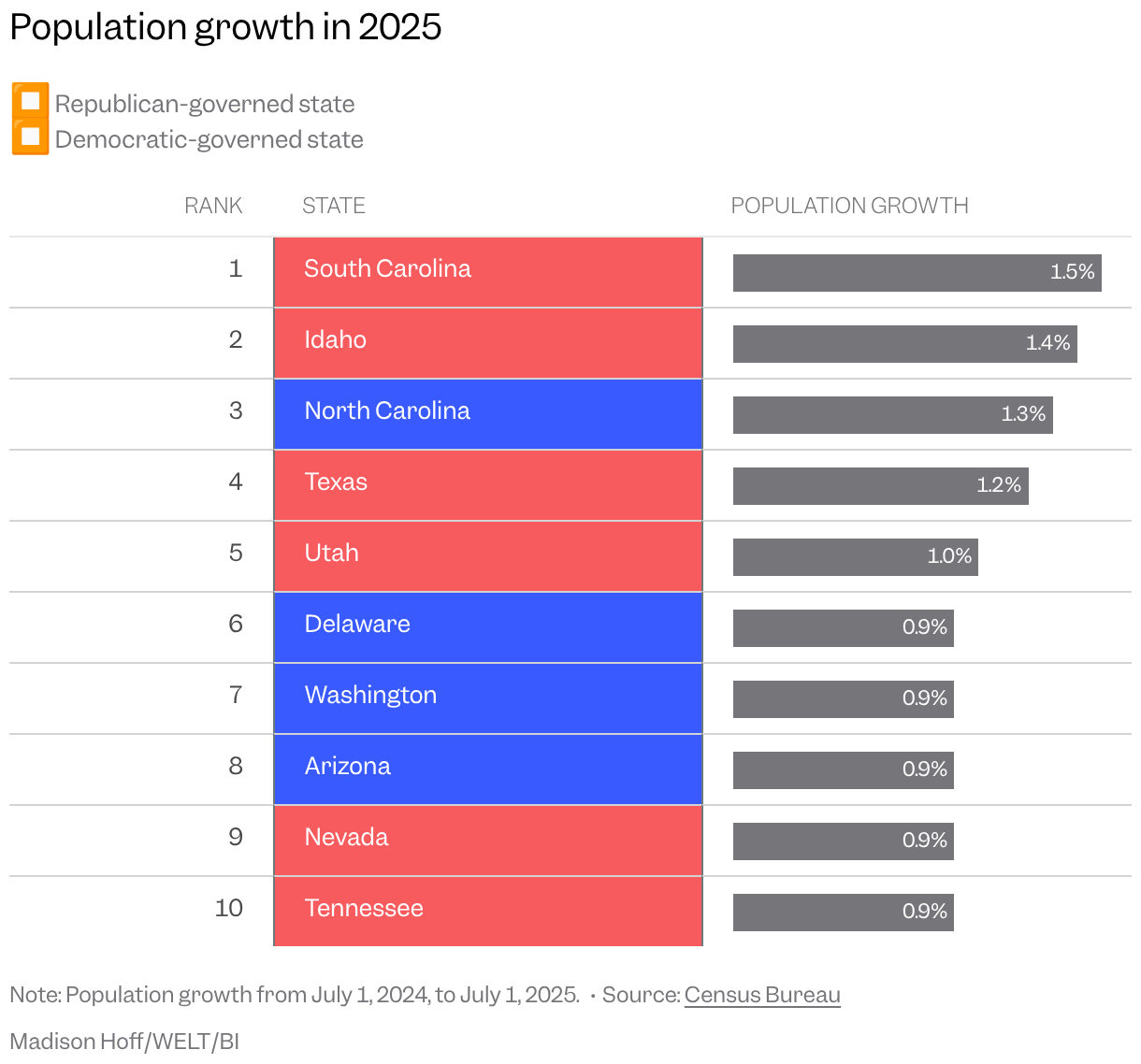
Table of states with the highest population growth from 2024 to 2025

While US GDP as a whole rose by 2.1% last year, Florida and South Carolina recorded gains of just over 3%, according to the Bureau of Economic Analysis — the highest rate of any state. Utah comes in just below that, with Texas also above the national average.

The trend of recent years is clear: While liberal metropolitan regions such as San Francisco, Boston, and New York remain the centers of finance, Big Tech, and research, industry is shifting ever more strongly into the Southern states. Manufacturing firms in particular are increasingly drawn to places where Republicans hold power. According to a report by CBRE, one of the nation’s largest real estate brokerage firms, 725 companies relocated their headquarters between 2018 and 2025. Increasingly, they left high-tax states like California or New York for Republican states like Florida or Texas.
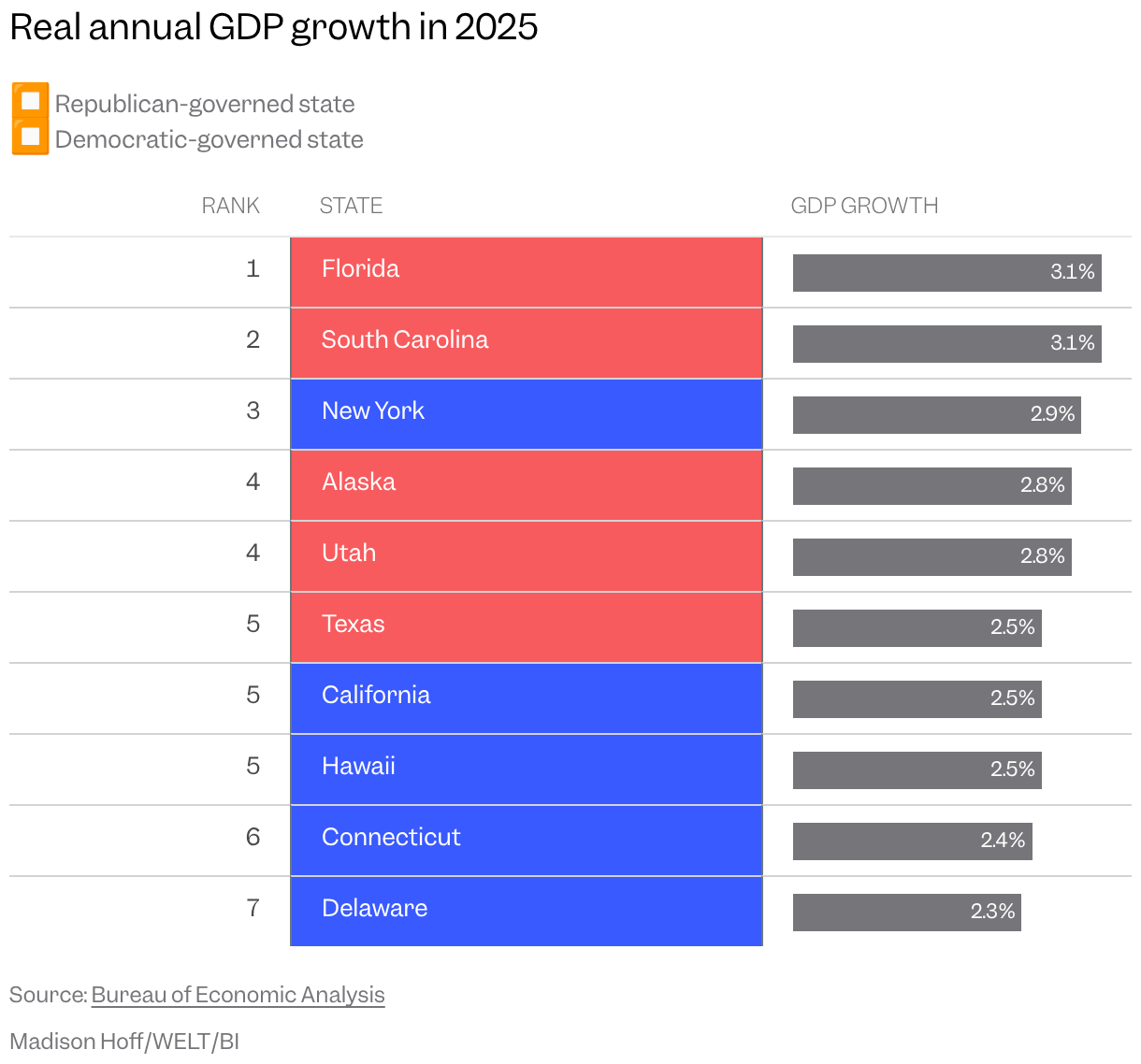
Table of states with the highest real GDP growth from 2024 to 2025

Economies of powerhouse states like New York and California are still growing too, driven above all by the tech boom. But the stronger momentum is currently elsewhere, as the population figures show. While New York’s headcount is stagnating, California has been losing residents for several years — and the list of big-name companies turning their backs on the “Golden State” is growing steadily longer.

South Carolina, by contrast, is currently the nation’s fastest-growing state in percentage terms. Texas, according to the US Census Bureau, is gaining the most residents in absolute numbers: In the past 15 years alone, nearly 7 million people have moved there. Often overlooked, Utah is also buoyed by a young, growing population, while Florida leads the field in immigration from abroad.

Behind these numbers lie millions of individual decisions. Taken together, however, they point to a clear conclusion: in the first year of “Trump 2.0”, it is above all Republican-governed states that are attracting industrial investment and people. There is no shortage of examples.

Take billionaire investor Kenneth Griffin, who — spooked by New York’s mayor Zohran Mamdani’s tax plans — has declared he would rather invest in Miami than in New York. Or the software engineers from Tesla or Oracle who have left overheated Silicon Valley for Austin, drawn by a mix of tech jobs, leafy suburbs, and low income taxes. Or the fast-growing cohort of retirees selling their homes in the Midwest to enjoy the Florida sun. It is the industrial sector in particular that is fueling the upswing in the South, while the former “workbench of America” — the so-called Rust Belt — continues to bleed out.

One of the companies on a growth track is JCB, which operates its largest US plant just outside the port city of Savannah. “Twenty-five years ago, this was just an acre,” Bianco recalls. Today, the factory alone turns out more than 20 excavators a day, and soon that number is expected to rise to 30 — the order books are full. The plant employs 560 workers in production and around 200 in administration.

Its success also has to do with America’s military build-up under Donald Trump. In its commercials, JCB presents itself as a problem-solver that makes heavy equipment for construction sites. But the company has long since moved into the booming military business, which people here euphemistically refer to as “defense”.

Workers assemble JCB machines on a factory production line
Construction and industrial equipment manufacturer JCB in Savannah, Georgia

During the plant visit in Georgia, press officers monitor every step the visitors take and repeatedly urge them not to take photos — the highest level of security applies in the military area. In terms of the US Army, Georgia has another strategic advantage: the state is home to the country’s largest infantry presence, meaning the armed forces, a major client, are effectively on the doorstep.

Republican-governed states tend to have one thing in common: in most cases, they have been traditionally “red” for decades. Especially in Texas and Florida, some politicians see themselves, with pride, as the antithesis to the “blue” coastal metropolises; talk of “blue state bullshit” that they want to keep at arm’s length is commonplace. The relentless culture war that has been raging in the US for years has only intensified since Donald Trump returned to the White House.

In reality, though, the reasons why industrial companies prefer to invest in the Republican South are rather prosaic. Governors and local politicians promise to keep taxes low, limit the rules imposed on business, and fast-track infrastructure projects. In practice, that means fewer requirements, quicker permits, and more projects. Big-name developers who might wait years for a building permit in California or the Northeast encounter municipalities here that actively court investors.

Few examples show this as clearly as the corporate empire Elon Musk has moved from California to Texas. In the southwest of the Lone Star State, SpaceX rockets now shoot into the sky, and the company boasts the highest stock market valuation in history, while just outside the capital, Austin, the world’s richest man has, within a few short years, built an entire “corporate town” around his companies, Tesla, The Boring Company, and X.

Texas is, overall, a special case. The oil and gas business is benefiting from Trump’s policy of giving fossil fuels more room again; at the same time, tech clusters are springing up along the highways around Austin, Dallas, and Houston, where start-ups sit side by side with branch offices of corporations that have shifted activities from expensive coastal regions to the Sun Belt.

Cities like Austin are long past being the cheap alternative for hipsters from San Francisco; they have themselves become pricey metropolises plagued by traffic jams, housing shortages, and rising homelessness numbers. Yet compared with many coastal cities, a house with a garden remains within reach — and above all, the tax burden is lower.

Perhaps the most visible consequence of the investment boom is the construction spree. Around cities like Houston, Miami, or Atlanta, one new suburban development after another is going up. On the outskirts of hubs such as Savannah or Laredo, Texas — the largest freight gateway on the Mexican border — cranes are erecting new logistics centers almost weekly.

On top of this comes a second, hugely capital-intensive trend: the boom in data centers. With space at traditional locations such as the Bay Area or greater Seattle exhausted and expensive, investors have shifted their focus to places where land and energy are cheap, and politics are on their side. Alongside Democratic-run Virginia, that means above all rural regions in states like Texas and Georgia. One key reason: with power supplies tight, some operators are building their own gas plants right next to the data centers. Projects like these are approved far more quickly in Texas than in California.

And there is another reason companies are increasingly turning away from the “Golden State” when making new investment decisions — one that is often glossed over: risk management. What sounds like something out of a Western movie has, in fact, become a major factor in supply-chain planning. In recent years, train robberies on the West Coast have reached shocking levels. At the peak, around 90 containers a day were being looted in the Los Angeles area alone.

“Companies from South Korea, China, or Japan now prefer to send their containers to the Port of Savannah rather than Los Angeles,” says Arthur Hutton, who oversees operations at a recently opened logistics center near the Savannah docks. As Hutton walks through the halls, a major shipment has just arrived: pianos from Japanese manufacturer Yamaha and paper rolls from China. And indeed, evaluations by the US Department of Transportation show that California has lost market share to Atlantic ports — even though the route from Asia is longer and therefore more expensive.

One other reason for the shift in investment that companies don’t mention publicly: Workers are less often unionized in the Southern states. Take the logistics center, dominated by Amazon, in Savannah, for instance: None of the staff is part of any union, Hutton says.

California still boasts the largest economic output of any US state, thanks to Silicon Valley and Hollywood. But alongside Austin in Texas, other states are vying for tech supremacy. One is Utah, governed by Republicans continuously since 1985. The region around Salt Lake City has developed in recent years into a tech hub often referred to as the “Silicon Slopes”. Software firms, start-ups, and service providers leaving the pricey West Coast find here a blend of good pay, relatively modest living costs, and spectacular scenery.

South Carolina, Alabama, and Georgia, meanwhile, stand for the industrial South and have attracted major automotive plants and suppliers in recent years — from Europe, Asia, and other parts of the US. In addition to ports such as Savannah and Charleston, one reason is that unions are less powerful here than in the coastal metropolises — certainly a strong argument in the location decisions of German carmakers like Mercedes and BMW.

While these corporations in Germany are mainly making headlines for job cuts and the car industry at home is in crisis, the US is still seen as a growth market. Mercedes is investing $7 billion in the American market this year alone; BMW is putting in at least $1.7 billion. The “red South” continues to grow — helped along by money from Europe.

This story originally appeared on WELT and is courtesy of the Axel Springer Global Reporters Network, which harnesses the resources of the company’s newsrooms to publish ambitious scoops, investigations, interviews, opinion pieces, and analysis. It allows journalists — including those from POLITICO, Business Insider, WELT, BILD, Onet, and Fakt — to collaborate on major stories for an international audience of hundreds of millions across platforms.

Read the original article on Business Insider

I used Amtrak’s USA Rail Pass to travel to 11 states in 30 days. Here are 6 things I wish I knew before buying it.

Malia sits in a seat on a train with her legs stretched out.
I bought the Amtrak USA Rail Pass, and there are a few things I wish I had known beforehand.
  • I purchased Amtrak’s USA Rail Pass, which allowed me to take 10 trips for $499.
  • Although I thought the pass was a great value, there are a few things I wish I knew ahead of time.
  • For example, long trips provide the best value, but sleeper-car upgrades aren’t available.

I took my first long train ride when I was 18, heading upstate from New York City. I can still remember the view of the gold, rust, and deep-red leaves out the window.

I grew up in Hawaii, where there are no trains or fall foliage, so the experience felt completely new to me. That trip stayed with me, and now, I try to travel by train whenever possible.

Last year, I traveled through the East Coast and Midwest by rail, and by the time I reached Chicago, I finally decided to give Amtrak’s $499 USA Rail Pass a try.

With 10 rides to use within 30 days, I traveled through 11 states in a single month. Here are eight things I wish I knew before buying the pass.

Long trips provide the best value

Train tracks and highways with mountains in the background.
When using the USA Rail Pass, I like to book long trips to get the most value for my money.

The pass allows riders to book 10 “segments” on almost any Amtrak route. A segment refers to one time that you board and disembark, regardless of the distance traveled.

In other words, a short regional train counts the same as a multi-day route that crosses several states. So, I learned I was better off booking long trips to really get my money’s worth.

However, if a trip requires a transfer, that counts as two segments, so choosing the most direct route helps to stretch the pass further.

Plus, long rides in coach can often run passengers hundreds of dollars if booked individually, so even a few rides might cover the cost of the pass.

Sleeper-car upgrades aren’t available when using the pass

I’ll be honest — there have been times when I wished I had a private room so I could stretch out or have a little more privacy on the train.

But one of the tradeoffs with the USA Rail Pass is that I’m placed in a coach seat for every segment and don’t have the option to upgrade to a sleeper car.

Luckily, the seats on Amtrak (which are typically about 23 inches wide) recline, have a decent amount of legroom, and are generally quite comfortable. However, the only downside is they don’t lie flat.

So, when going on multiple long-distance trips with the pass, I recommend taking a break between rides to stay at a hotel.

I can save money by packing my own snacks

An assortment of snacks from Trader Joe's on the tray table of a train.
I come prepared with lots of snacks.

Dining-car meals are included for passengers traveling in roomettes and sleeper cars, but unfortunately, they are not included for coach passengers traveling with the USA Rail Pass.

Although I can sometimes request a dining-car reservation if there’s space, it’s first-come-first-served and can fill up quickly. Plus, the additional cost adds up quickly.

As a coach passenger, I do get access to the café car, which serves coffee, snacks, sodas, salads, and a few reheated items like breakfast sandwiches or mac and cheese.

However, I usually pack my own food to keep costs down. Although the staff cannot reheat or refrigerate anything for me, they sometimes give me hot water if I ask nicely.

So, I bring things like powdered soups, oatmeal packets, tea, and snacks that keep well at room temperature.

Even though the baggage policy is generous, it’s important to pack light and keep essentials on hand

A sign explaining Amtrak's baggage policy in a train station.
All passengers can bring two carry-ons and a personal item with them.

All passengers, regardless of ticket type or class, can bring two carry-ons and a personal item with them on the train. However, I recommend packing light to allow yourself enough time to get on and off the train quickly.

In order to keep myself organized, I also like to pack a smaller bag in my carry-on that includes anything I’ll want easy access to during the trip.

For example, I carry extra layers of clothing in case I get cold, a neck pillow, a light blanket, earphones, an eye mask, earplugs, and hygiene products.

The WiFi isn’t always reliable

While on long-distance routes, I’ve noticed that Amtrak’s WiFi often becomes unavailable. I’ve sometimes been able to use my phone’s hotspot, but even so, I’ve encountered long stretches without any cell service at all.

Now that I’m a seasoned traveler, I like to plan ahead by downloading movies, music, books, or maps before my trip.

However, I’ve also found that train travel is a good excuse to disconnect. I like to journal or sketch, write a postcard to a loved one, or simply daydream.

The Sightseer Lounge offers the best views

The sightseer car on an Amtrak train at sunset.
I love spending time in the Sightseer Lounge.

Certain trains come equipped with a Sightseer Lounge, which offers beautiful views of the country from large windows. The louge, which includes a mixture of booths, single, and double chairs, is my favorite spot on any train that has one.

As a frequent traveler, I’ve seen the glow of golden hour over a field of wheat, the soft rise of mountain ranges, and canyons filled with rivers and patches of fall color.

In my opinion, sights like these are what make rail travel truly special.

This story was originally published on February 4, 2026, and most recently updated on June 11, 2026.

Read the original article on Business Insider

Jeff Bezos says AI is like a knife that can be used for good or bad, and the solution isn’t ‘no more data centers’

Jeff Bezos speaks during an event
Amazon founder Jeff Bezos is becoming a CEO for the first time since stepping down from his post at Amazon in 2021. He is co-CEO of Prometheus, a physical AI startup.
  • Jeff Bezos said “government regulation has a lot of reasonable purposes.”
  • When it comes to AI, Bezos said regulators have to be careful not to go too far.
  • The Amazon founder used the analogy of outlawing knives just “because it can be used in a bad way.”

The way Jeff Bezos sees it, AI and the data centers that support the novel technology are like knives.

“You don’t want to accidentally outlaw the knife because it can be used in a bad way,” the Amazon cofounder said on CNBC on Thursday.

“Knives are important tools and yes, every once in a while they get misused by someone, but you don’t say the solution to that isn’t to say, ‘OK, no more data centers, right? No more knives.’ That’s not a smart approach to regulation.”

Bezos said that government regulation has a lot of “reasonable” purposes, pointing to federal regulatory agencies like the FAA and the FDA ensuring public safety when people board planes or take prescription drugs.

“There’s lots to be said for healthy government regulation to improve safety and products and so on,” he said. “And I don’t see why that won’t be applied at some point to the kinds of new tools that are being built by AI.”

The balance, Bezos said, is not going too far.

“You want to regulate the application level,” he added.

Bezos, in addition to advising Amazon on AI as executive chairman, is taking on his first CEO role since stepping down from his post as Amazon’s CEO in 2021. Bezos is serving as co-CEO of Prometheus, a physical AI startup that he launched with Vikram “Vik” Bajaj, who helped create Google’s life sciences company, Verily. Prometheus raised $12 billion in a Series B round.

“That is a big chunk of the funding we’ve raised,” he said. “And one of the reasons we’ve had to raise a significant amount of funding is because what we’re doing is very compute intensive.”

Addressing speculation about what Prometheus will do, Bezos said the startup is not building robots. Instead, the company wants to build AI models that change the future of engineering and manufacturing, ultimately achieving Bezos’ goal of creating an “artificial general engineer.”

“It’s really a set of tools that will give those engineers the ability to turn their dreams into reality much, much more quickly than is possible,” said Bajaj, who was interviewed alongside Bezos.

AI regulation is top of mind

The debate around AI regulation has heated up in the last year amid wider backlash against the technology. Meanwhile, AI companies are spending big on lobbying efforts as various states weigh potential regulations.

President Donald Trump recently signed an executive order that allows frontier AI model makers to voluntarily submit models for federal review up to 30 days before their public release.

On Wednesday, Trump said he expects leading AI companies to agree to “giving back” to the public, a reference that came after news outlet NOTUS reported that the White House is considering whether the US government should hold equity in AI firms.

Bezos did not directly address Trump’s order, nor did Anthropic CEO Dario Amodei, who on Wednesday suggested that “models above a threshold of compute” should undergo mandatory third-party testing by the government or private organizations. Amodei also wrote in an essay that the government should have the power to block the release of AI models if such testing showed they would “present unacceptable risks.”

Read the original article on Business Insider

$9 billion startup Tanium had a leadership shake-up after losing 5 top execs

Orion Hindawi, cofounder and executive chariman of Tanium
Orion Hindawi, cofounder and executive chairman of Tanium.
  • Tanium, a $9 billion cybersecurity startup, lost five top executives.
  • Tanium’s legal, people, marketing, and information security chiefs departed.
  • Tanium’s IPO plans remain uncertain, and the company has stayed private since its founding in 2007.

The cybersecurity startup Tanium, which was last valued at $9 billion, recently underwent a leadership reshuffle after losing five top executives.

Tanium, based in the Seattle area, was founded in 2007 and has stayed private since then. It has raised nearly $1 billion, according to PitchBook, and is backed by investors such as Andreessen Horowitz, TPG, and Salesforce Ventures.

Tanium hired its chief financial officer, Marc Levine, in 2021 to conduct a “readiness assessment” for an initial public offering. Several employees and executives had left Tanium in the past few years over uncertainty about whether the company would ever go public, Business Insider previously reported.

The departures mark another period of uncertainty for one of tech’s longest-running IPO candidates. Now, with several senior leaders gone and new executives cycling into key legal, people, and strategy roles, the company faces fresh questions about its next chapter and whether an IPO is still part of it.

Tanium’s chief legal officer Brady Mickelsen, chief people officer Tobias Julén, and chief information security officer Chris Hallenbeck left the company in May, according to their LinkedIn profiles. Mickelsen now has the same role at DigitalOcean, and Julén now works at StillFront as chief human resources officer.

Tanium’s chief marketing officer, Tara Ryan, no longer appears on the company website. She and Mickelsen were listed on the website in early June, according to the Wayback Machine. Ryan did not respond to a request for comment.

Tanium also brought on a new chief people officer, Carol MacKinlay, who was hired in April and has since resigned.

MacKinlay says she resigned due to a sudden issue with her family.

“I feel sorry that I left them in a lurch, but family has to come first. Great company with a great trajectory, and I wish them the best,” she said.

Since then, Russ Evans has been promoted to chief legal officer, and Shannon Rosales Mirani is the interim chief people officer. Paul Black also joined as the chief information security officer in May. The website does not list a chief marketing officer.

In May, Tanium also promoted Ben Stein, previously senior vice president of global operations, to chief strategy officer.

“Like all responsible companies, Tanium continues to adapt our approach, as well as our team, to best serve our customers and partners,” a Tanium spokesperson said. “We will continue to evolve to meet the needs of our constituents — and best serve them at a time when they need us most. We are confident in our experienced team at the helm, our momentum, and our ability to continue driving innovation and value for our customers and partners.”

Last year, Tanium cracked down on its return-to-office policy in an unusual way by withholding some equity grants from employees who don’t comply, Business Insider previously reported.

Have a tip? Contact this reporter via email at rmchan@businessinsider.com, or Signal at rosal.13. Use a personal email address, a nonwork WiFi network, and a nonwork device; here’s our guide to sharing information securely.

Read the original article on Business Insider

Paramount is reshuffling streaming teams as David Ellison’s tech vision comes into focus

Paramount Ellison Pluto
Paramount Skydance CEO David Ellison has prioritized putting streaming services on one tech platform.
  • Paramount is about to change some staffers’ assignments as it unifies its streaming platforms.
  • The company is bringing together Paramount+ and Pluto TV to be more efficient.
  • CEO David Ellison has prioritized tech ahead of a planned merger with Warner Bros. Discovery.

Paramount Skydance is preparing to move around some streaming staffers as David Ellison’s company wraps up its long-term project of unifying the tech platforms of Paramount+ and free streamer Pluto TV.

This so-called “convergence” project has been a top priority for Paramount. Two high-level streaming employees recently said that convergence is on pace to meet the company’s stated goal of a “mid-year launch.” While Paramount is planning to keep Paramount+ and Pluto TV as separate services, the hope is that having a single tech platform will save resources and improve recommendations across each app, which could drive higher engagement.

Once convergence is complete, Paramount is planning to reassign staffers who’ve worked on it, streaming leaders told employees during a quarterly meeting on Wednesday morning.

Paramount said it will “organize our teams against thematic pillars” like monetization, content, and live & video, according to a screenshot of the presentation viewed by Business Insider.

Streaming staffers also learned that some employees “will be utilized to create select additional Solutions Teams” focused on advertising formats, user experience for the short-form video feed on Paramount+, and video playback.

A person familiar with Paramount’s streaming strategy said these changes are about “redeploying” product employees after convergence is finished. They said most streaming staff won’t be affected by these changes and that no associated layoffs were planned.

Boosting tech beyond convergence

Since Ellison became Paramount’s CEO in August, the company has prioritized technology by shaking up teams, making key hires, and adding new streaming features.

Paramount merged some technical streaming teams in March, Business Insider reported. The company said that putting the Paramount+ Global Quality Engineering group and Pluto TV’s Software Test Engineering team under one roof helped facilitate “AI enablement and automated testing.”

Ellison’s company has also emphasized data by expanding the role of EVP Jason Kim, who, since January, has overseen data and insights across all of Paramount, not just streaming.

Paramount has made several key hires. They include former Google AI executive Barak Turovsky as head of consumer AI; fellow former Google executive Hugh Williams as an EVP; and former Amazon ad sales leader Danielle Carney as head of its US ad sales group. Ellison has also brought over product chief Dane Glasgow from Meta and revenue chief Jay Askinasi from Roku.

Paramount has had key departures as well, including former tech chief Phil Wiser in May and former head of streaming product and tech Vibol Hou in January.

Besides marrying the tech stacks of Paramount+ and Pluto TV, Paramount hopes to boost streaming engagement by adding vertical video clips and interactive features, such as a shopping tool. The company is exploring adding video podcasts; rival Netflix recently made a major move into licensed podcasts.

Paramount’s most transformative change would be buying Warner Bros. Discovery, which would give it control of the Warner Bros. Studio, HBO, HBO Max, and cable networks like CNN. The merger still needs regulatory approval in the US and abroad, which the company hopes to get by the end of September.

Read the original article on Business Insider

These are the unique routes airlines added for North America’s World Cup

The Spanish national team players and their coach, Luis de la Fuente, before catching their flight to the World Cup.
Teams from 48 countries will compete for the World Cup title from June 11 to July 19.
  • Airlines are adding seats, larger aircraft, and new routes to help fans get to World Cup matches.
  • Surinam Airways is running an eight-hour, multi-stop trek across the Caribbean to Miami.
  • African airlines are timing all-new US route launches with the World Cup travel boom.

At least 5 million people are expected to fly across North America for the 2026 FIFA World Cup this summer, triggering a surge in short-haul and international air travel across 16 host cities in the United States, Canada, and Mexico.

With fans planning multi-city itineraries to follow their teams, carriers across the globe are adding seats, flying larger-than-usual planes, and launching new nonstop services to support the boom:

  • Colombia’s Avianca will run the only nonstop flight between Guatemala City and San Francisco.
  • Suriname Airways is running special flights to Miami that hop across the Caribbean.
  • Brazil’s GOL Linhas Aéreas is boosting flights to Florida by about 70%.
  • United and American added temporary routes to Kansas City for the quarterfinals.

The World Cup bump is modest in the context of the broader US airline system, which routinely flies millions of seats each week.

United Airlines’ CEO Scott Kirby recently called it a small portion of the overall booming summer travel season. It’s also possible that some regular leisure tourists who would otherwise travel may skip host cities during the games.

Still, IATA data shows bookings to most host cities rising 2%-8% year over year between June and July, with airlines preparing for a concentrated influx of travelers around marquee games featuring favorites like Spain and France.

As the tournament’s “Official North American Airline Supplier,” American Airlines said it’s adding 27,000 seats on 12 routes for the games, including two temporary ones from Atlanta and New York’s LaGuardia Airport to Kansas City for the quarterfinal round in July.

It’s also temporarily swapping some regional jets for larger Airbus and Boeing narrowbodies to carry more people.

United Airlines launched a special World Cup portal that includes special routes between Guadalajara, Mexico, and Chicago, and between Los Angeles and Kansas City, while Delta Air Lines has bolstered capacity to host cities.

World Cup team fans stand outside a stadium.
Fans are spending thousands of dollars to travel to the World Cup.

Several international airlines are also adjusting or launching new long-haul services ahead of the games. Scandinavian Airlines and SWISS, for example, are ramping up frequencies to host cities.

Surinam Airways will operate three special eight-hour treks from the South American nation of Suriname to Miami in June, with two stops along the way to pick up people in Aruba and Curaçao; Curaçao’s team qualified. Tickets start at about $440 one-way.

GOL is adding hundreds of flights to Orlando and Miami during the tournament, where travelers can connect to matches through its codeshare partnership with American. Some flights are pricey: flights from Manaus, in northwestern Brazil, to Miami in the days before the team’s June 24 game there start at $765 one-way.

LATAM Brasil is also adding capacity around Brazil’s match schedule; the national team is the most successful in World Cup history, with five titles.

Colombia’s Avianca is adding some 3,000 flights to host cities to support the World Cup traffic. It’s also increasing frequencies on its Los Angeles routes from both Guatemala City and San Salvador. Colombia is one of South America’s top teams, and narrowly lost the 2024 Copa America to Argentina.

Morocco’s Royal Air Maroc is operating special flights to New York, Atlanta, and Boston for its team’s matches. Round-trip flights start around $1,000.

New and returning routes from Africa

In some cases, new flights are not launched explicitly for the World Cup, but the tournament coincides with already-strong demand on diaspora-heavy routes and a broader surge in travel to host cities.

The national airline of the small West African nation of Cabo Verde, for example, resumed nonstop flights to Rhode Island on May 4 after an eight-year hiatus — a month before its national team arrived in the US for its first-ever World Cup appearance.

The unique route, which is also the only link to the US for the 500,000 Cape Verdeans, is scheduled to continue beyond the tournament.

Cabo Verde player signs flag.
Cabo Verde’s opening matches are in Atlanta, Miami, and Houston.

Similarly, EgyptAir added a new route from Cairo to Los Angeles in May, a nearly 14-hour flight, and Morocco’s Royal Air Maroc launched a new 12-hour nonstop from Casablanca to Los Angeles on Sunday.

It’s the first time Africa has been connected nonstop to the US West Coast, meaning passengers can finally skip the long layovers in Asia or Europe.

This effectively extends the continent’s reach into North America ahead of the World Cup and, in the long term, benefits diaspora communities, business, and tourism.

The World Cup is taking place against a backdrop of sky-high oil prices, with airfares rising an estimated 20% in recent months.

Argentina’s national airline even canceled some planned World Cup service because of fuel prices and lower-than-expected demand driven by expensive match tickets.

The tournament is also facing immigration restrictions that denied a referee and some team staff entry to the US.

Read the original article on Business Insider