Saks owes hundreds of millions to luxury brands from Chanel to Burberry

A person enters the Saks Fifth Avenue department store in New York on January 13, 2026.
  • Saks Global’s Chapter 11 filing reveals that it owes hundreds of millions to big-name brands.
  • Major unsecured creditors include Chanel, LVMH and Christian Louboutin, and Burberry.
  • Google and Meta are also among the list of unsecured creditors.

Saks Global has filed for Chapter 11 bankruptcy protection — and court filings reveal that the luxury retailer owes hundreds of millions of dollars to some of the fashion industry’s biggest names.

The question is, will they get paid?

In US bankruptcy proceedings, unsecured creditors generally stand at the end of the line for repayment, behind secured creditors and lenders.

“There will be a lot of hardship for those brands,” Gary Wassner, the CEO of Hilldun Corp., which acts as a guarantor or insurer for brands, told Business Insider about independent designers who aren’t part of a big conglomerate or use factoring firms, like Hilldun.

Saks Global, which owns Saks Fifth Avenue, Neiman Marcus, and Bergdorf Goodman, said in a statement on Wednesday that it expects to pay for future goods shipped as it restructures its debts.

Fashion industry experts, meanwhile, have told Business Insider that brands big and small are likely to keep doing business with Saks Global because they need the retailer and have few alternatives.

“In some cases, smaller brands, 40% or 50% of their business is done with Saks Global, so you can imagine what it’s doing to those companies,” said Wassner, whose firm represents about 140 brands that sell to Saks.

Documents filed by Saks Global in federal Texas bankruptcy court show the retailer owes its 30 largest unsecured creditors more than $700 million. Below is a breakdown of how much Saks Global owes some of its largest luxury suppliers, according to the retailer’s bankruptcy court filings.

Chanel Limited is owed just over $136 million
A model (Bag detail) walks the runway during the Chanel show as part of the Paris Fashion Week
A model walks the runway during the Chanel show as part of the Paris Fashion Week
Kering SA, owner of brands such as Gucci and Balenciaga, is due about $60 million
Gucci leather bag.
Gucci leather bag.
Capri Holdings Limited, owner of Jimmy Choo and Michael Kors, is owed $33.3 million
Designer Michael Kors on the runway during the Michael Kors Spring/Summer 2026 collection show.
Mayhoola LLC, which owns 70% of Valentino, is due $33.2 million
Actress Guan Xiaotong attends Valentino event on November 15, 2024 in Shanghai, China.
Zegna owner Ermenegildo Zegna N.V. is owed roughly $26.3 million
Zegna store.
Zegna store front
LVMH, owner of Louis Vuitton, Dior, Fendi, and Marc Jacobs, is due about $26 million
Louis Vuitton store.
Cartier owner Compagnie Financière Richemont SA is owed about $30 million
Cartier watch
Diane Batoukina wears a watch by Cartier on December 04, 2025 in Paris, France.
Christian Louboutin is due about $21.5 million
Christian Louboutin shoes
The Estée Lauder Companies Inc. is owed roughly $16 million
Estée Lauder store
Estée Lauder store
David Yurman, Inc. is due about $11.4 million
David Yurman jewelry.
A view of the Sculpted Cable Collection during the David Yurman event in NYC on April 25, 2024.
Giorgio Armani SpA is owed $10.7 million
Emporio Armani store.
Burberry Group plc is due about $9.5 million
Jade Thirlwall attends the Burberry show during London Fashion Week September 2024.
Dolce & Gabbana Srl is owed $9.1 million
Dolce Gabbana shoes.
Dolce & Gabbana shop on June 23, 2025 in Madrid, Spain.
Tech giants are also owed too, with Google at $9.6 million and Meta Platforms, Inc. at about $12 million
Revolving doors at Google's office in London
The Google office in Pancras Square, London, England, United Kingdom, on December 26, 2025.
Read the original article on Business Insider

California’s Attorney General is investigating Grok’s sexualized deepfakes

Rob Bonta speaks during a news conference
California Attorney General Rob Bonta said there was an “avalanche of reports detailing the non-consensual, sexually explicit material that xAI has produced.”
  • Elon Musk’s xAI is now the subject of an investigation by the California Attorney General.
  • Attorney General Rob Bonta is investigating reports that Grok is generating nonconsensual sexualized images of real people.
  • Regulators around the world have pressed xAI over the instances.

Elon Musk’s xAI is now facing pressure from US regulators over Grok’s generation of nonconsensual sexualized images of real people.

On Wednesday, California Attorney General Rob Bonta announced that his office was investigating the numerous reports of such images.

“The avalanche of reports detailing the non-consensual, sexually explicit material that xAI has produced and posted online in recent weeks is shocking,” Bonta said in a statement. “This material, which depicts women and children in nude and sexually explicit situations, has been used to harass people across the internet. I urge xAI to take immediate action to ensure this goes no further.”

The news comes after officials in India, the UK, Indonesia, and Malaysia have taken their own varying actions against Grok. Indonesia and Malaysia went so far as to block access to Grok.

Ofcom, the UK’s communications regulator, announced its investigation earlier this week. Prime Minister Keir Starmer previously told lawmakers that X could “lose the right to self-regulate.”

In response to Business Insider’s request for comment about Bonta’s probe, xAI replied, “Legacy Media Lies.” Musk’s AI company frequently responds to media requests with that line.

Amid the backlash, xAI limited access to Grok’s image generation to paying subscribers.

Earlier Wednesday, Musk said he was unaware of “any naked underage images generated by Grok.” Musk had previously said anyone asking Grok to make illegal content “will suffer the same consequences as if they upload illegal content.”

“Obviously, Grok does not spontaneously generate images, it does so only according to user requests,” Musk wrote on X. “When asked to generate images, it will refuse to produce anything illegal, as the operating principle for Grok is to obey the laws of any given country or state.”

Musk’s statement belies many of the instances that regulators were looking into. Namely, the investigations were sparked by concerns about users asking Grok to sexualize images, such as depicting a person in a bikini when the original photo did not show them in such a state of dress.

The US Senate unanimously passed a bill via voice vote on Tuesday that would give victims a federal civil right to sue users who ask AI to create such images. The text of legislation, called “The Defiance Act,” mentions the digital manipulation of a photo to “remove the clothing of the individual so that the person appears to be nude.”

Sen. Richard Durbin, an Illinois Democrat, who wrote the bill, said it was aimed at stopping instances like the Grok images.

“Recent reports showed that X, formerly Twitter, can ask its AI chatbot Grok to undress women and underage girls in photos,” Durbin said on the Senate floor. “Grok will comply to show various states of undress with images I won’t repeat for the record, but they’re horrible.”

It is unclear if the bill will receive a vote in the House.

Last year, President Donald Trump signed bipartisan legislation into law that requires social media platforms to remove non-consensual photos, as well as AI deepfakes, within 48 hours of receiving a request to do so.

Read the original article on Business Insider

Interior designers share the 9 biggest mistakes people make when decorating a living room — and how to avoid them

Living room with gray couch on edge of beige rug, ceiling fan, overhead lighting
A few simple design mistakes could be ruining the look of your living room.
  • Interior designers told us the top mistakes people make when styling and decorating a living room.
  • They said it’s important to have enough lighting and surfaces within the space.
  • Try to avoid mounting your TV too high above a fireplace and pushing your couch against a wall.

Even if your living room is pretty great, a few small details could be preventing it from looking even better.

To find out what mistakes we should be avoiding when styling these spaces, Business Insider spoke to several interior designers.

Here’s what they said could be sabotaging the look of your living room.

Buying a rug that is too big or too small for your living room can disrupt the entire space.
Leather couch on floor with small round rug under one leg
A rug that’s too small can look odd.

Gena Kirk, the vice president of design at KB Home, told BI that it’s important to ensure that a rug does more than just work within the design scheme of your home — it also needs to fit the room you intend to use it in.

“A rug that is too large will look overwhelming in the space and can make the room appear smaller,” she said. “A rug that is too small forces your furniture to be closer together, leaving the room feeling unbalanced and [creating] the feeling of wasted empty space.”

Kirk recommended using painter’s tape and taking exact measurements of the area rugs you’re considering to create mock outlines on your floor.

This way, you can envision how the rug might look in your space.

Having your couch up against a wall could be making the space look smaller.
Living room with round coffee table, blue couch
In some living rooms, it makes sense to have a couch or chair pulled away from a wall.

Lauren White, the owner and principal designer of Ellen W. Interior Concepts, told BI that instead of placing your sofa up against the wall, you should consider “floating” it.

“Floating furniture means that you place pieces off the wall, sometimes in the middle of the room,” she said. “When you do this in your living room, it makes the room feel and look larger because you will be able to walk around it.”

Though this won’t work for all spaces — especially smaller ones with limited options for furniture placement — it’s worth trying.

Using pieces of furniture that are too “matchy-matchy” could make your home look like a showroom.
Living room with light wood. floor, matching couch and chairs
Too much matching furniture can look a bit inauthentic.

Walk into a furniture showroom, and you’re likely to find that almost everything is sold in sets — including living-room furniture.

“The easiest thing would be to purchase an entire set, but don’t do it,” White said. “A space that looks too ‘matchy-matchy’ isn’t a good thing.”

Using separate pieces instead of sets can make your space look “curated,” she said, which “elevates the style in your home.” 

Mounting your television too high up is impractical.
TV mounted above fireplace on stone with built-in shelving on either side
Televisions don’t always belong above fireplaces.

Design is more than having a home that looks pretty — you should also be taking ergonomics into account.

“I know that placing your TV over the fireplace is the ‘it’ thing to do, but it does a huge disservice to your neck,” White said.

“Your TV should be eye-level to where you are sitting,” she said. “You should not have to look up.”

Not prioritizing comfort could be making your living room feel cold.
modern living room

You shouldn’t sacrifice comfort for style — and, if you do, your space might feel a bit unwelcoming or even sterile.

“Comfortability is one of the biggest factors that make a living room,” Sonja Rasula, a former interior designer on HGTV’s “Home to Go” who founded Unique Markets in Los Angeles, told BI.

Choose a couch that’s actually great to lounge on, a rug that’s soft enough to enjoy barefoot, and definitely add some comfortable touches to your space.

“Even if you are balling on a budget, adding a cozy blanket or a few plush pillows will make all the difference,” she added.

Without multiple light sources, your space could be lacking a cozy ambiance.
Living room with chandelier, tv mounted over fireplace, beige couch
One overhead chandelier isn’t enough to properly, cozily light a whole living room.

Living rooms are multifunctional, and your lighting choices should reflect that, Sara Ray, an interior designer based in Nashville, told BI.

“There should be overhead lighting on a dimmer that can be used to move throughout the space or dimmed to provide the right ambiance for a party,” she said. “You want to have plenty of secondary lighting so that tasks like reading can be done while sitting in the space.”

She suggested placing accent lighting on bookshelves, on a fireplace mantel, or above artwork to create layers of lighting in your living room.

Choosing furniture that’s too big or too small for your space can make the whole room feel off.
living room big furniture

Picking out the right furniture is important, but where you put it is equally essential to designing a living room.

“Large pieces in a small space can make the room look even smaller, where small pieces in a large space can leave too much empty space,” Rasula told BI.

For larger living rooms, she recommends leaving 30 to 36 inches of space between furniture pieces. In smaller spaces, like apartments, you can probably get away with 18 to 24 inches between pieces.

“This amount of distance will ensure you’re not overcrowding your living room while at the same time will help maximize space for a smaller living room,” she said.

Although you should utilize any shelving you have, you don’t want to pack them with large items.
living room clutter shelves

Whether you’ve got great built-ins or have added bookshelves or ledges to your living room, you’ll want to be careful when filling them up.

“You should utilize shelving space as much as possible, but try and avoid overhang, which could cause the space to look overcrowded,” she told BI.

She explained that overhang occurs when items are too large for the shelf or bookcase, causing them to stick out over the ledge. 

Not having enough tables and other surfaces to set your things on can be impractical.
living room sparse fireplace

Since a living room is often well-trafficked, you should probably have ample places to set down your drinks, books, and other items, Ray told BI.

“To create a functional living room, you should have a surface that you can easily reach from wherever you’re sitting,” she said. 

Consider including at least one or two side tables and a coffee table in your space — plus more surfaces if you’ve got the room.

This story was originally published in November 2019 and most recently updated on January 14, 2025.

Read the original article on Business Insider

Tesla’s EV market share soars in the US as rivals struggle without government help

The cab to a Ford all-electric F-150 Lightning truck prototype is seen on an automated guided vehicle (AGV) at the Rouge Electric Vehicle Center in Dearborn, Michigan September 16, 2021.
The cab to a Ford all-electric F-150 Lightning truck prototype is seen on an automated guided vehicle (AGV) at the Rouge Electric Vehicle Center in Dearborn, Michigan back in 2021.
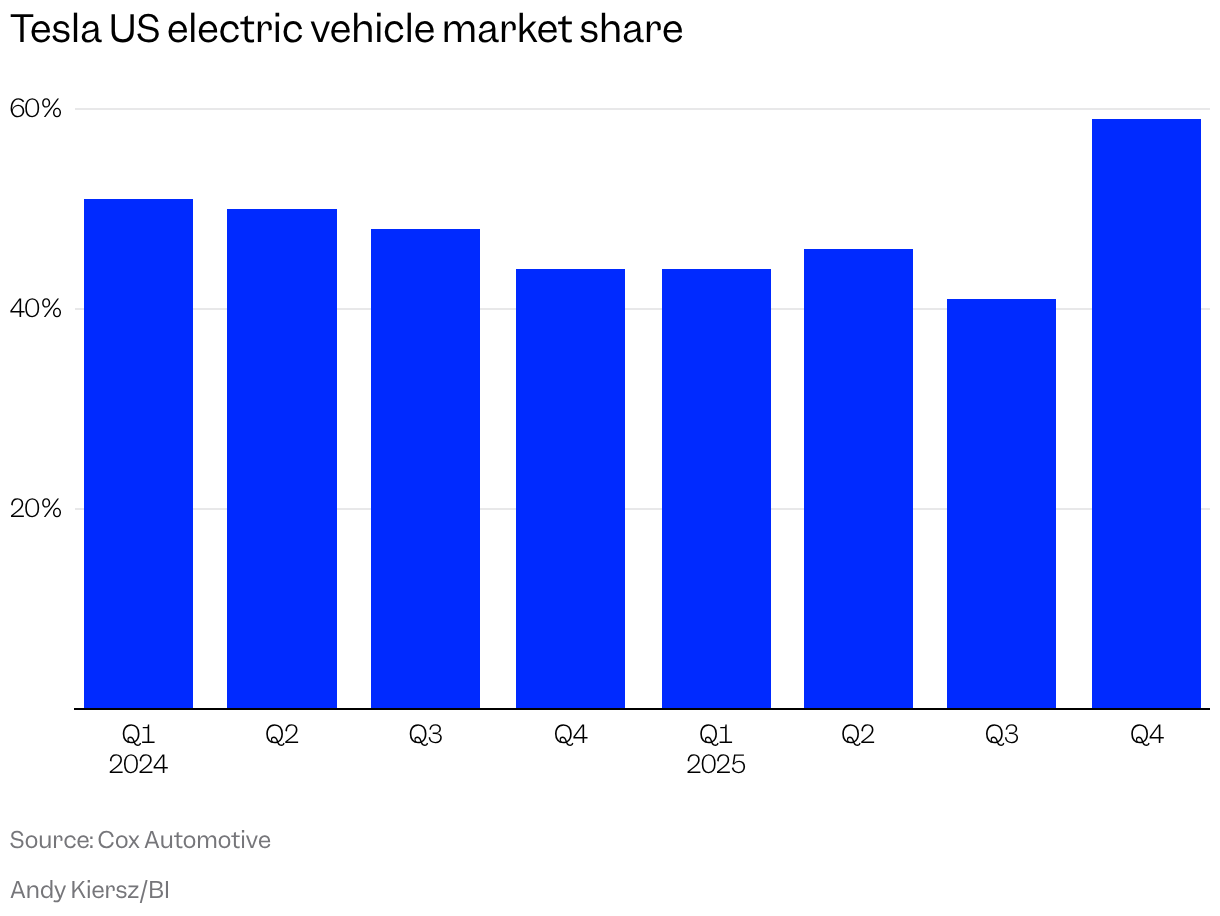
  • Tesla leads the US electric vehicle market with a 59% share, after the end of federal incentives.
  • Ford, Rivian, and General Motors struggle with low EV market share and profitability issues.
  • Several automakers scaled back or halted US EV plans due to high costs and low sales volume.

Federal incentives for electric vehicles disappeared at the end of the third quarter, leaving the US market to survive on its own merits.

So, how did companies perform in this new, realistic environment?

Cox Automotive, an industry data provider, has just released EV sales estimates for the fourth quarter on Tuesday, and the numbers reveal which companies thrive and which struggle without government assistance.

Tesla once again dominates the EV market in the US. Its market share surged to 59% in Q4, up from 41% in the previous quarter, Cox data shows.

Column Chart

One major reason is that EV companies in the US now have to make the numbers work without government help. A significant part of the equation is volume.

Despite a decline in sales recently, Tesla still sold 138,000 EVs in the US during the fourth quarter. That type of volume helps the company maintain relatively low prices while still making money.

Most rivals don’t have that volume, and their EV manufacturing operations just aren’t as efficient as Tesla’s because they still make other types of cars, which have way more parts than EVs. This can make them more expensive to manufacture and can lead to big losses.

“In the volume-driven business of automotive manufacturing, low volume is the enemy; EV profitability remains a distant dream for nearly every automaker,” Cox warned last year as federal incentives ended.

Ford’s EV market share was measly 6% in the fourth quarter, while Rivian’s stood at just 4%.

General Motors is performing somewhat better, with a market share of over 10%. Even here, the math just doesn’t add up. General Motors took $6 billion in fourth-quarter charges tied to scaling back EV plans in the US.

In December, Ford abandoned large EVs because it couldn’t make a profit on them. The company took a $20 billion write-down on its failing EV business. Rivian still loses a lot of money, although its cheaper R2 EV might improve things later this year.

In July, Mercedes stopped taking EV orders in the US. Stellantis recently shelved some of its EV plans, along with Porsche and Honda. Even Ferrari, which has juicy profit margins, dialed down its EV plans.

If EV operations can’t reach high-volume scale, they risk constantly losing money. At some point, they have to stop the bleeding. When incentives ended in the US, many players decided to give up.

Tesla remains the exception in the US. It’s proving that, in this industry, volume equals survival.

Sign up for BI’s Tech Memo newsletter here. Reach out to me via email at abarr@businessinsider.com.

Read the original article on Business Insider

The 10 highest-grossing actors at the global box office

Zoe Saldana with motion capture makeup on
Zoe Saldaña doing a motion-capture performance to play Neytiri in “Avatar: Fire & Ash.”
  • Stars like Tom Cruise, Robert Downey Jr., and Scarlett Johansson have brought in billions at the global box office.
  • The highest-grossing actors all starred in at least one major franchise.
  • See which actor is No. 1 on the list.

The actors who make the most money at the worldwide box office all have one thing in common: longevity.

Actors like Tom Cruise and Robert Downey Jr. have reinvented themselves over the decades, morphing from self-serious actors to major box office draws. Others like Scarlett Johansson and Zoe Saldaña may not have been working quite as long as Cruise and Downey Jr., but have systematically navigated their careers to land leading roles in box-office goliaths.

But whether they’re attached to Marvel hits, doing death-defying stunts on impossible missions, battling dinosaurs, or driving cars fast (furiously), these actors have cracked the code of what audiences want — and they have the box office stats to prove it.

Here are the all-time top 10 highest-grossing actors at the worldwide box office, according to figures from The Numbers.

10. Dwayne ‘The Rock’ Johnson — $11.46 billion
Dwayne Johnson in a green shirt
Dwayne Johnson.

Since going Hollywood in the early 2000s after a sensational pro wrestling career at the WWE, Johnson has gradually built up his box office tally. But the ticket sales got as big as his biceps when he joined the “Fast and Furious” franchise with 2011’s “Fast Five.”

Along with helping “Fast” entries like 2015’s “Furious 7” and 2017’s “The Fate of the Furious” each earn over $1 billion at the worldwide box office, he’s also scored other big hits like the “Moana” and “Jumanji” franchises.

9. Chris Evans — $11.48 billion
Chris Evans in a red jacket and black tie
Chris Evans.

As Captain America, Evans is attached to some of the biggest box office earners of all time, including 2019’s “Avengers: Endgame,” which is the second-highest-grossing movie of all time at the worldwide box office with over $2.7 billion.

Since then, he’s shown up in box office hits like “Free Guy” (just a quick cameo, but it still counts) and 2024’s “Deadpool & Wolverine.”

Expect him to rise up this list with him reprising his role as Captain America in “Avengers: Doomsday” coming out at the end of the year.

8. Vin Diesel — $12 billion
Vin Diesel in a black jacket
Vin Diesel.

As the star in all 10 movies in the “Fast” franchise, Vin Diesel is a major part of its over $7 billion take.

Diesel has also scored big as the voice of Groot in the “Guardians of the Galaxy” franchise.

7. Chris Hemsworth — $12.2 billion
Chris Hemsworth in a peach suit
Chris Hemsworth.

As the face of the Thor franchise, Hemsworth has helped it earn close to $3 billion at the worldwide box office. As a member of “The Avengers” franchise, he’s also been a part of the close to $8 billion those movies have grossed.

Most recently, he starred in the hit “Furiosa: A Mad Max Saga.” He will also be “Avengers: Doomsday.”

6. Tom Cruise — $12.7 billion
Tom Cruise in a suit holding a microphone
Tom Cruise.

Regarded as one of the last true movie stars, Cruise was topping box office charts long before most on this list had their first screen credit.

Now in his 60s, Cruise is proving he’s still got it as the latest (and perhaps final) “Mission: Impossible” movie, “The Final Reckoning,” is going strong in theaters, earning half a billion dollars worldwide. That adds to its already impressive tally of close to $5 billion for the eight-movie franchise.

There’s also talk of a third “Top Gun” movie after the franchise was revived in 2020 with “Top Gun: Maverick,” which brought in $1.4 billion.

5. Chris Pratt — $14.1 billion
Chris Pratt in a grey suit
Chris Pratt.

Who knew the jokester from “Parks and Recreation” would become such a huge box office draw?

From playing Star-Lord in the “Guardians of the Galaxy” movies (and several other Marvel releases), a lovable Lego figure in the “The Lego Movie” franchise, the hero in the “Jurassic World” movies, and the voice of Mario in “The Super Mario Bros. Movie,” Pratt’s hard work has paid off.

4. Robert Downey Jr. — $14.3 billion
Robert Downey Jr in a dark blue jacket
Robert Downey Jr.

Believe it or not, there was a time when Hollywood wanted nothing to do with Robert Downey Jr.

In the early 2000s, Downey Jr.’s years of drug use and brushes with the law caught up with him. After spending a year at a court-ordered drug-treatment facility, he was broke and virtually unhireable.

Then he got the offer that led to his comeback: the titular role in 2008’s “Iron Man.”

With that, Downey Jr. became the face of the lucrative Marvel Cinematic Universe, which has grossed over $31 billion worldwide to date.

After ending his run as Iron Man with 2019’s “Avengers: Endgame,” the second-highest-grossing movie of all time, he’s returning to the MCU as the villain Doctor Doom in “Avengers: Doomsday.”

3. Samuel L. Jackson — $14.6 billion
Samuel L. Jackson with hants folded wearing a hat
Samuel L. Jackson.

If there has ever been a blueprint for success in the modern-day movie business, it would be Sam Jackson’s filmography.

From “Star Wars” to the MCU to Pixar’s hit “The Incredibles,” the actor has been a staple of box-office sensations for decades — and let’s not forget all the memorable roles he’s played in movies from Spike Lee and Quentin Tarantino.

This is why he was No. 1 on this list for so many years.

2. Scarlett Johansson — $15.4 billion
Scarlett Johansson in a black jacket
Scarlett Johansson.

Since showing up as Natasha Romanoff/Black Widow in 2010’s “Iron Man 2,” Johansson has upped her box office game.

Along with being a fixture in the MCU as a member of The Avengers, she also found big box office dollars starring in movies like “The Jungle Book” and “Sing.”

As the face of the latest hit movie in the “Jurassic Park” franchise, “Jurassic World Rebirth,” which took in close to $870 million at the worldwide box office, Johansson was tops on this list.

But there’s a new leader…

1. Zoe Saldaña — $15.47 billion
Zoe Saldana in a red dress
Zoe Saldaña.

This recent Oscar winner has been on a box office hot streak for years.

Between playing Uhura in the “Star Trek” franchise, Gamora in the “Guardians of the Galaxy” movies, and Neytiri in the epic “Avatar” films, Saldaña’s role choices have been impeccable.

Returning as Neytiri in James Cameron‘s 2025 hit “Avatar: Fire & Ash,” which has scored over $1 billion at the global box office, has placed her as the current highest-grossing actor.

Read the original article on Business Insider

‘The Diary of a CEO’ host Steven Bartlett says only 7% of job candidates get a crucial question right in his hiring test

THE TONIGHT SHOW STARRING JIMMY FALLON -- Episode 2181 -- Pictured: Podcaster Steven Bartlett during an interview on Wednesday, September 10, 2025 -- (Photo by: Todd Owyoung/NBC via Getty Images)
“Diary of a CEO” host Steven Bartlett says he emphasizes character over skills in hiring.
  • “The Diary of a CEO” host Steven Bartlett uses a hiring test that prioritizes behavior over skills.
  • He says most people fail to nail one key question he thinks is a big determinant of success.
  • His scenario-based test seeks to identify high performers by challenging traditional thinking.

“The Diary of a CEO” host and entrepreneur Steven Bartlett swears by his scenario-based “Culture Test” in hiring, and says there’s one question he loves, but that’s rarely answered correctly.

Speaking on the “Hot Smart Rich” podcast, Bartlett said he uses a 35-question test rather than asking about academic grades to determine how people will act in a given situation and identify high-performing employees.

The question he loves goes like this: There’s an event that’s six weeks away, and an important supplier said they won’t be able to get you the things you need in time. The options are: scale back the event, push back the date, or — the answer Bartlett is looking for — ask why it takes six weeks.

“It’s so crazy, because about 7% of people click that button, but that is so clearly the right thing to do,” he said.

Bartlett said the concept came up in his own company when an employee said he couldn’t provide the animation for “DOAC” by Bartlett’s deadline. When the employee was asked why, he cited his aging laptop.

“$2,000 fixed the problem that’s now going to save me 60% of my time for years,” Bartlett said.

Bartlett’s point is that most people fall back on artificial constraints and traditions that keep them from pushing back. He cited innovators like fast-fashion company Zara and Bernard Sadow, a pioneer of the rolling suitcase, who challenged those conventions.

Bartlett said that, as a result, he prioritizes hiring and has developed a Culture Test, which he turned into a company by the same name.

He added on the podcast that he had spent “50% of my month on hiring.”

Bartlett’s flagship show, which often ranks at the top of Apple’s business podcasts chart, is part of his holding company, Steven.com, which he recently said raised an eight-figure investment. It encompasses businesses like Flight Story, a media and investment company that’s expanded into a network of other shows.

Bartlett presented another Culture Test scenario on the podcast: Consider what you might do if your biggest client called on Christmas Eve, saying they were logged out of their account. Would you reply immediately, wait until the holidays are over, or send a rude response reminding them it’s Christmas? He said that how people react represents the company culture.

Adding some heft to Bartlett’s view, research has shown that hiring people for culture fit can lead to higher performance and lower turnover.

There are potential pitfalls in prioritizing culture fit, however. Critics argue that it can lead employers to hire people who look like or share the same characteristics as existing staff, potentially at the expense of diversity. Research has shown that diverse teams outperform more homogeneous ones.

Read the original article on Business Insider