Tineke “Tini” Younger from “Next Level Chef” went viral on TikTok with her mac and cheese recipe.
FOX via Getty Images
I made the famous mac and cheese recipe by “Next Level Chef” star Tineke “Tini” Younger.
Her mac and cheese has racked up over 100 million views on TikTok.
I loved her twists on the recipe and think this dish is perfect for Super Bowl Sunday.
It’s not easy for a recipe to take hold on TikTok these days. So rarely does another dalgona coffee or feta pasta come our way.
That changed when “Next Level Chef” star Tineke “Tini” Younger shared her mac and cheese recipe.
Younger originally posted the video for Thanksgiving in November 2023, and the recipe — which seems to rack up more than 100 million views every time it’s shared — became an instant hit.
Tini’s recipe is now a holiday favorite, but I always crave mac and cheese on Super Bowl Sunday.
Here’s how to make it.
Tineke “Tini” Younger’s mac and cheese recipe features twists on the traditional ingredients.
Anneta Konstantinides/Business Insider
To make Tini’s mac and cheese at home, you’ll need:
1 pound of cavatappi pasta
16 ounces of mozzarella cheese, grated
16 ounces of colby jack cheese, grated
8 ounces of sharp cheddar cheese, grated
1 12-ounce can of evaporated milk
2 cups of heavy cream
3 tablespoons of butter
3 tablespoons of flour
1 tablespoon of Dijon mustard
1 teaspoon of garlic powder
1 teaspoon of smoked paprika
½ teaspoon of salt
½ teaspoon of pepper
First, I cooked my pasta.
Anneta Konstantinides/Business Insider
In her TikTok video, Younger said she opts for cavatappi noodles because their shape holds the cheese sauce better than elbow pasta.
“All that cream gets all in the hole, so you bite into the cream and the cheesiness,” she said.
Once my pasta was al dente, I drained the pot and set it aside while I started the sauce.
Then I turned on my oven and began prepping the cheeses.
Anneta Konstantinides/Business Insider
I preheated the oven to 350 degrees Fahrenheit and greased my baking dish (Younger recommends using a 9-inch by 13-inch pan) before I started grating all the cheese.
The recipe includes 2 ½ pounds of cheese, and Younger is adamant that you shred it yourself.
“Do not use pre-shredded cheese at all,” she says in the TikTok.
Next, I tossed all the cheeses together.
Anneta Konstantinides/Business Insider
After giving everything a good mix, I divided half of the cheese to use for the sauce.
I also prepped my seasoning mix.
Anneta Konstantinides/Business Insider
I threw my garlic powder, smoked paprika, salt, and pepper into a small bowl so it’d be ready for the roux.
It was time to get cooking.
Anneta Konstantinides/Business Insider
First, I melted my butter in a large pan over medium heat.
Once the butter had melted, I added half the seasoning mix.
Anneta Konstantinides/Business Insider
I started stirring as I added the flour. Younger said you should try to cook out all the flour, so I kept stirring for a few minutes.
I added the can of evaporated milk.
Anneta Konstantinides/Business Insider
Younger said you should start whisking right after adding the milk to avoid clumps in your roux. This is also when your sauce should begin to thicken.
I also added the heavy cream and the rest of my seasoning.
Anneta Konstantinides/Business Insider
My roux was ready!
I slowly began adding all my cheese.
Anneta Konstantinides/Business Insider
Younger said you should let each handful of cheese melt before adding more.
Once all the cheese had melted, I threw in the pasta.
Anneta Konstantinides/Business Insider
I made sure to give the pot a big mix so all the noodles were coated with the delicious-smelling cheese sauce.
Then I began building my mac and cheese pan.
Anneta Konstantinides/Business Insider
I added half of my cheesy cavatappi to the pan, spreading the noodles into an even layer.
I added half of my cheese mixture on top, then repeated the steps before throwing my pan into the oven.
Anneta Konstantinides/Business Insider
I baked my mac and cheese for 25 minutes, until the cheese had melted and began to bubble. Then I threw the pan on broil for two minutes to help give the top a beautiful golden crust.
My mac and cheese got everyone talking at a potluck.
Anneta Konstantinides/Business Insider
I made two pans of Younger’s mac and cheese (one with breadcrumbs and one without) for my friend’s NFL playoffs potluck, and it was one of the most popular dishes of the day.
The cavatappi noodles were the perfect vehicle for the thick and creamy cheese sauce, giving each bite an explosion of flavor. I far preferred them to the traditional elbow noodles, and I think Younger’s mac and cheese convinced everyone that cavatappi is the superior shape.
The cheese sauce was rich, indulgent, and delicious, and the Dijon mustard added a nice subtle tang. Our group was split 50/50 on whether the mac and cheese tasted better with breadcrumbs, so just stick to your personal preference.
If you’re looking for a Super Bowl side to steal the spotlight, Younger’s mac and cheese is the ultimate touchdown.
The cloud giant disclosed on Friday that it holds $45.8 billion of convertible notes and $14.8 billion of nonvoting preferred stock in the AI startup. Taken together, the figures show that Amazon‘s Anthropic stake is now worth $60.6 billion.
Amazon has invested $8 billion in Anthropic since late 2023, indicating a seven-fold increase in value. If borne out, that would rank among the most lucrative strategic technology investments the company has ever disclosed.
The two companies have a deep commercial tie-up. Anthropic has committed to buy 1 million of Amazon’s Trainium chips, binding one of the leading AI labs closely to Amazon Web Services.
Anthropic last raised $13 billion in September at a $183 billion post-money valuation, following a $3.5 billion round in March that valued the company at $61.5 billion. The AI startup is in talks for another funding round that would push its value to $350 billion.
The convertible notes held by Amazon convert to preferred stock as Anthropic raises additional capital. So every time the startup closes a round, Amazon gets valuable new stock in one of the hottest AI companies on the planet.
Some of the upside has already flowed through to Amazon’s earnings. Conversions in 2025 generated about $5.6 billion in recognized gains, and Amazon booked a further $7.2 billion upward adjustment to its “other income” in the third quarter as Anthropic’s valuation climbed.
An Amazon spokesperson told Business Insider that the value of the company’s Anthropic stake rose from $38.5 billion in the third quarter to $60.6 billion in the fourth. The company expects to book a further $15 billion gain in first-quarter “other income” as some of the notes convert to nonvoting preferred stock, the spokesperson added.
Amazon also disclosed that these valuations relied on “significant judgment.” The company classified the convertible notes as “Level 3” assets, meaning their values are based on unobservable inputs and Amazon’s own assumptions rather than market prices, the company disclosed.
That’s common with stakes in startups, which don’t have securities that trade regularly on liquid public markets. That’s what IPOs are for — and Anthropic is reportedly eyeing a listing this year.
Even as the broader US job market cools, AI keeps punching above its weight.
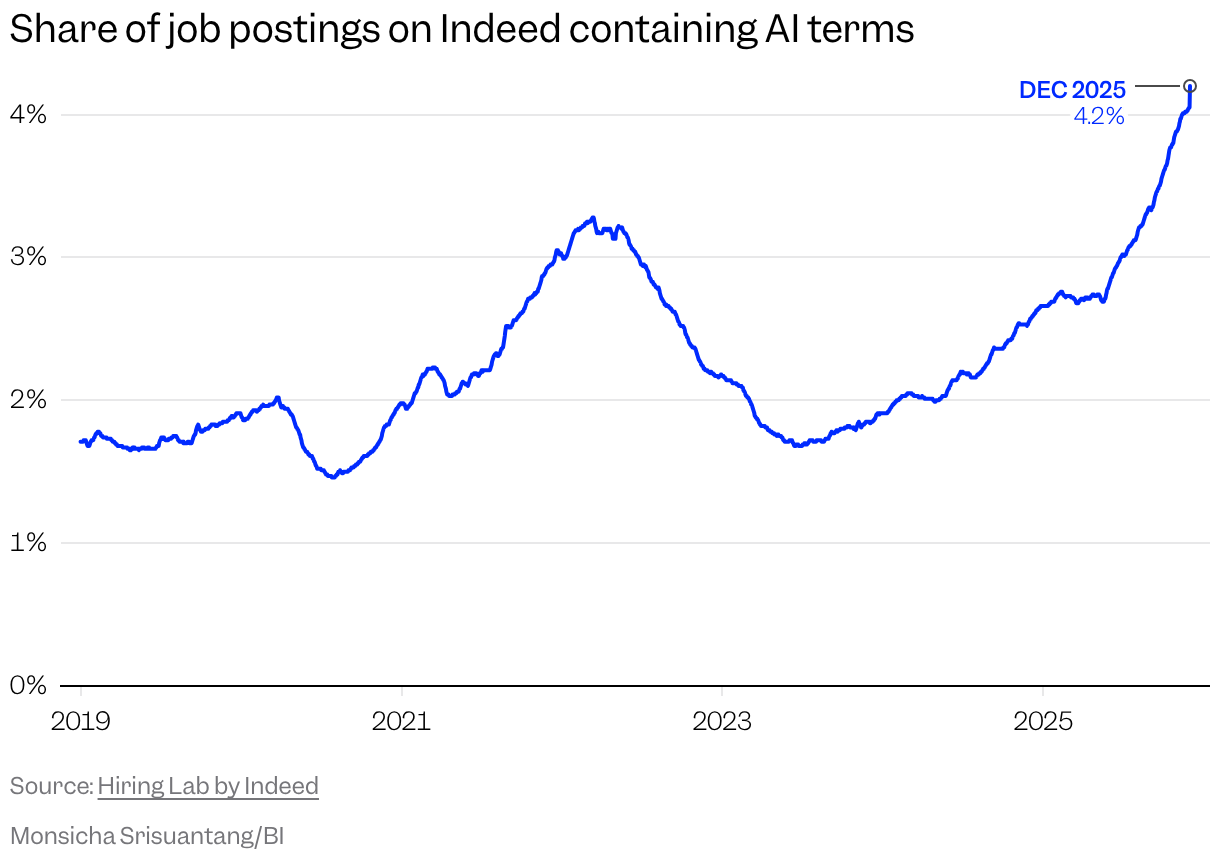
New data from Indeed shows overall job postings ended 2025 just 6% above pre-pandemic levels, but postings that mention AI are up more than 130% since early 2020.
The standout stat: more than 1 in 25 job postings now reference AI, pushing Indeed’s AI Tracker to a record 4.2% in December.
The skew is striking. Nearly 45% of data and analytics roles mention AI, compared with about 15% in marketing and 9% in HR, even as hiring across many knowledge-work fields remains weak.
As employers narrow hiring plans, AI roles are absorbing a growing share of expectations, raising a big question: Can AI carry the labor market in 2026?
Harry Luu has sold rare plants for $16,000 and $26,000. a piece.
Courtesy of Harry Luu
Harry Luu started growing rare plants as a hobby during grad school.
During COVID, he opened a business and eventually left academia to pursue it.
He works about 100 hours a week, including in greenhouses at his home, he says.
This as-told-to essay is based on a conversation with Harry Luu, owner ofPlantZaddyTherapy. It has been edited for length and clarity.
I’ve always been a gardener and enjoyed being around plants. While I was in graduate school studying math, my collection of houseplants grew. There’s an attention to detail and a hyperfocus that I found in both mathematics and plants, so my hobby complemented my academic career.
During the pandemic, my interest in rare plants blew up. I started getting a bigger collection and trading up for more valuable plants.
Eventually, my hobby transformed into a business. I finished my graduate degree and started teaching math in California, but three years ago, I left academia to sell plants full-time.
My academic career was a safety net for my family of 8
I grew up in Vietnam, and I’m the embodiment of the American dream for my family. They put all their eggs in my basket, which allowed me to come to America and study. Now, I feel it’s fair to return their investment. I support not only myself and my husband, but also my parents, my brother, my sister-in-law, my niece, and my nephew.
Leaving my job while supporting a family of eight in California might seem risky, but it was calculated. I had reached the point where I saw the potential for financial freedom from investments I had made during grad school that had very good returns. I had years of data on plant sales, and also knew I could return to academia if needed, so I had a safety net.
I price based on rarity and desirability, without going too high
I was already connected to the rare plant community, so selling increasingly expensive plants felt like a natural progression. I grew my platform on Palmstreet, an online marketplace.
This year, I had two record-breaking sales in one day. I sold a $16,000 plant (an Anthurium Variegated Forgetii x Heinz, one of only two in the world), then a $26,000 plant (the only specimen of the True Variegated Lux Albo Mother Plant).
A $16,000 plant sold on Palmstreet by Harry Luu
Courtesy of Palmstreet
I’m a math person, so I use a formula to price. I calculate rarity and desirability and compare them with price data from the previous three years. These plants were both very rare and highly desirable, which drove prices up. However, I didn’t want to price them too high, because I’m thinking about the long-term viability for my brand: people have to be able to purchase what I’m selling. Given how rare the plants were, their five-figure prices weren’t too big a splash.
I want to be able to connect with the community more
Despite those big numbers, the business’s income fluctuates dramatically. My best single week was over $200,000 in sales, but other weeks I might have no sales. The market is seasonal, and winter is slow. I’ve had to adapt to not having a steady, reliable income.
The money comes and goes, but the work never stops. Right now, I spend about 100 hours a week on the business. We have plants in our home, and also a large greenhouse on our property. My brother does some of the maintenance care for the plants, but all the breeding decisions are made by me.
I’m on the cusp of the company being able to sustain itself without me working so much. I look forward to that — when I can step back from the business side and focus more on the joy of growing. I would like to share my knowledge about rare plants and take the plants on the road to connect with my community more, since that’s what got me hooked on growing in the first place.
Maddi Thimont is a lawyer who works school hours to be also a present parent.
Courtesy of Maddi Thimont
Maddi Thimont had spent years building her career as a lawyer, working long hours and big jobs.
After having kids, she felt she had to choose between a big career and time with her family.
In 2024, she found a senior legal job working school hours – meaning she can have both.
This as-told-to essay is based on a conversation with Maddi Thimont, 37, based in London. It has been edited for length and clarity.
I always wanted a big career in law. I finished my law degree in 2007 with first-class honors and got my big break at a private law firm, gaining experience in corporate law.
It was very busy, with long hours, but it was amazing training, so it suited me really well at the time.
Securing my next role in corporate counsel at a Big Tech firm was a real career high. It was intense, but the experience really shaped me. But then, I became a mother of two, and at first, the perks of working for such a big brand were indisputable. Despite that, I started wondering if I could really have it all.
I wanted a 4-day week
This company had a great plan allowing a phased return from maternity leave, so both times, I did two and a half days a week for eight weeks. Being able to gradually get back into my career while still spending time with my children was priceless. Then, for the second half of the year, I worked a four-day workweek.
That was when it started to get tricky, and when I began to question: can I have it all? I had hoped that I could make a four-day workweek my new normal, but there wasn’t much of a precedent for it in my team, so I felt like I’d be navigating uncharted territory on my own.
Maddi Thimont says her weekends start at 3:10 p.m. on Fridays.
Courtesy of Maddi Thimont
And based on the pace I was already familiar with, I anticipated that I would have just had to fit a full-time load into less time. The thought of that didn’t thrill me, so that’s when I started to think about other opportunities.
I took a job that allowed me to have a shorter workday
I booked a call with a life coach to talk about what I wanted to do. I told her my ideal job would involve being intellectually stimulated during the day, but then to be around for my children, now aged 3 and 5, in the evening.
I started manifesting, in a way, by looking for my dream job as a senior lawyer that I could do during school hours. I did a double take when I saw a head of legal role advertised on LinkedIn for data analytics company Sagacity for 25 hours a week.
Just before Christmas 2023, I had an interview with the outgoing general counsel there. She talked about how she gave up her legal career for 15 years while raising her kids, and when she wanted to get back into it, someone gave her a chance in a part-time role. She wanted to pay that forward.
I did the math with my husband, and with our eldest close to starting school — meaning we’d have lower day care fees to pay — we were confident that we could make my new part-time salary work. I started my new job in March 2024 as Sagacity’s head of legal, working 10 a.m. to 3 p.m., five days a week. A year later, I was promoted to general counsel.
I have clear priorities and processes
What helps is having a really clear “ticket” system at the company for anyone who needs legal support. They raise a ticket, which goes into our legal dashboard with a deadline and a priority level (high, medium, or low). My team and I then provide an anticipated response date.
I’ve also created more templates and FAQs so people can be empowered to not have to come to legal for every single thing.
I am now on the senior leadership team and have frequent one-to-ones with other members to help prioritize my work. Then, obviously, if the CEO needs something, it usually takes priority.
I’m also very efficient with my time. If someone asks for a half-hour meeting, I try to cut it down to 15 minutes. I won’t accept a meeting without an agenda, either. I also don’t tend to have many coffee breaks or lunches with colleagues. I know it might sound a bit sad, but every minute counts.
I get to have a big career and be with my kids
I recognize that I’m in a privileged position to do this, as my husband is a lawyer too and works full-time as a partner at a firm. But I honestly feel so lucky, because our lives have totally changed.
Now, I still get to be a senior lawyer, and I can take the kids to their afternoon activities, like swimming and piano, and I can see how well they’re doing, which I love being part of. On Fridays, we just chill. I always say that our weekend starts at 3:10 p.m. on Friday.
With my shorter working hours, I have also found time to fit in additional opportunities. For example, I recently passed a well-recognised GDPR data protection qualification. I was also able to train for and complete the London Marathon.
Without this way of working, I would have likely continued on the corporate path with the long hours, paying for nannies, and after-school clubs. The alternatives may have been to take a demotion or find a part-time job doing something else, or just not work at all – none of which were right for me.
Committing to both work and the kids can feel intense at times – but I think the positives outweigh the negatives. Our family life is quite calm, so everything feels fulfilling.
China’s nuclear weapons arsenal is assessed to top 1,000 by 2030.
VCG/VCG via Getty Images
The US said it has intelligence that China conducted banned nuclear explosive tests.
The nuclear monitoring organization said it hadn’t detected activity related to an explosive test.
China is expanding its nuclear arsenal. An explosive test would violate an international agreement.
The US accused China of secret nuclear explosive testing and attempting to cover it up, an official said Friday.
Banned for decades under an international agreement to which China and the US are signatories, nuclear explosive testing involves the detonation of warheads. The US accusation comes on the heels of the expiration of the nuclear arms control New START agreement between the US and Russia, which limited their numbers of deployed warheads and launchers.
“I can reveal that the US government is aware that China has conducted nuclear explosive tests, including preparing for tests with designated yields in the hundreds of tons,” US Under Secretary of State for Arms Control and International Security Thomas DiNanno said in Geneva, Switzerland.
DiNanno added that Beijing had used “decoupling — a method to decrease the effectiveness of seismic monitoring — to hide its activities from the world,” and said one such test had occurred on June 22, 2020. Decoupling refers to muffling the seismic signal of an underground nuclear test.
A spokesperson for China’s embassy in the US told Business Insider that Beijing is “committed to peaceful development, follows a policy of ‘no first use’ of nuclear weapons, and a nuclear strategy that focuses on self-defense and adheres to its nuclear testing moratorium.” The spokesperson added China is ready to work with other countries to uphold the agreement.
The Comprehensive Nuclear-Test-Ban Treaty, adopted in 1996, banned the live tests that have occurred for decades and contributed to nuclear scares and radioactive exposure. The last such test conducted by the US was in 1992, and China’s most recent occurred in 1996. The only publicly known explosive testing this century has been by North Korea. The US, Russia, and China have signed the treaty but haven’t ratified it, unlike nearly 180 other countries.
China unveiled its nuclear triad for the first time on Wednesday.
Photo by PEDRO PARDO/AFP via Getty Images
Current testing practices rely on modeling, simulation, and subcritical testing, which officials have said are vigorous and dependable. Last year, US President Donald Trump raised concerns with vague comments on resuming nuclear testing in response to other countries.
“They seem to all be nuclear testing. We have more nuclear weapons than anybody. We don’t do testing, and we’ve halted it years, many years ago. But with others doing testing, I think it’s appropriate that we do also,” the president said.
There’s been some suspicion that US rivals have been preparing for testing, including work spotted at the Lop Nur and Novaya Zemlya nuclear sites in China and Russia, respectively.
But in response to DiNanno’s comments, Robert Floyd, executive secretary of the CTBTO, said the organization’s monitoring system “did not detect any event consistent with the characteristics of a nuclear weapon test explosion at that time. Subsequent, more detailed analyses has not altered that determination.”
Just a day before DiNanno’s comments, the New START agreement binding the US and Russia to a number of operational nuclear weapons and launchers, as well as a verification process and open communication, expired. Whether Washington and Beijing will continue to observe the treaty or attempt a new agreement remains unclear.
The Trump administration has said a new nuclear arms deal would need to account for the growth of China’s nuclear weapons stockpile, which the Pentagon has assessed will top 1,000 by 2030. “And as we sit here today, China’s entire nuclear arsenal has no limits, no transparency, no declarations, and no controls,” DiNanno said, adding that a post-New START treaty will address both Russia’s vast arsenal and China’s nuclear rise.