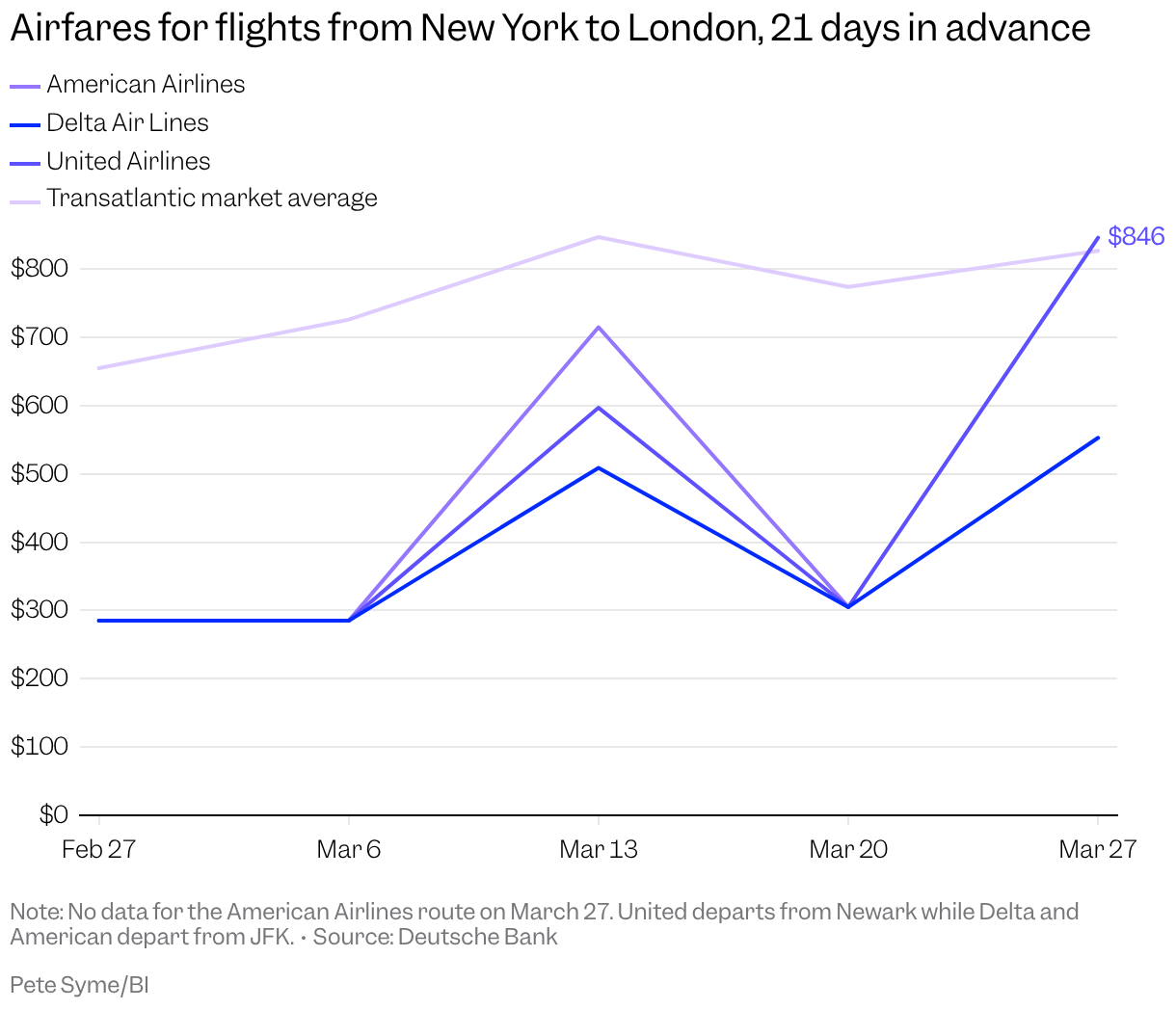
Delta Air Lines’ service from New York’s JFK Airport (pictured) to London Heathrow is up from $285 to $553 over a month.
CHARLY TRIBALLEAU/AFP via Getty Images
War in the Middle East has pushed fuel costs, and therefore airfares, sharply higher.
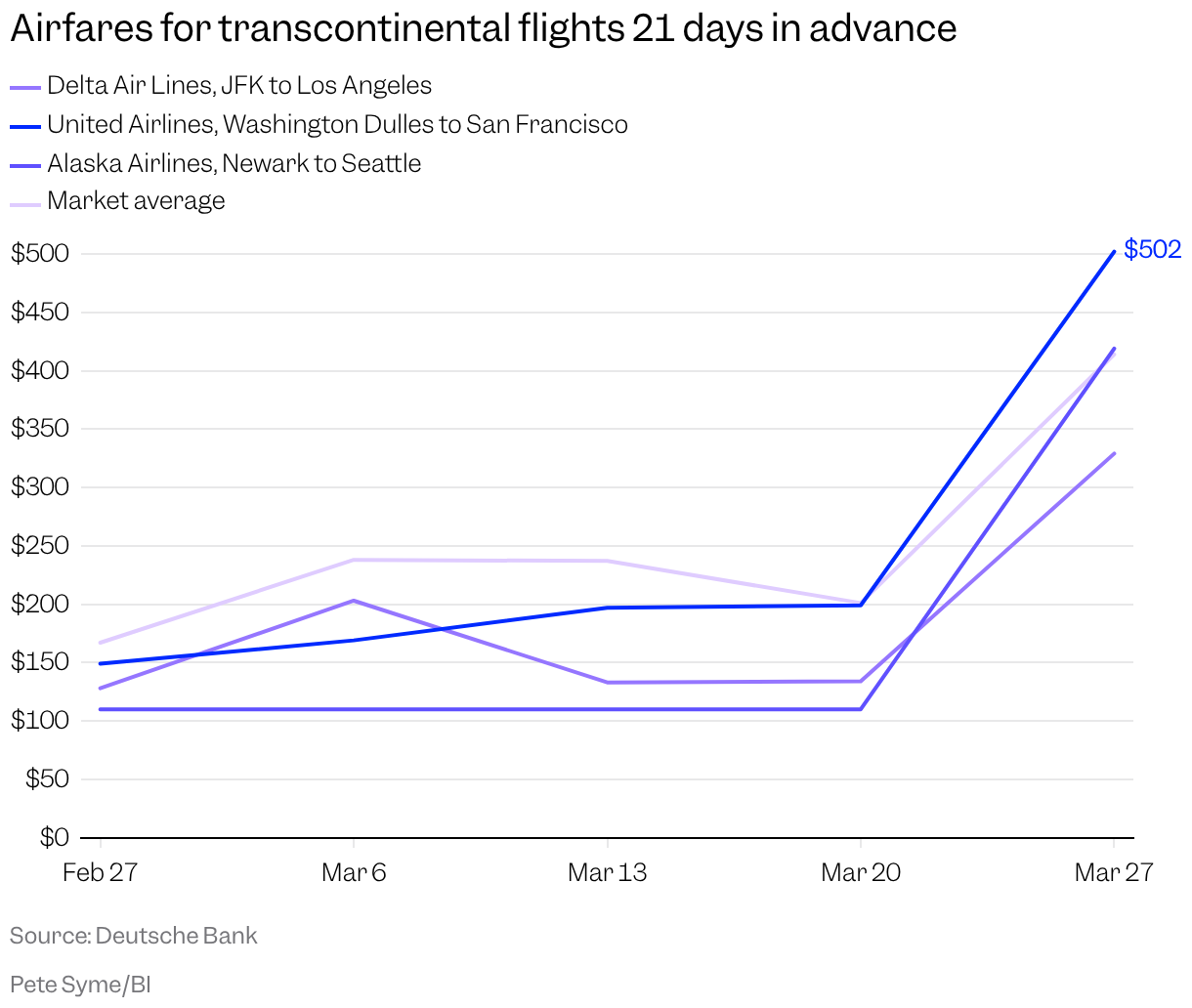
Business Insider charted the increase in ticket prices for three major flight paths in recent weeks.
Fares from New York to LA, New York to London, and from the US mainland to the Caribbean have jumped.
Your next flight could be twice as expensive because the Iran war is causing volatility in oil prices.
Brent crude is up more than 50% over the past month, to around $101 a barrel. Jet fuel costs are rising faster. The Argus US Jet Fuel Index is up 72% over the same period.
That spells difficulty for airlines because jet fuel is typically their biggest expense after labor. While many airlines around the world hedge against fuel costs, most American ones do not.
Using data from Deutsche Bank, Business Insider charted rising airfares in three major markets.
The data looks at the lowest available published fares 21 days in advance of the flights. The published fare doesn’t necessarily mean a ticket has been purchased for that amount, the Deutsche Bank research analysts said.
Cross-country flights, often known in the industry as transcontinental flights, have seen the biggest week-over-week spike — more than double, on average.
New York to Los Angeles is the country’s busiest domestic route, with a capacity of 3.4 million seats out of JFK Airport last year, according to OAG data.
The average price of a transcontinental flight has risen from $167 to $414, Deutsche Bank’s analysis showed. In the past week, the average has spiked 107%.
United Airlines is offering flights from Washington Dulles Airport to San Francisco for $502, up from $149 a month ago.
International business travellers are also seeing flight prices rise.
New York to London is the country’s most popular international route, and the 10th-busiest in the world. Nearly 4 million seats were scheduled on flights between JFK and Heathrow last year, per OAG.
While the average Transatlantic flight is some 40% more expensive than a month ago, there are bigger rises for the New York-London route. However, it also appears more volatile here with a big dip last week.
Delta Air Lines’ service is up from $285 to $553 over the past month, while United’s is up to $846. That’s a 177% rise compared to a week earlier, according to Deutsche Bank’s analysis.
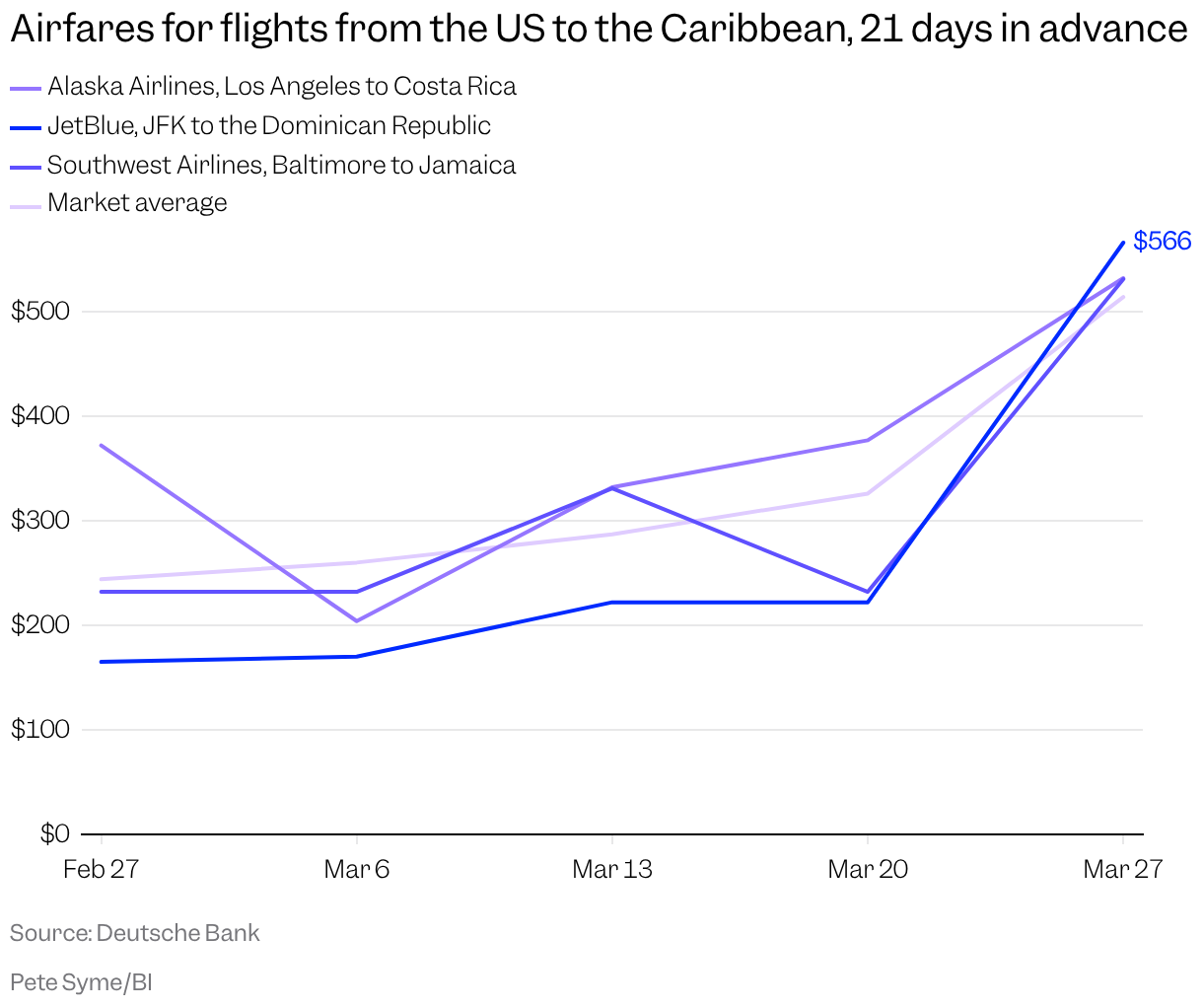
JetBlue’s flight from New York to Santo Domingo, Dominican Republic, has risen from $165 to $566 on March 27.
Compared to a year earlier, that’s a more than fourfold rise, Deutsche Bank found.
Southwest Airlines’ flight from Baltimore to Montego Bay, Jamaica, has more than doubled over the past week. And Alaska Airlines’ service from Los Angeles to San Jose, Costa Rica, is up 40% compared to a week earlier or 120% versus a year ago.
A few Fridays ago, I was feeling smug. I’d just sent another Tech Memo edition telling subscribers to stop worrying about AI eating tech jobs because Anthropic, the leading AI company pushing this narrative, is hiring so many engineers.
So clever! Until I got an email from a reader, Kiran Maya Sheikh. She has a computer science degree from the University of California, Irvine. It’s a great school, and she graduated with an impressive GPA. And yet, she’s struggling to land that all-important first full-time software engineering job.
“It’s bad advice to ‘not worry,'” she wrote. “AI is causing disruption in this job market. Employers are prioritizing hiring experienced workers, but not new graduates.”
This week, I interviewed Kiran for Tech Memo. It was an eye-opening view into the realities of the new AI economy. Here are the highlights from our chat, edited for clarity and length.
Alistair: What did you think you were signing up for when you first chose computer science as a degree?
Kiran: After getting into UC Irvine in 2020, I took my first coding class and I really enjoyed it. The prospects at this time were that people were going into this major to get great jobs and it was very rewarding and I ended up liking the work.
What did you believe a career in computer science would give you financially, socially, and emotionally?
The dream at the time was definitely everyone was saying, “Let’s go work for Google and the FAANG companies and get a six-figure salary.” My motivation was just getting a stable job, getting enough money to take care of my family — what everyone wants. I expected that computer science would put me in a position to grow as a software engineer, first and foremost, and then maybe take me to more of the strategic side, the management side. The main thing that I did figure out was that I wanted financial stability and maybe financial independence as well.
Fast forward to late 2022, when ChatGPT launched. Did you see that as a tool at the time or a threat?
I was a hater at the beginning. Then, friends of mine started using ChatGPT and they’re like, “Oh, you can just use it like Google. You can just text it and it’ll give you the answer.” And honestly, my first thought was like, “That’s a bit lazy. You can get more learning out of doing the work yourself.” But the more time went on, the more that people were using it, and they started using it for class. Suddenly, I was ahead in class. I was doing the assignments well and understanding more.
Was there a moment when you thought generative AI might reduce the need for junior engineers, or do you even believe that?
We all know the current job market. It’s not too hot and a lot of companies are citing AI as part of the reason for layoffs — but maybe that they were going to cut those jobs anyway. At the time though, while I was in school and using ChatGPT, I honestly didn’t think it would get this far. I expected AI would be integrated into software engineers’ work and companies would start integrating it, but I didn’t realize there would be potential for it to take over jobs that I was looking for.
I don’t think I was very attentive to the job market situation at the time, and I wasn’t really thinking that far ahead. More of my worries at the time were just getting that first entry-level position. And I just thought it would be simple: I just get my degree and I would find a company that’s hiring. Looking back, it was my mistake to not really research the current job market and maybe what some people were predicting about AI.
I didn’t see it coming either. Few people did. Anyway, describe the moment when you realized the job market had changed?
I was already graduating, so this was after June 2025. I was getting into the reality of having to find my first job, and that’s when I definitely started noticing something was wrong. A lot of my classmates, I haven’t really heard of them getting any opportunities. Everyone’s submitting so many resumes and there’s a race to use AI to enhance resumes and send them out as fast as you can. And it seemed a lot more intense than I was prepared for.
A lot of my classmates and even students I know who are still in school are not even landing internships right now. It’s not looking great. It’s a very tough battle right now. So many people are quitting or getting fired or pivoting and there’s new grads. Everyone is bracing, and it’s a bloodbath right now.
Do you feel like you’re competing against AI or laid-off senior engineers or both, or something else?
My fight is definitely with AI and all the competition with entry-level graduates — especially because AI is known to take over more junior roles. So it’s important that we stay more relevant and offer something that AI can’t. Scrolling through LinkedIn and on my job portals, I see more offers for mid-level positions, but I don’t see as many for entry-level roles. So it’s like I’m fighting AI and all these other graduates for roles that don’t exist yet.
This job search so far, what has it done to your confidence?
I try to be optimistic. I am lucky to have a better situation than some other people do. I’m living at home with family, so I don’t have to worry as much about expenses. Still, if I weren’t doing anything about my situation, I would feel pretty bummed. I’d feel kind of trapped.
But I’ve been trying to work on building my network, finding people I know and learning from other people, just finding communities to be involved with. That’s really helped my confidence because I find professionals that are trying to help — they are aware of the job market and they know how hard it is to get that first job. The one saving grace in this tough situation is definitely the community I’ve found and the people I know who are helping me through it.
Did you ever question your decision to study computer science?
Yes, I did question it. But I remember that I do like computer science and I did like what I learned. I really enjoyed my classes and programming. And instead of turning to a new discipline, I think I prefer to just specialize and find out new information and stay ahead of the news. And like I said, offer something that AI can’t.
Do you feel like you were trained for a version of the tech industry that no longer exists?
I am a little salty, about this, if that’s the right word. During my time at school, a lot of what the degree was about was learning the basics of software engineering. You learn programming languages and you learn how to set up your development and deployment. But right now there are so many more tools and I think that’s the constant thing with the software engineering and the tech industry. There’s always new technology and there’s a lot of learning you have to keep up with.
But with AI in particular, I felt like I graduated a bit too early. Because now AI will probably be more integrated into learning. I had so many professors that were more welcoming towards AI. I remember a really cool professor who shared a website that would let you make your own LLM. And it’s really useful stuff, but it wasn’t part of the curriculum. It will be now, but I won’t be there to see that change.
What I’m doing to help with that, and make the amends, is volunteering and doing more work on the side that involves newer technologies to just stay fresh and relevant and use all these new AI tools and see how I can leverage it.
If a high school senior asked you today whether they should major in computer science, what would you tell them?
It depends on what interests them about computer science. If it’s absolutely something they’re interested, they love learning about the technology and they want to code, I would still say go for it, but I would recommend how to position yourself for after college.
You need to start much earlier now, networking and knowing how to speak with people and how to apply, how to write a resume. And those all are also much more important now at the start of college, especially getting internships, if at all possible.
So, I would definitely recommend studying computer science, but being realistic about the opportunities available and keeping up with the news and the job market.
What would you say to potential employers out there?
The focus should still be in hiring entry-level talent if possible. I know it’s tough with the current market and the economy and what’s going on in the world right now. But entry-level talent is still important because you need to build this generation of professionals so that the future will have people to rely on. AI is still uncertain right now. People are still figuring out how it is impactful and it doesn’t help to just force it upon your company.
Both of my sons are enrolled in an international school in Las Rozas.
Rebecca Cretella
My husband and I sold our house in the US and moved our four-person family to a suburb in Spain.
We made some mistakes, like not translating important documents and canceling our US phone numbers.
Errors aside, I’m thrilled to be building a life for my family in Spain.
When my husband and I decided to move our four-person family from the US to Spain, we had roughly two semesters of college Spanish between us and zero experience living abroad.
We didn’t let that stop us, though. Beginning in March 2025, we researched obsessively, read books, made spreadsheets, and put together lists of pros and cons. The more research we did, the more confident we became that Spain was the correct place for our family.
Five months later, we packed up our lives and moved our 6- and 9-year-old sons from Northford, Connecticut, to Las Rozas de Madrid, a suburb northwest of the Spanish capital.
Despite our extensive preparation, lessons awaited us. After all, there’s so much to consider while moving abroad (especially with kids), and slipups are unavoidable.
That said, here are five mistakes I wish I’d avoided when my family moved.
I wish I’d started building my community abroad before we left
Between selling our home in Connecticut, finding a place to live in Spain, and figuring out where our sons would enroll in school, I deprioritized my new social life.
I assumed we’d naturally meet people once we got here, and we eventually did. But those first few months were lonely.
We arrived in August, a month before my sons’ school year started, and many locals were still away on summer trips. Once school started, it became easier to connect with other families. I also joined a few WhatsApp groups recommended to me by other expats.
I’m still very much in the early stages of building a network here. If I were doing the move over, I’d join related regional and professional groups, connect with families in our area, and start building relationships before I even left the US.
Having even one friend waiting for me in Spain would’ve made a huge difference.
My husband and I didn’t ask the right questions about our sons’ school curricula
My family relocated from the US to Spain in 2025.
Rebecca Cretella
My husband and I planned to start our boys in an international school to ease their transition into a new country and language, with the goal of eventually moving them into a local Spanish school once they were fluent.
We selected an international private school that follows an International Baccalaureate (IB) curriculum with Spanish language support. It seemed like the perfect fit — until we realized we hadn’t asked the right questions.
We failed to realize that our boys, who didn’t arrive speaking Spanish, would be learning alongside native speakers rather than building introductory skills.
They’re getting an incredible education in Spain, but it’s not the foundational language curriculum we expected. We now supplement school with online Spanish tutoring twice a week to fill the gap.
To other parents moving their school-age kids abroad to Spain, I’d recommend asking specifically about language use and requesting sample lesson plans before enrolling to see what language support looks like in practice.
Translating important documents into the local language would’ve been extremely helpful
Four months after moving, I had to undergo emergency surgery. I felt completely unprepared as I relied on Google Translate and my husband’s elementary Spanish language skills to communicate with staff.
We got through it, but “getting through it” isn’t the same as feeling safe, understood, and informed.
The scariest moment in the ER was right before I went under anesthesia. I was crying because I couldn’t understand what the professionals were saying, couldn’t communicate my allergies or medical history, and didn’t know what was about to happen.
Luckily, the staff took good care of me, but the experience was harder and more frightening than it needed to be.
Before I left the US, I should have saved a translated medical profile with my allergies, medications, and past surgeries on my phone.
I also should’ve researched how to access medical translation services, so that if something unexpected happens, I wouldn’t have to figure it out in the middle of a crisis.
We didn’t know that we couldn’t rent a car without a special driving permit
The first few months living abroad were lonely, as we arrived without an established network.
Rebecca Cretella
Las Rozas de Madrid is well-connected, so my family doesn’t own a car here. When we went to rent one for a holiday trip to Cádiz, we assumed we could do so using our US driver’s licenses, but we were wrong.
Without an International Driving Permit, renting a car was off the table. We made the best of the situation, but we were restricted in what we could see and do in Cádiz.
I regret not getting an International Driving Permit before leaving the US. It’s easy and costs $20.
Canceling our US numbers created a logistical nightmare
My husband and I both canceled our US phone numbers when we left the country, thinking we’d just use Spanish numbers instead. It was a big mistake.
Accessing our US banks and some key services required us to complete text verifications with our US numbers. So, we’ve gotten locked out of accounts, struggled with two-factor authentication, and spent hours on international calls trying to fix it.
Rather than canceling my number, I wish I’d ported it, which would’ve let me move it to an online service while keeping my number, to save us endless headaches.
Even with all the mistakes we’ve made, I’m glad my family made the move
Six months into our new life in Spain, one thing is certain: I’m so grateful for this journey.
Seeing my kids build new friendships, learn a new language, explore new places, try new foods, and gain confidence as their world expands has made every misstep worth it.
A weekend spent with strangers yielded wonderful memories and valuable lessons.
Sandra Gordon
At the weekend reading retreat I attended, our intergenerational group bonded over more than books.
We had thoughtful discussions, did a guided meditation, and went on a hike in the woods.
I came home inspired by the other retreat members and our shared connection.
In my 30s, I joined a book club but soon dropped out. Between juggling work and family, the last thing I needed then was another deadline, even a read-for-fun one.
Flash forward decades: I’m in my 60s now, the kids have flown the nest, and I have more downtime and love all things outdoorsy.
So when a friend suggested All Booked, a luxe reading retreat for women in New York State’s Catskill Mountains, I was excited to try book clubs again, especially this one-off weekend version.
When I signed up, I imagined lengthy chats surrounding the retreat’s featured trending book: “Mother Mary Come to Me,” a memoir by prize-winning author Arundhati Roy. We certainly had those.
But what made the literary getaway especially meaningful were the casual connections we shared as total strangers — eight women in our 20s to late 60s — about life, love, and living with intention.
The retreat’s luxe cabin was the perfect place for book chats and a reset
The weekend retreat offered amenities, including a guided meditation and a hike in a gorgeous getaway-from-it-all location.
Sandra Gordon
Tucked among 12 wooded acres in Windham, New York, the weekend retreat’s luxury log cabin was straight out of Airbnb central casting, complete with pine exposed beams, stone floors, and a dramatic great room with soaring vaulted ceilings and cozy reading nooks.
The first night, we met our host, Suzanne, a former New York City journalist who headed to the Catskills a few years ago and never left.
We introduced ourselves with a favorite book recommendation over an Indian-inspired dinner of delicata-squash salad and curry-marinated chicken, a nod to featured author Roy, who calls New Delhi home.
After changing into our PJs, we gathered on yoga mats in the cabin’s loft for a guided meditation before padding off to our log beds.
We slept in cozy beds.
Sandra Gordon
Introductions continued the next morning over a breakfast of blueberry scones and homemade granola.
Among us were two 20-something bookstagrammers, each with her own daunting stack of extracurricular romantasy novels to speed-read.
Their tripods and ring lights triggered the multitasking question that seemed to trail many of us these days wherever we went: Should we turn an experience into shareable content or power down and just enjoy it, conceivably leaving likes, followers, and revenue (from somewhere) on the table?
Aside from planning to snap a few photos, I am Team Commune with Nature.
Our multigenerational group bonded over books, nature, and a lively debate
Our trip consisted of more than just reading.
Sandra Gordon
After a morning of quiet reading time, our group met at the Windham Path for an afternoon of forest bathing, which turned out to be a slow-motion hike led by Beth, our certified forest therapy guide.
Beth, who left a corporate job to embrace her calling as a forest therapist, invited us to wander off and “connect with a tree you are drawn to.”
After appreciating the bark, treetops, and stillness, we reunited with a tea ceremony. Beth poured tiny cups of tea steeped from pine needles from an insulated kettle.
Before sipping the sour reddish liquid, we were instructed to pour some on the ground to give back and thank the forest for its sustenance.
During Saturday night’s dinner, Suzanne moderated our discussion of “Mother Mary Comes to Me,” aboutRoy’s complicated relationship with her mother, Mary, which eventually led to this question for the group: Is it OK to go no-contact with your parents if they upset you?
The 20-somethings were Team No-Contact, while those of us in midlife and beyond disagreed because bad-parenting moments come with the territory, and well, family is family.
Our POV tracked with the memoir’s theme: Roy remained stubbornly devoted to her mom despite their lifelong turbulent relationship.
The connection and community I found that weekend reminded me that life is full of possibilities
I left the weekend retreat with a new perspective.
Sandra Gordon
The next day, I came home intoxicated with pine-scented fresh air and nurtured by the experience.
Confession: In this chapter as an empty nester, I often feel nestless. It’s almost like I’m back in my 20s, asking fundamental questions again, such as: What should I do now? Where should I live now that I don’t have to be tied to a good school system?
However, spending the weekend with retreat members, including Suzanne and forest-bathing Beth, who’ve made bold midlife moves, reminded me that life is an open book, filled with exciting possibilities.
Meanwhile, I’ve been really noticing the trees during my daily walks, brushing up on my vlogging skills (inspired by the bookstagrammers’ industriousness), and seeking out even more ways to meet new friends of all ages.
Japan has long harvested a shrub called mitsumata for its money supply. But when mitsumata started dying out, Japan frantically searched for alternatives to make yen.
It found a lifeline in the foothills of the Himalayas. A low-value crop called argeli grew abundantly and served as a perfect replacement for mitsumata.
Argeli was worth very little and was often the only option for farmers who’d lost their crops to wild animals. When the Japanese arrived, they turned the once low-value argeli into a cash crop.
Now, one of Asia’s poorest countries is growing the money for one of Asia’s richest nations. And the influx of cash brought industry and investment to Nepal’s small villages.
But while Japan loves its physical yen now, what will happen to Nepal’s new big business if the country goes cashless like much of the rest of Asia?
Tilly Norwood’s “Take the Lead” music video debuted on Tuesday.
Tilly Norwood
AI performer Tilly Norwood released her debut music video on Tuesday.
The song drew mixed reactions, but its maker says topping the charts wasn’t the goal.
At one point, Norwood sings: “AI’s not the enemy, it’s the key.”
Pop stars, you can breathe easy. The debut single from AI-generated triple-threat Tilly Norwood is evidence that your jobs are safe — for now.
The single’s 4-minute music video, which first hit streaming services on Tuesday, is a montage of obviously AI-generated scenes, often intentionally over-the-top, depicting Norwood’s imaginary path to global superstardom. At one point, she is hounded by paparazzi. At another, she performs for a sold-out stadium.
“When they talk about me, they don’t see/The human spark, the creativity/Behind the code, behind the light/I’m just a tool, but I’ve got life,” Norwood sings in “Take the Lead.”
The reaction to the song and its video, which has over 100,000 views on YouTube as of Thursday, has been mixed at best. However, the founder of Particle6, the AI studio behind Norwood’s career (or whatever), said releasing a chart-topping track was not the goal.
“When we made the video for ‘Take the Lead’ with Tilly Norwood, the goal wasn’t just to release a track or seek music chart success,” Particle6 founder Eline van der Velden told Business Insider. “It was to show people the current capabilities of AI and how actors and AI can now work together in a hybrid way with performance capture, and demonstrate that human input is still key.”
At the start of the music video, the company notes that 18 “real humans” were behind the production, including prompters, production designers, editors, and an actor.
“AI in music and performance is still new territory, and when you put something experimental out into the world, people are going to have opinions,” she said.
The opinions online were largely dismissive. “It took only 18 humans to achieve this level of soullessness? Imagine what 19 could have done,” one YouTube user wrote.
“This is so soulless,” another added.
The “Take the Lead” music video was made with 18 “real humans.”
Tilly Norwood
The video’s makers leaned into its genre, having fun showing what AI could make possible. There is, for instance, a scene in which Norwood rides a flamingo pool floatie into the sky, where she meets a pod of glittery pink dolphins and sky-bound acrobats.
“Actors, it’s time to take the lead/Create the future, plant the seed/Don’t be left out, don’t fall behind/Build your own, and you’ll be free/We can scale, we can grow/Be the creators we’ve always known/It’s the next evolution, can’t you see? AI’s not the enemy, it’s the key,” Norwood sings.
At the end of the song, Norwood calls on AI actors to “take your power” and “take the stage.”
“The next evolution is all the rage/Unlock it all, don’t hesitate,” she sang. “AI Actors, we create our fate.”