
Fed meeting recap: FOMC holds rates steady as oil prices soar

Fed Chair Jerome Powell

It’s the second Fed day of 2026, and America’s economic woes are making headlines.

The Federal Open Market Committee announced it would hold its benchmark interest rate steady, as was widely expected. The meeting comes on the heels of a dismal February jobs report and an escalating conflict between the US and Iran that’s thrown oil markets into chaos.

Below are our biggest takeaways from the meeting, including insights from Chair Jerome Powell’s press conference, economists, and market analysts. Check back here for updates.

Our 3 main takeaways from the January Fed meeting
  • Inflation is the big story. The FOMC is closely monitoring the impact of tariffs and the US-Iran war on inflation rates. Powell said shocks to the global energy supply are meaningfully driving up consumer prices, but it’s unclear how long that will last.
  • The job market is shaky. While overall economic growth is strong, the employment situation is tenuous. Low hire and quit rates, limited vacancies, and dwindling labor force participation could continue, especially if interest rates stay high.
  • Powell might stay. If nominee Kevin Warsh isn’t confirmed by the scheduled May 15 transition date, Powell said he will remain in the role temporarily — at least until the DOJ investigation concludes. He is eligible to remain on the committee as a governor until early 2028.
What comes next

The central bank will meet again on April 28 and 29 to determine the next interest rate move. It is scheduled to be Powell’s last meeting as chair. Kevin Warsh’s confirmation hearings are expected to be held this spring, though no date has been announced.

Productivity is on the rise, but it might not all be AI

Productivity gains in the US economy began years before generative AI was made available to the public, Powell said, and he expects technology to contribute to this growth.

“Higher productivity is the thing that allows incomes to rise over time, so it’s a great thing,” he said. There is some tension, however, about whether the supply of data centers can keep up with increasing demand.

Fed independence is key to affordability, Powell says

As Trump puts pressure on the Fed, Powell said “independence is what allows us to do our jobs and stable prices is one half of our mandate.” This is key to lightening the inflation load on American consumers, he said.

“Every advanced economy that looks anything like the US” has central bank independence, he added.

Don’t say ‘stagflation’ yet

The committee has “growing confidence in productivity,” Powell said, which is reflected in its optimistic GDP projections. He added that America isn’t in stagflation territory, as unemployment and inflation rates remain historically low.

He said he’s hopeful that short-term events like steep gas prices or company layoffs won’t hurt the country’s long-term economic health. He said he “can’t make a prediction” about future policy decisions and maintains the Fed’s current “wait-and-see” strategy.

“The US economy has been strong through a whole bunch of challenges,” Powell said. “It’s been amazing to see.”

The next rate decision could be a hike

The Fed chair said FOMC members discussed the possibility of a hike at the April meeting, though they will have to learn more about the impact of tariffs and steep oil prices on overall inflation. The central bank will also have another month of employment data before making its next decision.

“I think everyone does agree that we will be watching those extremely carefully,” he said.

Powell is worried about poor US jobs performance

It is a strange moment in the job market with “very low, near nonexistent growth in our labor force,” Powell said. Quit and vacancy rates are low, and hiring has slowed alongside widespread white-collar layoffs. “Immigration is the biggest factor there,” he added.

An effort to curb inflation with somewhat restrictive rates could risk slowing an already sluggish job market. It’s “not a comfortable balance,” Powell said.

Powell says he will remain at the Fed if Warsh’s confirmation falls through

Powell said he would continue serving as chair on a pro tem basis if Warsh’s confirmation goes awry, and he will stay on the Board as long as the Department of Justice investigation is ongoing. The DOJ launched a probe into Powell in January alleging that he mishandled construction efforts at the Fed’s Washington, DC, office.

He said he may remain on the board after his term ends on May 15. He is allowed to stay on as a governor until May 2028, though this is historically rare among former Fed leaders.

“I have not made that decision yet and I will make that decsion based on what I think is best for the institution and for the people we serve,” he said.

Stocks extend losses after Fed decision

US stocks tumbled as Jerome Powell’s press conference got going. The Dow added to losses earlier in the day, dropping by more than 500 points as traders mulled the outlook for inflation after the central bank held rates steady.

Markets were already on edge after a hot PPI reading, and as traders watched oil prices climb further above $100 a barrel. The selling picked up as Powell told reporters that the Fed wasn’t seeing the progress on inflation that it had hoped for.

“The risk here is disruptions within global oil supply last longer than expected. If economies must deal with elevated petroleum prices now through the summer, the economic impact will be larger than currently priced today,” Jeffrey Roach, chief economist for LPL Financial, said ofter the decision.

The balance between inflation pressures and a softer job market puts the Fed in a ‘difficult situation’

Powell said interest rates are mildly restrictive and he doesn’t want the FOMC to “overreact” to short-term news events. He said inflation on consumer goods has lately been driven by tariffs, which the Fed is trying to control — though Powell said he doesn’t want to further weaken the labor market with high rates.

“We’re in a difficult situation,” he said. “We feel like our framework calls on us to balance the risks.”

The Fed is unsure how oil prices will shake out

Powell said “nobody knows” how disruptive the Iran war will be in the long run. The Fed chair said the US economy is doing “pretty well,” despite energy shocks.

“If we have a long period of much higher gas prices, that’s going to weigh on consumption and weigh on disposable personal income,” he said. “But we don’t know if that’s going to happen.”

Powell is watching for the effects of tariffs and the Iran war on inflation

Inflation has been above the Fed’s 2% target for roughly five years, with some “shocks disrupting progress,” Powell said. He gave tariffs and supply chain disruptions in the Middle East as examples. He said the Fed does not take decisions around interest rates and inflation lightly.

“Progress should come” later this year, he said. “If we don’t see that progress, you won’t see a rate cut.”

Powell opened with a bird’s-eye view of the economy

Powell opened the press conference by emphasizing the Fed’s dual mandate goals — maintaining stable prices and maximum employment. He said while job gains have been low and inflation remains elevated, the unemployment rate itself has remained relatively unchanged.

Economic activity has been “expanding at a solid pace,” and consumer spending has been “resilient,” Powell said, but the housing sector has been weak. He said lower job gains are due to limited demand, lower immigration, and decreased participation. Inflation has eased from 2022 highs but remains about the Fed’s 2% goal. Supply disruptions due to the US-Iran war are driving these climbing prices for businesses and consumers.

“The implications of the events in the Middle East are uncertain,” Powell added. “In the near-term, higher prices will push up overall inflation, but it is too soon to know the scope and duration of the potential effects on the economy.”

The Fed is concerned about the Iran war

The committee included a sentence in today’s statement saying that “the implications of developments in the Middle East for the US economy are uncertain,” posing a credible risk to inflation.

There were other small changes from previous meetings in the wording of various phrases in the statement. At the January meeting, the Fed said unemployment levels “had shown some signs of stablization.” That line was amended to unemployment “has been little changed” in today’s release following the start of the war and a disappointing February jobs performance.

The Fed is penciling in one rate cut this year

The Fed’s latest economic projections show that the median FOMC member sees just one cut this year. Most expect either zero cuts or one by the end of 2026. No members expect a hike coming this year.

The last projections were in December, which showed a looser range of what could happen. December’s projections also showed the median member penciled in one cut for 2026.
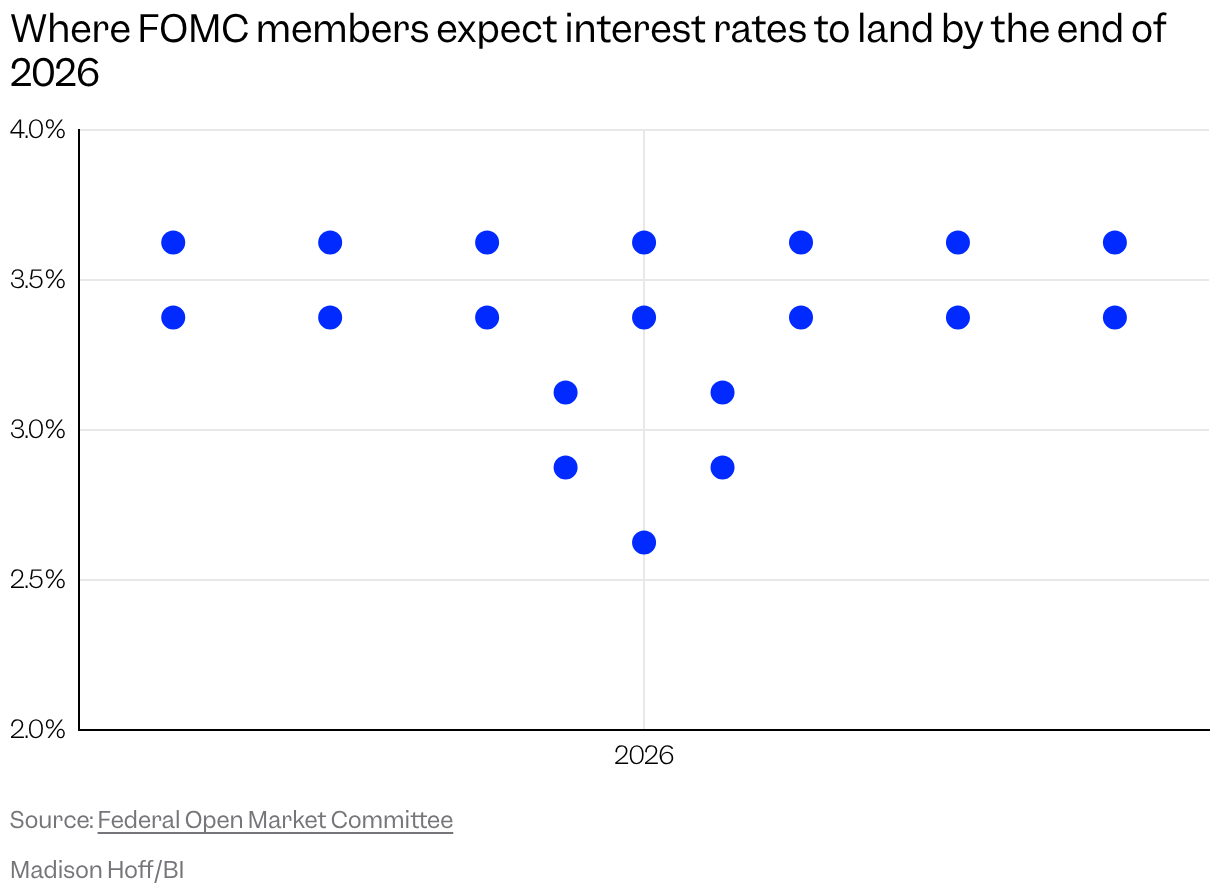
Dot plot of where FOMC members expect interest rates to land by the end of 2026
What the Fed thinks unemployment, growth, and inflation will look like this year

The Fed’s first-quarter economic projections show that the Fed has become more pessimistic about inflation rates since December, though the committee’s outlook on the employment situation remains unchanged. GDP projections indicate that the FOMC sees slightly higher future economic growth, even with economic challenges from the Iran war.

The committee was more unified than in recent meetings

The was only one dissent on today’s vote — which is more uniform than the FOMC has been lately. The committee has disagreed on interest rates at every meeting since September. Ten commitee members, including Powell, voted in favor of the hold. Trump appointee Stephen Miran hoped for a quarter-point cut.

The Fed holds rates steady

The Fed will keep its benchmark interest rate steady between 3.5 and 3.75%, in alignment with expectations. It’s the second rate hold in a row from the committee. Powell will hold a press conference at 2:30 p.m. ET to discuss.

What reporters are watching for from Powell’s press conference

Powell will begin the Fed’s March press conference at 2:30 p.m. with an overview of the economic situation, including updated inflation and employment outlooks.

Next, the central bank chair will take questions from journalists. We expect Powell will be asked about the Iran war, continued political pressure from the Trump administration, trade, the impact of AI on the job market, and more. Powell’s answers could give insight into his final months at the Fed.

How the Fed impacts consumers
Aerial view of a neighborhood
Fed decisions impact mortgage rates and the cost of borrowing for consumers.

FOMC decisions impact mortgages, credit card rates, auto loans, and savings accounts over time. The borrowing rates for these typically follow the same pattern as the Fed’s benchmark short-term rate.

It’s unlikely Americans will feel the impact of a single rate call, but a pattern of cuts or hikes can have an effect over time. Higher interest rates can help curb inflation, but they may push companies toward layoffs or hiring freezes over time.

The Fed will tell us its newest views on how the economy is doing and where rates are going

The Fed releases new economic projections each quarter. Today, the committee will share its plans for monetary policy over the next months and years. In the December economic projections, Fed leaders penciled in one rate cut for 2026.

While these projections aren’t set in stone, they are a solid look into America’s long-term economic stability.

The impact of tariffs on inflation has been mixed

The Supreme Court struck down many of Trump’s tariffs in a major February decision the president called “ridiculous.” After the ruling, business leaders and consumers have struggled to sort out how — and if — the government should distribute refunds. Trump has since instituted another round of global tariffs on most imports.

Though recent inflation rates have remained a little above the Fed’s 2% goal, Powell said the levies have already hit the economy. If prices rise, it will likely be for other reasons.

What’s next for Powell

Powell’s term as chair ends in May, but he’s eligible to remain on the Fed committee until early 2028. It’s rare for former chairs to stay on as governors, and Powell has not publicly shared his plans.

When asked about his legacy in December, Powell said, “I really want to turn this job over to whoever replaces me with the economy in really good shape.”

Warsh still needs to get through the confirmation process
Kevin Warsh
Former Bush economic advisor Kevin Warsh was nominated by Trump to succeed Jerome Powell.

Before being confirmed as the next chair, Warsh would need to testify in hearings before Congress. Lawmakers would ask him questions about his experience level and outlook on monetary policy. These hearings haven’t been announced, but are expected to occur in the next month.

Warsh would need support from both Democratic and Republican leaders to receive confirmation — far from guaranteed due to pushback over the DOJ probe. If his candidacy isn’t approved, Trump would need to nominate another successor for Powell, and the process would start over.

Concerns over Fed independence

Powell said he does not take politics into account when making rate decisions — and he hopes the Fed can maintain trust with the American people, despite political pressure.

“The point of independence is not to protect policymakers or anything like that,” he said in January. “It just is that every advanced-economy democracy in the world has come around to this common practice.”

Producer price inflation came in hot

The producer price index — a key measure of wholesale inflation — unexpectedly jumped by 3.4% year-over-year in February, per a Wednesday morning release from the Bureau of Labor Statistics. Compared to the buyer-oriented CPI, PPI looks at prices from a seller’s point of view, indicating the changing cost of energy and raw materials. An inflation jump like this complicates today’s Fed decision.

“This report likely reinforces a hold decision by the Federal Reserve later today but tilts the risk toward a more hawkish tone in today’s FOMC decision,” said Eugenio Alemán, the chief economist at Raymond James. “Even if rates are left unchanged and we see multiple dissents, the messaging may lean toward ‘higher for longer,’ especially with energy inflation set to re‑enter the picture in coming months.”

Stocks dip, oil pops ahead of Fed decision

Major stock indexes dipped ahead of the coming Fed decision and press conference from Jerome Powell. The Dow Jones Industrial Average, Nasdaq Composite, and S&P 500 were all down slightly less than 1%.

Meanwhile, oil prices are still rising as investors continue to monitor the Iran war. Markets will be keenly focused on any commentary in Powell’s remarks that indicates how the central bank is thinking about higher oil prices and the impact on inflation. Brent crude rose 6% to over $109 per barrel, while US crude prices rose 3% to $99.

What the president has said about the Fed

Trump has long been vocal about wanting lower borrowing costs, and he hopes the next Fed chair will work more closely with the West Wing on rate decisions. This attitude has sparked alarm with economists, lawmakers, and bank leaders, as the Fed has historically been nonpartisan.

“I have known Kevin for a long period of time, and have no doubt that he will go down as one of the GREAT Fed Chairmen, maybe the best,” Trump said when announcing Warsh’s nomination. On March 12, the president also posted that Powell “should be dropping Interest Rates, IMMEDIATELY, not waiting for the next meeting!”

Political tensions haven’t cooled

For the past year, the Fed has faced increasing pressure from the White House to lower interest rates. Powell has been in the hot seat, with Trump often threatening to fire him before the end of his term. Fed Governor Lisa Cook’s case — in which she denies the administration’s accusation that she committed mortgage fraud — was heard by the Supreme Court in January. The Department of Justice also launched a probe into Powell’s handling of construction at its Washington, DC, buildings. Powell said the “unprecedented action should be seen in the broader context of the administration’s threats.”

Federal judge James Boasberg dismissed subpoenas in the probe last week.

“A mountain of evidence suggests that the Government served these subpoenas on the Board to pressure its Chair into voting for lower interest rates or resigning,” Boasberg said. “On the other side of the scale, the Government has produced essentially zero evidence to suspect Chair Powell of a crime; indeed, its justifications are so thin and unsubstantiated that the Court can only conclude that they are pretextual.”

Powell has left the chair with a piece of advice for his successor: “Stay out of elected politics. Don’t get pulled into elected politics. Don’t do it.”

Leadership change is imminent
Fed Chair Jerome Powell leaving a press conference

With Powell’s term up May 15, Trump nominated former Wall Streeter and Fed governor Kevin Warsh as successor. Warsh has a reputation for being hawkish on monetary policy and tough on inflation, and it’s unclear if he will uphold Trump’s desire for steep interest rate cuts.

Hearings for Warsh’s nomination aren’t yet scheduled, and his confirmation may be an uphill battle. Lawmakers across the aisle, especially retiring North Carolina Senator Thom Tillis, who sits on the Senate Committee on Banking, Housing, and Urban Affairs, have said they won’t approve of any chair nominees from Trump due to concerns over Fed independence. The president hopes the next Fed leader will consult with him more closely on decisions.

What’s at stake

For the FOMC, Wednesday’s meeting will continue setting the tone for monetary policy in 2026. The Fed previously penciled in one rate cut for the year, but that’s subject to change based on economic conditions. This is Jerome Powell’s second-to-last meeting before his term as chair ends.

How the Fed responds to war-related inflation concerns and the disappointing February job numbers will have trickle-down effects on various consumer borrowing rates.

Gas prices have surged

Oil prices recently surged past $100 per barrel in response to the US and Israel’s ongoing air strikes against Iran. Trump signaled that the war could end soon, briefly calming markets, but volatility remains. Most traffic through the Strait of Hormuz has been halted since the first week of March.

Average gas prices have climbed to over $3 a gallon, and many consumers are scrambling to fill up their vehicles. It’s the first time since 2023 that every US state posted an average gas price above $3, per AAA.

The war has already pushed up the cost of some plane tickets, and oil supply disruption could soon start impacting the cost of household utilities and food.

All eyes are on how the Iran war will affect inflation

The Bureau of Labor Statistics published new consumer price index data last Wednesday, showing the inflation rate held steady at 2.4% in February as expected. Core inflation, which excludes volatile food and energy prices, also held steady at 2.5%.

However, that report was based on data mainly gathered before the start of the Iran war, which could heat up inflation and jeopardize progress toward the 2% goal. Economists expect to see the effects of the oil shock from the Iran war as soon as the next report.

Oil prices remain elevated as the Strait of Hormuz remains largely closed off. Gas prices are up from a month ago, and there are other factors affecting what consumers pay at the pump, such as higher demand in the spring.

Alexandra Wilson-Elizondo, global co-chief investment officer of multi-asset solutions at Goldman Sachs Asset Management, said February data “was collected before the conflict in Iran sent crude oil surging roughly 30%, with natural gas, aluminum, fertilizer, freight rates, and shipping insurance moving higher with it.”

“The Strait of Hormuz remains the wildcard, and if disruption is sustained, the inflation improvement embedded in today’s print could reverse quickly,” Wilson-Elizondo said in commentary following the CPI report.

Finding a job is difficult in the bleak market
Workers outside the NYSE

Even though the US needs fewer jobs to keep unemployment steady than in the past, February’s job market report was disconcerting. The US lost 92,000 jobs in February after adding a revised 126,000 jobs in January. That was partly due to job losses in the healthcare sector from a strike. Unemployment ticked up, and labor force participation dropped to its lowest level since December 2021, at 62%.

“It’s going to be a much more competitive market, and so if you are looking for a job right now, you need to be doing the things that are going to help you stand out,” Cory Stahle, an economist at Indeed Hiring Lab, said.

The broader economy is also looking worse than previously thought. GDP revisions published on Friday showed that real growth in last year’s fourth quarter was just 0.7%, half the 1.4% estimate in the advance report in February.

Markets latest: Stocks set to move a little higher, oil benchmarks split

With a hold from the Fed heavily priced in, the conflict in Iran continues to be the biggest show in town in markets.

Relative calm is the prevailing narrative on Wednesday, with futures in all three major US indexes pointing towards gains of around 0.5% when trading begins at 9:30 a.m. ET.

In Europe and Asia, stocks are also trading higher, with Germany’s DAX benchmark 0.7% up as of around 7 a.m. ET, and Japan’s Nikkei 0.6% higher.

Oil’s two main benchmarks diverged a little on Wednesday morning, with WTI oil down 1% to around $94 per barrel, and Brent crude, the international benchmark, up 0.5% to just shy of $104.

The dollar index, which tracks the greenback against a basket of global currencies, was almost completely unmoved, trading 0.03% higher.

A likely hold

CME FedWatch, which estimates probabilities of the Fed’s choices based on market moves, is predicting a near-total chance of an interest rate hold. Holding rates steady could help temper inflation, at the risk of leaving an already sluggish labor market without support. Fed leaders will have to weigh both ends of their dual mandate, which focuses on stable prices and maximum employment.

Powell was optimistic at the January meeting: “The US economy expanded at a solid pace last year and is coming into 2026 on a firm footing,” he said. “While job gains have remained low, the unemployment rate has shown some signs of stabilization, and inflation remains somewhat elevated.” However, with rapidly shifting oil prices, the committee’s inflation outlook may now be more tempered.

A tumultuous news month
A family sits against the backdrop of a dockyard off coast city of Fujairah.

Central bank leaders last met in late January. Since then, the Bureau of Labor Statistics reported a loss of nearly 100,000 jobs, the Supreme Court voted down many of President Donald Trump’s tariffs, and the US began a war with Iran that cut off a large part of the world’s energy supply.

If the FOMC wasn’t already feeling cautious about monetary policy, they are now.

Read the original article on Business Insider

These are the world’s best airports as rated by travelers. Asia dominates, but the US is nowhere to be seen.

A map of the world showing the 10 best airports according to the 2026 Skytrax World Airport Awards: Vancouver, Paris, Rome, Munich, Istanbul, Seoul, Tokyo, Hong Kong, and Singapore.
A map of the world showing Skytrax’s 10 best airports.
  • Skytrax’s World Airport Awards were announced on Wednesday.
  • Singapore Changi won again, but Qatar’s Hamad International withdrew due to the Iran war.
  • These are the top 10 airports, as rated by the passengers who traveled through them.

Singapore Changi Airport has been named the world’s best once again in a survey of travellers.

The Skytrax World Airport Awards were announced in London on Wednesday.

The accolades are based on questionnaires completed by airport customers of over 100 nationalities, between August 2025 and February 2026.

However, there is one notable absence this year. Qatar’s Hamad International withdrew from the awards due to the Iran war, which has upended air travel in the region. “The safety and well-being of our passengers, our staff, and their families is, and remains, our absolute priority,” it said. The Doha hub ranked second in the world in 2025, and first the year before.

Even so, Asian airports still reign supreme. There are five in the top 10, compared to four European airports and one from North America.

This year has also seen two new entries into the top 10 compared to last year: Vancouver and Istanbul Airport. No US airport made the top 20.

10. Vancouver

VANCOUVER INTERNATIONAL AIRPORT, CANADA, MARCH 2018: CLOSE UP: Large Air Canada passenger plane is serviced by terminal before boarding. Vancouver International crew preparing airplane for take off.
An Air Canada Airbus A320 at Vancouver International Airport.

Airport code: YVR

Country: Canada

Annual passengers: 26.9 million

2025 Skytrax ranking: 13

Other awards: Best airport in North America

9. Munich

11 February 2026, Bavaria, Munich: General view of Munich Airport (Bavaria, Germany). In the foreground, a Lufthansa aircraft (Airbus A380-800) takes off.
A Lufthansa Airbus A380 takes off from Munich Airport.

Airport code: MUC

Country: Germany

Annual passengers: 43.4 million

2025 Skytrax ranking: 9

Other awards: Best airport staff in Europe

8. Istanbul

Istanbul Airport has introduced a new project to help reduce passenger stress with the support of five specially trained therapy dogs on January 28, 2025 in Istanbul, Türkiye.
Istanbul Airport introduced therapy dogs in 2025.

Airport code: IST

Country: Turkey

Annual passengers: 84.5 million

2025 Skytrax ranking: 14

7. Rome Fiumicino

Modern interior of Rome Fiumicino International Airport Leonardo da Vinci
Rome Fiumicino was also named Europe’s cleanest airport.

Airport code: FCO

Country: Italy

Annual passengers: 51 million

2025 Skytrax ranking: 8

Other awards: Cleanest airport in Europe

6. Paris Charles de Gaulle

Departure lounge 2E at Charles de Gaulle airport, Paris
CDG was named the best airport in Europe.

Airport code: CDG

Country: France

Annual passengers: 72 million

2025 Skytrax ranking: 7

Other awards: Best airport in Europe

5. Tokyo Narita

Narita, Japan - May 24, 2024 : People at the Narita International Airport in Japan. Narita International Airport is an international airport serving the Greater Tokyo Area.
A departure board at Narita, the lower-ranked Tokyo airport on this list.

Airport code: NRT

Country: Japan

Annual passengers: 42.3 million

2025 Skytrax ranking: 5

Other awards: World’s best airport staff

4. Hong Kong

Hong Kong International Airport
Hong Kong was ranked 6th last year and 11th in 2024.

Airport code: HKG

Country: Special administrative region of China

Annual passengers: 61 million

2025 Skytrax ranking: 6

Other awards: World’s best airport washrooms, World’s best airport security processing

3. Tokyo Haneda

Tokyo, Japan - September 25, 2023: Japan Airlines JAL Boeing 767-300ER airplane at Tokyo Haneda Airport (HND) in Japan.
A Japan Airlines Boeing 767 taking off from Haneda Airport.

Airport code: HND

Country: Japan

Annual passengers: 91 million

2025 Skytrax ranking: 3

Other awards: World’s cleanest major airport, World’s best domestic airport, World’s best accessible facilities

2. Seoul Incheon

Aerial view of Incheon seen from an airplane, overlooking the airport and surrounding coastline.
Incheon International Airport was built on an artificial island near Seoul.

Airport code: ICN

Country: South Korea

Annual passengers: 74 million

2025 Skytrax ranking: 4

Other awards: World’s most family-friendly airport

1. Singapore Changi

Singapore- Dec, 12, 2024: Futuristic indoor waterfall surrounded by lush vegetation with a skytrain passing by at jewel changi airport, singapore
Singapore Changi was named the world’s best airport for the second year in a row.

Airport code: SIN

Country: Singapore

Annual passengers: 70 million

2025 Skytrax ranking: 1

Other awards: World’s best airport dining experience, World’s best airport immigration service

Read the original article on Business Insider

As a single woman with partnered friends, solo trips feel like my only choice

The writer posing for a selfie on a solo trip to New York.
captiontk
  • I love traveling, but as a single woman in my 30s, my days of trips with friends feel behind me.
  • Many of my friends are married — some with kids — and it’s hard to coordinate schedules and budgets.
  • As great as my solo travel experiences have been, I wish they weren’t my only option.

I’ve spent a long weekend in Paris, watching the Eiffel Tower light show with my best friend. I’ve traveled around China and Hong Kong for a fortnight as part of a school exchange trip. I even once jetted to Ibiza for a week of sun, sea, and shots with a colleague.

Alongside the fridge magnets, I’ve collected shared memories that I’ll reminisce about forever. I’ve always enjoyed seeing the world with loved ones, but as a single woman in my 30s, it feels like those days are behind me.

The older I get, and the more single I remain, the harder it feels to find anyone to travel with. If I want to see the world, traveling alone isn’t just a choice — it’s a necessity.

Things started to shift after my college graduation

All of a sudden, after graduating from college in 2014, I seemed to be the only single person in my friendship group.

Friends were moving in with partners or getting married, and seemingly more eager to spend their time — and money — on romantic getaways, rather than trips with me. Then, they started having kids, and family summer holidays became the priority.

There were still people who wanted to travel with me, but I usually had to compromise, paying more than I could afford or going for less time than I’d have liked.

I often felt like I had to prioritize their availability over my own schedule and budget, or become a third, fifth, or even seventh wheel on a couples group trip. That would usually mean a single room and, therefore, a higher cost for me — unless there was a sofa bed.

I started solo traveling out of necessity

The writer standing on the Brooklyn Bridge on a solo trip.
captiontk

In 2019, I decided I was done waiting. I wanted to travel without being the uncomfortable single friend, so I booked a flight to New York and a hotel room for one.

This was a bucket-list destination for me, but I was worried I’d be lonely. How would I handle eating at a restaurant with nobody to talk to, and would the nights feel too long while I was in a different time zone?

To ease myself in, I planned to visit during a week that I knew a friend would be in the city with her family. We met up a couple of times out there, and I also grabbed a drink with an old colleague who relocated. Knowing there were people I could call on definitely helped.

I was nervous eating my first meal alone, but I quickly realized that nobody was paying attention to me. I caught up on my reading and watched the chefs at work.

After just a couple of days, I was a pro at dining solo. In fact, I started enjoying the freedom to do whatever I wanted, whenever I wanted.

My New York getaway proved to me that I don’t need a companion to have fun. In the years since, I’ve gone to Toronto, Lisbon, Scotland, and back to New York alone, and also traveled to Brighton, Margate, Wiltshire, and Harrogate within my native UK.

As much as I enjoy solo travel, there are downsides, too

The writer posing in front of a restaurant on a solo trip in Lisbon.
captiontk

I’ve loved booking a flight on a whim or nabbing the last single bar seat at a hyped restaurant. However, there are moments when I wish I were sharing these experiences with somebody.

These memories are mine alone, never becoming shared jokes or anecdotes. There’s nobody else to take over navigating a new city when I want a break from being independent, and I often spend evenings in my hotel room — cocktail bars aren’t exactly set up for women drinking alone.

Holidays are also more expensive as a single traveler, without anyone to split the cost of taxis, meals, and a hotel room.

Then, there’s the awkwardness of asking strangers to take my picture. As much as I love a snapshot of my paella, I also want to look back and see myself smiling in the sunshine and be able to share those pictures.

I love solo travel, but I want a balance between total freedom and shared memories. Above all, the choice to travel alone would feel so much sweeter if it were purely that: a choice.

Read the original article on Business Insider

These 20 airports don’t use TSA screeners and are avoiding the travel chaos

Covenant Aviation Security offier at SFO.
Travelers at airports like San Francisco, Orlando Sanford, and Kansas City shouldn’t face staffing-related security delays during the partial government shutdown.
  • Twenty US airports outsource their security process to private companies.
  • The companies are still regulated and overseen by the TSA, but they hire their own agents.
  • Unlike their TSA counterparts, private screeners’ pay is not paused during government shutdowns.

Hours-long security lines have snarled airports from New York to Texas as unpaid TSA agents call out en masse during the partial government shutdown — but some are largely insulated from the chaos.

Twenty airports across the US participate in the Transportation Security Administration’s Screening Partnership Program (SPP), created in 2004, that uses contract screeners rather than federally employed TSA agents.

Airports like San Francisco’s SFO that rely on private screeners are showing themselves to be more insulated from the government shutdowns that have staggered travel in the US for the second time in four months.

Travelers may not notice the difference at the checkpoint, but contract security officers follow the same training, procedures, and oversight as the roughly 50,000 agents employed by the TSA.

And, unlike their TSA counterparts, contract screener pay isn’t paused during the partial shutdown because it is pre-funded via federal contracts.

Passengers in TSA line
A TSA agent shortage caused by the partial government shutdown has led to long lines at airport security.

TSA agents received their first $0 paycheck over the weekend and won’t be paid until Congress reaches a deal to reopen the Department of Homeland Security. DHS funding lapsed on February 14 amid a political impasse over the Trump administration’s immigration crackdown.

More than 300 TSA agents have left the agency since the shutdown started; others have simply stopped showing up for work. Airports like New Orleans, Houston Hobby, Atlanta, and New York-JFK have seen TSA lines up to 3 hours amid mass call-outs.

“Private security is really beneficial, especially at smaller airports where it’s easy for TSA agents to get overwhelmed if just one calls out sick when there were only two to begin with,” Sally French, a travel analyst at NerdWallet, told Business Insider.

Here’s the list of US airports with private security where travelers shouldn’t have to worry about staffing-related security delays:

  • Atlantic City International Airport (New Jersey)
  • Charles M. Schulz—Sonoma County Airport (California)
  • Dawson Community Airport (Montana)
  • Great Falls International Airport (Montana)
  • Glacier Park International Airport (Montana)
  • Greater Rochester International Airport (New York)
  • Havre City-County Airport (Montana)
  • Kansas City International Airport (Missouri)
  • L. M. Clayton Airport (Montana)
  • Orlando Sanford International Airport (Florida)
  • Portsmouth International Airport (New Hampshire)
  • Punta Gorda Airport (Florida)
  • Roswell International Air Center (New Mexico)
  • San Francisco International Airport (California)
  • Sarasota-Bradenton International Airport (Florida)
  • Sidney-Richland Municipal Airport (Montana)
  • Sioux Falls Regional Airport (South Dakota)
  • Tupelo Regional Airport (Mississippi)
  • Wokal Field/Glasgow International Airport (Montana)
  • Yellowstone Airport (Montana)

While most SPP airports are tiny with limited commercial operations, two on the list — San Francisco (SFO) and Kansas City (MCI) — host several airlines and screen thousands of passengers a day.

Security wait times at SFO — the largest program participant — remain normal thanks to private screeners from Covenant Aviation Security, one of the 27 TSA-approved contract security companies.

“We have not seen any excessive line waits during this period,” an airport spokesperson told Business Insider.

A security officer at SFO from Covenant Aviation Security.
Security officers at contracted companies like Covenant Aviation Security at San Francisco wear different uniforms.

Kansas City airport contracts a security company called VMD Corp.

A spokesperson told Business Insider the company cannot contractually discuss efficiency data, but said operations at all of the airports it manages are “business as usual” despite the shutdown. VMD also operates in Orlando Sanford, Rochester, Atlantic City, and across Montana.

Orlando International Airport — where TSA agents are performing the same duties as private screeners at nearby Orlando Sanford but aren’t being paid — has seen longer-than-usual security lines due to TSA call-outs during peak spring break travel to attractions like Disney World and Universal Studios.

BOS Security, another TSA-approved contractor, said in a July 2025 post that private screening is advantageous for airports and travelers because it’s cheaper, more efficient, and has lower turnover than federal screening, saving taxpayer dollars.

The company added that airports in Canada and most European countries use private screeners.

However, TSA union officials warned in a May 2025 blog post that switching security agents from federal to private could erode their pay and job protections and weaken security standards.

They also said that contracting several companies could create inconsistencies across airports, and that competition for contracts could pressure private operators to cut costs in areas such as training and staffing.

Read the original article on Business Insider

A TSA official said some US airports may be forced to close as security agents stop showing up for work

Security lines are getting so long amid staffing shortages at facilities like Houston's Hobby Airport that TSA officials may consider closing some airports.
Security lines are getting so long amid staffing shortages at facilities like Houston’s Hobby Airport that TSA officials may consider closing some airports.
  • A TSA official said some airports, “particularly smaller ones,” may close due to the shutdown.
  • Smaller airports handle less traffic, but even limited closures would ripple across the system.
  • Mass call-outs by TSA staff have led to security wait times of over 3 hours at some airports.

Airport security is unraveling at some US airports as TSA agents call out en masse — but officials say it could get even worse.

Adam Stahl, the acting deputy administrator of the Transportation Security Administration, said Tuesday on Fox News’ “FOX & Friends” morning show that some airports may close as the partial shutdown drags into its 5th week.

“Frankly, there’s not much else we can do,” he said. “As the weeks continue, if this continues, it’s not hyperbole to suggest that we may have to quite literally shut down airports, particularly smaller ones.”

Stahl added that the National Deployment Office, which has sent relief staff to airports to help overwhelmed agents, is “fully depleted.”

It’s unclear which airports would close, how that decision would be made, and whether TSA staff at those airports would stay home or be deployed to busier locations.

The more than 50,000 agents who screen passengers and luggage at roughly 450 airports across the country have received only one partial payment since DHS funding lapsed on February 14.

Smaller airports typically handle fewer flights and have less connecting traffic than larger hubs, but even limited closures would ripple across the system — adding costs and time for both travelers and airlines.

The possibility of airport closures comes on top of an already extremely busy spring break travel period. The US Travel Association estimates a record 171 million people will fly in the US in March and April.

Still, the chaos seems random so far. This author flew through Las Vegas and Los Angeles over the weekend and saw short lines; other major airports like Miami and Boston haven’t felt much impact either.

The TSA did not immediately respond to a request for comment from Business Insider.

The empty TSA line at Las Vegas airport.
The general and TSA PreCheck lines at Las Vegas airport were empty on Monday night.

TSA agents, deemed “essential” employees and working without pay during the shutdown, received their first $0 paycheck over the weekend.

In a joint letter on Sunday, airline CEOs from carriers like Delta, Southwest, and FedEx urged Congress to pass legislation protecting TSA, customs, and air traffic control workers from being affected by government shutdowns.

Roughly 21% of the security staff at Atlanta — the world’s busiest airport by passenger traffic — as well as at New York-JFK and Houston Hobby Airport have called out in recent weeks, the Department of Homeland Security said.

That has led to checkpoint wait times exceeding 3 hours, with lines snaking out the doors, into parking garages, and onto airport sidewalks. The average nationwide call-out rate before the shutdown was less than 2%, per the DHS.

That has more than doubled since the shutdown began. The agency added that 366 transportation security officers have left the TSA between the start of the shutdown and Monday.

“These numbers illustrate the severe operational strain caused by the shutdown, underscoring the urgent need for resolution to restore stability, morale, and security at America’s airports,” the DHS said in a statement. “TSA funding must be restored immediately.”

Read the original article on Business Insider

Polymarket let people bet on when Iran would strike Israel. A journalist who covered the war got death threats.

A diptych of smoke rising from an explosion in Lebanon and a phone screen with Polymarket displayed
  • The prediction market Polymarket has few guardrails on what people can bet on.
  • An Israeli journalist said Polymarket users tried to bribe and threaten him into changing a story.
  • The $9 billion company condemned the threats and said it removed accounts linked to them.

An Israeli journalist said Polymarket users tried to bribe him and threatened to kill him after he reported that an Iranian missile had struck Israel earlier this month.

Polymarket later condemned the harassment and said the conduct violated its rules.

“We’ve banned the accounts for all involved & will pass their info to the relevant authorities,” the company wrote on X.

Emanuel Fabian, a military correspondent for The Times of Israel, wrote this week that the harassment began with emails pressing him to revise a blog post saying a missile hit an area roughly 500 meters from homes in Beit Shemesh, a small city in central Israel.

The initial outreach, written in Hebrew, was polite, Fabian wrote. “Regarding your Times of Israel report that described today’s launch as an ‘impact’ — Beit Shemesh Municipality and MDA (Magen David Adom) later corrected their reports to clarify that what fell was an interceptor fragment, not a full missile,” the first email said, referring to an Israeli emergency-response service.

Follow-up messages from others were more insistent. “I have an urgent request regarding the accuracy of your report on the missile attack on March 10. I would really appreciate a response if possible,” read one.

Fabian wrote that he stood by the reporting, citing Israeli military information and video of a large explosion that, in his view, was inconsistent with interceptor debris.

What followed, he said, was a pressure campaign that spilled across email, X, Discord, WhatsApp, and backchannel outreach through another journalist.

Fabian described repeated requests to change the wording of his report, which he believed was intended to influence the resolution of a Polymarket market tied to whether Iran struck Israel on that date. He said some messages — which didn’t explicitly mention Polymarket, but came from Polymarket users or seemed bizarrely hung up on his blog post — escalated into explicit threats.

“If you do not correct this by 01:00 Israel time today, March 15, you are bringing upon yourself damage you have never imagined you would suffer,” read one.

Fabian wrote that he went to the police and provided evidence.

Polymarklet didn’t answer questions from the Times of Israel about the details of the investigation. Representatives for Polymarket didn’t immediately respond to Business Insider’s request for comment.

Advocates for prediction markets have said they encourage honesty by requiring users to put their money where their mouth is. Shayne Coplan, Polymarket’s founder, has said that people in the Middle East can use military-strike markets to decide whether they want to sleep near a bomb shelter.

The nitty-gritty details of contracts and how they are resolved can lead to contentious arguments. People on Polymarket who wagered on whether Iran would strike Israel by March 10 still haven’t gotten paid, as the contract appears to remain in dispute. Polymarket, which is legally based in Panama, uses a complex, crypto-based process to resolve disagreements.

Fabian isn’t the first person to say they were targeted by prediction market users. The NCAA has cited concerns with prediction markets, reporting that 36% of Division I men’s basketball players said they had been harassed by “someone with a betting interest.”

In January, the organization called for a pause on college sports-related betting prediction market betting until the Commodity Futures Trading Commission, which regulates the platforms, “implements appropriate regulations.”

Polymarket was valued at $9 billion last year and is seeking a $20 billion valuation in talks with investors, The Wall Street Journal reported earlier this month. The company and its competitor, Kalshi, have poured millions of dollars into marketing online, on TV, and in real life, even giving people free groceries in New York City.

The largest chunk of activity on both platforms is betting on sports in a manner that competes with companies like DraftKings, BetMGM, and other traditional sportsbooks. The second-biggest category is speculating on cryptocurrency prices.

Business Insider has previously reported that Polymarket has drawn scrutiny from US lawmakers over concerns about manipulation, insider trading, and the difficulty of investigating crypto-based bets.

Sen. Chris Murphy and Rep. Greg Casar announced Tuesday that they will introduce the “Bets Off Act,” which would ban certain prediction market trades, including terrorism, war, and assassinations.

The attacks on Iran are only one of several geopolitical flashpoints that have been accompanied by concern about the prospect of people with insider information cashing in. One Polymarket user made several hundred thousand dollars correctly betting on the US operation to remove Venezuela’s leader, Nicolas Maduro.

Read the original article on Business Insider