
Apple earnings updates: Wall Street is bullish on iPhone demand, AI, as market cap tops $4 trillion

Apple CEO Tim Cook holding an iPhone
Apple is set to report its earnings for the fourth quarter on Thursday.

Hot off its historic jump to a $4 trillion market cap, Apple will report earnings for its fiscal fourth quarter after the closing bell on Thursday.

Wall Street is highly bullish on iPhone demand, which analysts see as the key driver of a consensus-beating report. Investors should also be listening for updates on the company’s AI ambitions, as some commentators this year have feared that Apple’s mega-cap peers are pulling ahead in the AI race.

The iPhone maker will report results shortly after the closing bell, typically around 4:30 p.m. ET, with the analyst call scheduled for 5 p.m. ET.

The $1.1 billion tariffs question

While Tim Cook has managed to curry favor with President Donald Trump, Apple has still felt the bite of tariffs — $800 million in added costs in its fiscal third quarter, to be precise.

That number was expected to grow considerably in this most recent quarter, with Apple guiding that its tariff-related costs would be around $1.1 billion.

We’ll soon see if it managed to mitigate those costs down below that estimate — or whether the impact was worse than anticipated. Analysts will also be eyeing Apple’s tariff guidance for next quarter.

What’s Apple cooking up in the lab? Don’t expect any big announcements until next year.

With Meta’s Ray-Ban AI glasses selling well, Apple is rumored to be exploring its own smart glasses while it continues work to slim down its bulky Vision Pro headset.

When asked about the Vision Pro on Apple’s last earnings call, Cook signaled there was more to come.

“We continue to be very focused on it,” Cook previously said. “I don’t want to get into the road map on it, but this is an area that we really believe in.”

Apple is also reportedly working on some AI home devices, including one with a robot arm, as well as a foldable iPhone expected to launch as soon as 2026. Samsung, Google, and Huawei have already entered the foldable phone space.

Third-party data suggests a strong sales start to the iPhone 17 lineup

Demand for the iPhone 17 lineup appears strong, according to third-party data, with the entry-level 17 and high-end Pro models the early standouts.

Apple’s newest iPhone lineup is outperforming last year’s models in both the US and China, two of its most important markets, according to data from Counterpoint Research. Sales of the iPhone 17 series were estimated to be 14% higher than those of the iPhone 16 lineup during the first 10 days on the market.

In the US, Counterpoint estimates that demand was strongest for the iPhone 17 Pro Max, the priciest model in the lineup, through the first two weekends of its release.
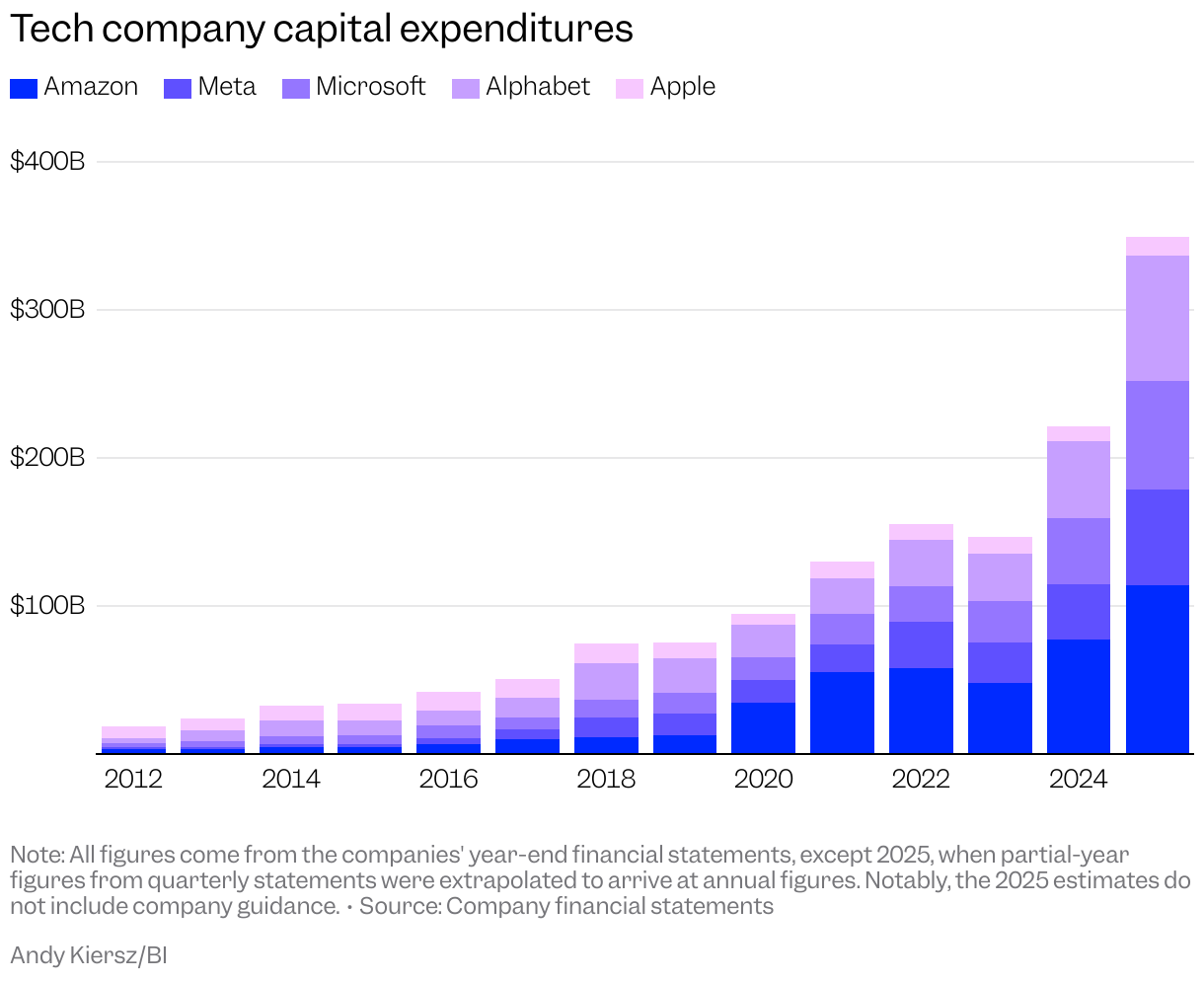
A look at tech companies’ rising capex
Stacked column chart

Don’t be surprised if analysts focus some questions around Apple’s capital expenditures and AI investments — it’s been a theme on other Big Tech earnings calls this week.

Tech companies are pouring more money than ever into AI, which has some investors worried. After all, the hot debate right now in Silicon Valley is whether we’re in an AI bubble…

Asked about capex growth on Apple’s last earnings call, CFO Kevin Parekh said that “a significant portion of the driver of growth that you’re seeing now is really driven by some of our AI-related investments.”

Apple can expect to hear more questions about the iPhone Air

The thin and sleek form factor of the iPhone Air turned heads when it was introduced at Apple’s September event.

At 5.6 millimeters — Apple’s thinnest iPhone yet — the frame comes with a smaller battery than Pro models and no physical SIM card. To make up for what it lacks in battery life, Apple released an external battery pack alongside the iPhone Air, which costs $99. But Apple’s battery-rich Pro models, with top-of-the-line cameras, are typically the company’s most popular, and reports have begun to emerge that Apple is cutting back on Air production.

A Keybanc survey of more than 2,000 iPhone owners found weak demand for the Air model compared to the strength of the Pro and Pro Max. Three percent of respondents said they upgraded to the iPhone Air, while 41% went for the iPhone 17 Pro Max.

While Apple’s most recent quarter will only include a week or so of sales from the 17 lineup, execs will likely provide some color on how the Air is doing so far.

Apple continues to show its ability to finesse its supply chain amid tariff pressures.

US shoppers discovered earlier this month that the M5 Vision Pro, a refreshed model, is labeled as being a product of Vietnam. A few creators noted the change online as they unboxed their new Vision Pros. It’s the latest example of Apple making changes to its supply chain for US-bound products to mitigate its tariff costs.

The original Vision Pro, with an M2 chip, was manufactured in China ahead of its 2024 release. Around the same time, Apple was exploring ramping up supply chain options outside of China.

Earlier this year, Tim Cook said Apple expects “the majority of iPhones sold in the US will have India as their country of origin” in the June quarter.

Tim Cook’s promotion of American production

Don’t be surprised if Tim Cook leans into Apple’s work in the US.

Earlier this year, Cook committed to investing $600 billion in US manufacturing amid President Donald Trump’s tariff push. In August, Cook presented Trump with a gift, an American-made glass plaque set on a 24-karat gold base.

Cook has proven to be a savvy political navigator — and it appears to be paying off. After receiving the gift, Trump said companies like Apple “will be treated really well.”

Cook, alongside other tech leaders, joined Trump for a dinner event in September. The Apple CEO addressed the president in a speech, praising his efforts to bring more manufacturing to the US.

Earlier this week, Nvidia CEO Jensen Huang gave an America-themed presentation during Nvidia’s GTC October keynote.

Apple (lacking) Intelligence

There’s an argument to be made that Apple’s slow start in AI hasn’t hurt it all that much — at least not yet. Yet with all the headlines around its AI talent departing, Apple would do well to reassure the market that big and exciting things are coming. One of those is a long-anticipated overhaul of Siri with Apple Intelligence, touted for next year.

Then there are reports of new home devices and AR glasses — all of which will need good AI. Don’t expect Tim Cook to break character and start gossiping about future products, but this would be a good time for a bit of extra candor.

CFRA Research eyeing More clarity on tariffs.

Apple looks like it’s in a better position heading into its earnings report than it has been in a year, according to Angelo Zino, a senior equity analyst at CFRA Research.

Zino pointed to how investors now have more clarity relating to Apple’s regulatory issues and the potential impact of tariffs.

“Recent comments about tariffs tied to the company from the Trump administration make us feel much more comfortable about the margin outlook ahead,” he added.

Demand for iPhones also looks solid heading into the print. CFRA said it was “conservatively” estimating that iPhone revenue was on track to grow 6% for the current quarter and 5% for the upcoming quarter.

CFRA issued a “Buy” rating on Apple and a $280 price target, implying 4% upside from the stock’s current levels.

Bank of America: Long-term growth in focus.

Bank of America has a strong outlook for Apple over the next five years. Analysts pointed to revenues potentially increasing due to AI and its possible impact on coming product offerings.

Analysts also said they saw “strength” in new iPhone demand, and estimated that total iPhone unit sales could reach 57 million for the current quarter, compared to consensus estimates of 54 million.

“Reiterate Buy on strong capital returns, eventual winner in AI at the edge & optionality from new products/markets,” BofA said on their rating of the stock.

Analysts lifted their price target for the stock from $270 to $320 a share, implying 19% upside from Wednesday’s price.

JPMorgan: Strong outlook through year-end.

JPMorgan said it expected Apple earnings to “track modestly better” from September through the end of the year, thanks to strong demand for the iPhone 17.

The bank also said it expects Apple to post solid revenue growth in the first quarter of its 2026 fiscal year.

“AAPL shares are heading into the upcoming earnings print with a greater halo of positivity than any time in the past year,” analysts wrote in a recent client note, adding that they believed that chatter around Apple’s investment thesis had narrowed down to the strength of new iPhone sales.

Melius Research analysts see Apple ‘getting its groove back’

Apple stock could be boosted by a few catalysts contained in its report, Melius Research said.

The research firm said it believed that the company’s sales in China would pick up over the near term. Profit margins could also improve on demand for Apple’s new lineup of iPhones, analysts said, adding that they believed Apple was “getting its groove back.”

“We think there is more to go as a beat and raise could be on the horizon when it reports,” analysts wrote of the stock’s momentum.”Bottom Line: Apple is on a mission to silence its critics. We see upside to sales in China into CY26 and momentum in new models overall.”

The firm reiterated its “Buy” rating on the stock and issued a price target of $290 a share, implying 8% upside from current levels.

Goldman Sachs predicts an iPhone-driven earnings beat.

Analysts at Goldman said they expect Apple to beat on earnings for the quarter, driven largely by strong demand for its new iPhones.

The bank estimated that iPhone product revenue could see a 10% year-over-year increase to $50.8 billion, compared to the consensus estimate of $49.8 billion in revenue for the quarter.

Apple could also see its services revenue grow 13% year-over-year, thanks to continued momentum across subscription services like iCloud+ and AppleCare+, analysts added.

Still, “key areas of debate” among investors include the sustainability of iPhone demand due to trade policy uncertainty, as well as risks to the company’s App Store revenue, the bank said.

Goldman reiterated its “Buy” rating for the stock and issued a price target of $279 a share, implying 3% upside from current levels.

Wall Street is expecting Apple to report $102.1 billion of revenue for Q4.

Fourth Quarter

  • Revenue estimate $102.19 billion
  • Products revenue estimate $73.49 billion
  • Mac revenue estimate $8.55 billion
  • iPad revenue estimate $6.97 billion
  • Wearables, home and accessories estimate $8.64 billion
  • Services revenue estimate $28.18 billion
  • Greater China rev. estimate $16.43 billion
  • Americas rev. estimate $44.45 billion
  • Europe revenue estimate $26.36 billion
  • Japan revenue estimate $6.41 billion
  • Rest of Asia Pacific revenue estimate $8.08 billion
  • EPS estimate $1.77
  • Total operating expenses estimate $15.75 billion
  • Research and development operating expenses estimate $8.8
    billion
  • SG&A operating expense estimate $6.96 billion
  • Gross margin estimate $47.41 billion
  • Cash and cash equivalents estimate $51.67 billion
  • Cost of sales estimate $54.47 billion
  • Total current assets estimate $144.92 billion
  • Total current liabilities estimate $159.68 billion

    First Quarter

  • Capital expenditure estimate $3.97 billion

    2026

  • Capital expenditure estimate $15.03 billion

Source: Bloomberg
Read the original article on Business Insider

Amazon Q3 earnings updates: Analysts expect answers on AI progress and AWS as AMZN lags other Mag 7 stocks

Amazon CEO Andy Jassy

Amazon is heading into its latest earnings report as the laggard of the Magnificent Seven this year, and investors are looking for some key updates that could spark new momentum.

Specifically, Wall Street wants to know more about its AI ambitions and how it plans to position itself against stiff competition from other Big Tech players like Microsoft and Alphabet. AWS, retail margins, and any lingering concerns over the impact of tariffs will also be on investors’ radar.

The call with analysts is scheduled for 5 p.m. ET.

We could get insight into Amazon’s holiday plans and early results

Amazon’s Prime Day event in October has become an early chance for shoppers to score holiday deals, and other retailers have even debuted their own versions. On Thursday’s call, Amazon could provide an early glimpse into how holiday shopping is shaping up.

Expect Amazon to play a big role once the holiday shopping season starts in earnest. About 73% of shoppers surveyed by marketing platform Omnisend said that Amazon is their go-to source for deals on Black Friday and Cyber Monday.

Ads have been a bright spot for Amazon

Amazon’s ad business has been finding potential growth opportunities lately.

A recent deal with Netflix will let brands buy ad slots on the streamer through Amazon’s own demand-side platform. The move rattled shares of adtech rival The Trade Desk after it was announced.

Expect an update on Amazon’s capex and AI investments

Amazon is expected to give a capital expenditures update on its earnings call this afternoon. Last quarter, Amazon’s capex totaled $31.4 billion, and the company said the figure was “reasonably representative” of its quarterly capex rate for the rest of the year. It’s largely driven by investments in AWS — particularly AI and tech infrastructure — and Amazon’s fulfillment and transportation network.

Capex growth is a hot-button issue across Big Tech. The following chart shows how spending stacks up so far.

Stacked column chart
Amazon’s grocery business got a shuffle this summer

Investors will be listening for any details that CEO Andy Jassy and the company offer about Amazon’s grocery business in light of a recent reboot.

In June, a memo obtained by Business Insider showed that Whole Foods, Amazon Fresh, and Amazon Go were being united under a single “One Grocery” operation eight years after Amazon acquired Whole Foods for $13.7 billion.

The company launched a $5 private-label grocery line earlier this month aimed at luring value hunters away from Walmart and Aldi.

Wedbush says get ready for a highly bullish report

Wedbush has high hopes for the tech giant heading into the call, maintaining a $280 price target, up from its previous target of $250 a share.

The firm’s analysts predict that it is poised for a breakout in 2026 and likely to shake off the volatility that has weighed on the stock recently. They expect Amazon to reach $99.6 billion in full-year revenue, and predict Q3 revenue of $20.1 billion.

“Heading into the print, we are most focused on AWS momentum and emerging AI monetization, rising operating margins supported by the mix shift to higher-margin revenue, capex requirements to support infrastructure and AI investments, and persistent growth within the advertising business,” Wedbush analysts wrote in a preview note.

They also cited several immediate-term catalysts, including savings from automation and robotics progress, and the commercialization of Alexa’s new AI capabilities.

Got more questions about Amazon’s layoffs? Check out our livestream at 2 p.m.

Business Insider’s Chief Tech Correspondent Eugene Kim and Chief Correspondent Aki Ito will join Deputy Executive Editor Dan DeFrancesco to talk about Amazon’s decision this week to lay off 14,000 employees in a livestream at 2 p.m. ET. AI’s role in the layoffs will be a key topic.

Got a question that you want the panel to answer? Send it to moderator Dan DeFrancesco.

Amazon’s layoffs raise a big question for Wall Street

Amazon said on Tuesday that it would cut 14,000 corporate jobs in one of the biggest rounds of layoffs in the company’s history.

It raised a big question for Wall Street: Is the company cutting jobs because growth is stalling, or is the retail giant’s big bet on AI making it more efficient? Business Insider’s Alistair Barr wrote in Thursday’s Tech Memo newsletter that Amazon’s latest quarterly earnings report could answer that all-important question.

Revenue growth for Amazon Web Services, the company’s crucial cloud business, is the number to watch when Amazon reports this afternoon, Barr wrote.

For the third quarter, Wall Street expects AWS revenue to increase 18% year over year to $32.4 billion, according to Bloomberg.

UBS analysts see headwinds waning

UBS analysts are feeling optimistic heading into the report, although they anticipate some “noise” around operating income due to the company’s recent $2.5 billion settlement with the FTC.

The bank recently raised its price target for Amazon stock from $271 to $279, maintaining its Buy rating. While analysts said that they are waiting to see investment proof points from AWS, they still see the area as a likely growth driver for Amazon, as they expect multiple headwinds to wane in the near future.

“Overall, we continue to see the potential for upside across Amazon’s business segments, including e-commerce, cloud, advertising, and Kuiper / low earth orbit satellites,” analysts wrote in a recent earnings preview.

AWS, Amazon’s growth engine, is facing AI challenges

Investors will want to hear more about AWS’s latest AI strategy, including what it’s doing to attract new customers.

Early-stage startups are skipping traditional cloud spending and heading straight to model-training tools and niche providers. These companies are Amazon’s “blind spot,” according to an internal document seen by Business Insider. Amazon has traditionally relied on venture capital firms to find startups that could be new clients.

AWS also hired a new vice president of security services and observability this month, a sign that the unit is trying to improve security around its AI products.

JPMorgan flags concerns about AI plans

JPMorgan analysts said that while they believe Amazon has done a good job executing on retail sales and margin expansion, they’re worried about its positioning in the booming generative AI space.

“There is concern around AMZN’s GenAI positioning/strategy, relative gap to Azure/Google Cloud growth, & trajectory of 2H AWS growth pick-up,” they said. “There is also concern around the impact of tariffs & changes to the de minimis exemption on demand & OI margins.”

However, the analysts add that AWS growth acceleration will likely continue, and said that they expect AI supply chain gaps to ease, which they see as bullish for Amazon.

JPMorgan maintains an overweight rating and a $265 price target for Amazon stock.

Amazon lags the Magnificent 7 in stock returns
Magnificent 7 stock returns over the past 5 years

Amazon ranks last among the Magnificent Seven tech companies — and the broader S&P 500 — when it comes to stock performance over the last five years, Business Insider’s Joe Ciolli wrote in Thursday’s First Trade newsletter.

Amazon’s stock has returned 43% over that period, behind Meta’s 168%, Alphabet’s 253%, and Nvidia’s mammoth 1,490%.

On Wall Street, some interpret Amazon’s position on that chart as a sign that its AI strategy is struggling to compete with rivals.

Bank of America is optimistic about progress in key areas

BofA analysts are upbeat heading into the report, even as doubts swirl around Amazon’s AI strategy.

“Given healthy retail sales, strength in Online advertising, and July AWS layoffs, we see potential for operating income upside and are 4% above Street for GAAP operating profit at $20.4bn vs $19.7bn,” the analysts wrote.

“We believe Street expectations are for around 1-2% beat on US retail, AWS growth at 18-18.5% based on 3P data, and op. profit slightly above the high end of Amazon’s 3Q guidance range.”

The bank maintains a Buy rating on Amazon stock and a $272 price target, implying 21% upside from Wednesday’s price.

Wall Street analysts estimate Amazon will report revenue of $177.8 billion and EPS of $1.58 for Q3

Third Quarter

  • Net sales estimate $177.82 billion
  • Online stores net sales estimate $66.93 billion
  • Physical Stores net sales estimate $5.56 billion
  • Third-Party Seller Services net sales estimate $42.05 billion
  • Subscription Services net sales estimate $12.49 billion
  • Amazon Web Services net sales estimate $32.39 billion
  • North America net sales estimate $104.96 billion
  • International net sales estimate $40.77 billion
  • Third-party seller services net sales excluding F/X estimate
    +10.8%
  • Subscription services net sales excluding F/X estimate +10.7%
  • Amazon Web Services net sales excluding F/X estimate +17.9%
  • EPS estimate $1.58
  • Operating income estimate $19.72 billion
  • Operating margin estimate 11.1%
  • North America operating margin estimate +6.98%
  • International operating margin estimate 4.02%
  • Fulfillment expense estimate $27.49 billion
  • Seller unit mix estimate 60.7%

Fourth Quarter

  • Net sales estimate $208.45 billion
  • Operating income estimate $23.78 billion
  • Capital expenditure estimate $32.33 billion

Year

  • Capital expenditure estimate $118.76 billion

Source: Bloomberg

Read the original article on Business Insider

American’s new Airbus A321XLR is finally crossing the Atlantic as the long-haul narrowbody race heats up

American's A321XLR.
American’s first-ever Airbus A321XLR.
  • American Airlines will fly its brand-new A321XLR between New York and Scotland beginning in March.
  • The super-range jet flies city pairs too thin for big planes or out of reach for similar-sized ones.
  • United Airlines will soon welcome its own A321XLR to replace existing Boeing 757 routes.

American Airlines is reviving a type of flying it hasn’t done in years: long-haul trips on single-aisle jets.

The carrier took delivery of its first Airbus A321XLR in October — a new narrowbody plane built specifically for long-distance routes.

With an extra fuel tank, the jet can fly about 5,400 miles, or up to 11 hours nonstop, while burning less fuel than previous-generation options.

American will first use the A321XLR on a domestic transcontinental route in December. But its long-haul debut comes on March 8, when the airline launches seasonal service between New York and Edinburgh, Scotland, through October 24.

Tickets go on sale November 3. Pricing isn’t yet public for the Edinburgh route, but roundtrip fares on the A321XLR’s first route, New York to Los Angeles, start at about $750 in economy and around $3,000 in business class in December.

American last flew a narrowbody across the Atlantic in 2019, relying on the Boeing 757. The plane’s eventual retirement, accelerated by the pandemic, was due to high fuel and maintenance costs.

The A321XLR is meant to fix the efficiency issue for American — and the airline has configured it for long-haul comfort.

Customers can expect a premium-heavy cabin, including lie-flat business-class seats and a dedicated premium economy section. The amenities include hot meals for all 155 passengers, with upgraded dining and amenities up front.

The enclosed AA A321XLR suite.
The new narrowbody business class cabin will appear on A321XLR transcontinental and transatlantic routes.

The Edinburgh route will complement American’s existing widebody service from Philadelphia, while adding to a growing list of seasonal transatlantic flights such as Prague and Budapest next summer — those still scheduled on larger aircraft.

Edinburgh is just the first stop on the A321XLR’s expected European tour.

The A321XLR is designed for long, thin routes: City pairs that don’t have enough demand for a widebody but are too far for existing narrowbodies to fly comfortably and economically — like Charlotte to Venice or Milan. That opens new possibilities on both sides of the Atlantic.

The move aligns with a broader industry shift of airlines sending narrowbodies across the Atlantic. And that’s significant for American, after it had largely ceded the market to rivals but is now leaning back in.

American isn’t alone

Data from aviation analytics firm Cirium show that American, Delta, and United flew about 10,000 long-haul narrowbody flights in 2019 — all on 757s.

This type of flying tapered off through the mid-2010s as the 757 grew less efficient, and the pandemic nearly halted international travel in 2020.

But, with the rising popularity of Airbus’ long-haul narrowbodies, JetBlue revived the trend in 2021, flying its 4,600-mile-range A321LR to cities such as London, Paris, and Amsterdam. Like American, its planes feature a premium-heavy cabin.

That move let JetBlue enter major business markets without investing in a widebody fleet — planes with two aisles that are far more expensive to build and operate and harder to fill consistently in competitive markets.

The inside of a JetBlue A321neoLR with blue lighting.
A JetBlue A321neoLR at the Paris Air Show in June 2023

In 2025, Delta, United, and JetBlue are scheduled to operate more than 14,000 long-haul narrowbody flights, per Cirium. That number is only expected to increase as American joins the mix in 2026.

United Airlines, for its part, has doubled down on the strategy — using Boeing 757s and 737 Max jets to connect the US to smaller leisure European destinations, like Ponta Delgada in the Azores, Portugal, and Tenerife, Spain.

The airline plans to soon replace many of those 757s with its own A321XLRs.

It has also signaled interest in opening more niche transatlantic markets with the aircraft. That could mean new nonstop options from the US East Coast to places like West Africa or Northern Italy — spots that previously required a connection.

In other words, more single-aisle planes are now capable of crossing oceans — and that’s reshaping how people fly long-haul.

Delta has been the outlier, scaling back 757 transatlantic flying and relying more heavily on widebodies. It remains the only major US carrier that has not ordered the A321XLR.

Read the original article on Business Insider

Tesla rival Polestar closes R&D sites in the UK and lays off 130 staff

Polestar
Polestar is targeting the same upper-mid-tier EV market as Tesla.
  • Polestar is shutting its UK R&D sites and laying off 130 staff.
  • A spokesperson for the EV maker said it was centralizing its R&D in Sweden.
  • Polestar posted a $1.03 billion loss in its second-quarter earnings.

Tesla rival Polestar has shut down its two R&D sites in the UK and laid off 130 staff, Business Insider has learned.

Staff at the Swedish EV maker were notified earlier this month that its R&D efforts would shift from Nuneaton and Coventry in England to its headquarters in Sweden, three sources told Business Insider. The redundancy process is expected to finish by the end of the year, they added.

A Polestar spokesperson confirmed the layoffs to Business Insider.

In an emailed statement, the spokesperson said it no longer requires the R&D capacity in the UK now that the engineering work for the Polestar 5, its upcoming model, is complete.

They added that it was centralizing its R&D work at its headquarters in Sweden.

“With a leaner organisational set-up, our focus remains on developing the best performance EVs on the market,” the spokesperson said, adding that its focus was on supporting those affected by the cuts.

Polestar, which employs 2,100 people globally, has increasingly shifted its focus to Europe as US tariffs have rocked the global auto industry. The Nasdaq-listed company is majority-owned by the Chinese conglomerate Geely, which owns Volvo Cars and Lotus.

Polestar sold a record 2,758 vehicles in the UK last month. However, the luxury carmaker is burning through cash, reporting a net loss of $1.03 billion in the second quarter of 2025.

Its sales also lag behind Tesla. There were just under 8,000 new Tesla registrations in the UK over the same period, according to data from SMMT.

In January 2024, Polestar announced plans to cut 450 jobs globally, which was equivalent to about 15% of its workforce.

Read the original article on Business Insider

JPMorgan’s analytics boss lifts the lid on how America’s biggest bank is schooling 300,000 workers on AI

View of the Park Avenue entrance to new JPMorgan Chase Headquarters.
JPMorgan Chase is teaching every employee to use AI.
  • JPMorgan Chase is proactively rolling out AI technologies across the bank.
  • The mass rollout will affect different workers in different ways, its chief analytics officer said.
  • Derek Waldron told McKinsey how the bank is training engineers, data scientists, and more.

America’s biggest bank wants every member of its more than 300,000-strong workforce to be an expert on how to juice AI.

The bank, with its $18 billion technology budget, has invested extensively in AI development. Now, it’s turning its attention to a firmwide training push. The goal? To educate its worldwide workforce on how to make AI work for every single employee — not a one-size-fits-all approach, Derek Waldron, chief analytics officer at JPMorgan Chase, said in an interview with McKinsey about the bank’s AI adoption strategy.

“Training needs are varied, just like AI applications. The best way to approach this is segment by segment,” Waldron said in the interview, which was published on the consulting firm’s website this week. Everyone from rank-and-file workers to company leaders will have to learn new skills, Waldron continued.

That being said, JPMorgan launched an internal training program for beginners, “AI Made Easy,” he said, adding that “tens of thousands” had already taken the course. The firm has created modules to educate users on how to conduct thorough research with AI or get the most out of several different data sets.

It’s not just the managed who may need to change their ways — it’s the managers, too. Waldron predicted that CEOs and business leaders will have to adopt new approaches as the tech’s reach becomes more widespread. “Value from gen AI won’t come just from giving people tools; business leaders must lead cross-functional teams through transformation in the age of AI,” he said.

A multi-pronged strategy — from town halls to communications from managers to marketing campaigns on screens across the bank’s offices — is helping to get people comfortable, he said.

What training looks like

Teaching people about AI comes down to two main layers, Waldron explained. Step one: What can AI large language models do and not do? And step two: How do you formulate the right questions?

“Once there’s familiarity with capabilities,” he said, “we move into how to construct good prompts, with frameworks and examples and constraints.” Then, things get more sophisticated: “how to pivot the persona of an LLM from maker to checker, or how to use two LLMs to debate a concept to get more creative.”

This transition is a companywide endeavor, with workers often teaching one another.

“Many teams quickly set up prompt libraries, ‘prompt of the week’ emails, and social channels to share power-user innovations,” he said, adding: “If we get the technology into employees’ hands — with change management and training — they’ll be best positioned to innovate and put it to good use.”

Everyone will have to make changes

Waldron also offered insight into how some technical roles are learning new skills.

“Software engineers need to be upskilled to build scalable AI systems based on agents and LLM components,” he said, adding: “Another population is technologists, who will increasingly want to build sophisticated applications using agentic or gen AI. That skill set is something that needs to be trained.”

Agentic AI is drawing significant focus from Wall Street and Silicon Valley. The notion that semi-autonomous digital “agents” could orchestrate end-to-end projects independently has been polarizing in some quarters. But at a conference last week, Teresa Heitsenrether — JPMorgan’s chief data and analytics officer, to whom Waldron reports — said she thought managing battalions of digital agents would give early-career workers a taste of being a boss earlier than they might get otherwise.

For data scientists, Waldron said that tech advances meant the days of building standard models were over. Third-party providers tend to handle this now, he said, letting in-house data scientists evaluate and enhance ready-made models and “apply their skills to designing, evaluating, and optimizing systems.”

In other words — the fun stuff.

Read the original article on Business Insider

Why Nvidia is worth $5 trillion: Inside a $35 billion, 1 gigawatt AI data center.

OpenAI's Stargate data center project in Texas
OpenAI’s Stargate data center project in Texas
  • AI data centers are measured in gigawatts of power these days.
  • Wall Street analysts have been getting their arms around the cost of these beasts lately.
  • Nvidia dominates spending on giant AI data centers, according to new analyst estimates this week.

If you want to know why Nvidia is valued at $5 trillion, take a look at the data and chart below. They show how this tech giant is scooping up a huge portion of the AI spending boom.

As AI enters its industrial phase, the world’s most advanced data centers now measure their scale not in square footage or servers, but in gigawatts of computing capacity. Wall Street has begun to measure the cost of these gigawatts, and predict which companies might benefit from the spending spree.

TD Cowen analysts put this in context, writing in a research note this week that 1 gigawatt is roughly the output of a nuclear reactor. That’s the new baseline for next-generation AI data centers, such as xAI’s Colossus 2 in Memphis, Meta’s Prometheus in Ohio and Hyperion in Louisiana, OpenAI’s Stargate, and Amazon’s Mount Rainier project in Indiana.

These sprawling structures require huge amounts of electricity, and combine that with capital and silicon to churn out intelligence. It’s an expensive process.

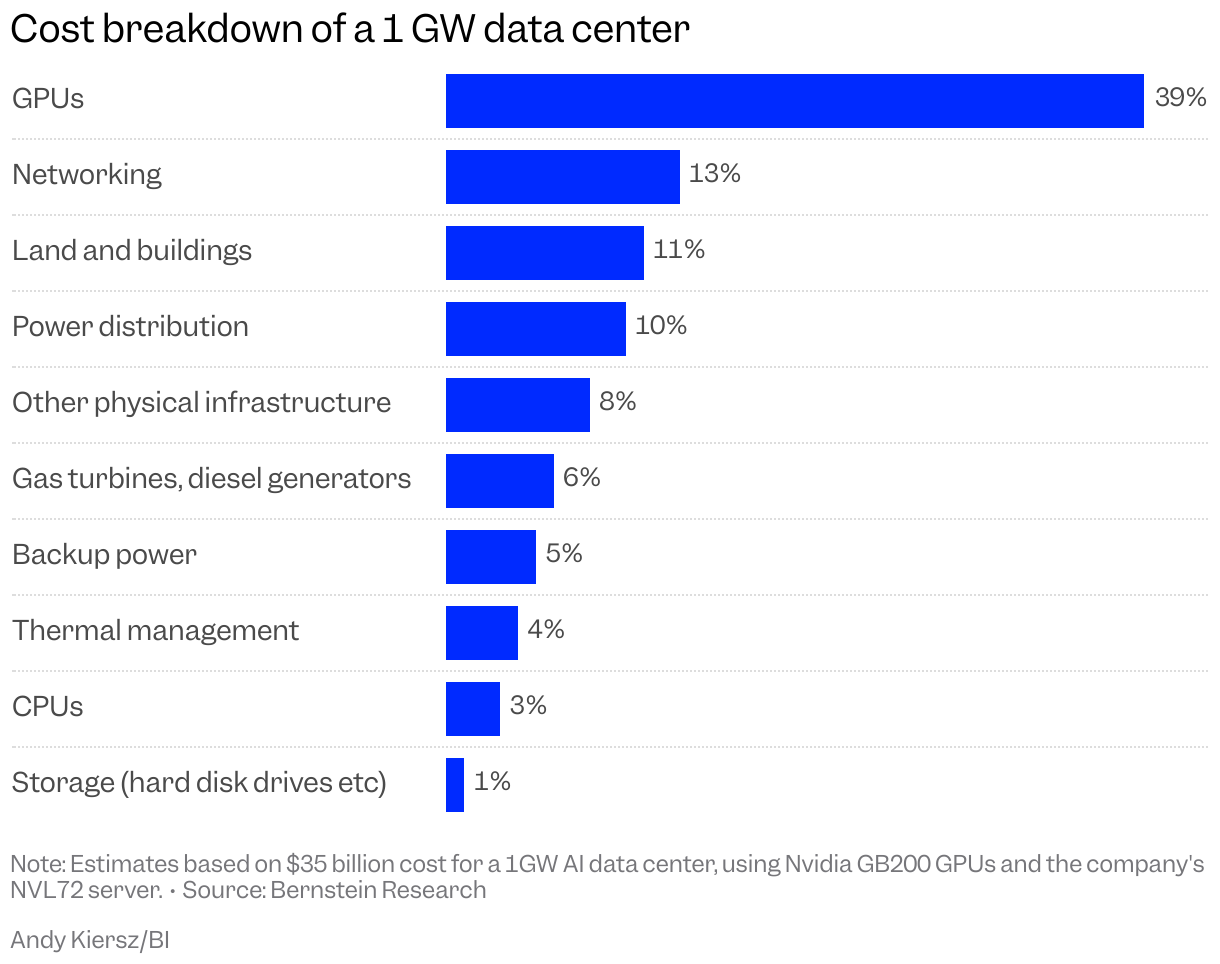
According to new analysis from Bernstein Research, 1 gigawatt of AI data center capacity costs about $35 billion. That may sound extreme, but it represents the new economic foundation of AI. Each gigawatt of data center capacity is not just a measure of power, but a proxy for an emerging industrial ecosystem spanning semiconductors, networking gear, power systems, construction, and energy generation.

Here’s what makes up the $35 billion gigawatt (GW), and which companies stand to gain, according to Bernstein and TD Cowen estimates this week.

Bar Chart

GPUs

The single biggest cost driver in an AI data center is the compute itself. Bernstein estimates that roughly 39% of total spending is devoted to GPUs, dominated by GB200 and other upcoming AI chips from the company, such as the Rubin series.

With Nvidia’s 70% gross profit margins, Bernstein calculates that the company captures nearly 30% of total AI data center spending as profit. No wonder this company is worth almost $5 trillion.

TD Cowen’s data shows that each gigawatt translates to more than 1 million GPU dies, the core brain of these AI chips. Nvidia’s foundry partner, TSMC, earns $1.3 billion per GW from manufacturing many of these components, these analysts estimated.

Other chipmakers such as AMD and Intel are trying to catch up, while hyperscalers including Google, Amazon, and Microsoft are investing in AI ASICs, custom accelerators that could reduce total system costs. Even so, GPUs remain the economic center of gravity, according to Bernstein and TD Cowen analysts.

Networking

Next in line are the arteries connecting those GPUs together. Bernstein estimates 13% of data center costs go to networking equipment such as high-speed switches and optical interconnects.

Arista Networks, Broadcom, and Marvell are positioned to benefit as switch vendors and chip designers. Arista’s high margins mean its profit share is proportionally greater than its revenue share.

Meanwhile, component makers including Amphenol and Luxshare gain from cabling and connectors, while optical transceiver makers such as InnoLight, Eoptolink, and Coherent stand to profit, too, according to Bernstein analysts.

Power and Cooling Infrastructure

The physical infrastructure around compute racks, generators, transformers, and uninterruptible power supplies, accounts for another big part of the costs of a 1 GW AI datacenter. Power distribution alone takes up nearly 10% of spending, according to Bernstein.

Eaton, Schneider Electric, ABB, and Vertiv are major players here. Vertiv also has an opportunity in thermal management, which makes up about 4% of total spend, split between air and liquid cooling systems, Bernstein estimates.

Real Estate, Electricity, and Labor

Land and buildings make up about 10% of upfront costs. But once the lights go on, operational costs are surprisingly small. It costs about $1.3 billion in electricity to run a 1 GW AI data center for a year. Personnel costs are also negligible, with huge data centers reportedly operating with 8 to 10 people who get paid $30,000 to $80,000 per year each, according to Bernstein.

The bottleneck, however, is shifting toward power availability. Siemens Energy, GE Vernova, and Mitsubishi Heavy now report surging orders for turbines and grid infrastructure as hyperscalers fight to secure reliable electricity at scale.

Sign up for BI’s Tech Memo newsletter here. Reach out to me via email at abarr@businessinsider.com.

Read the original article on Business Insider