Sundar Pichai, chief executive of Alphabet Inc., during an interview on “The Circuit with Emily Chang” on May 1, 2024.
David Paul Morris/Bloomberg via Getty Images
While some companies are slashing head count, Google’s is surging.
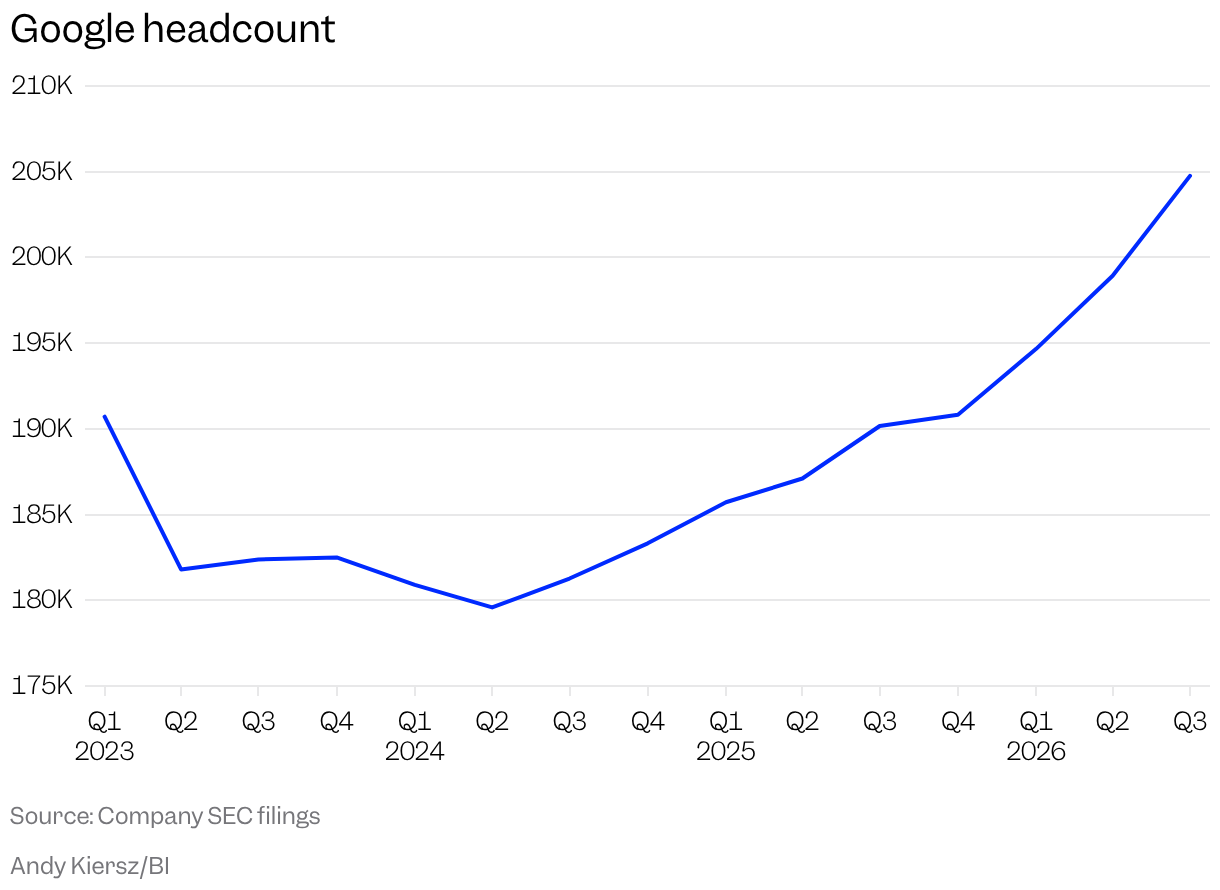
The company had nearly 205,000 employees at the end of September.
While Google has conducted layoffs, it has also ramped up hiring and acquired Wiz.
While AI may be driving some companies to slash their head count, Google’s is soaring.
When Google reported its Q3 earnings on Wednesday, it said it had 204,757 employees for the quarter ending September 2026. That means Google added roughly 10,000 people to the payroll since the end of March.
The uptick in head count runs counter to another trend across the tech industry, where some of Google’s peers are slashing their workforces. Meta has been on a cost-cutting odyssey for several years, while Microsoft recently offered voluntary buyouts to 60,000 employees.
Some of Google’s head count growth can be attributed to mergers and acquisitions. On March 11, Google said it had completed its acquisition of cybersecurity firm Wiz, which had roughly 2,000 employees.
In January 2023, Google announced it would slash roughly 12,000 roles — around 6% of the workforce at the time — and has since made several smaller rounds of layoffs, Business Insider has reported.
While the head count has grown somewhat steadily since Q2 2024, it has accelerated since the end of 2025. Google also reported Wednesday that its quarterly revenue grew 25% from this period last year.
Cristina Junqueira, the co-founder and CEO of Nubank, with Dan DeFrancesco, executive editor and anchor of Business Insider Today.
Carl Timpone/ BFA
Nubank’s CEO joined Business Insider’s The Long Play to discuss the bank’s expansion into the US.
The company looks to simplify banking with a digital-first fintech approach.
CEO Cristina Junqueira focuses on building trust through credit options and brand building.
Nubank is the largest digital bank in Latin America — now it’s turning its eyes towards the US.
Cristina Junqueira, the co-founder and CEO of Nubank, sat down with Dan DeFrancesco, executive editor and anchor of Business Insider Today, at Business Insider’s The Long Play, to talk about the digital bank’s expansion on Thursday.
How it began
Since its founding in 2013, the fintech bank has pushed for financial inclusivity in Latin America by providing access to banking and financial services through its mobile app. Headquartered in Junqueira’s home country of Brazil, the simple, low-cost, and digital-first approach discarded the need for physical banks, which are at times harder to reach in parts of Latin America — a key part of its success in the region.
It all started with a purple credit card with no fees.
“We had this vision that data, design, technology, completely transforms people’s relationship with money,” she said.
Junqueira previously worked as an executive at Itaú Unibanco, the largest private-sector financial giant in the region, also headquartered in Brazil and now a direct competitor of Nubank. Today, it is the largest company in Brazil based on primary banking relationships, and two-thirds of the country’s adult population are customers, she said.
Entering the US market
The digital bank is set to expand into the US after opening a branch in September, operating under the name Nu. This comes after expansion into Mexico and Colombia in 2021.
“We always saw the thesis as a global one,” she said. “Everywhere in the world, people want more convenience. People want more transparency. People want simpler experiences managing their finances. People still get like paralyzed by complexity through their financial lives.”
Entering America’s crowded banking sector is a risk — but for Junqueira, entering no country goes without risk.
“The US is a very hard market, but I haven’t found easy ones either,” she said. “Building a bank is hard everywhere, so you might as well go for the biggest payout.”
In the US, she said getting a bank account is still “surprisingly hard” and normally requires you to go to a physical branch, while Nu offers an easier alternative to that, she said. Foreign digital-first banks have tried to bring their platforms to the US before and failed. German fintech N26 and UK fintech Monzo both tried to expand their businesses to the US, and ultimately withdrew from the market.
The American consumer is unique, which is why Junqueira aims to take a different approach than her competitors to earn trust and scale the platform. She said most other companies started with debit cards, while Nubank is the first to start with credit cards.
Starting people out with a debit card “requires you to build a lot of trust with those customers because you’re asking them to deposit their money with you,” she said. “In our case, all the countries that we started, we started with credit. This is a very different relationship because you’re the one trusting the consumers,” she said.
Some Latin American immigrants who already live in the US are responding positively to Nu as it enters the market.
“I’ve been positively surprised not only by the amount of people, sure, but Brazilians, Mexicans, and others are here and have been waiting for this,” she said.
Junqueira also pointed to emerging AI technology and how it could impact the company and the banking sector. She said the company is “heavily leveraging AI,” integrating it in credit underwriting, customer support, and product development.
Brazil’s presidential election on Sunday made headlines as President Luiz Inácio Lula da Silva unexpectedly won a runoff against Flávio Bolsonaro, who fled the country to the US after he was under investigation for alleged corruption and money laundering. When asked about how she reacted to the big market sell-off in response, Junqueira said volatility is part of operating in a country like Brazil, but having 13 years of experience in the country has helped them learn they are going to run the company for the long run.
“We got to focus on the fundamentals, and the reality is, last quarter we turned over a billion dollars in net income,” she said. “Markets don’t like surprises, right? But we manage our business regardless of what happens.”
Building a brand
The CEO said one of the hardest things Nu will have to do in the US is build a brand that connects with users on an “emotional” level. Junqueira’s dream scenario, five years from now, is to find evidence of that connection in the US.
One of the ways Nubank is attempting to spread its brand is through a recently signed deal with the Mercedes F1 team. Junqueira pointed to fans’ passion for specific teams, as they follow the championship around the world, which was part of why they wanted to take part.
“We got a lot of visibility out of that, and we’re working with them on brand activations,” she said. “We’re producing very interesting activations for consumers that help us amplify the branding fast, and that really help us bring this partnership to life.”
Another huge part of the digital bank’s brand is gender equality. In 2021, Nubank set a goal for 50% of Nubank’s leadership to be women by 2025. Junqueira said today that the company’s workforce is over 45% women, with many in leadership positions. In the four countries where they operate, all CEOs are women. Junqueira said the biggest challenge of being an executive while raising a family is not having the flexibility to juggle the demands of both roles.
“The reality is, as hard as we have to work, I think the hardest part is not having enough flexibility,” she said. “It has been wonderful for us to have that type of opportunity, for us to really be able to tap into this part of the workforce that often struggles to have this type of career opportunity.”
Barry Diller told Business Insider’s Peter Kafka that “forever assets” like MGM and its Las Vegas resorts are protected from AI disruption.
Carl Timpone/ BFA
Barry Diller says he tried to buy all of MGM because real-world experiences like a trip to Las Vegas are a strong hedge against AI.
He said the deal fell apart because he didn’t want to take on debt or raise money from third parties.
Diller spoke to Chief Correspondent Peter Kafka at Business Insider’s The Long Play.
Media mogul Barry Diller thinks businesses that operate in the real world have a strong protective moat against AI.
That was the inspiration for his company People Inc.’s June bid for MGM Resorts International’s casino and hotel business, which he called “forever assets.”
As some consumers turn to AI chatbots to complete tasks like buying plane tickets or managing subscriptions, digital-only businesses could get boxed out. That creates real risks for internet brands like Expedia Inc., where Diller is an investor and board member. It’s less of a problem for companies whose businesses exist in the real world, he said.
Nothing is going to replace Las Vegas, Diller said — and no one’s going to buy another one. Gaming is only part of the equation, he said.
“No disintermediation is coming between a person who wants to go to a place, and that place,” he said, speaking to BI’s Chief Correspondent Peter Kafka at Business Insider’s The Long Play event in New York on Thursday.
People Inc. first took a 27% stake in MGM in 2020. The company, which operates magazines such as Food & Wine, People, and Southern Living, later offered to buy the Las Vegas brand outright in June but withdrew its bid in September.
Diller said the deal fell apart after he became uncomfortable with the proposed structure, which involved taking on debt and asking third parties for money.
MGM later offered to buy People Inc. instead, but told investors on Wednesday that it had shelved the plan. Diller said it was “highly unlikely” that MGM was interested in People’s magazine assets, but rather it had hoped to buy back People’s MGM shares.
People remains MGM’s largest investor, though it has agreed not to buy more than a 29.9% stake in the company and to vote with MGM’s board in connection with a change-of-control transaction.
Barry Diller says AI isn’t going to get between someone who wants to go to Las Vegas and the resort town.
Carl Timpone/ BFA
People, which, beyond its magazine portfolio, also owns stakes in The Daily Beast and the car-rental company Turo, laid off 195 workers on Thursday, per a memo from CEO Neil Vogel, which Business Insider viewed. The vast majority of whom work on its “print and legacy web businesses,” the memo said. The company has “added 320 new employees so far in 2026,” it said.
Diller told Kafka that the layoffs were a sign of a healthy company that has a profitable print business in a “steady kind of decline.”
“We’ve been transferring out people in these legacy businesses and transferring in people to do the new work,” he said.
Diller is a longtime media operator. He served as chairman and CEO of Paramount Pictures in the 1970s and 80s, before joining Fox Inc. and helping to start Fox Broadcasting with Rupert Murdoch in the mid-1980s. He then worked at QVC before serving as CEO of IAC and taking on roles at Expedia Group. He is on the board of directors at MGM.
Instagram is offering some creators six figures to help make it a long-form video hub.
The Meta platform is reviving its IGTV ambitions, allowing horizontal videos of up to 90 minutes.
Creators are required to cross-post their long-form YouTube content to Instagram as part of nonexclusive deals.
Instagram wants what YouTube has — and it’s willing to pay up to get it.
In an effort to persuade content creators to post long-form video on Instagram, the company is paying a select number of creators hefty sums, according to people familiar with the deals.
Not every deal is equal. The Meta-owned platform has offered select creators $50,000 to post long-form video to its new “Features” product, while others have been offered six-figure deals, some of which have reached $500,000, Business Insider exclusively learned.
“We’ve been public about the fact that we are funding Features content directly with some creators right now to support them,” a Meta spokesperson told Business Insider. “The details of those deals are confidential, but we’re excited to see the content going live.”
On Monday, Instagram unveiled an overhaul of its video formats. Most importantly, it’s resurrecting IGTV — a long-form video product Instagram launched in 2018 and sunset in 2022 — in the form of Features. The horizontal, wide-screen videos will exist within the Instagram app, and can be as long as a feature film: 90 minutes.
Instagram is expanding its offerings for long-form video content.
Meta
Long-form video isn’t exactly what people are used to watching on Instagram. Reels, the platform’s answer to TikTok’s meteoric rise, has redefined the Instagram experience and is driving time-spent and revenue across Meta’s apps.
YouTube, however, reigns king as the internet’s destination for sit-down, longer-form videos.
Instagram knows this. The deals do not require exclusivity to Instagram, multiple people familiar with the agreements said; one person familiar with the offers said it’s asking creators to post to Instagram any of the long-form content they publish to YouTube that same day.
Reza Izad, partner at Underscore Talent, whose clients include “Subway Takes'” Kareem Rahma and Noah Beck, called the deals an “exciting opportunity” for creators.
“Every time there’s a new feature in these apps that the company’s promoting, people will have more opportunity to be seen because there’s going to be algorithmic preference to this kind of content,” he said. “And unlike short-form, there’s not a lot of abundance.”
Money, money, money
This isn’t the first time Instagram has inked paid deals with creators to lure them to post more on Meta’s apps.
Last year, Meta was paying creators thousands of dollars to post short-form videos to Instagram and Facebook in the midst of TikTok’s potential ban. The company has tested several bonus programs paying creators for the performance of their Reels on Instagram, though those programs have dwindled.
Back in 2021, when IGTV was still part of Instagram’s big video bet, it inked deals with creators, funding long-form episodic shows from creators like TikTok’s “Sway Boys” and “Dance Moms” alum Nia Sioux. Briefly, IGTV had its own monetization program, too, which let some creators earn a cut from ad revenue on the format.
While Instagram is paying some creators directly, a big question looms over the creator economy: What about the rest of them?
A major draw of YouTube is its long-standing Partner Program, which pays eligible creators a share of the ad revenue generated by their videos. Even though YouTube has increased its eligibility requirements, the potential to turn a hobby or passion project into a cash-earning career has kept YouTube on top as the go-to video platform for creators.
It’s no surprise, then, that when Instagram announced its video overhaul, creators immediately had questions about monetization.
“We understand the economics matter a ton, and are exploring multiple options to help long-form creators get paid,” Instagram’s top executive, Adam Mosseri, wrote in an X post on Wednesday.
After winning “American Idol” in 2002, she’s remained a household name through her music, children’s books, and TV roles. She was also involved in public drama this year when she started feuding with a Brooklyn toy store.
No matter the occasion, though, Clarkson has stood out onstage and across red carpets with her ever-evolving style.
Here’s a look at how her fashion has changed over the years.
Kelly Clarkson was the ultimate girl next door when she became a household name in 2002.
Kelly Clarkson attends the 2002 premiere of “Swimfan” in Westwood, California.
Robert Mora/Getty Images
After winning “American Idol,” she wore one of her most memorable looks to date at the “Swimfan” premiere.
It included a strapless tie-dye dress over bootcut jeans and platform sandals. Clarkson also sported a statement pendant and a red newsboy cap.
She embraced little black dresses throughout 2003.
Kelly Clarkson attends the 2003 Billboard Music Awards in Las Vegas, Nevada.
Carlo Allegri/Getty Images
Clarkson wore various versions of the fashion staple that year, including at the Billboard Music Awards.
Her strapless dress that night had a knee-length skirt, a bustier bodice, and all-over ruching. She wore it with pointed pumps and long diamond earrings.
And she showed her feminine side in 2004.
Kelly Clarkson attends the 2004 American Music Awards in Los Angeles, California.
Jon Kopaloff/Getty Images
At the 2004 American Music Awards, Clarkson walked the red carpet wearing a floor-length gown with satin detailing.
She accessorized the red ensemble with gold sandals and matching earrings, and completed the look with an updo hairstyle.
The next year was defined by punk-rock outfits.
Kelly Clarkson attends the 2005 KIIS-FM Wango Tango in Los Angeles, California.
J. Merritt/Getty Images
For most of her performances in 2005, Clarkson appeared onstage in torn band T-shirts, low-rise jeans, and either sandals or sneakers.
She wore a version of that exact outfit — a Rolling Stones top, low-rise pants, and a studded belt — to perform at the 2005 Wango Tango concert.
She mixed her edgy and glamorous styles in 2006.
Kelly Clarkson attends the 2006 Grammy Awards in Los Angeles, California.
Gregg DeGuire/Getty Images
For the 2006 Grammy Awards, Clarkson stunned in a black Max Azria gown.
The strapless piece had a form-fitting bodice and full, ruffled skirt, which added unique texture and mirrored the wavy style of her hair.
Normally a fan of gowns, Clarkson began experimenting with minidresses in 2007.
Kelly Clarkson attends the 2007 ASCAP Pop Music Awards in Los Angeles, California.
Jeffrey Mayer/Getty Images
She attended the ASCAP Pop Music Awards that year in an olive-toned shift dress with a beaded neckline and bubble skirt.
Clarkson also debuted a new bob hairstyle that night and accessorized with a silver bracelet and sandals.
The musician sparkled throughout 2009 and the early 2010s.
Kelly Clarkson attends the 2009 American Music Awards in Los Angeles, California.
Frazer Harrison/Getty Images
At the 2009 American Music Awards, Clarkson walked the red carpet in a sleeveless CD Greene design.
The knee-length dress had clusters of silver sequins at the top and more embellishments cascading down its bodice and skirt.
She wore the garment with fishnet tights, black pumps, and a crimped red hairstyle.
Clarkson returned to her rock roots in 2012.
Kelly Clarkson performs a 2012 show in Birmingham, United Kingdom.
Steve Thorne/Getty Images
At concerts that year, Clarkson performed while wearing band T-shirts and skinny jeans.
For a show in Birmingham, for example, she hit the stage in black denim, a ripped UFO concert tee, and a sparkling vest.
She wore a ton of red throughout 2013.
Kelly Clarkson visits the SiriusXM Studios in New York City.
Taylor Hill/Getty Images
Clarkson especially seemed to favor the color while promoting her Christmas album “Wrapped in Red.”
She wore it during a visit to the SiriusXM Studios via a plaid dress with zipper detailing, a cropped sweater, and studded sandal heels.
By 2015, Clarkson’s fashion was full of bold prints.
Kelly Clarkson visits the SiriusXM Studios in New York City.
Cindy Ord/Getty Images
During another visit to the SiriusXM Studios, she wore a music-inspired outfit that included a knee-length skirt printed with images of vinyl records.
She also wore gold sandals and a yellow T-shirt that said New York City.
Clarkson opted for chic looks in 2016.
Kelly Clarkson makes a 2016 appearance on “Extra” in New York City.
Dia Dipasupil/Getty Images
Her office-ready style included black minidresses, sheer tights, and pointed pumps — just like she wore to appear on “Extra” that year.
Clarkson was also sporting blonde hair in loose waves at that point.
By 2019, Clarkson was having more fun with her red-carpet outfits.
Kelly Clarkson attends the 2019 “UglyDolls” premiere in Los Angeles, California.
Steve Granitz/Getty Images
At the “UglyDolls” premiere, Clarkson walked the orange carpet in a hot-pink gown designed by Christian Siriano. It had a floor-length skirt with a short train and giant, puffy sleeves.
The outfit was likely inspired by Moxy, the pink “UglyDolls” character that Clarkson voiced for the film.
In the 2020s, Clarkson has seemingly found her signature style: a mix of glamour and rock ‘n’ roll.
Kelly Clarkson attends the 2020 Billboard Music Awards in Los Angeles, California.
Amy Sussman/Getty Images
She attended the 2020 Billboard Music Awards in an outfit that perfectly embodied that style.
Balmain designed her silver gown, which had large shoulder pads and fringe hanging from its skirt and sleeves.
She’s not afraid to experiment with daring looks.
Kelly Clarkson performs at the 2023 iHeartRadio Music Festival in Las Vegas, Nevada.
Rich Polk/Stringer/Getty Images
In 2023, Clarkson performed in a series of bold outfits — including the lace jumpsuit she sported at the iHeartRadio Music Festival.
She wore the see-through garment under a blazer styled as a dress, and thigh-high leather boots.
Minidresses and metallics have become signature parts of her wardrobe.
Kelly Clarkson at the 2024 Rock & Roll Hall of Fame induction.
Kevin Mazur/Getty Images
Clarkson attended the 2024 Rock & Roll Hall of Fame induction ceremony in a Rebecca Vallance minidress.
The long-sleeve piece was black with a sheer waist panel and metallic sequin embellishments all over.
She wore it with black sandal heels and her new wavy hairstyle with bangs.
So have glamorous gowns.
Kelly Clarkson performs at her Las Vegas residency in 2025.
Denise Truscello/Getty Images
When Clarkson performed her Las Vegas residency in 2025, she wore a tan gown covered in sparkles and feathers.
It hugged her body from her shoulders to her knees, where the gown was made of mesh and embellished with silver sequins.
Its sleeves and skirt were more dramatic. They puffed out and were covered in rows of feathers, which added texture and shape to the look.
Today, Clarkson’s style is simple but elevated.
Kelly Clarkson performs on “The Kelly Clarkson Show” in 2026.
Weiss Eubanks/Getty Images
Before “The Kelly Clarkson Show” ended in August 2026, Clarkson appeared in a multitude of chic outfits.
One of them was a sheer black gown with a plaid pattern. It revealed the bralette and miniskirt she wore beneath the floor-length piece.
She completed the outfit with neutral makeup and a wavy hairstyle.
People in Big Pharma keep making progress and accept that their industry is hated, Hastings said.
Erica Denhoff/Icon Sportswire via Getty Images
Netflix cofounder Reed Hastings says Silicon Valley execs are like airlines, banks, and Big Pharma.
They’re all powerful and hugely consequential. They’re also widely disliked, he said.
Americans have lost love for tech CEOs — and new movies are highlighting the execs’ darkest hours.
Reed Hastings thinks the tech industry has some Big Pharma energy.
During an interview with “On with Kara Swisher,” released on Monday, the Netflix founder and former co-CEO responded to questions about the unpopularity of Silicon Valley executives.
“Well, think of pharma,” he said. “Pharma is hated by the general public, and to my eyes, is continuing to do amazing and positive work. But people hate the high drug prices, and so pharma is deeply hated.”
Hastings also said that drug companies have developed “remarkable” products — like the COVID vaccines — but still draw public ire.
“Did people fall in love with those companies? They did not.”
He also compared tech execs to banking and airline bosses: powerful, consequential, and largely disliked.
Swisher raised the question as Hollywood is highlighting some of tech’s ugliest chapters in movie theaters across America. A24’s “You Can See Everything” has blown up the box office — it’s a documentary following former Theranos CEO Elizabeth Holmes in the weeks before she reports to prison. Aaron Sorkin’s “The Social Reckoning” dramatizes whistleblowing at Meta. Alex Gibney’s “Musk” tracks the rise of Elon Musk’s political influence. And Luca Guadagnino’s “Artificial,” a biopic about a biopic that focuses on OpenAI CEO Sam Altman, is out on Christmas.
Hastings said that tech’s yearslong tumble out of public favor is not particularly unusual. Large industries always invite skepticism.
“That’s the natural state of how much of the public thinks about business,” he said.
Still, Hastings, who sits on Anthropic’s board, said that Silicon Valley companies still have one potential PR golden goose.
“We’ve got to actually cure some diseases,” he said. “That’ll help.”