OpenAI integrates Codex into its ChatGPT app, creating a hub for work and AI tools.
OpenAI’s new GPT-5.6 models are designed to meet varying user needs with different price points.
The wave of models and product releases comes amid fierce competition in both areas.
OpenAI has built a super app for work.
On Thursday, the company announced it is now merging its popular Codex AI coding tool into its ChatGPT desktop app, a move to turn the flagship AI app into a one-stop shop for engineers and other professionals. OpenAI also revealed a Work setting for the ChatGPT app and a batch of state-of-the-art AI models in its new GPT-5.6 family.
The latest wave of releases encapsulates OpenAI’s ambitious strategy: train uber-powerful AI models, deliver them to ChatGPT’s massive user base, and become an indispensable part of life for millions of workers. ChatGPT has almost 1 billion users, OpenAI engineer Thibault Sottiaux said on a Thursday livestream.
OpenAI, which had an early lead in the industry, is fighting to stay at the forefront of AI capabilities, duking it out release by release with rival Anthropic and trying to stay ahead of Google, Meta, SpaceXAI, and cheaper Chinese AI models. Meta also announced its first paid AI model on Thursday.
OpenAI originally launched Codex as a software engineering tool and has since expanded its reach to a broader market. In June, the company released a report that said areas like data analysis and research were growing faster than traditional coding uses on Codex and that 5 million people use the tool each week.
Codex leader Andrew Ambrosino called Thursday’s merger of Codex into ChatGPT “only the first” step: “We’re working to unify the experience across web, mobile, and desktop—but we want to do it thoughtfully, not smash two things together with a toggle and call it a day.”
On OpenAI’s Thursday livestream, Sottiaux and other colleagues showcased the desktop app’s new Work feature, which will incorporate popular aspects of Codex, such as the ability to modify a computer’s files and to operate autonomously in a browser.
OpenAI has filed the confidential paperwork to go public. The AI competition, government involvement, and research progress could affect the timing of the company’s initial public offering.
When asked by CNBC on Thursday if OpenAI would go public this year, CEO Sam Altman said, “I don’t know.”
Have a tip? Contact this reporter via email at scouncil@businessinsider.com, or over text, Signal, Telegram, or WhatsApp at 415-757-8198. Use a personal email address, a nonwork WiFi network, and a nonwork device;here’s our guide to sharing information securely.
I went on a road trip to four national parks in six days.
Daniel Lu
With three friends, I embarked on a whirlwind road trip to four national parks in six days.
Limited time at parks led to rushed visits, especially at Yellowstone and Glacier National Park.
Weather impacted the experience, but overall, the trip was considered a success despite challenges.
In June, three of my friends and I embarked on a long, ambitious, and, at times, tiring road trip from Wyoming to Seattle. We had planned to stop at four national parks in six days, spending a few hours in each.
We knew from the start that we wouldn’t be able to see everything in any of the parks, and we were fine with that. When else were we going to fly to Montana or Wyoming?
We wanted our trip to include a mix of national parks, state parks, urban exploration, and open roads.
When we went to Yosemite National Park last October, we wished we could have stayed forever, but we had no regrets about spending one night there, so we assumed the same would be fine this time around.
Seeing four of the most stunning national parks in one week — Grand Teton, Yellowstone, Glacier, and Mount Rainier — was hard to put into words.
However, I felt overwhelmed by how much there was to see and knew I would likely have to return to get the full experience.
We didn’t have enough time to explore each place
There was so much to see with so little time.
Daniel Lu
We spent the most time in Grand Teton National Park, staying two nights in Jackson, Wyoming, at a motel. We spent plenty of time at Jenny Lake, went horseback riding with the mountains in the background, and viewed Grand Teton’s snowy peak for hours.
When it came time to go to Yellowstone, though, we calculated we could spend only five hours there, since we had to drive another hour north to Livingston, Montana, to reach our hotel.
As soon as we arrived, we headed straight for Thumb Geyser. It was less crowded than but not as stunning as Old Faithful, which we rushed to 15 minutes later. Then, we bolted to Grand Prismatic Spring.
By then, we were hungry and knew we had to find an open restaurant on the Montana side of the park, so we drove out and stopped for a few pictures along the border.
The weather wasn’t perfect some days.
Noah Sheidlower
I was so enamored by Grand Teton that I definitely did not give Yellowstone enough of my enthusiasm and time.
For the next two days, we drove through Montana’s major cities, stopping in Bozeman, Helena, Butte, Missoula, and Kalispell en route to Glacier National Park.
Given our tight schedule and an added delay from getting lunch at a restaurant with very slow service, Glacier somehow felt more rushed.
We had time for about an hour of kayaking on Lake McDonald before heading up Going-to-the-Sun Road to Avalanche Lake, where the road had closed due to ice. I left wishing I could have done much more in what many consider America’s prettiest national park.
Though we only spent about three hours in Mount Rainier, I was more satisfied with what we saw. The mountain was stunning from every angle, and I didn’t feel the longer hikes would have been as fulfilling as staring at Mount Rainier’s reflection on the lake.
As the trip progressed, all of the nature seemed to blend together
The parks are so beautiful, but some views began to feel repetitive.
Daniel Lu
Every park had its unique beauty, and the mind-bending geysers of Yellowstone complemented the tranquil, deer-filled trails of Glacier.
By the time we got to Mount Rainier, though, I had felt natured-out. We had seen so many waterfalls, valleys, mountains, and wildlife that I almost felt numb to the views at the latter two parks.
On one occasion, we passed by an overlook that I was convinced we had seen before, only to realize it was an entirely different viewpoint.
By the time we got to Old Faithful, we were quite tired.
Noah Sheidlower
Aside from the major distinguishing sites, many of the trails and roads in the latter parks felt like repeats of those in the earlier ones we visited, which I’m confident would not have been the case if I had visited them on separate trips.
I know I missed much of the nuance in each park; every moose or bison I saw on the side of the road was just “another bison.”
Since our schedule was so tight, we were stuck with whatever weather we got
Some days, the weather was excellent.
Noah Sheidlower
Given that we only had a few hours in each park except Grand Teton, we had to deal with whatever the weather turned out to be.
We were lucky overall, with mostly clear skies, though we got stuck in a storm at Grand Teton that prevented us from doing more ambitious hikes.
The mountains disappeared behind heavy clouds, and visibility was low. This was also the case in part at Mount Rainier, where clouds blocked most of the mountain at a few viewpoints.
Of course, if we had stayed longer at any of these parks during a rainy week, the outcome could have been worse. Still, our tight schedule left too little of a cushion for adverse weather.
I have no regrets, but I wouldn’t do this trip again
The stunning beauty of the natural parks was overwhelming.
Noah Sheidlower
After a few weeks of reflection, I have no regrets about how we planned this trip. Every park visit worked out, the road trip was smooth, and everywhere we went was beautiful.
My friends and I paid only $80 combined to get into the parks because we had America the Beautiful annual passes that covered parking, plus entrance and standard-amenity fees. It felt like a great deal, and we can still use our passes until they expire to visit other parks and federal recreational lands around the US.
As much as I wish we’d spent more time at each stop, the reality is we all have limited vacation days, travel budgets, and so much else we want to see in the world.
We probably wouldn’t have been able to see all four of these parks in the next few years if we had broken the trip into two or three parts.
Still, I likely would have been able to enjoy the national parks more if I divided the trip into Grand Teton and Yellowstone, then a separate trip doing Glacier, Mount Rainier, and Olympic National Park outside Seattle.
To get the full experience of most of these places, though, I do feel I need to plan some return trips.
The tech giant announced its latest AI model, Muse Spark 1.1, on Thursday, saying it performs well on industry tests for coding and AI agents. It’s Meta’s first AI model that it charges users for.
In comments on X, Meta CEO Mark Zuckerberg said the model has a “very low price.”
Zuckerberg called out other AI companies for pricing their chatbots at “very extreme” levels in comments to Bloomberg. He told Bloomberg that the model outperformed Google’s Gemini in several categories, including agents, coding, and other capabilities.
“We think that there’s a real ability to be able to offer frontier or very high-level intelligence at a much more affordable cost,” Zuckerberg told the outlet.
The model, which isn’t fully available to developers yet, marks the latest milestone for Meta’s AI efforts — and shows the company intends to compete on price.
If Meta’s new AI models can compete with widely-used coding tools from rivals like Anthropic, OpenAI, and Cursor, that could represent a huge new source of revenue. Meta’s stock was up nearly 2% on Thursday.
Meta’s chief AI officer, Alexandr Wang, told CNBC that the company will charge $1.25 per million input tokens and $4.25 per million output tokens — lower than the pricing for Google and OpenAI’s flagship models.
The cost of using AI has become a growing concern for companies as employees incorporate the technology into more of their day-to-day work. Companies have been throttling their employees’ use of AI in recent months as vibe coding takes off. Coinbase, for example, now limits its engineers’ weekly AI spending to $500 to $5,000 a week.
Meta quoted one of its customers, AI coding startup Cline, saying that the new AI model’s price point makes it easy to run heavy AI coding tasks at scale.
“That combination is rare, and it’s exactly why we wanted Cline developers to have access early,” Saoud Rizwan, the Cline CEO, said on Meta’s website.
Meta is spending massive amounts of cash on AI, raising its capital expenditure guidance for this year to $125-$145 billion, up from a previous estimate of $115-$135 billion. Meta remains highly dependent on its ads business, which accounts for about 98% of its total revenue, according to its first-quarter earnings results.
“We believe Meta is well positioned to generate ample revenue to support its spending, driven by monetization of its own AI initiatives, advertising share gains, incremental subscription revenue, an optionality of cloud offering, and fees for external use of its AI models,” BNP Paribas Equity Research senior analyst Nick Jones wrote in a note to investors on Thursday.
Joe Tigay, Equity Armor Investments portfolio manager, said that undercutting prices signals that Meta’s AI lags behind Anthropic’s and OpenAI’s.
“They are forced to compete on price and raw computing real estate rather than model superiority,” he told Business Insider.
Meta is also working on a coming AI model codenamed “Watermelon,” which Wang said has caught up to one of the latest versions of OpenAI’s ChatGPT. The model uses “an order of magnitude” more computing power than Meta’s previous model, Wang told staff last week, Business Insider reported earlier.
Meta didn’t respond to a request for comment.
Correction: July 9, 2026 — An earlier version of this story misspelled an analyst’s name. It should be Nick Jones. This story has also been updated to include Wang’s comments to CNBC on the model’s pricing.
The author got to go to a World Cup game in Houston, TX, with her son and daughter.
Courtesy of Jamie Davis Smith
My son, 11, is a huge soccer fan — so much so that he’s gotten me into the sport.
I wanted so badly to get tickets to the World Cup for us, but it started to seem impossible.
I wrote about my quest and got an email from Sugar Land, TX, that I worried was fake. It wasn’t.
My son, 11, is a die-hard soccer fan who did the impossible: He got me to love soccer and soccer culture. Long before the World Cup began, he begged me to go to a match. He typically plays soccer five days a week, often following a skills class with travel team practice. He almost exclusively wears soccer jerseys and knows minute facts about soccer players and teams.
I assumed getting tickets to the World Cup would be difficult but possible. I entered every ticket lottery and opened a credit card that promised priority access, but struck out at every turn. Because I am a storyteller, Iwrote about our quest to see a match. When getting tickets proved far harder than I anticipated, my son was despondent but still hopeful.
The author flew to Texas with her daughter and son to see a match between Brazil and Japan.
Courtesy of Jamie Davis Smith
We still planned a great World Cup experience — until a concussion thwarted our plans
Even though we didn’t have tickets to the World Cup, we decided to make the best of the tournament. We planned to attend watch parties and tune in to as many games as possible. My son, a graduating 5th grader, was looking forward to an all-day World Cup-themed extravaganza at school to celebrate.
However, the night before the World Cup started, an angry teammate threw a soccer ball directly at my son’s head, leaving him with a concussion. Instead of a joyful World Cup opener and the end of elementary school, my son was coping with a raging headache, nausea, and fatigue.
He missed celebrating the World Cup’s first match with his friends. Because he had to significantly limit screen time and loud noises hurt his head, we couldn’t go to watch parties or view more than a few highlights of early games. My son also missed playing with his soccer team for the last match of the season and spent much of his graduation ceremony with a splitting headache.
We spent my son’s time convalescing, sorting through Panini World Cup stickers, and swapping with other soccer fans so he could fill in his World Cup book with all 980 stickers. We built Legos, including a new Ronaldo set released for the World Cup.
My son’s grace in handling the loss of so much he had been looking forward to made me even more determined to get him to a World Cup match. However, sky-high ticket prices, combined with loss of income from having to take off work and medical expenses, meant a match was more out of reach than ever.
At first, the author thought the email from Sugar Land, TX, was too good to be true.
Courtesy of Jamie Davis Smith
A too-good-to-be-true email landed in my inbox
In the midst of World Cup excitement that seemed out of reach, an unexpected email landed in my inbox. A representative from Sugar Land, TX, just outside the World Cup host city of Houston, readaboutourdeterminationtoseeaWorldCupgame. “Would my son and I like to attend a game in Houston and visit Sugar Land?” they asked.
My response was an immediate and enthusiastic yes, although I didn’t tell my son about the offer right away because it seemed not just improbable but impossible. If I could get my son to Texas, Visit Sugar Land, an official supporter of the World Cup in Houston, would provide us with tickets to a match, and I could bring my daughter too. I spent several hours wondering if the offer was real. However, after a few days of ironing out logistics and no odd requests for our Social Security numbers or my mother’s maiden name, I bought our plane tickets. We started counting down the days until the match.
The author’s son thoroughly enjoyed the match.
Courtesy of Jamie Davis Smith
The match was so much better than we expected
When it was time to fly to Sugar Land, my son wasn’t completely recovered, but his doctor cleared him to travel. He boarded the plane in complete shock that he was actually headed to see Brazil face off against Japan in a knockout match.
My son barely slept the night before the game. When the hour to head to the match finally arrived, he wore a customized Brazil jersey that a friend brought for him straight from Rio de Janeiro a few years ago. The jersey was a little too big then, but it fits perfectly now, perhaps a sign that this was meant to be.
My son insisted that we get to our seats over an hour early so that we didn’t miss a second of the pre-game ceremonies. He screamed when the countdown clock hit zero, and the kickoff began. The energy in the stadium was electrifying. After about 30 seconds of play, my son turned to me and said, “This is a thousand times better than I was expecting,” a bold statement since he had impossibly high expectations to begin with. At half-time, my son told me that our trip to Sugar Land was the best one he had ever taken. That night, drifting off to sleep, he said “the whole match” was his favorite part of the day.
Our World Cup trip turned into an unexpected getaway
The author and her kids also enjoyed a minor league baseball game while in Texas.
Courtesy of Jamie Davis Smith
Although our trip to Sugar Land started as a pilgrimage to the most storied soccer tournament of all time, it turned into a fun family trip to a place we might not otherwise have visited. We saw the Sugar Land Space Cowboys win a minor league baseball game, explored the city’s natural history museum, and enjoyed a ropes course in a forest.
We ate delicious food, from Thai to Tex-Mex, that reflects the Houston metro area’s reputation as one of the most diverse parts of the country. Throughout it all, my son and I were on a high that lasted well past the match, almost erasing everything we had to cancel during the worst of his concussion. This is truly the spirit of the World Cup: learning about new places and bringing people together.
Thanks to the kindness of strangers, my family had a World Cup experience we will never forget — and I fell even deeper into my love of everything soccer.
Brown University professor Roberto Serrano told Business Insider that the “cost of cheating has basically gone down to zero.”
Roberto Serrano
Brown University professor Roberto Serrano saw scores drop between a take-home midterm and an in-person final.
He suspects the students cheated with AI. “It’s certainly a wake-up call to the professors,” he told Business Insider.
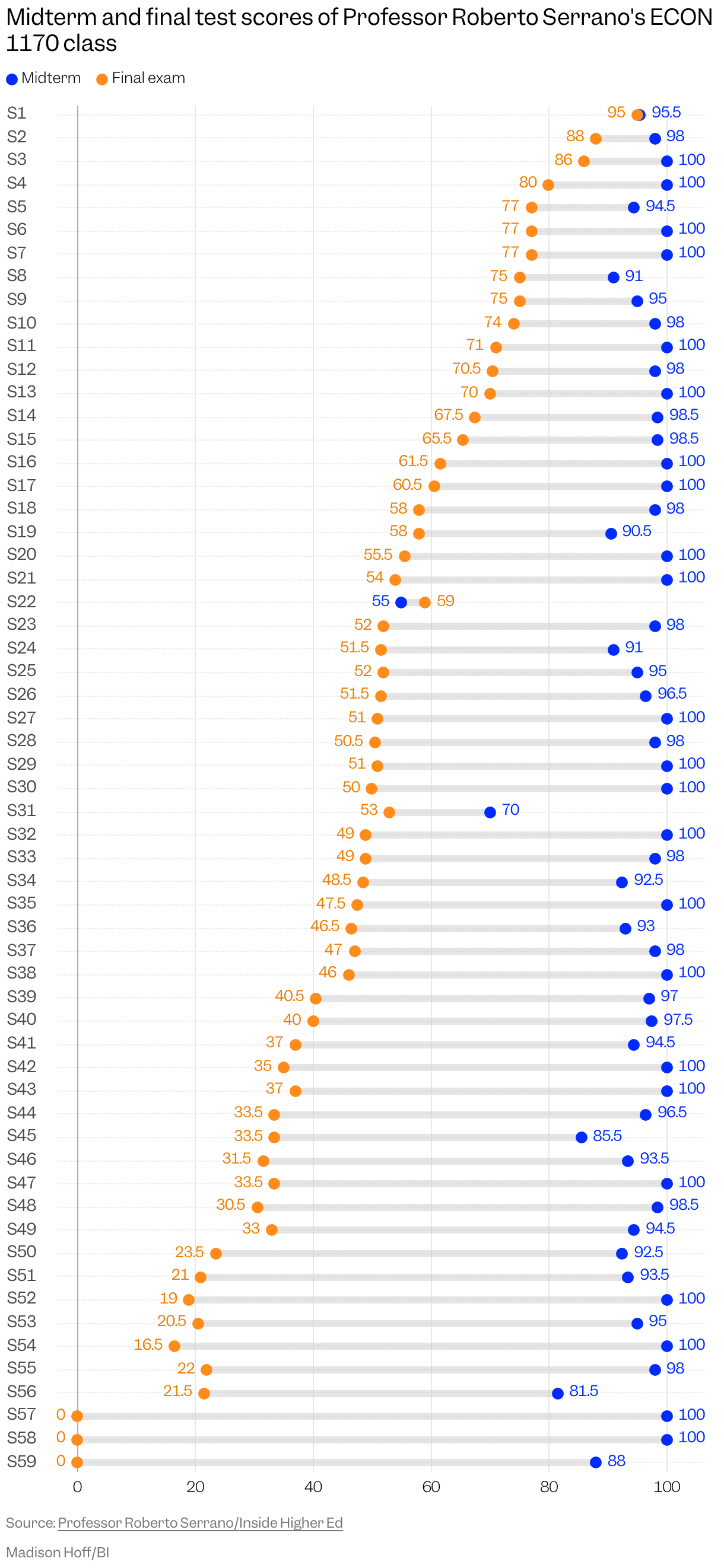
Serrano shared the exam scores. Some dropped from perfect scores on the midterm to below 20% on the final.
Roberto Serrano’s class scored curiously well on the take-home midterm exam. When he suspected widespread AI cheating and made their final exam in-person, their grades tanked.
The Brown University professor teaches welfare economics and social choice theory. The midterm was administered from home after a shooter killed two students in December.
“The problem with this technology is that the cost of cheating has basically gone down to zero,” he told Business Insider. “It’s very easy for students to succumb to the temptation.”
When he told students that the final exam would be in person, many previously high-scoring students dropped out. Others who scored in the high 90s on the midterm scored in the 50s on the final.
A chart of the data, which was first publicized by Inside Higher Ed, shows each student’s grades:
Brian E. Clark, Brown’s VP for news and strategic campus communications, wrote to Business Insider that Serrano shared details with the university’s standing committee on the academic code on July 8. The committee “move forward according to its procedures.”
“Brown treats every allegation of academic integrity with the utmost seriousness,” Clark wrote.
The scandal has drawn interest across the internet, and particularly among those who work in tech. Y Combinator cofounder Paul Graham posted on X about it; two GoogleDeepMind staffers also shared their thoughts.
Serrano wasn’t shocked that the score changes drew interest — but he was surprised by the scale. “I’m a little overwhelmed,” he said.
He said he’s received “hundreds of emails,” many from Brown alums. His colleagues, who are off campus for summer break, have also been texting him about it.
Some of those commenting online applauded the student who was consistently high-scoring: first a 95.5, then a 95. Serrano said this was an “excellent student” that he knew “very well.”
Others shouted out the consistently low-performing student: first a 55, then a 59. “I admire that person,” Serrano said.
Glass AI founder Tom Henke’s commentary on the scoring chart.
X.com/@TomGlassAI
More debated the merits of this generation coming into the workforce. Can students who cheat on exams with AI be trusted to do hard work? Some argued that the consistent scorers are the ones who’d make the best workers.
Serrano agreed. “Since I’m a big defender of integrity, yes, I would hire that person,” he said.
University professors continue to debate how to rebuff AI-driven cheating. Last year, teachers told Business Insider that they were crafting assignments that were more difficult to complete with a chatbot.
Serrano’s grade distribution isn’t a perfect study, of course. There are other reasons there could be variance in test scores, like the final being harder than the midterm, and it hasn’t been definitively proven that there was mass cheating with AI, though the university is investigating.
But the incident does demonstrate just how much of a headache concerns of AI cheating have become for instructors. Serrano himself said he plans never to administer a take-home exam again and will also eliminate the homework portion of his students’ grades.
He advised other educators to think critically about their own AI policies, too.
“It’s certainly a wake-up call to the professors,” he said. “We need to pay attention to this.”
The author (not pictured) sent her kids away in the summer.
Henglein and Steets/Getty Images
Summer break created childcare and scheduling challenges as a single parent.
I relied on community programs, friends, siblings, and extended support networks.
Looking back, I believe those summers helped surround my children with people who cared for them.
More than New Year’s celebrations and their birthdays, the first and last days of school each year were the greatest markers of time’s passage in my five children’s lives.
I can still recall their nervous excitement as they anticipated the start of school each fall and their relief as it ended nine months later. I loved their enthusiasm for learning, especially during their earliest years in a classroom. They took their jobs as students seriously but were always eager to celebrate that final assignment and 10 weeks off before starting the cycle over again.
I had a different response.
For me, watching the months tick by brought on waves of melancholy. It made me sad to realize how quickly the years were passing. On top of that, as a single mother, it was up to me to find ways to keep them safe and occupied during the weeks the school doors were locked.
My flexible work schedule allowed me to be with my kids in the summer
I was fortunate to have a flexible work-from-home schedule that could accommodate all their activities. It worked well during the three seasons they were at school. It was more challenging during the summer.
The author felt guilty for working through the summer months.
Courtesy of the author
It’s not that I didn’t welcome the slower pace of the warmer months when we swapped the frenzy of early-morning wake-ups for a calmer, more relaxed entry into a less structured day. It was the tension I felt while sequestered in my home office, wondering what they might be doing and feeling guilty for not offering them an enhanced experience while they were home.
With the promise of afternoons at the community pool if they allowed me to work uninterrupted in the mornings, we created a system that served us all well until I transitioned to a full-time, office-based job.
I did not want my kids to be home alone while I was at work
My two oldest sons had summer jobs when I started a new job, but the three younger kids didn’t. Our very small town, only 3 square miles in size, offered daily activities in the park for school-aged children up to age 12.
Believing in safety in numbers, I allowed my younger children to walk to the park together to participate. That worked for a few years, but given the spread in ages — my oldest and my youngest share the same birthday, 16 years apart — they quickly aged out of the program, and I had to find alternatives.
The author didn’t want to leave her kids alone at home during the summer.
Courtesy of the author
When my daughter entered her teens, she decided to adopt a family with an actively involved father. She missed having a dad in her life, so she latched onto a classmate and was welcomed as a part-time member of their household. She frequently slept at their home, attended events with their extended family, and even went camping with them. Occasionally, my youngest son would join them, but he did not feel as attached as she did.
I let my youngest son travel out-of-state during the summer
By the time my youngest was a preteen, his older siblings had moved from our home. They were forging lives as young adults, making him an only child in a large family. That’s when I started sending him on vacation with others.
For two consecutive summers, I sent him to Michigan with his best friend’s family. I felt relieved that he wasn’t sitting home alone while I was at work. He enjoyed these trips to a lakefront house where he could fish, pick berries, and just hang out.
When he turned 12, I started sending him to San Francisco each summer to celebrate the July birthday he shared with his oldest brother. He would fly across the country on his own to spend a month in the Bay Area. He turned 16 in a college dorm there while attending a summer semester at the university where he eventually enrolled after high school. After class, he’d walk to his brother’s apartment, where they’d share dinner before returning to his room on campus.
I was lonely during the summer, but I think it was a good decision to let them go. Even though I missed them, I knew they were having fun with people who cared about them. It was the solution that resolved our problem, but also enveloped them in the love of more people who cared about their well-being.