
I thought I’d feel lonely on a cruise full of travelers in their 60s and 70s. I’m glad I was wrong.

The writer wearing a red jacket and standing in front of ice-covered mountains on a cruise in Antarctica.
I was one of the youngest people on a 12-day expedition cruise.
  • I was nervous when I realized I was one of the youngest guests on an Antarctica expedition cruise.
  • However, my fellow cruise-goers immediately took me under their wing and made sure I wasn’t alone.
  • I left the cruise with new professional mentors and friends, and a new perspective on connection.

I don’t spend much time with anyone over 50, besides my parents.

As someone in my early 30s, I mostly find myself interacting with people in a similar life stage: completing postgrad degrees, building careers, and figuring adulthood out.

I typically take my trips solo, too, connecting with other travelers around my age as I explore. All of this changed in January, when I boarded a 12-day expedition cruise to Antarctica with about 200 other guests.

I knew there would be some older travelers on board, but by the end of my first full day on the ship, I discovered I was the third-youngest. I was also the only one my age traveling solo.

When I realized that most of my fellow cruise-goers were retired, in their 60s and 70s, and traveling in pairs or groups, I braced myself for 12 days of isolation.

Luckily, I couldn’t have been more wrong.

Being young and solo on an expedition cruise made me visible in a way I hadn’t anticipated

Two kayakers paddle a yellow tandem kayak through icy water between large blue-white icebergs.
I was surprised by how quickly the other guests took an interest in my life.

I thought that my age — and status as a solo traveler — might isolate me, but instead, it made me stand out. On the first night, a couple nearby saw me sit down alone for a drink. They smiled and invited me to join them.

The same happened at dinner, then throughout the activity program on the upper deck, where groups began pulling me onto their trivia teams and including me in karaoke.

By the time we were setting out on wildlife excursions, I was receiving so many dinner invitations I had to start jotting them down. I thought I would spend my evenings eating alone, journal in hand, but I ended up barely writing in it at all.

It was nice to be included, but what surprised me the most was how interested people were in my life. I’m curious by nature and love to ask questions, but guests would try to redirect the conversation back to me and my life. One afternoon in the hot tub, a large group that traveled together set aside their own conversations to ask about me.

I assumed that conversations might stay surface-level, but I shared my outlook on life, love, and global politics more times than I can count. In most of my prior interactions with people from older generations, I’ve been the one listening — and I assumed it would be the same here.

I hadn’t considered that the other cruise-goers might be just as curious about my take on the world as I was about theirs.

I received some invaluable professional advice

Over drinks one evening, a fellow guest complimented the way I’d carried myself on the boat. Another cruise-goer chimed in with more kind words. This exchange turned into questions and curiosity about my life and passions — and even offers to help my career.

Over the course of 12 days, I met retired professionals in industries ranging from aviation to medicine and technology, who were eager to learn about my work and offer valuable advice and support.

One person gave me tips on using my reputation as a journalist to bolster my communications consultancy. Another offered guidance on pricing strategies for clients once we got off the ship. The insight from these conversations helped me land a new client just weeks after I got home.

I was grateful to hear from people who have lived long enough to offer me fresh, thoughtful insight. People would have paid for this kind of wisdom and mentorship, and my new friends’ willingness to offer it freely over cocktails was the most meaningful part.

I’d definitely go on a trip like this again

The writer wearing a life vest and a red jacket and sitting on a cruise in front of snowcapped mountains.
The memories I made on the cruise will stay with me for a long time.

Antarctica was easily the best trip I’ve ever taken. Sure, I got to see penguins and whales in their natural habitat, but I learned as much on the ship as off it.

Those 12 days gave me a clearer sense of what I want my professional future to look like. I left the ship with a better vision for my consultancy and a renewed sense of confidence.

It gave me unexpected friendships, too — I’ve stayed in touch with many of my fellow cruise-goers via social media and email. One guest lives near me in London, and I recently went to her 70th birthday party.

Stepping outside my comfort zone and connecting with people from different generations led to some of the most fulfilling conversations I’ve ever had.

I’d initially dreaded having such a big age gap between myself and my fellow travelers, but now, it’s something I’d intentionally seek out when planning a trip.
Read the original article on Business Insider

Mapped: How FIFA’s president criss-crossed North America on a private jet to watch over 40 World Cup games in 39 days

US Secretary of State Marco Rubio (L), FIFA President Gianni Infantino (C), and FBI Director Kash Patel (R) talk ahead of the 2026 World Cup Group K football match between Colombia and Portugal at the Miami Stadium in Miami Gardens on June 27, 2026.
Marco Rubio, Gianni Infantino, and Kash Patel talk ahead of Colombia vs. Portugal in Miami on June 27.
  • Gianni Infantino has attended more than 40 World Cup games thanks to a private jet.
  • He traveled some 70,000 miles on a $65 million Gulfstream G650ER operated by Qatar Executive.
  • Business Insider created a map and a chart showing his journeys throughout the tournament.

FIFA President Gianni Infantino managed to catch more than 40 World Cup games in 39 days thanks to the elite’s favorite time-saving tool: a private jet.

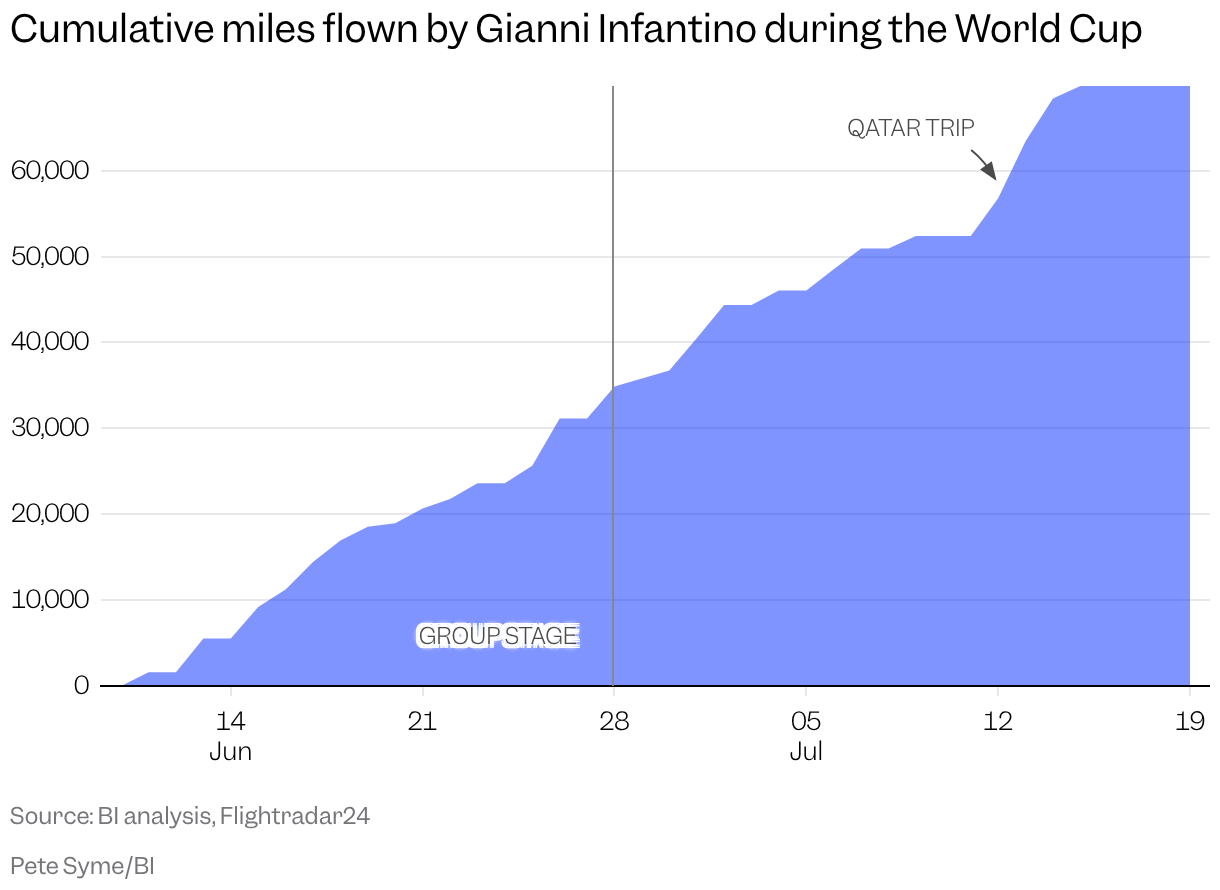
Ahead of Sunday’s final, which will be Infantino’s 44th game of the tournament, Business Insider’s analysis found that throughout the World Cup, he traveled some 70,000 miles. That’s almost three times the Earth’s circumference.

The Guardian first reported that Infantino was using a private jet provided by Qatar Airways, as part of its sponsorship deal as the World Cup‘s official airline partner.

We used photographs, TV broadcasts, and Instagram posts to track Infantino’s whereabouts through the tournament. These matched up with the movements of a Gulfstream G650ER owned by Qatar Executive, the airline’s private-jet division.

FIFA and Qatar Airways did not respond to requests for comment.

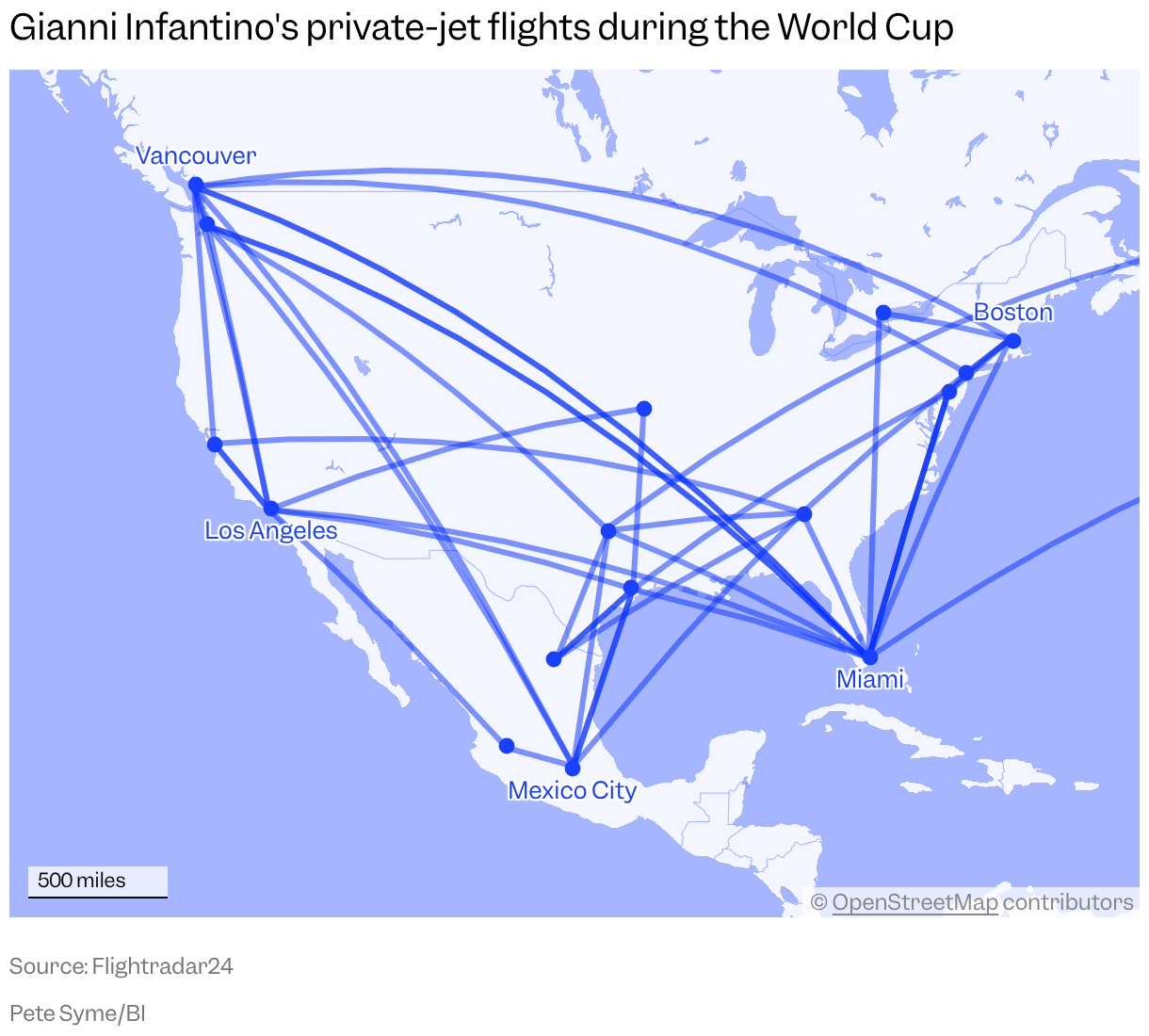
Using data from Flightradar24, we mapped out the airplane’s more than 50 flights, from the first game through to the final.

You can hover over each city marked on the map to see how many times Infantino went there.

Locator map

Our map shows all the trips Infantino has made in the US, Canada, and Mexico during the tournament, but doesn’t fully show a trip he took to Qatar during the gap between the quarterfinals and semifinals.

Last Monday, Infantino said on Instagram that he went to offer his condolences to the Qatari Emir, whose father had died. The four-leg trip — departing from Miami, including refueling stops in Madrid, and returning to Dallas — covered some 11,500 miles.

Between two World Cup games, Infantino’s longest journey was between Vancouver and Miami — a five-hour flight, which occurred twice.

Excluding four repositioning flights, the shortest journey was a 27-minute hop from Seattle to Vancouver on July 6. The two World Cup stadia are about a three-hour drive apart.

Infantino typically attended two games a day during the group stage, the first part of the World Cup that lasted until June 27, in which all 48 teams competed in mini-leagues.

His highest-traveled day was June 26, when the G650ER covered 5,500 miles. From Miami to Dallas, where Infantino met the Jordan team at their training camp, then onto Seattle for Egypt vs. Iran, and finally a red-eye back to Miami for a game the following day.

Area Chart

In all, Infantino appeared to spend more than 140 hours on board the private jet across the five-and-a-half-week tournament.

Infantino’s frequent appearances throughout the tournament have helped make him a celebrity in his own right, with a higher profile than his predecessors.

He was often shown on TV broadcasts watching games and photographed alongside attendees ranging from legendary players like Ronaldo to such dignitaries as the Crown Prince of Norway and Marco Rubio. On Friday, he appeared at a media event with President Donald Trump, and the two are expected to sit together at Sunday’s final.

Under Infantino’s leadership, the 2026 World Cup has been more expensive, and arguably more commercialized, than ever before.

The cost of tickets has been a major bone of contention among fans, with prices significantly higher than in previous World Cups when adjusted for inflation. For the final, seats with the best view of the pitch cost $10,990 when released in the first general-admission sale in April.

The interior of a Qatar Executive Gulfstream G650.
The interior of a Qatar Executive Gulfstream G650ER.

High-fliers

The Gulfstream G650ER is a premium private jet that costs about $65 million to buy new. Elon Musk, Jeff Bezos, and Mark Zuckerberg are among those who have owned one.

It has a top speed of 610 miles per hour at its typical cruising altitude of 43,000 feet. Meanwhile, the cabin pressure means it feels no higher than 4,850 feet — half as much as on a commercial airliner — ameliorating the effects of jet lag and dehydration.

Online charter listings for the Qatar Executive version used by Infantino show it can carry 13 passengers and has a couch in the rear that can transform into a double bed.

While Infantino attended at least one game in all 16 host cities, he didn’t see two of the 48 teams in action: Jordan and Germany. The team that he saw play the most games was England, with five.

He also made time for other stops during the tournament: a FIFA summit in Miami, appearing on “Fox & Friends” at its New York studio, and a media visit to New Jersey’s MetLife Stadium.

FIFA President Gianni Infantino poses with the TRIONDA FINAL the Official Match Ball for the semi-finals, bronze final and final during his visit to the New York New Jersey Stadium on July 09, 2026 in East Rutherford, New Jersey.
Infantino poses with a ball during a media visit to the MetLife Stadium on July 9.

Infantino’s voyage exemplifies why the wealthy are keen to shell out millions of dollars to buy a private jet or tens of thousands of dollars an hour to charter one. In addition to the added security and luxurious cabin, flying private can save valuable time.

Passengers can bypass the usual security lines and be driven onto the tarmac, choosing to take off whenever they please rather than aligning with airline schedules.

Indeed, this appeared to come in handy for Infantino, as he had some tight timings during his odyssey.

On June 22, Infantino first watched France play Iraq in Philadelphia, but the second half was delayed by two hours due to a thunderstorm. The jet then flew to New Jersey’s Teterboro Airport and touched down 1 hour and 23 minutes after Norway vs Senegal kicked off at the nearby MetLife Stadium. TV broadcasts showed the FIFA president in the stands with four minutes remaining in the game.

His ability to move between stadia so quickly attracted commentary from soccer fans on social media, too. At least two images of Infantino in the stands were edited with the scorebug of a game he didn’t attend, to joke that he had been in two places at once.

Read the original article on Business Insider

I went on Walmart’s last World Cup store tour. It was peak America.

A spokesperson walks visitors through the cereal aisle of a Walmart store.
Walmart capitalized on international travelers’ awe.
  • International World Cup fans have fallen in love with some very American brands, including Walmart.
  • The big box store has been hosting tours to cash in on the attention.
  • I went to the final tour the day before the World Cup final.

A Walmart Supercenter is a fluorescent palace of American consumption.

To US shoppers, it’s a utilitarian one-stop shop where groceries, televisions, tires, and just about everything else sit beneath one enormous roof.

To some international World Cup fans, though, it is a viral tourist sensation. Many fans made a point to visit Walmart during their stay in the United States. Even Spanish soccer star Lamine Yamal shopped there between matches.

@risingballers Yamal went grocery shopping at a Walmart in the U.S. 😭🔥 @⚽️ #LamineYamal #Yamal #footy #footballtiktok #soccer ♬ origineel geluid – user21258162452

Walmart said it organized the tours to seize on all the attention. Over the past month or so, the retailer has worked with the professional Spanish soccer league, LaLiga, to offer guided store tours paired with appearances by some of soccer’s biggest names.

I attended the final tour at Walmart’s East Brunswick, New Jersey, store on Saturday, about 29 hours before Spain and Argentina were scheduled to kick off the 2026 World Cup final.

On the tour, guests received VIP lanyards, giveaway bags, and small “passports” to be stamped as they moved through a carefully curated version of the Walmart experience.

The featured main attractions: peanut butter, ground beef, soccer jerseys, and — of course — ranch dressing.

America’s surprising superstore star

A Walmart employee leads tour guests through a Walmart with a light blue "Follow Me" flag.
Walmart hosted around two dozen guests on a store tour on Saturday.

As soccer-loving (er, football-loving?) travelers crisscrossed the country for this year’s World Cup games, some of the most ubiquitous fixtures of American consumer culture inspired genuine awe: a cheap Waffle House breakfast, the sprawling excess of a Buc-ee’s gas station, and the giant aquariums inside Bass Pro Shops.

Videos went viral after a crowd of Australian national team fans turned a Dallas Walmart’s produce section into an impromptu party. Wearing yellow-and-green jerseys, they traded the familiar “Aussie! Aussie! Aussie! Oi! Oi! Oi!” chant for a new refrain: “We’re going to Walmart!”

The tours were Walmart’s effort to turn that organic wonderment into an official welcome — and to highlight its unique position as both a cornerstone of American consumerism and a place to get ranch dressing.

There was just one surprise at the tour I attended: The passport holders I spoke to were Americans.

Passports, ranch dressing, and rain

A Walmart "legendary kickoff" venue in a store's parking lot.
Walmart’s tour ended at 11 a.m. The outdoor event was interrupted by a thunderstorm.

Walmart said it had expected international visitors at the East Brunswick event.

The store sits about 30 miles from MetLife Stadium, where Argentina star and overall legend Lionel Messi was set to chase a second World Cup title the following day. The outdoor LaLiga event — which included games, free food, and live music — also promised appearances from retired Spanish star Carles Puyol and Colombian striker Radamel Falcao.

About four hours before the player meet-and-greet, Walmart representatives handed tour guests giveaway bags containing about $35 in merchandise and small paper “passports.”

The first stop was the condiments aisle, where guides presented ranch dressing and peanut butter as American staples. Guests received a stamp in their passports before moving on.

Next came the meat department, where ground beef earned a steak-shaped stamp. We stopped near the apparel, where Walmart showed off soccer-themed jerseys and added one last mark to each passport.

Finally, we ended back in the produce section, where Walmart highlighted its best-selling product across the US: the banana. Walmart says they sell 4.46 billion bananas each year.

While Walmart said they expected international travelers in New Jersey, that wasn’t who showed up on Saturday. Everyone I spoke to said they all lived in the United States.

Karl Marttz, who lives 40 minutes away in North New Jersey, brought his children along for the tour while rain fell outside.

“As a person who lives near another Walmart, it was … eh,” he told Business Insider after the tour concluded. He was mostly there for the meet-and-greet.

A Walmart spokesperson told Business Insider it built the tours to “be relevant for first-time or longtime fans,” and that they were “happy from all of the positive feedback.”

Quickly after the tour, the weather soon worsened. A thunderstorm swept through, prompting organizers to move the meet-and-greet from the parking lot into the store.

That put the soccer stars under the same enormous roof as the now-Walmart-product-passport-holding Americans.

Nearly everyone I spoke with said they planned to watch the final on television the next day. One woman told the group she was going to MetLife Stadium to see Messi in person.

“I am so excited,” she said.

Read the original article on Business Insider

I thought the internet made parenting easier. It also made me less present.

Woman holding phone
The author (not pictured) regrets her heavy phone use around her kids.
  • I thought I was balancing work and parenting well.
  • My adult children helped me see how often I was mentally elsewhere.
  • I regret the everyday moments I lost to my phone more than my career.

My son was 11 when he volunteered to be the boy soloist at the school Christmas concert. Nobody else would do it. That alone made me proud. He stood up there looking like a young Aled Jones, and he was magnificent.

The school hall was packed. Other parents leaned forward in their plastic chairs. So smart in his pressed uniform and surprisingly melodic. It was one of those moments that announces itself — pay attention, this is the real thing.

I took out my phone to film him.

I thought about how my own mom would have been in tears watching this. She’d died five years previously. So who on earth was I filming it for?

Online life happened at the same time as I had kids

Online life for me didn’t arrive despite the children; it arrived with them, pretty much on the same day. I was the first of my friends to be married, the first to have a baby. While they were still in the real world, I was home with a newborn and a brand new computer, and a discussion forum was the only room where everyone else was also awake at 2 a.m. — or the only room I was in, anyway.

And we all know what the early days led to. Facebook happened, and the phones got smarter. But it wasn’t just the scrolling through social media — work was digital too.

As the editor of a family page, my kids were becoming content, whether I liked it or not. I would run to my computer to write same-day scripts for the radio as soon as my second baby went down for his nap. Sitting beside the bathtub, Googling symptoms. Not even cooking without a digital recipe open on the screen. There was no switch off.

I was physically present, but not really there

Back then, if you’d asked me, I’d have told you I was completely present. Physically, I was. My kids would tell you something different.

My youngest is 19 now. Recently, he said that he had to ask me three times for anything. “I didn’t know if you were working or scrolling. I was getting the same lack of reaction either way,” he added. To a child, the face looking at a screen is still the same face.

All three of my kids are now adults. And I still see what I did when they were little everywhere — the phone and the stroller, the row of parents on their screens while the children play nearby. I know that parent. I was that parent. I probably still am that parent.

But the regret isn’t really about the big moments. It’s about the minutes. The small, unremarkable minutes that slipped by while I was half somewhere else. Minutes that don’t feel like much individually but that add up, and keep adding up, until one day you do the maths and 25 years have gone by.

I regret scrolling all the time

I don’t regret working. I don’t regret the career, the deadlines, the ambition. But the rest — the mindless checking, the reflexive scrolling, the being physically present and mentally elsewhere — What was it all for? What did I actually gain?

Reading my son’s words again, I keep coming to the same answer. Time you’ll never get back.

We’re talking about banning phones in schools, restricting social media for under-16s. None of it means anything if the adults collecting them at the gate cannot put their own down.

Read the original article on Business Insider

I lost nearly 350 pounds without surgery or GLP-1s. It started with wall pushups and a trainer.

Henry Gonzalez weight loss
Henry Gonzalez lost weight without surgery or meds.
  • Henry Gonzalez is the founder of a San Francisco-based clothing brand.
  • He lost about 350 pounds without surgery or medicine.
  • He’s managed to keep the weight off for seven years.

This as-told-to essay is based on a conversation with Henry Gonzalez. It has been edited for length and clarity.

I’ve lost nearly 350 pounds and kept the weight off. As a kid, I was never small. I was a bigger kid through my teenage years.

When I was 21, I weighed 470 pounds. I was able to lose 50 pounds, but then gained weight again. In my 20s, I got in trouble and went to jail, and ended up gaining more weight because I thought nothing mattered and I should just do what I wanted to. I didn’t care about anything. At 27 years old, I weighed 565 pounds.

I was working the graveyard shift then, and I’d wake up, eat a bunch of eggs with bacon or sausage, and go right back to sleep after a huge breakfast. Then, I’d wake up again and go to Taco Bell or Jack-in-the-Box. Then, I’d snack at work all night on stuff from the vending machine. I was constantly eating. I was also drinking a lot of alcohol. I have no idea how many calories I was eating a day, but it was a lot.

I found a trainer in a private gym

I was worried about getting my life on track. But I was self-conscious, so I avoided working out at bigger gyms. But I felt comfortable at a private gym I found through a friend. In the beginning, it was body weight exercises. Being that big, just moving your body is a workout. So I’d do things like wall push-ups or assisted squats. Then, I was using 15 to 20 pounds and going slowly.

The trainer was great, so I just shut my brain off and listened to him. I would show up and shut up. He set me up with a meal plan for about 2,500 calories per day, and he bugged me every week to keep the calorie deficit and stay motivated. He kept me accountable.

From November 2019 to January 2020, I lost 50 pounds. Within the first six months, I lost 150 pounds.

I was tired of being ignorant and thought I should learn. I never finished school, and I hated learning. Now, I love it. I started paying closer attention and asking more questions, and the more I understood what was going on, the easier it felt. It was easier for me to eat fewer calories because I understood the goal. I became fascinated with how our bodies work. And seeing results kept me motivated.

I’m now 34, and I’ve kept my weight loss off for almost 7 years

I just did my first skin removal for my neck, and I’m doing another one later this year. I want to lose another 20 to 30 pounds of fat, and then I’ll be happy. I’m currently 225 pounds, but I want to remove the excess skin and get down to 200 on the scale.

I now eat the same foods almost every day: two eggs plus one cup egg whites with a couple of slices of turkey bacon and half an avocado. Lunch and dinner are 8oz of the protein of my choice with rice and veggies. I drink a gallon of water a day, and I have cheat meals every once in a while. I am training three to four days a week and walk about four to six miles every day.

I almost had gastric bypass surgery. At the orientation, they told me things I didn’t like hearing, like what all the restrictions are after surgery. I’m glad they scared me. Some people need surgery, but I told myself I’d try it naturally first. My advice to anyone who wants to lose weight naturally is to take the first step and just try. I didn’t care about losing weight, but something told me to try it naturally.

I’ve invested so much time and money into myself. I’m stubborn. I don’t want to lose what I’ve done.

Read the original article on Business Insider

2 US troops were killed during an Iranian missile and drone attack, the Pentagon says

Iranian missiles streak across a dark sky
The US said two American troops were killed and several others injured during an Iranian missile attack in Jordan on Friday.
  • The Pentagon said two US service members were killed in Jordan on Friday during an Iranian attack.
  • A third US service member is missing, and others were injured in a missile and drone attack.
  • The US war on Iran has intensified after a fragile ceasefire agreement fell apart.

Two US service members were killed in Jordan on Friday after American and partner forces came under Iranian missile and drone fire, the Pentagon said on Saturday.

Another US service member is missing, and several others were injured in the Iranian attacks. It marks the first publicly acknowledged American military fatalities in the Middle East conflict since March.

Fourteen US service members were killed during the first few weeks of Operation Epic Fury. More than 425 others have been injured over the course of the conflict, which began when the US and Israel launched surprise attacks on Iran on February 28.

US Central Command, which oversees military operations in the Middle East, said in a statement that the two service members were killed as American and partner forces “defended against Iranian ballistic missile and drone attacks.”

Centcom said four US service members were medically evacuated to local hospitals but have since been discharged, and several others received minor injuries. They returned to duty.

“Out of respect for the families,” the military said, it will “withhold additional information, including the identities of the fallen warriors, until 24 hours after the next of kin have been notified.”

The US resumed combat operations against Iran earlier this month after a fragile ceasefire collapsed following unsuccessful attempts by the two sides to reach a peace deal.

Iran has carried out attacks on vessels transiting the Strait of Hormuz and launched missiles and drones at countries across the Middle East, including those that host US bases.

The US has carried out near-daily strikes against Iran in response, targeting surveillance sites, weaponry, maritime capabilities, and other military facilities.

The US casualties are likely to trigger a strong response from the Trump administration.

Read the original article on Business Insider