SpaceX says some travelers are skipping direct options just to fly on a plane with Starlink

A line of airlines waits on an airport tarmac.
SpaceX president Gwynne Shotwell said the technology company has heard that customers are favoring short-haul flights with Starlink capabilities.
  • SpaceX’s president said customers are choosing shorter flights and more stops to get Starlink.
  • MrBeast said he would eventually book flights based on Starlink access, even if it adds a layover.
  • BI contacted 13 airlines with Starlink agreements, but none verified Shotwell’s account.

“Actually, I would like to add an extra flight to my trip,” said no one, ever.

Well, until Starlink came along, apparently.

During SpaceX’s Tuesday earnings call, the company’s president, Gwynne Shotwell, highlighted the expansion of Starlink, the company’s satellite-powered internet service, across commercial airlines.

“In fact, we heard from one of our airline customers, shockingly, customers are flying shorter hop flights instead of direct, so that they could ensure that they’re on a Starlink-activated flight,” Shotwell said in her opening remarks on the call. “They’d never seen this in the business before.”

YouTuber MrBeast made a similar statement earlier this year on “The Good Guys” podcast, saying he would eventually choose flights based on whether the aircraft offered Starlink — even if it meant taking an extra layover.

He also joked that he would rather have Starlink WiFi than Biscoff cookies, a snack closely associated with Delta Air Lines. Delta does not have an agreement with SpaceX to use Starlink.

Business Insider contacted 13 airlines with agreements to use Starlink and asked whether they had observed passengers choosing itineraries based on the service.

A Southwest spokesperson said he believed Shotwell was referring to another carrier, noting that Southwest does not operate regional jets and uses its Starlink-equipped aircraft across a variety of routes.

Alaska Airlines declined to comment. The other airlines did not respond by publication time. SpaceX also did not respond to a request for comment or verification of Shotwell’s account.

SpaceX also touted a new agreement with American Airlines to bring Starlink to 500 planes, as well as new partnerships with Southwest, Virgin Atlantic, Iberia, and Aer Lingus. The company said enterprise and government contracts generated $1.8 billion in quarterly revenue.

Shotwell said SpaceX saw “significant growth opportunities” for Starlink and had never lost an enterprise customer.

A SpaceX first

A contrail from a SpaceX Falcon 9 rocket in February.
Tuesday’s earnings call was SpaceX’s first as a public company.

Tuesday was SpaceX’s first earnings call since its June IPO. The company reported $7.8 billion in quarterly revenue, up 92% from a year earlier, and a net loss of $541 million.

Much of the call focused on SpaceX’s increasingly expansive ambitions. Shotwell said the company plans to turn Starlink Mobile into a full-fledged carrier capable of taking customers from AT&T, Verizon, and T-Mobile.

CEO Elon Musk, meanwhile, defended SpaceX’s nearly $16 billion in quarterly spending on AI infrastructure and outlined plans that included data centers in space, factories and robots on the moon, and a possible $1 trillion in annual revenue as early as 2029.

Investors appeared less enthusiastic about the price tag: SpaceX shares fell after hours despite the company’s revenue beat. The stock is down about 30% since its June IPO.
Read the original article on Business Insider

The 10 best and 10 worst cities for renters

Aerial view of urban streets and shopping buildings at sunset.
Four of the 10 best cities for renters were in Arizona.
  • WalletHub ranked nearly 200 cities based on rental market and quality of life.
  • Six of the 10 best cities to rent in are in the Sun Belt.
  • Arizona cities scored particularly high on the list.

The buy vs. rent pendulum is always swinging, but some cities cater better to those already set on renting.

WalletHub analyzed 182 markets based on two factors: rental market & affordability, and quality of life. Every city was graded on a 100-point scale using 21 metrics, like the share of renters and the job market.

The Midwest and Sun Belt have been duking it out for the title of best region to live in in recent years, but one Sun Belt state west of the Mississippi River made the biggest splash on WalletHub’s list: Arizona.

On the whole, the state of Arizona hasn’t been a popular choice, but for renters, it checks some important boxes. Chandler, Gilbert, and Scottsdale, Arizona, all finished in the top five in quality-of-life rankings, with Scottsdale ranking first.

US News & World Report ranked Arizona 17th in employment, and according to WalletHub, a majority of renters in all three cities spend less than 22% of their income on rent.

As for the cities on the opposite end of the spectrum, unsurprisingly, they ranked low in rental market & affordability, and quality of life, with rankings not exceeding 123rd for either category.

Read below to see which cities are good for renters, and which ones aren’t.

Worst cities for renters
Two weathered vacant houses with broken windows and overgrown yards stand along a quiet urban street.
10. Shreveport, LA
Downtown Shreveport skyline rises behind a truss bridge and river at dusk with colorful reflected lights.
Shreveport, Louisiana.

Total score: 38.08

Rental market & affordability rank: 123

Quality of life rank: 179

9. Huntington, WV
Downtown streetscape with storefronts, mid-rise buildings, a small park, and autumn trees under a cloudy sky.
Huntington, West Virginia.

Total score: 38.02

Rental market & affordability rank: 143

Quality of life rank: 172

8. Augusta, GA
Downtown August from overhead
Short-term rental prices in Augusta, Georgia, surge during Master’s week.

Total score: 38.00

Rental market & affordability rank: 136

Quality of life rank: 180

7. New Orleans, LA
New Orleans at sunset.
New Orleans.

Total score: 36.51

Rental market & affordability rank: 154

Quality of life rank: 162

6. Newark, NJ
Illuminated downtown skyline reflects across a calm river at dusk under a cloud-filled sky.
Newark, New Jersey.

Total score: 36.08

Rental market & affordability rank: 149

Quality of life rank: 169

5. Akron, OH
Downtown Fort Wayne skyline rises beyond a tree-lined parking lot under warm sunset clouds.
Akron, Ohio.

Total score: 34.38

Rental market & affordability rank: 170

Quality of life rank: 167

4. Memphis, TN
Downtown Memphis skyline and illuminated highway interchanges beside the Mississippi River at dusk.
Memphis.

Total score: 32.97

Rental market & affordability rank: 114

Quality of life rank: 182

3. Jackson, MS
Illuminated Mississippi State Capitol stands amid trees and downtown Jackson skyline at dusk.
Jackson, Mississippi.

Total score: 32.79

Rental market & affordability rank: 181

Quality of life rank: 146

2. Cleveland, OH
Downtown Cleveland skyline rises beside the Cuyahoga River with Terminal Tower and waterfront parks in warm light.
Cleveland.

Total score: 32.02

Rental market & affordability rank: 174

Quality of life rank: 178

1. Detroit, MI
Aerial view of downtown Detroit from over the Detroit River.

Total score: 29.95

Rental market & affordability rank: 160

Quality of life rank: 181

Best cities for renters
Illuminated buildings and pedestrian railings reflect in a calm urban canal at blue hour.
10. Amarillo, TX
The cityscape in Amarillo, Texas.
Amarillo, Texas.

Total score: 60.18

Rental market & affordability rank: 20

Quality of life rank: 34

9. Sioux Falls, SD
Urban river flows beneath a bridge between downtown buildings at dusk under a clear blue sky.
Sioux Falls, South Dakota.

Total score: 62.33

Rental market & affordability rank: 1

Quality of life rank: 108

8. Huntsville, AL
Huntsville, Alabama, park and downtown cityscape at twilight.
Huntsville, Alabama.

Total score: 63.10

Rental market & affordability rank: 4

Quality of life rank: 38

7. Bismarck, ND
Aerial view of the North Dakota State Capitol in Bismarck, North Dakota, on a dramatic overcast sunset with a red-tinted sky in the fall.
Bismarck, North Dakota.

Total score: 63.60

Rental market & affordability rank: 3

Quality of life rank: 55

6. Peoria, AZ
Afternoon aerial view of the downtown skyline and surrounding housing of Peoria, Arizona.
Peoria, Arizona.

Total score: 65.25

Rental market & affordability rank: 22

Quality of life rank: 2

5. Columbia, MD
Modern office and apartment buildings reflect in a calm lake beside autumn trees under a clear blue sky.
Columbia, Maryland.

Total score: 65.80

Rental market & affordability rank: 2

Quality of life rank: 39

4. Overland Park, KS
Aerial view of an office district with mid-rise buildings, parking lots, roads, trees, and a clear blue sky.
Overland Park, Kansas.

Total score: 66.94

Rental market & affordability rank: 9

Quality of life rank: 4

3. Chandler, AZ
Aerial view of a sunny urban business district with office buildings, streets, parking lots, palm trees, and distant mountains.
Chandler, Arizona.

Total score: 67.20

Rental market & affordability rank: 11

Quality of life rank: 5

2. Gilbert, AZ
Aerial view of office buildings, parking lots, a water tower, and surrounding neighborhoods with mountains in the distance.
Gilbert, Arizona.

Total score: 67.63

Rental market & affordability rank: 6

Quality of life rank: 9

1. Scottsdale, AZ
Aerial cityscape of Scottsdale, Arizona, under a colorful sunset sky.
Scottsdale, Arizona.

Total score: 69.05

Rental market & affordability rank: 24

Quality of life rank: 1

Read the original article on Business Insider

The K-shaped economy isn’t dead yet

Colorful patterned magnetic alphabet letters are scattered across a dark glossy surface.
The economy keeps getting called new letters.
  • The shape of the economy, and which letter best describes it, has become a point of contention.
  • Treasury Secretary Scott Bessent said the K shape is over, and the C shape is in.
  • In a K-shaped economy, higher earners see their fortunes grow while lower earners experience the opposite.

Is the economy still K-shaped?

The label came into vogue to describe an economy where the rich keep pulling ahead while the poor fall further behind. Recent comments from business executives and policymakers suggest that shape might be changing.

Hilton CEO Christopher Nassetta said that sales growth is spreading beyond just luxury. And Treasury Secretary Scott Bessent said the economy is now C-shaped, with outcomes at either end of the wealth spectrum starting to converge.

“I got sick of hearing about this K-shaped economy,” Bessent said in an interview with CNBC’s Squawk Box. “I can say here, definitively, the K-shaped economy is over.”

But the data suggests a more limited shift: lower earners have seen some gains, but higher earners are still spending and doing well enough that the broad trajectory of diverging economic outcomes has not fully changed.

“C-shaped would suggest that maybe we’re seeing some compression in inequality — that as the high end does a little bit worse and the low end does a little bit better, we start to meet more in the middle,” said Elizabeth Pancotti, the vice president of policy, advocacy, and research at the Groundwork Collaborative, a left-leaning think tank. “I don’t think we’ve seen any evidence to suggest that we’re closing the gap on those things.”

What would turn a K into a C?

In Bessent’s accounting, the C shape is defined by robust wage gains for lower earners, housing inflation moderating for renters and homeowners, and more favorable tax policies, such as no taxes on tips, under President Trump’s sprawling new package.

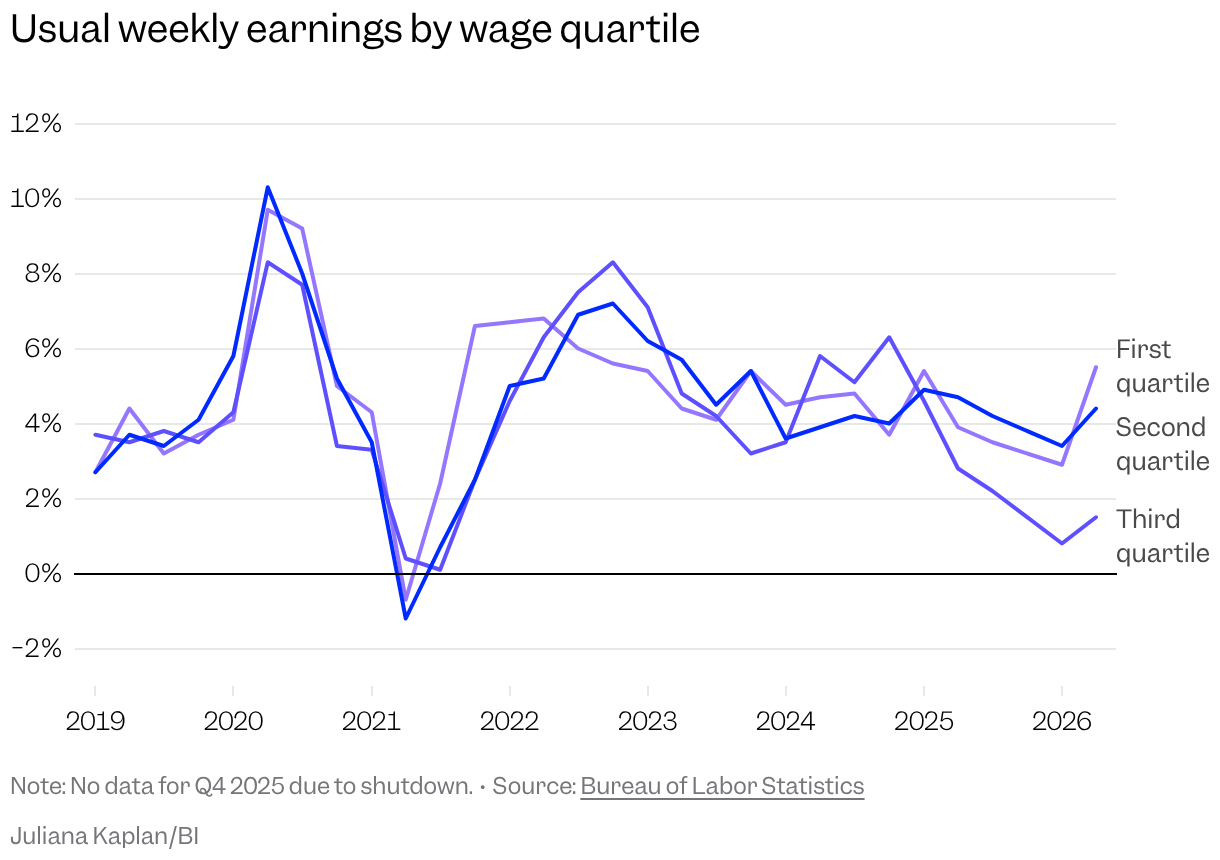
Bessent pointed out that wages for the lowest quartile of full-time workers grew 5.5% year over year. That tracks with Bureau of Labor Statistics data that tracks wage growth among full time wage and salary workers. Higher-paid full-time workers saw much slower wage growth — an indicator of a possible C formation.

Line chart

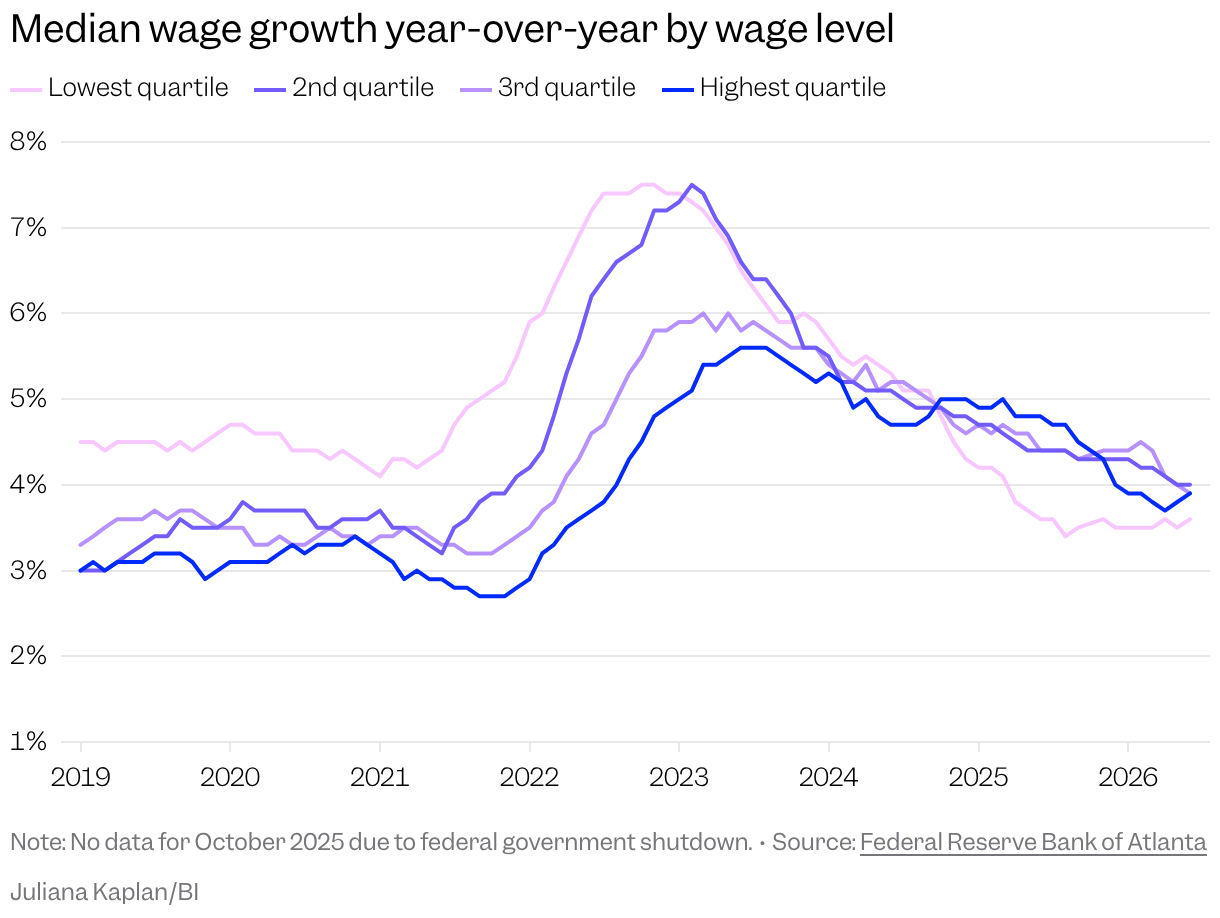
But including hourly or part-time workers in the analysis changes the picture. Earnings data analyzed by the Federal Reserve Bank of Atlanta, which includes such workers, shows that the lowest earners have seen the smallest gains since late 2024.

Line chart

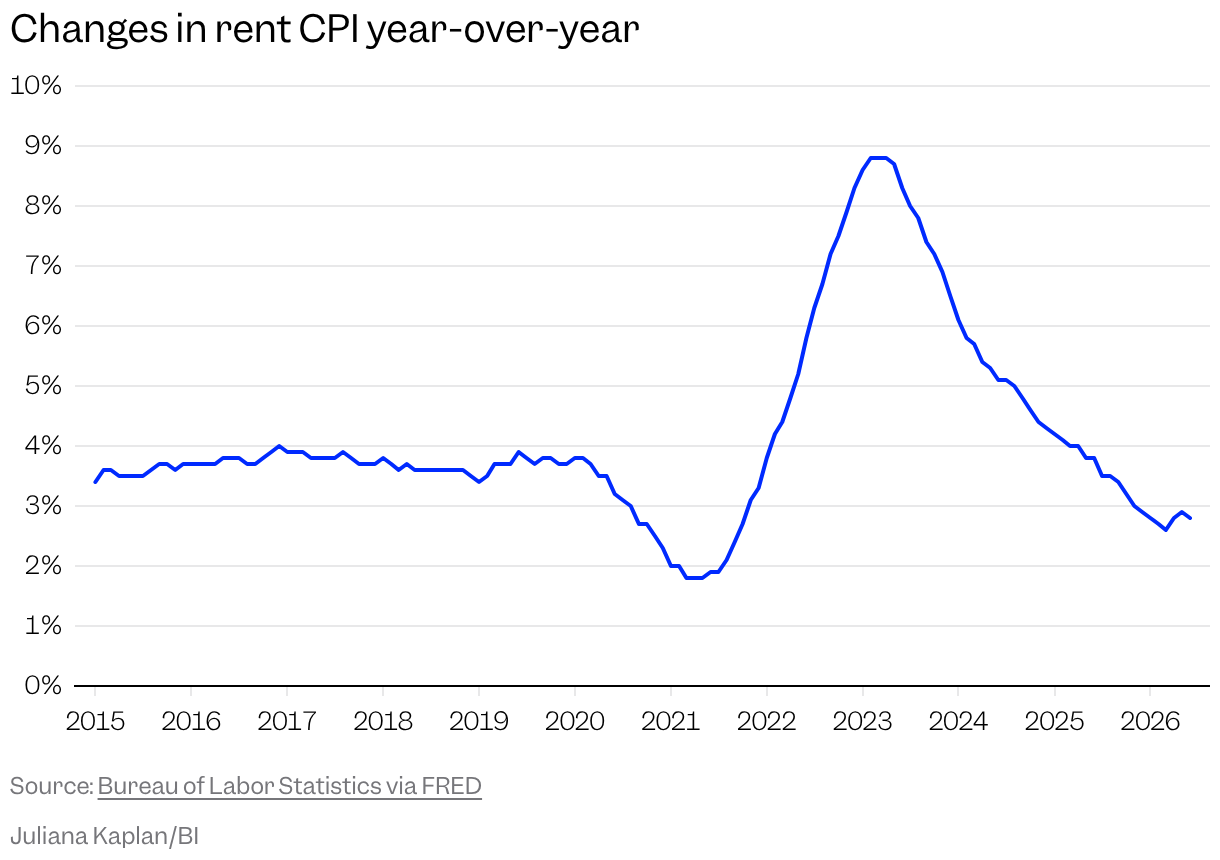
Bessent cited rent as an example of falling inflation. But housing costs for renters and homeowners continue rising, despite recent tempering. Rent CPI is slowing, but is likely not having a huge impact on bending the K.

Line chart

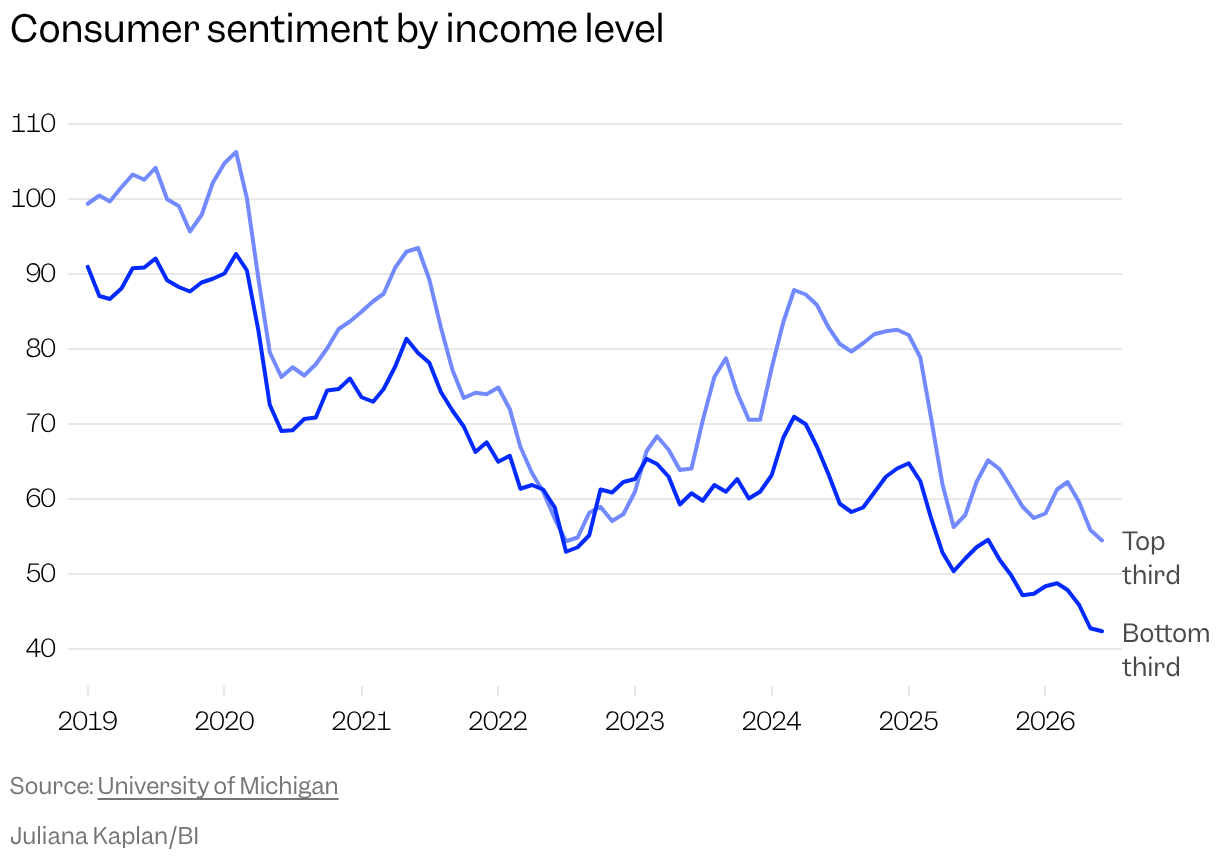
Higher-and lower-earners both feel dreary about the economy, with consumer sentiment for both groups falling in a similar shape since late 2024. Even so, lower earners continually feel worse.

Line chart

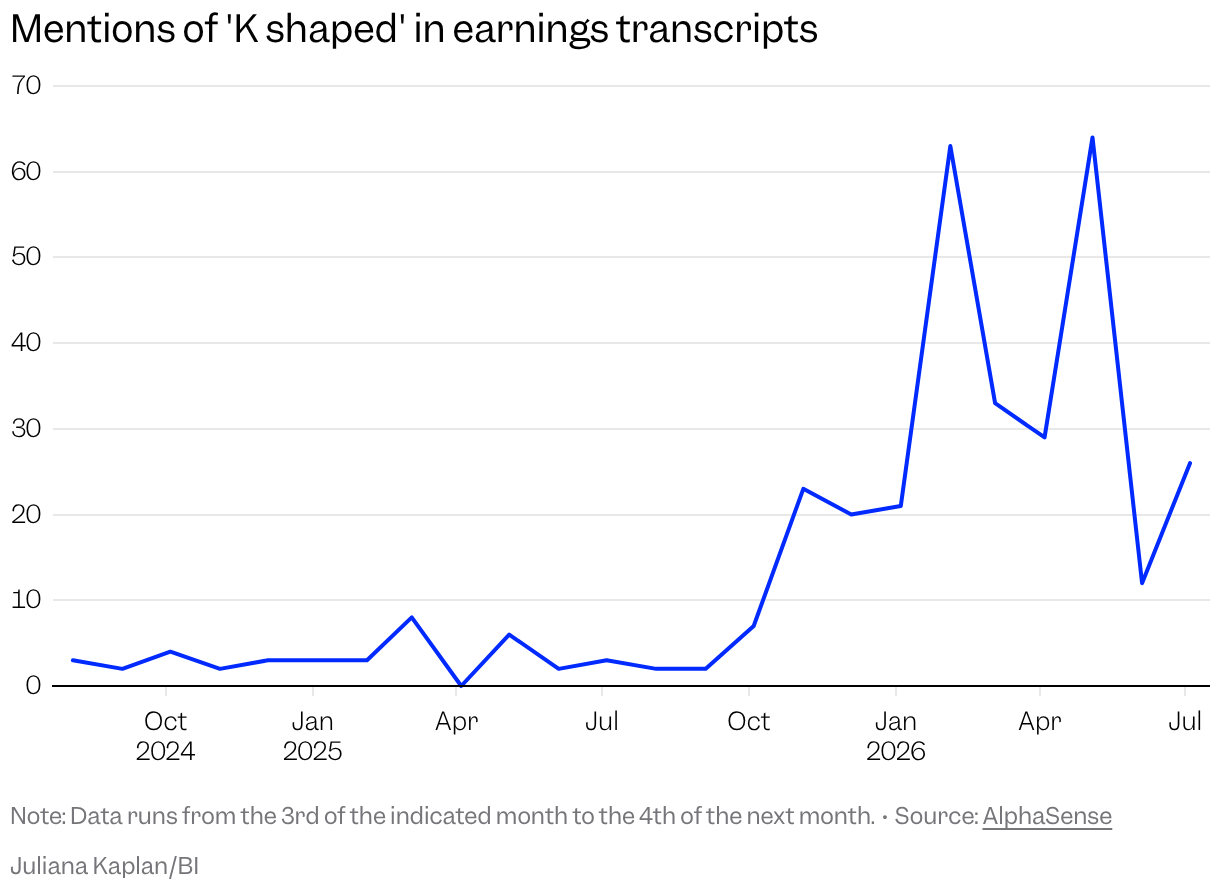
While firms are still mentioning the dynamic in earnings calls, the number of mentions has fallen from early and mid-year peaks. Conversely, there have been just eight mentions of a “C shape” in the past two years.

Line chart

Finally, the K-shape still shows up clearly in consumer spending. A study from the Federal Reserve Bank of Atlanta found that, from 2021 through its most recent data in 2025, spending among the top 40% of earners grew the fastest, while spending among the lowest quintile grew the slowest.

“I think that in general, high income, high wealth consumers are doing just fine,” Pancotti said. “They have no issue buying first-class airfares even when they have doubled over the past few months.”

Instead, the dynamic that’s been shaping up is more akin to a K with slightly softer prongs: The trajectory for high earners hasn’t changed, and the lowest earners are seeing slightly more stability.

Ultimately, trying to describe the economy with a letter shape might just be alphabet soup.

“I don’t think we’re in a K-shaped economy when it comes to the consumer,” said Ernie Tedeschi, the chief economist at Stripe. “By definition, the rich always have more money. They’re driving some amount of consumer spending growth, and it just doesn’t look like the story in 2024 or 2025 or 2026 is meaningfully different from any other solid economy with a roughly 4% unemployment rate.”

Read the original article on Business Insider

Bank of America spends more than $250 million on GLP-1s

Brian Moynihan sits in a television studio wearing a dark suit and purple tie.
Brian Moynihan said Bank of America spends more than $250,000 on GLP-1s.
  • Bank of America spends more than $250 million on GLP-1s for its employees.
  • CEO Brian Moynihan said it’s part of a long-term investment in employee health.
  • GLP-1s are not only transforming corporate healthcare budgets, but also introducing HR nightmares.

Weight-loss drugs are costing Bank of America more than a quarter of a million dollars a year.

CEO Brian Moynihan said that the more than $250 million is a worthwhile investment in benefits for his more than 210,000 employees.

“We see a great impact on employees,” he told CNBC on Wednesday at the Aspen Economic Strategy Group annual meeting, noting that the bank has other health initiatives. The firm’s annual healthcare budget is around $2 billion.

As Moynihan sees it, the payoff is in short- and long-term health benefits, like a reduced risk of heart disease. He said that though some people might leave Bank of America before benefiting from the medication, “it’s still the right thing to do.” The firm, he added, is working to get the drugs as cheaply as possible, especially now that the medication is available as pills.

Not all employers have adopted the same strategy. Only 36% of companies cover GLP-1 costs for diabetes and weight loss, according to a 2026 survey from the International Foundation of Employee Benefit Plans. Some big employers, including PwC, have reportedly stopped covering the drugs for weight loss.

Yet GLP-1s are transforming more than corporate budgets. Business Insider’s Juliana Kaplan recently reported on how employers are grappling with demand for GLP-1s, as well as the HR nightmares arising from the drug’s prevalence among employees. Some Americans who rely on the drugs have struggled to pay after changes in their insurance, creating a precarious balancing act between financial and physical health.

Have a tip or a story? Contact this reporter via email at atecotzky@insider.com or Signal at alicetecotzky.05. Use a personal email address and a nonwork device; here’s our guide to sharing information securely.

Read the original article on Business Insider

Jack Ma quietly invested $30 million in Corgi, one of Y Combinator’s hottest startups

Alibaba co-founder Jack Ma.
Alibaba cofounder Jack Ma.
  • Jack Ma’s private equity firm, Yunfeng Capital, quietly led Corgi’s latest funding round.
  • Corgi, a San Francisco AI insurance startup, saw its valuation quadruple over the last few months.
  • Corgi marks Yunfeng’s first known US deal, as it mostly touts Chinese investments.

Jack is back.

Chinese billionaire Jack Ma’s private equity firm secretly led the latest funding round for Corgi, marking the first time the firm is known to have invested in a startup founded in the US.

Yunfeng Capital, co-founded by Jack Ma and businessman David Yu, funded Corgi with about $30 million, according to a source familiar with the matter and correspondence seen by Business Insider. That round valued Corgi at $4 billion, Forbes previously reported last month.

Corgi is an AI business insurance startup that was part of Y Combinator’s summer 2024 cohort. It’s one of the hottest startups in San Francisco, with its valuation almost quadrupling over the last three months. It’s best-known for operating a 24-hour café in San Francisco and touting a 7-day workweek.

Corgi and Yunfeng Capital didn’t respond to requests for comment. Ma’s charitable foundation and Alibaba also didn’t respond.

Geopolitical tensions between Washington, D.C., and Beijing have made cross-border tech investment increasingly fraught.

Publicly, Yunfeng Capital largely touts Chinese companies in its portfolio.

It’s also a rare overseas bet from Ma, who has kept a much lower profile in recent years. The Alibaba cofounder disappeared from public view after criticizing Chinese regulators in 2020. Last year, Ma reemerged in China as the country’s government embraces AI.

China has exerted greater control over outbound capital and technology, for example, ordering Meta to unwind its acquisition of AI agent startup Manus.

The US has also tightened scrutiny of Chinese investment through the Committee on Foreign Investment in the United States.

Prior to the tensions, Alibaba actively invested in US companies, including Lyft in 2014 and Magic Leap in 2016. Ma stepped down as Alibaba’s chairman in 2019.

Have a tip? Contact Charles via email at crollet@businessinsider.com or on Signal and WhatsApp at 628-282-2811. Contact Ben via email at bbergman@businessinsider.com or on Signal at @BenBergman.11. Use a personal email address, a nonwork WiFi network, and a nonwork device; here’s our guide to sharing information securely.

Read the original article on Business Insider

Microsoft is retiring its peer-feedback tool as it overhauls employee reviews, an internal message shows

Satya Nadella microsoft
Microsoft CEO Satya Nadella.
  • Microsoft is retiring a peer-feedback tool once lauded as a sign of a “kinder, gentler Microsoft.”
  • The change comes as the company overhauls performance reviews.
  • The internal message suggests the tool will be replaced by informal discussions.

Microsoft is retiring a peer-feedback tool as it overhauls employee reviews, according to an internal message viewed by Business Insider.

The tool, called Perspectives, allowed employees to request input on their performance from peers that would be visible to the employee and their managers. Microsoft has been using this tool since 2018.

“The Perspectives tool is being retired,” the message says. “Feedback remains an important part of our growth mindset, and we heard from employees and managers that feedback is most valuable when shared through ongoing, in-the-moment conversations rather than formal requests.”

The tool is no longer available for new feedback requests, though employees can respond to active requests and export feedback history until September 15, according to the message. The message suggests the tool will be replaced by informal discussions with an employee’s peers.

The change comes as Microsoft overhauls its performance review system, simplifying ratings into five categories while making performance distinctions significantly sharper.

At the same time, managers have been instructed to reduce the number of employees in higher-level engineering roles as Microsoft continues flattening parts of the organization, emblematic of a broader hardcore work culture that’s spread across Big Tech in the last few years.

The Perspectives tool had replaced the company’s previous Feedback Tool, which allowed managers to collect, review, and summarize peer feedback for employees. Perspectives was intended to be “less intimidating,” as reported by Quartz in 2022, as a sign of a “kinder, gentler Microsoft.”

A Microsoft human resources executive told Quartz at the time that Perspectives deliberately omitted the word “feedback,” which she said triggered negative impressions.

Have a tip? Contact this reporter via email at astewart@businessinsider.com or Signal at +1-425-344-8242. Use a personal email address and a nonwork device; here’s our guide to sharing information securely.

Read the original article on Business Insider