
I sent my son to Australia alone when he was 13 so he’d be more independent. Now that he’s an adult, I get advice from him.

Mom and son walking on beach
The author (not pictured) raised her kids to be independent.
  • I sent my son abroad at 13 to help him grow more independent.
  • Over time, my kids became capable adults with skills and confidence.
  • Now I look to my children for advice, guidance, and inspiration.

As a mom, I’ve made a few what-was-I-thinking parenting decisions.

The first, and perhaps the most consequential, was choosing to send my oldest son to work on a banana plantation in Australia for 10 weeks the summer prior to his freshman year of high school. I believed it would accelerate his maturity and help him develop a worldview that might broaden his horizons in the future.

I did it to fulfill my primary goal in raising my five children — to guide them from total dependence to independence while they lived under my roof.

My son was 13 when he left, which, because he was the first of my kids to reach that age, didn’t seem that young at the time. He celebrated his 14th birthday in the Outback and returned home brimming with newfound wisdom and confidence. None of his siblings chose to replicate this trip, which was fine with me once I realized 13 was a really young age to send a child to the other hemisphere.

My kids know more than me

In preparation for the plantation work, his team learned rudimentary construction skills, such as laying bricks and pouring concrete. When he returned home, he proved how adept he’d become by mixing concrete for a memorial stone for his dog, who died while he was away.

As I watched him patiently cure the cement, I realized this kid knew a lot more than any of the rest of us. From that day forward, he was the one to fix the cracks in the front pathway, level the driveway, and lay the bricks for the patio.

Six years later, he asked me how I’d made the decision to leave home when I was his age. It was his way of preparing me for his departure, one of the best decisions he’s ever made.

My kids set an example for me

Even though I was sad to see him go, I didn’t discourage him from moving from Boston to San Francisco. Those first few months on the West Coast were challenging, but it didn’t take long for him to find his footing. Within the year, he enrolled in art school and today has a flourishing career as an artist in LA.

Man cooking meats

His fearlessness set an example for me, who, a few years later, followed him westward. Upon our arrival, this oldest child, now well established, helped his youngest sibling and me set up housekeeping. He recommended the car dealer, the bank, and the furniture store with the best deals. He even suggested which barber his youngest brother should use.

Now I’m the one asking questions

My children do not just offer practical advice. They inspire me. Three are talented artists making names for themselves. On those rare occasions when we gather to share a meal, I walk away praying that their artistic genius will spark my own creativity. I ask them how they come up with ideas. I stalk — I mean follow — them on social media to learn how they promote their work. I talk to them about business plans and strategies that lead to success.

It’s no longer appropriate for me to offer suggestions

What I don’t do is offer them professional advice. That was a tough pivot for me. For too many years, it was my job to review homework and make suggestions on how to improve an essay or refine a research paper. I learned the hard way that these professionals no longer need that.

My son, who’s a photographer, has kept a 3-year-old email from me in his inbox as a reminder that Mom doesn’t know what she’s talking about. I honestly don’t remember writing that I thought the subjects of his photo essay should smile more, but I did.

I welcome their advice

I don’t mind when they offer me advice. In fact, I welcome it. I want my son, who works in finance, to recommend investment opportunities. I want my daughter, who has a talent for decorating, to suggest the color for my bedroom walls. I’m open to them telling me how best to interact with my grandchildren.

My children have become wise adults. I think it’s a combination of life experience, book learning, and their innate abilities to figure things out. I appreciate learning from what they’ve learned along the way, and now it’s my turn to benefit from their guidance.
Read the original article on Business Insider

Police arrest suspect after a Molotov cocktail was thrown at Sam Altman’s $27 million home

MARCH 11: OpenAI CEO Sam Altman speaks during the BlackRock Infrastructure Summit on March 11, 2026 in Washington, DC. The global investment management company held the summit consisting of leaders from government, business, and labor to address expanding U.S. infrastructure. (Photo by Anna Moneymaker/Getty Images)
OpenAI CEO Sam Altman
  • OpenAI said someone threw a Molotov cocktail at Sam Altman’s San Francisco home early Friday morning.
  • The San Francisco Police Department has a suspect in custody.
  • OpenAI praised the SFPD’s quick response and said that no one was harmed during the incident.

San Francisco police say they have a 20-year-old male in custody after someone threw a Molotov cocktail at Sam Altman‘s mansion early Friday morning.

Officers responded to a North Beach residence at approximately 4:12 a.m. local time for a fire investigation, a spokesperson for the San Francisco Police Department, Allison Maxie, said in a statement. No one was injured and the fire was contained to an exterior gate, the spokesperson said.

OpenAI later confirmed that the attack occurred at Altman’s $27 million estate in the Russian Hill neighborhood of San Francisco.

The suspect fled on foot, and his description was later broadcast to all officers, according to SFPD.

At around 5:07 a.m., officers responded to OpenAI’s office, where they said an unknown man was threatening to burn down the building. Officers quickly realized the man making the threats matched the description of the individual who threw the Molotov cocktail at Altman’s home, the police spokesperson said.

A spokesperson for OpenAI praised SFPD’s quick response.

“Early this morning, someone threw a Molotov cocktail at Sam Altman’s home and also made threats at our San Francisco headquarters. Thankfully, no one was hurt,” a spokesperson for the AI company said. “We deeply appreciate how quickly SFPD responded and the support from the city in helping keep our employees safe.”

SFPD said that charges are still pending and the investigation is ongoing.

Once just a mainstay in Silicon Valley and the startup scene, Altman has become an international fixture who has traveled with President Donald Trump and met one-on-one with numerous other foreign leaders.

At the same time, views of AI in the US have cratered in recent months. Criticism of OpenAI spiked in the wake of the company’s decision to announce a deal with the Pentagon just hours after Anthropic refused to agree to the Department of Defense’s contractual demands.

Read the original article on Business Insider

Americans feel worse about the economy than ever before

people fill up their cars with gas at a gas station in california
Americans are feeling bad about the economy, and it’s due in part to prices at the gas pump.
  • New data showed consumer sentiment slipped to a record low in April.
  • Rising gas prices are affecting people’s view of the economy.
  • Other economic issues, like the frozen job market, are probably worsening the dreariness.

Americans’ economic mood can be succinctly described in one word: Terrible.

While inflation soars as conflict with Iran drags on and shows up at the gas pump, consumer sentiment is plummeting. University of Michigan’s Consumer Sentiment Index, which tracks how American consumers feel about economic conditions, fell to 47.6 in April — a record low and a nearly 11% decline month-over-month.

The overall sentiment index combines views of how the economy is doing right now with what Americans think is going to happen in the near future, and both crashed this month.

“Demographic groups across age, income, and political party all posted setbacks in sentiment, as did every component of the index, reflecting the widespread nature of this month’s fall,” Joanne Hsu, University of Michigan’s director of surveys of consumers, said in a release.

It’s not the first time in recent years that sentiment has tanked at the same time costs spike. The last low was in June 2022, at 50, when inflation rose to 9.1%, and gas prices hit record highs amid Russia’s war in Ukraine and a broader inflationary spiral.

Now, sentiment is worse than the plunges seen in the wake of the Great Recession and the COVID-19 pandemic. Some of that can likely be chalked up to the very real, immediate price hikes showing up at the pump. New consumer price index data showed gas prices increased by a record 21% over the month in March, and accounted for about three-fourths of the overall monthly CPI increase of 0.9%.

“Much higher gasoline prices, the lower stock market, and volatile news headlines are biting down on consumer sentiment,” said Nationwide economist Oren Klachkin. “We don’t see sentiment recovering in short order since high gas prices are likely to stick around at least in the short term, adding to ongoing cost of living frustrations.”

Beyond gas, the trickle-down effect of rising oil and energy prices has shown up in everyday purchases and has tampered with Americans’ vacation planning — something likely to lead to a more dreary outlook.

“Airlines are raising prices because of higher jet fuel,” Gbenga Ajilore, chief economist at the Center on Budget and Policy Priorities, said. “Transportation costs are rising because of higher diesel prices which filter into the goods we pay for with Amazon, UPS, FedEx.”

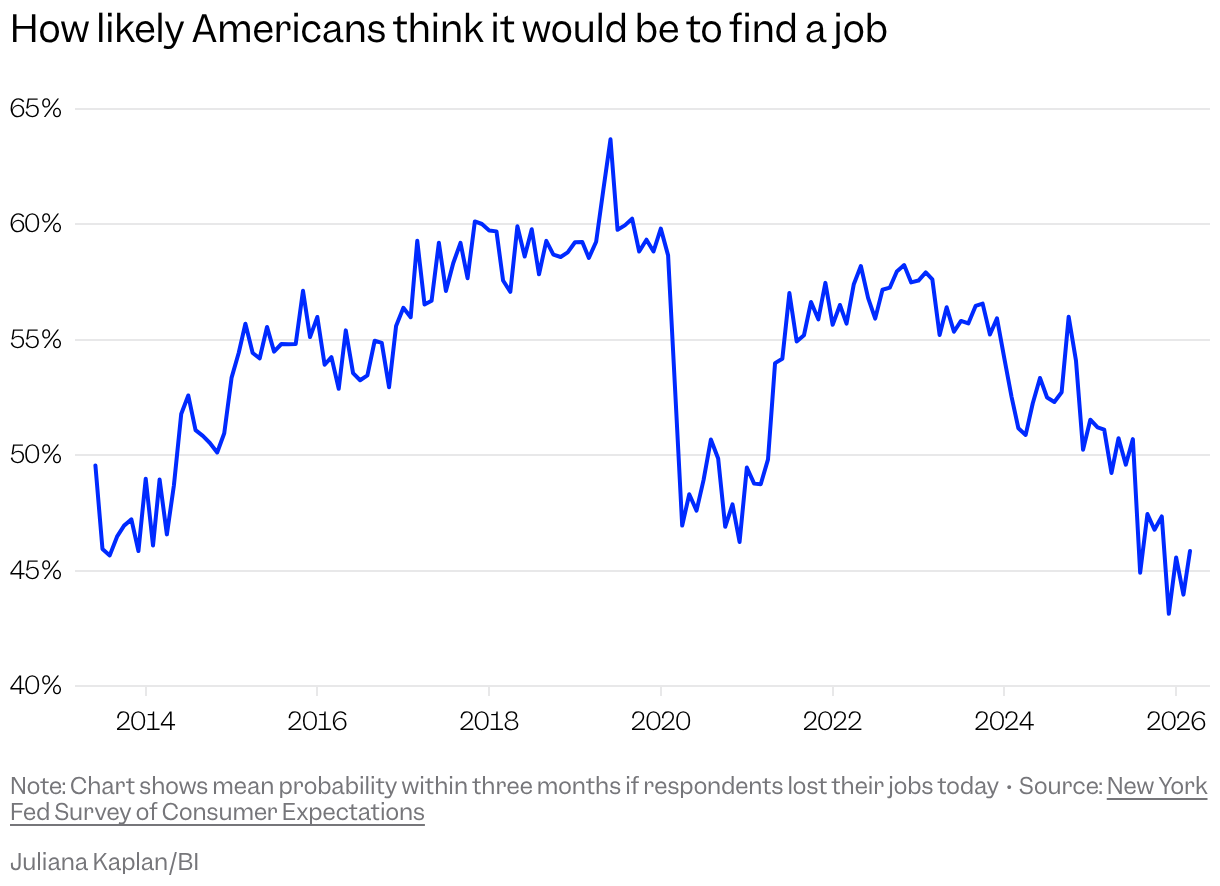
The general malaise may also be exacerbated by a dreary jobs outlook. Consumers’ assessments of their own personal finances fell by 11%, according to the University of Michigan’s survey, and Americans surveyed by the Federal Reserve Bank of New York increasingly don’t think they’d find a new job in the next three months if they lost theirs today.

Line chart

Dreary sentiment might be here to stay as the effects of the conflict with Iran keep prices high and drag on the economy.

“Even if the prices of gasoline and diesel start to come down after the conflict resolves, the effect on the economy will be more long-lasting,” Stephen Kates, a financial analyst at Bankrate, said. “Fuel prices will not fall as quickly as they rose.”

Do you have a story to share about how rising prices and volatility are affecting your economic outlook? Contact these reporters at jkaplan@businessinsider.com and mhoff@businessinsider.com.

Read the original article on Business Insider

I left Florida to retire in New York City at 62. Living in a bustling city keeps me feeling young.

A woman and a man clink glasses at a restaurant and pose for a selfie.
Karen Meadows and her husband, James.
  • While many people move to Florida for retirement, Karen Meadows and her husband did the opposite.
  • The couple left their calm, slow-paced life in Panama City Beach for a faster one in Brooklyn.
  • At first, many things about moving to NYC, like the subway, scared Karen, but now she feels at home.

This as-told-to essay is based on a conversation with Karen Meadows, a 62-year-old Floridian who moved to New York in 2024. The conversation has been edited for length and clarity.

My husband and I have been married for 34 years, and we spent 17 of those years living in Panama City Beach, Florida. It’s where I raised both of my kids and where I started my running coaching business and a 10K charity race.

Panama City Beach was a gorgeous place to live, with beautiful skies every day, clear blue water, and pure white sand. While it was a touristy area, when we first moved there, it was still pretty sleepy during the off-season. That’s actually why I got into the racing business — I was really bored, and there wasn’t that much to do.

However, over the time we lived there, it became more popular.

A family of four - mom, dad, son, and daughter - holds a pumpkin and smiles at the camera.
Meadows, her husband, son, and daughter.

Many people move to Florida to retire because it’s quiet and has a slower pace of life. But for me, I wanted to move somewhere with more energy.

In 2024, my husband and I moved to New York. It’s funny because the first thing everybody says about our move is, “Oh my God, you did the opposite.” And they’re right.

To be honest, at first, I was afraid to live in New York. And I’ll tell you, most days I’m still a little bit afraid. But I’m a huge believer in the idea that your brain is your central governor; it rules everything, and that the second you start restricting yourself because of fear, or thinking you should slow down, you will.

In New York, there are so many people to see and things to do. I’m more active, and living here is keeping me positive about aging.

We moved to be closer to our children

Moving to New York was definitely driven by our children. In 2020, my son was accepted to Columbia University. My daughter also attended Boston University and now lives in New Jersey. My husband and I really wanted to be closer to them.

We did have some issues selling our house in Florida. It was a really pretty home, but it also had a lot of quirky touches. On top of that, there was so much new construction that we were facing a lot of competition.

I took the first decent offer we received. By that point, I didn’t care about trying to squeeze out more money — I felt like my mental health was worth more than that. We made enough from the sale to put some money in the bank and feel like we could downsize comfortably.

An aerial view of Williamsburg, Brooklyn.
East River and Brooklyn Bridge.

There’s such a big contrast between New York and Florida. It made it pretty stressful trying to figure out where to live. But my son introduced me to Williamsburg in Brooklyn, and I liked that it had plenty to do while feeling a little less hectic than Manhattan.

When we first moved to Williamsburg, we lived in an old converted loft building. When our lease was up there, we moved to Three Williamsburg Wharf in 2025. We live in a two-bedroom, two-bath unit and pay around $8,700 a month. Our corner unit has a view of the Brooklyn skyline and overlooks the Brooklyn Navy Yard, which I love because you can see so much going on.

Two side-by-side images of the interior of a condo in a NYC apartment. First photo is a living room with white furniture overlooking the city. The second photo is a bedroom with a large white bed and an open window with the Brooklyn skyline in the background.
A model home at Three Williamsburg Wharf

Coming from a big house, a two-bedroom apartment is a huge downsize. And while I thought I wouldn’t like renting, I’ve never been happier. There’s a lot less to worry about; there are no property taxes, and everything gets done for you. I also love the sense of community here, from wine tastings and Super Bowl parties to the people I’ve met in the building.

Moving to New York was a risk, but I’ve found a new community

I’ve always been a bit of a risk-taker, and I think it’s important to challenge yourself.

That’s part of why I’m such a dedicated runner — I regularly train for marathons, and I’ve run the New York City Marathon and the Boston Marathon many times.

Still, moving to a new place comes with plenty to worry about.

Karen Meadows has two peace signs in the air as she completes a marathon.
Karen Meadows as she completes a marathon.

Some of the fears I’ve had to overcome in New York included learning to use the subway — my son showed me how to use maps, which made it much less intimidating — and getting comfortable driving in a busy city.

The way I got over that fear was by driving more. I also started volunteering with North Brooklyn Angels, a nonprofit food delivery service. Doing that community work has also helped me become more social.

In addition to volunteering with North Brooklyn Angels, I’ve joined the North Brooklyn Runners Club, started a book club, and recently begun volunteering with City Harvest, a food rescue organization. These groups have been especially important to me because I left behind my whole life and many of my friends in Florida. I also love helping people in need.

I know I probably could have moved somewhere more laid-back, warmer, and with lower taxes, but I love New York. I’m almost 63, and I feel better and more alive than ever. Life feels freer, I’m more engaged, and there’s still so much to explore.

Read the original article on Business Insider

Appellate judges signal strong interest in overturning Diddy’s sentence — but there’s a big catch

Sean Combs.
Sean “Diddy” Combs remains behind bars in at a federal prison in New Jersey.
  • Sean “Diddy” Combs’ attorneys are trying to overturn his conviction and sentence.
  • Combs was sentenced to 50 months for two prostitution-related charges last year.
  • In appellate court arguments Thursday, a defense lawyer argued that Combs was treated unjustly.

During a lively exchange of questions and arguments on Thursday, a trio of federal appeals judges signaled their strong interest in overturning last year’s sentence on prostitution-related charges for Sean “Diddy” Combs.

The appellate judges repeatedly voiced skepticism over the Manhattan sentencing judge’s decision to hold the trial’s ample evidence of coercion and force against Combs in sentencing.

Combs was acquitted of using coercion or force to sex-traffick his two longtime girlfriends, the judges noted — and it’s the appellate court’s duty to ensure that sentencing guidelines are followed, and “that the jury’s acquittal isn’t negated,” as Judge M. Miller Baker noted Thursday.

The judges’ apparent sympathy with arguments by a Combs attorney on Thursday comes with a catch, however.

Even if the defense wins and the case is kicked back down to US District Court Judge Arun Subramanian for resentencing, Subramanian has already said that even without considering coercion and force, 50 months remains, in his judgment, a fair sentence for Combs.

Overturning Combs’ sentence could set an important precedent in future cases — setting firmer guidelines on what federal judges can and cannot weigh at sentencing. Still, resentencing Combs could ultimately result in Subramanian imposing the exact same penalty for the “I’ll Be Missing You” rapper.

“Any potential error would be harmless here,” Christy Slavik, a lead federal prosecutor in the case, told the panel.

‘An exceptionally difficult case’

The millionaire hip-hop mogul was sentenced in October to 50 months in prison on two counts of transporting male escorts across state lines for the so-called “freak offs” at the center of the trial.

In her oral arguments Thursday, Combs defense lawyer Alexandra Shapiro repeatedly told the appellate judges that coercion and force had nothing to do with the jury’s limited finding that Combs transported male escorts across state lines.

“This case presents an important issue about respect for jury verdicts and public confidence in our criminal justice system,” Shapiro told the panel.

In detailed questions and statements from the bench, all three judges at times agreed with Shapiro, suggesting they may be open to Shapiro’s arguments and to vacating the 50-month sentence Subramanian imposed in October.

At other times, the judges of the Manhattan-based US Court of Appeals for the Second Circuit expressed skepticism with both the defense’s and the prosecution’s arguments.

The panel of judges repeatedly interrupted Shapiro and Slavik as they presented their arguments, pressing them hard to defend their positions.

And at least one appellate judge appeared sympathetic to Slavik’s argument that Subramanian correctly weighed Combs’ admitted violence and drug use against him at sentencing.

“We have two women who were plied with drugs to participate in this and one of them became an opioid addict,” Baker told Shapiro at one point, referencing trial testimony by R&B singer Cassie Ventura.

“This is an exceptionally difficult case,” Judge William Nardini said at the hearing’s conclusion, telling both sides that the three-judge appellate panel is reserving decision.

‘A thirteenth juror’

Combs, who was not at the hearing, is currently serving out his sentence at a low-security prison in Fort Dix, New Jersey.

Prison records show the 56-year-old music tycoon is currently expected to be released on April 15, 2028. He has been locked up since his September 2024 arrest.

Thursday’s arguments centered on Combs’ two federal Mann Act convictions, for transporting male escorts across state lines so that he could watch them engage in drug-fueled sex encounters with his two ex-girlfriends, including Ventura.

At Combs’ seven-week trial, the jury cleared the onetime near-billionaire of the top sex trafficking and racketeering conspiracy charges against him. The two Mann Act counts were the only charges the jury found Combs guilty of.

In appellate briefs filed by Combs’ attorneys in December, his lawyers argued that Subramanian “acted as a thirteenth juror.”

“The judge defied the jury’s verdict and found Combs ‘coerced,’ ‘exploited,’ and ‘forced’ his girlfriends to have sex and led a criminal conspiracy,” Combs’ attorneys wrote.

They added, “These judicial findings trumped the verdict and led to the highest sentence ever imposed for any remotely similar defendant — even though most others, unlike Combs, ran prostitution businesses that exploited poor or undocumented women or minors.”

Read the original article on Business Insider

The USPS is suspending contributions to employee pensions as it warns of a ‘pending liquidity crisis’

A United States Postal Service (USPS) worker carries containers and packages from a vehicle in Tracy, California, US, on Wednesday, March 25, 2026.
The USPS plans to raise prices in some of its mail categories by 8% come April 26.
  • The USPS is temporarily suspending payments to an employee pension plan, it said on Thursday.
  • The move is set to free up $2.5 billion this fiscal year, the postal service said.
  • USPS is facing liquidity problems and warned that it could run out of cash in early 2027.

America’s postal service is temporarily halting payments to its employees’ pensions to free up cash, citing fast-approaching financial troubles.

The payment suspension to the Federal Employees Retirement System pension plan is set to take effect on Friday, the US Postal Service said in a document with frequently asked questions and answers. The FAQ attributed the pause in pension payments to “a pending liquidity crisis in which the postal service could run out of cash as early as February 2027.”

USPS chief financial officer Luke Grossmann said that the suspension would not cause “any immediate detrimental impact” to current employees or retirees.

“The risk to the Postal Service and the American public from insufficient liquidity for postal operations dramatically outweighs any longer-term risk to the pension funds from not making the currently due payments,” Grossmann said in a statement.

The pause is the latest sign of trouble for USPS. Last fiscal year, the postal service lost $9 billion.

In a congressional hearing last month, Postmaster General David Steiner said the financial situation puts USPS at a “critical juncture.” Without action, Steiner said, USPS might not be able to deliver mail starting in early 2027.

By suspending pension payments, USPS said it would save $2.5 billion in the current fiscal year. USPS pays about $200 million every other week to fund the pensions. Contributions to employees’ Thrift Savings Plans, a separate savings option for federal employees, won’t be affected by the pause, USPS said.

The pension payment pause isn’t a permanent solution to the postal service’s financial problems, USPS said. The agency has cut costs and pursued new revenue, but said it also needs Congress to increase its funding.

“Legislative action is desperately needed to return the Postal Service to profitability,” USPS said in the FAQ.

Do you have a story to share about USPS? Contact this reporter at abitter@businessinsider.com or via encrypted messaging app Signal at 808-854-4501. Use a personal email address, a nonwork WiFi network, and a nonwork device; here’s our guide to sharing information securely.

Read the original article on Business Insider