
Alix Earle and Alex Cooper are feuding, and the internet has a favorite

NEW YORK, NEW YORK - SEPTEMBER 13: Alix Earle (L) and Alex Cooper attend an 'Unwell' fan screening at the Paris Theater on September 13, 2023 in New York City. (Photo by Gotham/GC Images)
Alix Earle and Alex Cooper in happier times.
  • Social data shows more positive online sentiment toward Alix Earle than toward Alex Cooper.
  • The social media stars have captivated the internet with their public feud for the past week.
  • Neither star is really “winning” the spat, however.

Two of the biggest personalities in digital media, Alex Cooper and Alix Earle, are feuding, and the internet has a favorite.

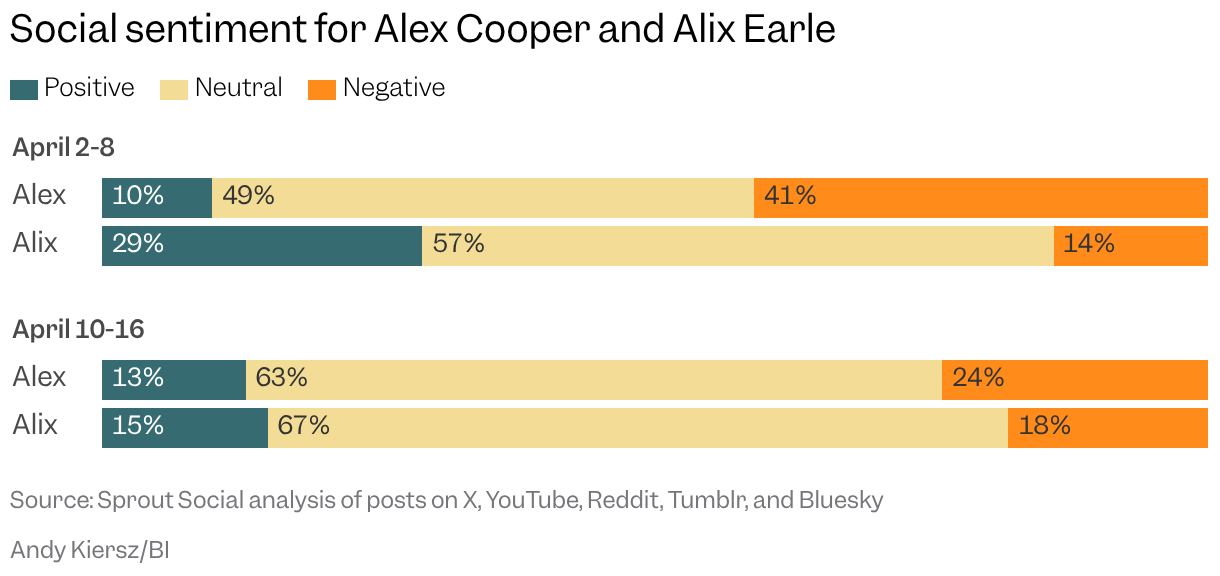
Data from two social listening firms, Muck Rack and Sprout Social, showed higher negative sentiment toward Cooper than toward Earle since the public feud kicked off late last week.

That’s not to say anyone’s truly “winning” this clash. Earle has seen negative commentary about her increase since the feud began, and Cooper entered the dispute riding a prior wave of negative sentiment.
Stacked Bars

Sprout Social said negative sentiment around Cooper was already high before the spat began. The firm attributed this partly to some Hannah Montana fans being upset about the perceived quality of Cooper’s interview with Miley Cyrus, connected to the show’s 20th anniversary celebration.

“For these large female brands, there’s always going to be a lot of haters who want to pull them down,” said Jo Wang, GM of Pop Store, an AI commerce company that helps creators build online businesses.

Overall, though, it’s worth noting that the social listening firms found the sentiment for both Earle and Cooper was largely neutral.

A rep for Earle declined to comment, and reps for Cooper didn’t respond to multiple requests for comment.

How the recent drama started

The recent drama began last week when Earle — who used to work with Cooper’s company — reposted a critical TikTok about Cooper that called her an “ambulance chaser” for interviewing people at vulnerable times, among other accusations.

Cooper, 31, then posted a video calling out Earle, 25. She encouraged Earle to “say what you got to say about me,” to which Earle commented, “Okay on it!!”

Internet commenters have jumped to take sides. Some on social media have criticized Cooper for building an empire on sometimes-questionable advice for young women, while others have defended her as a successful businesswoman. Earle watchers have called her passive-aggressive, while others have praised her for not directly engaging.

People are looking for an escape from the politics and war-dominated news cycle, and Cooper and Earle are delivering it, said Juda Engelmayer, a crisis PR professional whose clients include Harvey Weinstein and Diddy. He said he thought online commenters were drawn to Earle because she presents as authentic and has a younger fan base that’s quick to show their support on social media.

The dustup isn’t that serious — so far — and could even benefit both by introducing them to a wider audience, he said.

“No one’s getting canceled for this,” he said. “This is just bringing name recognition.”

The social stars have a history

The social media frenzy surrounding the two women reflects their ability to command huge audiences and cut big business deals.

Earle, with more than 8 million TikTok followers, became famous for her get-ready-with-me videos in 2022 and is known for selling out products, including her new skincare line, Reale Actives.

Cooper founded the Unwell Network of podcasts, which includes her popular “Call Her Daddy” show. She’s one of the highest-paid podcasters, with a three-year, $125 million deal with SiriusXM. She also has an electrolyte beverage with Nestlé called Unwell Hydration.

In 2023, the Unwell Network signed Earle to host her own podcast, “Hot Mess,” but it ended after less than two years.

There’s been speculation that the two don’t get along — Earle took a slight jab at the situation in a 2025 interview — but this is the first time they are openly taking shots at each other.

Read the original article on Business Insider

A doctor, who treated a 22-year-old with colon cancer, shares what everyone should know about cancer symptoms

A young woman holding her stomach, sitting in bed with abdominal cramps.
Stomach cramps, bloating, abdominal pain, and digestive upset can be early signs of colorectal cancers.
  • A doctor said he’s seeing a growing number of patients under age 45 with colorectal cancers.
  • He recently treated a 22-year-old with stomach pain. She had a tumor so big it nearly blocked her colon.
  • Symptoms of colon cancer can be subtle, so it’s crucial to know the right screening options.

The patient was 22 years old and a recent college graduate, suffering from inexplicable stomach pain.

She’d had the pain off and on for about a year and assumed it was stress-related. She finished her studies and spent a busy summer working at an animal shelter, preparing to apply to veterinary school.

When she saw a doctor, she was told to wait and see if the pain resolved on its own. But when it became so severe, she went to the emergency room. Scans found a tumor large enough to cause a near blockage of her colon. She had no family history of the disease.

It was colon cancer: a growing concern for younger patients, according to Dr. Marc Greenwald, who ultimately treated the patient and wrote a case study on her care.

Greenwald, the chief of colorectal clinical services and surgeon-in-chief at North Shore University Hospital in New York, told Business Insider that while colon cancer cases are decreasing in older adults, they’re on the rise in people under 45 as a growing number of young cancer patients are showing up at his hospital.

“There’s no doubt that we’re seeing more people,” he said. “The problem is that a lot of the symptoms are somewhat subtle. If there are new symptoms for somebody, regardless of age, they should seek medical attention.”

Here’s what Greenwald said everyone should know about the symptoms and your options for cancer screening that could catch the disease in time for effective treatment.

Colon cancer symptoms that everyone should know

Decades ago, colon cancer cases in young people were rare.

Stomach pain and indigestion in 20- or 30-something patients would often be attributed to irritable bowel syndrome or dismissed as a minor ailment.

Today, colon cancer is the top cause of cancer-related death in people under 50, prompting doctors and patients alike to be on high alert for possible symptoms.

Most concerning is that in early-onset colon cancers, symptoms may be subtle or may not appear at all until the cancer has advanced.

Greenwald said his 22-year-old patient likely developed the tumor in her colon as a teenager, and it may have continued to grow unnoticed for years.

“The most dangerous misconception is that I have no symptoms, so I must be fine,” he said. “That is really the wrong attitude because if colorectal cancer is caught before symptoms occur, your chance of a cure is much higher than if you wait for symptoms.”

How to get tested for colon cancer

Early onset cases of colon cancer include patients in their 40s, 30s, and as young as their 20s. That’s a problem because there are currently no screening guidelines for people under 45.

Colonoscopies, recommended starting at age 45, help detect cancer and also prevent it by removing any existing polyps or abnormal growths that can develop into tumors.

If you’re too young for a regular colonoscopy, it’s even more crucial to monitor any changes in your health and seek early screening if necessary.

Greenwald said patients can sometimes postpone or avoid a colonoscopy because they’re anxious about the procedure or colonoscopy prep (although a Business Insider reporter previously shared that it’s easier than you might think).

There are also less-invasive alternatives to colonoscopies, such as stool tests that can be collected at home and mailed to a lab. Blood tests for cancer are currently under development, too, although their reliability can be mixed.

If you have symptoms, even minor ones like a change in bowel habits or digestion, it’s important to talk to your doctor as soon as possible and find a testing option to rule out cancer.

“If you’re not going to do a colonoscopy, do something to get screened,” Greenwald said.

This article is not a substitute for professional medical advice, diagnosis, or treatment. Always consult your qualified physician or healthcare provider.

Read the original article on Business Insider

OnlyFans is an amazing business that seems to scare off investors

Keily Blair, CEO, OnlyFans on Centre Stage during day three of Web Summit 2025 at the MEO Arena in Lisbon, Portugal.
OnlyFans CEO Keily Blair runs a very, very profitable company.
  • OnlyFans has an amazing business model: It sells subscriptions to user-generated porn.
  • That means the company generates enormous profits.
  • But those profits aren’t enough to entice mainstream investors, so OnlyFans has struggled to find a buyer.

OnlyFans is an internet business marvel: low costs, huge profits, nonstop growth. But every time it goes looking for mainstream capital, it runs into the same problem: Investors are scared of buying into a porn company.

Our newest reminder of this tension comes from the Financial Times, which reports that OnlyFans’ parent company is close to an investment deal with Architect Capital that would value it north of $3 billion — down meaningfully from previous targets.

It’s one of a series of data points about OnlyFans’ difficulty in attracting investors. In 2022, it took a run at going public via a SPAC deal that never materialized. In 2025, it was trying to sell itself for $8 billion.

Details and deal structures keep changing in all of these would-be transactions — now the company is reportedly talking about selling a minority investment instead of a controlling stake, for instance. The fact that owner Leonid Radvinsky died in March from cancer has also complicated sales talks. I’ve asked OnlyFans and Architect Capital for comment.

But the main throughline is that many mainstream investors have looked at OnlyFans’ numbers, which describe an amazing business, and concluded that they’re better off staying away. The reputational, regulatory, and legal risks of owning a user-generated porn subscription business have convinced them it’s not worth it.

And again, you can’t overstate just how impressive OnlyFans’ numbers are, which you can see for yourself in British filings. In 2024, it posted a staggering pretax profit of $684 million on revenue of $1.4 billion; people familiar with the company’s business tell me those numbers spiked again in 2025.

As I noted a couple of years ago, that performance comes because OnlyFans is built on a simple and effective business model: “It has connected one of the internet’s favorite things (porn), with one of its favorite content strategies (getting users to create all of its content, for free), and one of its favorite monetization strategies (payments and subscriptions).”

And that made OnlyFans incredibly lucrative for Radvinsky, who took out $700 million in dividend payments in a single year.

Let’s compare that to Match Group, another internet business based on subscriptions and user-generated content, minus the porn: In 2025, the company behind dating apps like Tinder and Hinge posted similar pretax profits of $746 million — albeit on revenue of $3.5 billion. But investors value the company north of $8 billion.

That gap in valuation makes for a pretty easy read: If OnlyFans weren’t a platform best-known for adult content, it could be worth much more. Instead, it looks like it will remain a hugely profitable business with meaningful porn penalty.

Read the original article on Business Insider

15 books to read while you wait for Emily Henry’s ‘Beach Read’ movie to come out

A composite of a photo of Phoebe Dynevor and Patrick Schwarzenegger.
Phoebe Dynevor and Patrick Schwarzenegger are set to star in the adaptation of Emily Henry’s “Beach Read.”
  • Emily Henry’s “Beach Read” is being adapted into a film for 20th Century Studios.
  • Phoebe Dynevor and Patrick Schwarzenegger will star in the movie.
  • While you wait for the movie to come out, you can read books that are similar to “Beach Read.”

The “Beach Read” movie is officially on the way.

Emily Henry’s romance debut tells the love story of writers January Andrews and Augustus Everett. The novel, published in 2020, was an instant hit, and Henry went on to write five more bestselling romance books. Several are being adapted into films, including “Beach Read.”

In April 2023, Deadline reported that Yulin Kuang, who cowrote the adaptation of Henry’s “People We Meet on Vacation,” released on Netflix in January 2026, would be adapting and directing the film version of “Beach Read” for 20th Century Studios.

Updates about the film have been sparse in the years since, but traction finally began to build in early 2026. In February, Deadline reported that “Bridgerton” star Phoebe Dynevor had been cast as January, and on Tuesday, the outlet announced Patrick Schwarzenegger, who starred in season three of “The White Lotus,” would play Gus.

Though the leads have been cast, 20th Century Studios has yet to announce when filming will begin or when the movie will premiere. Fans will have to wait a while before they can see Gus and January brought to life on the big screen, but they can read books similar to “Beach Read” in the meantime.

Read on to check out 15 books that are perfect for fans of “Beach Read.”

“People We Meet on Vacation” by Emily Henry
The cover of "People We Meet on Vacation" by Emily Henry
“People We Meet on Vacation” by Emily Henry.

Emily Henry’s second novel, “People We Meet on Vacation,” is just as delightful as its predecessor. The book swaps “Beach Read’s” enemies-to-lovers trope for friends-to-lovers.

No one expected Alex and Poppy to be friends, let alone best friends. Alex is a homebody who has a codependent relationship with his cat, while Poppy is a free spirit who writes a travel blog.

Despite all odds, Alex and Poppy have clicked since college, managing to keep their friendship alive after Poppy moved to New York City through an annual weeklong vacation. Then, after a decade of trips, they make a mistake they can’t take back, leaving their friendship in pieces. 

Two years later, they still haven’t spoken, and Poppy feels lost even as everything in her life falls into place. Fixing things with Alex feels like the key to it all, so she breaks their stand-off to see if he’ll go on a last vacation with her. 

When Alex says yes, Poppy knows it’s her last chance to make their relationship right. A reunion means they’ll both have to confront feelings for each other they don’t want to have, putting their friendship on the line once again. 

“The Unhoneymooners” by Christina Lauren
the unhoneymooners

Christina Lauren’s New York Times bestseller stars Olive Torres, the unlucky twin who feels like she’s always living in her sister’s shadow.

Things change at her sister’s wedding, though. The entire wedding party gets sick, aside from Olive and Ethan Thomas, a groomsman she happens to loathe. The pair is given the chance to take the newlyweds’ 10-day honeymoon in Hawaii, and Olive agrees to go for the free trip despite her hatred of Ethan.

As the unlikely pair enjoy their surprise vacation, Olive finds herself feeling things for Ethan she never expected. Has her luck finally changed?

“The Wedding Party” by Jasmine Guillory
The cover for "The Wedding Party" by Jasmine Guillory.

Every installment of Jasmine Guillory’s “The Wedding Date” series offers a steamy love affair, and the third book, “The Wedding Party,” is no exception. 

Theo and Maddie have never liked each other — though they share a mutual attraction that’s hard to ignore. Most of the time, they do their best to avoid each other, only hanging out when their best friend Alexa forces them to. 

When Alexa gets engaged and Theo and Maddie are both made members of the bridal party, they’re forced to spend time together, making it harder and harder to ignore the spark between them as the wedding looms closer.

Eventually, they give in to their temptation, swearing that they’ll end their secret affair the second Alexa says “I do.” What will Theo and Maddie do when they realize they’re falling for each other?

“The Hating Game” by Sally Thorne
The cover of "The Hating Game" by Sally Thorne.
“The Hating Game” by Sally Thorne.

Lucy Hutton and Joshua Templeman might both be assistants to co-CEOs of a publishing house, but that’s where their similarities end. Josh is as type A as they come, while Lucy approaches her life with excitement and colorful clothes.

It’s no secret that they hate each other, and their loathing only increases when they realize they’re up for the same promotion.

Lucy decides she’s not going to let Josh intimidate her anymore, and soon, their fiery hate is turning into something else entirely. After years of fighting, how can either of them trust that this change of heart is real?

Sally Thorne’s debut is the enthralling workplace rom-com you’ve been waiting for, and you can stream the movie adaptation after you finish the book.

“Act Your Age, Eve Brown” by Talia Hibbert
The cover of "Act Your Age, Eve Brown" by Talia Hibbert.
“Act Your Age, Eve Brown” by Talia Hibbert.

Fans of Talia Hibbert will love “Act Your Age, Eve Brown,” the third installment of the Brown sisters series.

The novel follows Eve, who has always been more comfortable with chaos than order, as her purple hair makes clear.

It’s no surprise that constantly controlled Jacob Wayne doesn’t hire her to be the chef at his bed and breakfast — but it is a shock when Eve accidentally hits his car and breaks his arm.

To make amends, Eve lingers around the B&B, becoming a nuisance that Jacob is prepared to hate. His loathing soon turns to something else, warming a place inside him he didn’t know existed.

“Red, White, and Royal Blue” by Casey McQuiston
red white and royal blue book

The enemies-to-lovers trope gets a fresh twist in this delightful debut by Casey McQuiston, which has since been adapted into an Amazon film. “Red, White, & Royal Blue” follows Alex Claremont-Diaz, the son of the first female president of the United States.

As his mother begins her reelection campaign, Alex causes an international crisis when he gets into a public fight with his sworn nemesis, Henry, who happens to be the Prince of England. The two begin a fake friendship to appease their families, but they soon find themselves drawn to each other in ways they never expected.

As Alex and Henry grow closer, they’ll have to decide if they’re willing to put their families and political careers on the line for love.

“Shipped” by Angie Hockman
The cover of "Shipped" by Angie Hockman.
“Shipped” by Angie Hockman.

In Angie Hockman’s “Shipped,” Henley Evans and Graeme Crawford-Collins have been enemies from the day they started working together at a cruise line — though they’ve never met in person since Graeme works remotely. 

Their first IRL meeting comes in the form of a company trip to the Galápagos Islands, where they’ll both be competing for their dream promotion. Henley is prepared to do whatever it takes to crush Graeme, but her plan falls apart when she meets Graeme and discovers he’s nothing like she thought he was.

Her feelings for him threaten to ruin everything she’s been working toward — which might be the best thing that ever happened to her.

“The Viscount Who Loved Me” by Julia Quinn
The cover of "The Viscount Who Loved Me" by Julia Quinn.
“The Viscount Who Loved Me” by Julia Quinn.

Julia Quinn’s second “Bridgerton” book, “The Viscount Who Loved Me,” is a great fit for “Beach Read” fans. Plus, when you’re done, you can stream the Netflix series and check out Dynevor’s acting chops ahead of the film’s premiere.

When Anthony Bridgerton decides he’s finally ready to marry, he doesn’t anticipate any obstacles. After all, as Viscount Bridgerton, any lady of the ton should be thrilled to marry him.

To his surprise, there is one lady who doesn’t think Anthony is marriage material: Kate, the sister of the lady he hoped to marry.

Anthony is determined to win Kate’s approval, but Kate is focused on protecting her sister from a rake. As they continue to vex each other, Anthony and Kate find the tension between them turning into a different kind of heat.

“Heated Rivalry” by Rachel Reid
The cover of "Heated Rivalry" by Rachel Reid.
“Heated Rivalry” by Rachel Reid.

If you somehow missed the “Heated Rivalry” craze after the show dropped on Crave in 2025, reading the book is a great entry point to Rachel Reid’s series.

As two of the best professional hockey players, Shane Hollander and Ilya Rozanov have been pitted against each other for years. Shane, captain of the Montreal Voyageurs, is steadfast and reserved, while Ilya is cocky and unafraid to make enemies on the ice as captain of the Boston Bears.

The world expects them to hate each other, and on the ice, they do. Little does the world know, though, that Ilya and Shane have been finding ways to steal moments alone together since their rookie season. Their connection is addictive — and terrifying, as getting outed could cost them their careers.

As their feelings for each other grow and the stakes of getting caught rise, Ilya and Shane will have to decide whether what they have is worth the risk.

“Every Summer After” by Carley Fortune
The cover of "Every Summer After" by Carley Fortune.
“Every Summer After” by Carley Fortune.

If you loved the second-chance element of “Beach Read,” you’ll love “Every Summer After” by Carley Fortune.

Sam Florek was the center of Persephone (Percy) Fraser’s summers for six years. After her family bought a lake house on Barry’s Bay, Sam and Percy became inseparable, and their friendship blossomed into something all-consuming as they went from tweens to teens. At 17, when she pictures her life, all Percy sees is Sam.

Then, one mistake ruins it all, and Percy doesn’t return to Barry’s Bay — or see Sam — for a decade. When she’s finally accepted that there will always be a Sam-shaped hole in her life, his mother’s funeral brings her back to her beloved lake for one weekend — and face to face with the man she’s loved for nearly all her life.

Percy and Sam’s bond is as strong as ever when they reconnect, but all that’s unsaid between them is keeping them at a distance. With the story spanning the weekend and the summers of their youth, Percy and Sam will have to decide if it’s worth digging up their past for a shot at their future.

“Not in Love” by Ali Hazelwood
The cover of "Not in Love" by Ali Hazelwood.
“Not in Love” by Ali Hazelwood.

Rue Siebert feels like she owes everything to her career as a biotech engineer at Kline. She loves her work, the financial stability it brings, and the close friends she’s made at the company.

Everything she loves feels at risk when The Harkness Group walks into Kline, intent on taking over the company. Rue is ready to hate every member of the group — until she lays eyes on Eli Killgore, Harkness’ money man and the guy she had an almost-one-night stand with the night before.

Rue wasn’t part of Eli’s plans, but now that he knows she’s at Kline, he’s struggling to let her “no repeats” rule or his company’s objectives stand in the way of pursuing her. Soon, Rue and Eli give in to their attraction, agreeing to a no-strings-attached relationship that won’t compromise their loyalty to their respective companies.

The more time they spend together, the harder it is for either to remember why staying unattached was the best plan.

“Sweet Heat” by Bolu Babalola
The cover of "Sweet Heat" by Bolu Babalola.
“Sweet Heat” by Bolu Babalola.

The sequel to her debut novel, “Honey and Spice,” Bolu Babalola’s “Sweet Heat” asks whether true love really deserves a second chance.

At 28, Kiki Banjo already feels like she’s on the precipice of more change than she can handle when her ex-boyfriend Malakai walks back into her life. Three years after their breakup, which Kiki feels she barely walked away from, she and Malakai have to reunite to serve as the maid of honor and best man at their best friends’ wedding.

Kiki hopes she can get through the wedding season by avoiding Malakai, whom she’s disappointed to discover is as gorgeous, funny, frustrating, and talented as ever. When their career ambitions lead them to work on a joint project, she’ll have no choice but to reenter his orbit.

Kiki tells herself she can handle a few months of dealing with Malakai, but her heart might not be as ready to shut him out as her brain.

“Yours Truly” by Abby Jimenez
The cover of "Yours Truly" by Abby Jimenez.
“Yours Truly” by Abby Jimenez.

Jacob Maddox joining the staff at her hospital is the last thing Briana Ortiz needs in “Yours Truly” by Abby Jimenez.

Fresh off a divorce and caring for her sick brother, Briana has no time for the new doctor who is her competition for the Chief of Emergency Medicine job she deserves after 10 years of service. It doesn’t help that he makes the worst first impression, confirming all her suspicions about the supposed hotshot doctor.

Briana is sure she’ll loathe Jacob for the rest of their time working together, until he is shockingly kind to her when he finds her crying and sends her a letter that shows her he’s not the menace she thought. Briana and Jacob become pen pals and work friends, and then she finds herself rethinking everything about him when he gives her brother a kidney.

When Jacob asks her to pretend to be his girlfriend for a family wedding, Briana is more than happy to oblige. However, what will Briana and Jacob do when they realize there’s nothing fake about their feelings for each other?

“You Between the Lines” by Katie Naymon
The cover of "You Between the Lines" by Katie Naymon.
“You Between the Lines” by Katie Naymon.

Like “Beach Read,” Katie Naymon’s “You Between the Lines” also tells the love story of two writers with a complicated history.

Leigh has a serious case of imposter syndrome when she is accepted into an MFA program. She’s always loved writing, and she doesn’t think her sorority girl life has to be at odds with that. However, Leigh took it to heart when Will, her high school crush, told her that a poem she wrote was superficial.

So when Leigh arrives at her grad program and discovers that Will, who now goes by William, is in her cohort, she feels 16 and unsure of herself all over again. Beating William out for the program’s fellowship seems like the best way to get past her insecurities once and for all, and the competitive spark between them burns back to life instantly.

Yet there’s more to her history with William than Leigh wants to face — until he writes a poem that makes her realize she might not be the only one haunted by what they could have been.

“First-Time Caller” by B.K. Borison
The cover of "First-Time Caller" by B.K. Borison.
“First-Time Caller” by B.K. Borison.

Aiden Valentine is a love skeptic, which is a bit inconvenient considering he hosts the most popular romance hotline show in Baltimore, “Heartstrings.”

He needs something to make him believe in love again. The answer to his problems comes in the form of a call from a kid looking to help her mom find a boyfriend.

Lucie Stone is mortified when her daughter calls into “Heartstrings” on her behalf, but as she speaks to Aiden, she finds herself opening up about loneliness and her fears about dating. Her plight strikes a chord, and soon, Aiden’s network wants to help Lucie find love.

Aiden is tasked with helping Lucie date as Baltimore listens in. But as they share the radio booth several times a week, Aiden and Lucie find themselves drawn to each other when they’re supposed to be searching for her soulmate.

Read the original article on Business Insider

What Allbirds needs to do to make its Hail Mary AI pivot succeed

A sign at the entrance of an Allbirds store says "This store is closed."
Allbirds is trying to pull itself out of a financial tailspin by pivoting to AI.
  • Allbirds’ plan to trade shoe stores for data centers won’t be easy to pull off.
  • The company needs more money, expertise, and relationships with hyperscalers.
  • It could also try to acquire a private company already doing this work.

In November, Allbirds told shareholders it was on the brink of insolvency. Transforming the shoe company into an AI compute company is its last-ditch plan.

It won’t be easy.

Allbirds, which intends to change its name to NewBird AI, currently lacks the money, the physical assets, the expertise, and the relationships it will need to compete in an increasingly crowded space, AI industry insiders say.

Here’s what the company would have to do to reinvent itself.

Raise more money

Allbirds last month said it had sold its shoe business and the underlying intellectual property for $39 million. The company Wednesday said it had raised $50 million in a convertible note that it could use to purchase graphics processing units used to train and deploy AI language models.

Even so, Allbirds’ war chest, some $90 million or so, is still small change in an industry that’s raising tens of billions of dollars to build the data centers and buy the chips needed to run large language models. And the company owned no warehouses or real-estate assets as of the end of 2025, according to company filings. Allbirds didn’t respond to a request for comment for this story.

CoreWeave, the leader of a class of firms known as neoclouds that Allbirds appears aimed at joining, plans to spend $30 to $35 billion this year building its capacity.

“To run institutional grade compute clusters it can be in the order of a couple hundred, a few hundred million, at least,” Warren Hosseinion, the head of capital markets at GPU investor Compute Labs, told Business Insider.

Find customers

One of the first tasks will be signing contracts with the likes of Amazon, Google, Meta or Microsoft. Allbirds could then use those contracts to secure the additional financing to buy more GPUs.

Though CoreWeave has pioneered such a model, Allbirds may struggle to persuade potential partners as well as potential investors that it’s in the game for the long haul, AI industry executives said.

“If you can pass the underwriting diligence…that will be their biggest hurdle,” Hosseinion said.

Consider an acquisition

One way for Allbirds to move faster would be to acquire a private company already doing this work, said Darren Kimura, CEO of AI Squared, which helps companies deploy artificial intelligence tools.

The merged company would then be publicly traded and have access to public markets capital.

Allbirds’ $50 million in financing should be enough to hire a management team, some chips, and begin what would essentially be a proof of concept, Kimura said.

“You could buy enough to get going, and use that as an example to demonstrate the model working, and then build it out.”

Hire leaders with AI experience

AI infrastructure companies need management with expertise in politics and energy, said Paul Calatayud, the founder of AI data center developer VoltScape, who said he has several billion-dollar-plus projects under development.

“Somewhere in between there has to be a group that knows how to handle running a data center,” he said.

Allbirds Chief Executive Joe Vernachio, who succeeded founder Joey Zwillinger in 2024, comes from the retail clothing industry. He led a turnaround at Mountain Hardwear, and also held executive roles at The North Face and Spyder Active Sports, according to his LinkedIn profile.

Annie Mitchell, the CFO, worked at Gymshark and Adidas before joining Allbirds, according to a press release announcing her hire.

Both executives will receive retention bonuses if they stay at the company through the closing of the sale of the shoes business, expected sometime in the second quarter. It’s unclear how much longer after that they will stick around.

Read the original article on Business Insider

Spirit could disappear from the skies as fuel costs rise. See how it rose from a trucking company to a low-cost giant.

Spirit Airlines old and new aircraft
Spirit Airlines’ old and new aircraft.
  • Spirit Airlines could liquidate as early as this week, reports say.
  • It’s in its second bankruptcy since 2024, and rising fuel costs is making recovery harder.
  • Spirit’s closure would mark the end of a 62-year history that started as a trucking company.

Spirit Airlines’ iconic yellow paint job could soon fade from the skies.

CNBC reported on Wednesday that the ultra-low-cost carrier, which has struggled to return to profitability post-pandemic amid changing traveler habits and rising costs, could liquidate as early as this week.

The airline had recently shown signs of progress in its Chapter 11 bankruptcy proceedings — its second since 2024 — but rising fuel costs tied to Middle East conflict are now making that recovery even harder.

A Spirit spokesperson told Business Insider that it doesn’t “comment on market rumors and speculation.”

It’s unclear what would happen if Spirit were to abruptly shutter. Beyond the immediate impact on customers, the airline’s operations would likely cease and its fleet would be grounded.

Any potential outcome would depend on whether a buyer emerges for its assets. JetBlue Airways, which attempted to acquire Spirit for $3.8 billion in 2024 before the deal was blocked by regulators, could revisit a bid.

Other carriers eyeing Spirit’s relatively young aircraft and sizeable East Coast network could also see value, though no formal interest has been announced.

If Spirit were to disappear — the nail in its coffin likely being the oil crisis and rising demand for premium travel it can’t match — it would close the book on a 62-year history.

Spirit started as Clippert Trucking Company in 1964.
Spirit's planes in 2007.
Spirit’s livery in 2007.

In 1974, the company was refounded as Ground Air Transport Inc. by Michigan-native Ned Homfeld.

Homfeld eventually founded the first passenger version of Spirit in 1980: Detroit-based Charter One Airlines. The charter tour company officially launched operations in 1983 using turboprop aircraft.

It focused on gambling trips, offering routes to Atlantic City, New Jersey, from Chicago, Detroit, Boston, and Providence, Rhode Island.

As gambling soon became popular in other states, Charter One began ferrying northerners to warmer destinations, including Florida, the Bahamas, Las Vegas, and San Juan.

Scheduled air service officially launched in 1990.
A Convair
Convair 580 turboprop (not Charter One Airlines).

A decade after its founding, Charter One launched scheduled air service from Boston, Detroit, and Providence to Atlantic City, marking the start of the company’s commercial operations.

Charter One leased two Convair 580 twin-engine turboprops for the service. It would operate the planes for only a couple of years before rebranding to Spirit Airlines.

Charter One became Spirit Airlines on May 29, 1992.
Spirit Airlines McDonnell Douglas MD-80
Spirit Airlines McDonnell Douglas MD-80.

Spirit rebranded and added four DC-9 jets to its fleet. The company was able to secure the planes at a low price after the demise of low-cost competitor Midway Airlines brought down used-aircraft prices.

In June, the company launched its first flight from Detroit to Atlantic City, which operated twice daily. The airline’s code is NK for “Ned’s Kids.”

Spirit’s early fleet also included McDonnell Douglas MD-80 aircraft. According to Plane Spotters, 44 DC-9 and MD80 planes were delivered through the 1990s and early 2000s, with the last MD80 leaving the company in July 2010.

Spirit was small but gained early momentum with its staple cheap fares.
The snacks on Spirit
The snacks on a Spirit Airlines flight. The offerings change over the seasons.

Spirit flew more than a quarter-million passengers in 1993 and generated $21 million in revenue. The company’s background as a tour operator helped it fill planes.

The carrier won over customers with cheap fares, powered by its low-cost business model in which everything beyond an unassigned seat — even water — cost extra. This secured lucrative ancillary revenue.

Legacy airlines with higher operational costs were often forced to slash fares to stay competitive when Spirit entered the market. This exacerbated the financial strains of the 1990s.

Spirit thrived as legacy airlines struggled during the 1990s recession.
Pan Am flight attendant serving drinks on the company's 747.
Pan Am flight attendant serving drinks on the company’s 747.

The 1990-1991 US recession opened the door for startups to acquire cheap planes and nonunion staff who had been employed by collapsed Pan Am, Trans World Airways, Eastern Air Lines, and Midway.

From 1993 to 1999, Spirit expanded its route network, offering flights to Philadelphia, Orlando, St. Petersburg, Myrtle Beach, Los Angeles, and New York City.

Spirit’s brand was tarnished after a failed deal with Delta Air Lines.
Spirit's catch the spirit livery.
The “Catch the Spirit” livery.

Delta’s defunct regional carrier, Comair, wanted to buy Spirit for $20 million in the mid-1990s. The deal was part of Spirit’s attempt to find a home in a bigger organization to help it expand amid growing competition.

The deal never materialized. Comair pulled out after a budget carrier, ValuJet, crashed into the Everglades in 1996, which created a stigma about the safety of low-cost airlines.

To address customer concerns, Spirit sent thousands of postcards to reassure customers about the safety of its planes.

It also launched a “Catch the Spirit” media campaign that included TV, radio, and billboard ads to sell Spirit’s perfect safety record and involved adding a new logo to its aircraft.

It took advantage of Northwest’s pilot strike.
Northwest pilot strike.
In 1998, pilots at Northwest, which merged with Delta in 2008, went on strike, leading to thousands of flight cancellations.

Spirit recorded a loss in 1996, mostly due to a 25% rise in fuel prices, consumer hesitation to fly low-cost carriers, and some legacy carriers matching Spirit’s fares and pushing it out of key markets.

However, Spirit’s planes began filling again in 1997. In June of that year, Spirit took over defunct carrier Sun Jet’s routes from New Jersey to Florida. It also acquired more planes to take advantage of Northwest’s 1998 pilot strike that grounded the rival for weeks.

That year, Spirit reported revenue of $121 million, had 20 aircraft in its fleet, posted the industry’s highest load factor at 76.4%, and carried 1.4 million passengers, an increase of 80% from 1997.

Spirit moved its headquarters to Florida in 1999.
Spirit Airlines headquarters in Mirimar, FL

The airline had been courted by several other cities, including Detroit and Atlantic City, before making its move from Eastpointe, Michigan to Miramar, Florida.

Miramar made sense because it was in the Fort Lauderdale area where Spirit’s tour company was already based, and the airline had been serving Fort Lauderdale-Hollywood International Airport since 1993.

It still has a stronghold in the city, though it has trimmed capacity in recent years to optimize its network and better manage costs.

Spirit began growing its Airbus A320 fleet in 2002.
Spirit Airlines plane in San Juan, Puerto Rico

It’s still the only aircraft family in its fleet today, and it’s relatively young at an average of eight years. The planes are no-frills with only economy seats and a few rows of premium loungers.

Spirit continued to expand throughout the 2000s. It added San Juan, Puerto Rico in 2001. Boston, Grand Cayman, and San Francisco were added in 2006.

The airline has rebranded its premium seats over the years.
Flying Spirit Airlines across the US — Spirit Airlines Flight 2021
Flying Spirit Airlines from Santa Ana, California to Newark, New Jersey.

In 2007, the airline rebranded its “first class” as the Big Front Seat, which passengers can secure for an extra fee.

Spirit has since further revamped its most expensive seats, adding legroom, wider seating, and bundled perks to lure more premium flyers.

It’s part of a wide industry focus on premium revenue as flyers remain willing to pay up for comfort.

The last US pilot strike was by Spirit pilots in 2010.
Spirit Airlines pilot strike

The strike occurred amid poor wages and benefits, leading to thousands of flight disruptions.

At the time, Spirit crews were among the lowest-paid pilots in the US despite flying the same planes as their higher-paid counterparts at other airlines.

Spirit was the first airline to charge for carry-on bags.
Spirit Airlines bag size checker

The move reduced its operating costs because the resulting fewer overall bags lowered the aircraft’s fuel consumption. It also sped up the boarding process and freed up overhead bin space.

The à la carte model became its bread and butter.

In 2011, the carrier began charging for boarding passes printed at the airport ticket counter and reduced its maximum checked baggage weight from 50 to 40 pounds.

Spirit’s no-frills strategy has been controversial throughout its history.
Flying Spirit Airlines across the US — Spirit Airlines Flight 2021
Flying Spirit Airlines from Santa Ana, California to Newark, New Jersey.

In 2008, Spirit was the number one airline for customer complaints. It still managed to fly five million passengers and achieve a net profit during the recession, making it one of the few carriers to do so.

In 2011, the Department of Transportation fined the airline $50,000 for what it described as deceptive advertising, claiming it did not disclose hidden fees, like baggage.

In 2014, Spirit was the top airline pick for growth among investors, and in 2016, Spirit was the first US carrier to add the A320neo to its fleet.

By 2019, Spirit was consistently profitable and popular.
Spirit Airlines in the Caribbean

It had become a budget leader and consistently turned a profit as people sought cheap vacations and didn’t mind a bare-bones experience.

By 2019, the airline was operating 600 daily flights to 72 destinations across the US, Mexico, Central America, and the Caribbean.

The pandemic changed everything.

Spirit was hit hard during the coronavirus pandemic.
Spirit Airlines passengers during the pandemic

Spirit recorded a 2020 net loss of $428 million. Nevertheless, Spirit expanded operations with new city pairs and airports in 2021.

It ended the year with what it described as a “better than expected” operating revenue, despite the mix of poorly timed weather, system outages, and staff shortages that left thousands of customers stranded.

The customer outrage led to a warning from regulators. Still, Spirit continued to improve in 2022, reporting strong ancillary revenue in the first quarter. Things appeared to be moving back toward how they were in 2019.

Changing traveler habits derailed everything.
Spirit's barebones planes.
Spirit planes are still largely barebones, with some rows now offering more legroom and perks.

Airlines have been doubling down on premium revenue as flyers remain willing to pay extra for better comfort across all cabins. This prompted Spirit to rethink its all-economy strategy.

It started bundling its fares and offering premium seating to lure more customers, but its “first class” seat still pales in comparison to the amenity-stuffed loungers on rivals like Delta and United.

In its latest update, it said it would continue to focus on high-demand routes, reduce its debt, and have just 80 aircraft by late 2026 — down from over 200 at its peak.

Read the original article on Business Insider