Elon Musk thanked Samsung, TSMC, and Micron on Wednesday’s earnings call.
It was a particularly 2026-like moment — companies are trying to supply chips as prices go wild.
“They’ve got to make some very tough decisions on memory allocation,” Musk said.
Elon Musk took a moment during Tesla’s earnings call on Wednesday to thank three companies that have little to do with traditional automaking.
Musk praised Samsung and TSMC during the call, and then turned to another company that manufactures semiconductor chips. “I’d also like to thank Micron for giving us a memory allocation,” he said. “They’ve got to make some very tough decisions on memory allocation.”
Micron and Samsung are two of the world’s largest manufacturers of DRAM, the short-term memory that allows computers to rapidly access and process data. The chips have become one of the AI boom’s hottest commodities — and increasingly difficult for companies to secure at reasonable prices.
The rapid construction of AI data centers has consumed huge amounts of memory. Manufacturers have also shifted production toward high-bandwidth memory, a more advanced and profitable form of DRAM used with AI processors, leaving less capacity for conventional chips.
The shortage has pushed manufacturing prices higher as companies compete for limited allocations.
And the consequences have spread to regular shoppers: Computer and video game makers have announced price increases, while smartphone manufacturers like Apple have announced higher prices.
That makes Musk’s coziness with the three companies all the more important.
The automaker needs memory throughout its vehicles — but its appetite is poised to grow as it shifts its business and spends billions of dollars on AI infrastructure, robotaxis, and its Optimus humanoid robots.
Musk said Micron had allocated a “significant” amount of memory to the company under reasonable terms, though neither company has publicly detailed the products, prices, or length of the arrangement.
In the past month, Micron has also partnered with General Motors and Ford to continue supplying automotive chips.
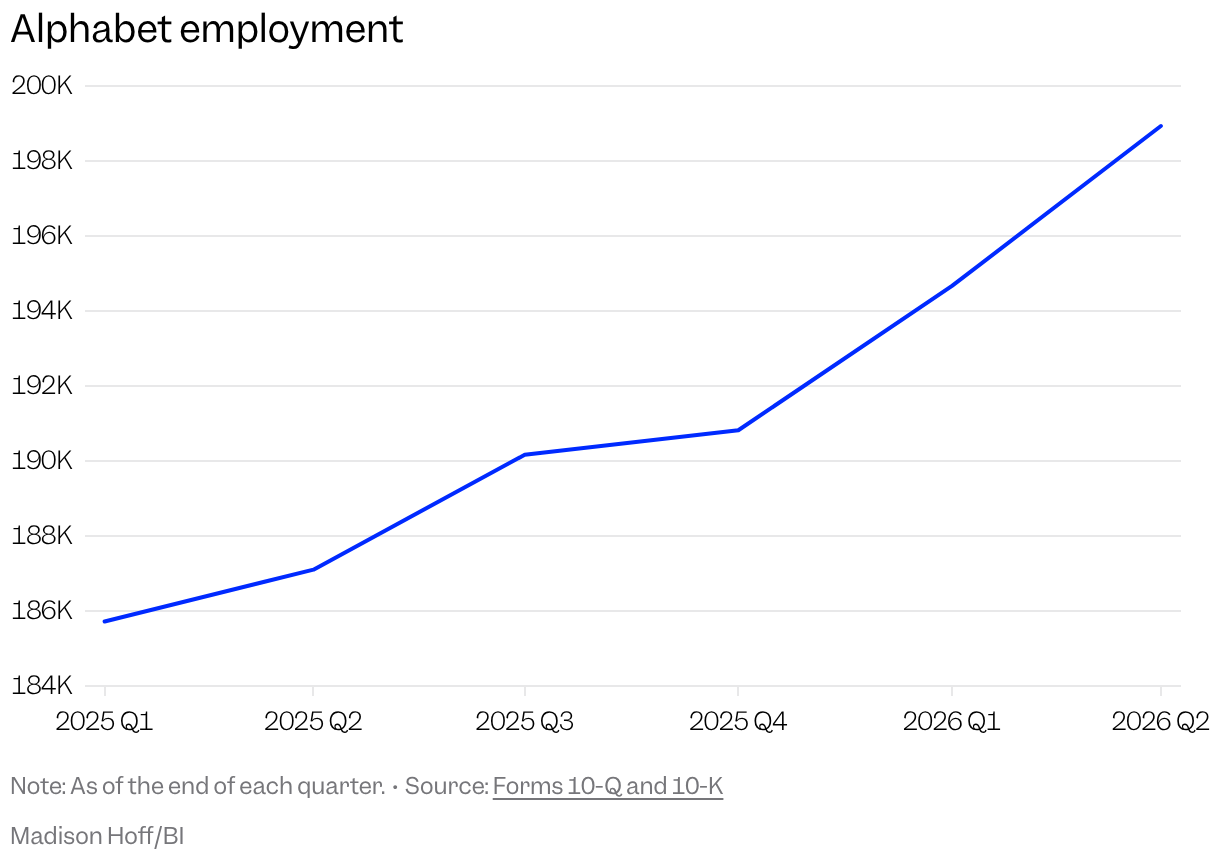
Alphabet reported blockbuster second-quarter earnings, with revenue climbing 24% year over year to $119.8 billion. The company revealed in its earnings report that it increased head count by 11,830 employees, from 187,103 to 198,933, between June 30, 2025 and June 30, 2026.
The chart below shows how Alphabet’s workforce has grown from the end of the first quarter of 2025 through the end of the second quarter of 2026.
The biggest jump in Alphabet’s head count of the last couple of years came in the second quarter of 2026, when the company added over 4,000 workers, accounting for more than one-third of net hiring over the past year.
Since 2022, companies including Google, Meta, Amazon, and Microsoft have cut thousands of jobs. Google laid off 12,000 employees in 2023 and has conducted several smaller rounds of cuts since, impacting thousands of employees in total.
Google employees from around the country rallied last week to demand stronger protections against layoffs. Roughly 4,500 employees signed a petition about job security addressed to CEO Sundar Pichai and three senior executives at the tech giant.
While Google didn’t share which roles it has hired more of over the last year, the company said in its earnings on Thursday that it’s prioritizing long-term AI growth and doubling down on its AI buildout.
The tech giant raised its 2026 capital expenditure outlook to between $195 billion and $205 billion, up from a previous estimate of up to $190 billion. The company said its demand for AI infrastructure continues to outpace available capacity.
My family had a great trip to the Amalfi Coast, but if we were to do it all over, there are a few things I’d change.
Alexa Mellardo
I went on a trip to the Amalfi Coast in Italy with my husband and parents, who are in their 60s.
Spending more time in Capri instead of Sorrento, which felt a bit busy, would’ve been nice.
I wish we’d made fewer dinner reservations and booked more cooking classes, which we loved.
Italy stole my heart over a decade ago, when I spent a semester of college studying abroad there.
This beautiful country is where I cliff-jumped into the Mediterranean Sea, toured wineries throughout Tuscany’s rolling hills, tossed coins into the Trevi Fountain in Rome, and perused chic boutiques in Milan.
Although I was sad to leave, I knew I would return someday. The Amalfi Coast, in particular, sat at the top of my bucket list, as I was only there for a day.
This past year was the perfect opportunity to make that dream a reality, since we wanted to celebrate my dad’s retirement after 45 years of hard work.
So, my parents, who are both in their 60s, and my husband and I, who are in our 30s, packed our bags and jetted off to explore the Amalfi Coast.
The first big decision we made was choosing Positano as our “home base” for the week due to its central location, jaw-dropping cliffside views, and plethora of restaurants and shops.
From there, we took day trips to the surrounding towns. We planned everything from a private boat ride along the coast to a hike on Sentiero dei Limoni, “the Path of the Lemons,” in Minori.
For our first family trip to the Amalfi Coast, I was genuinely happy with where we stayed and everything we experienced. But the next time I go, I may do a few things differently.
Staying in a less touristy town might’ve been nice
Our hotel was great, though I’d love to stay somewhere else next time.
Alexa Mellardo
My family agreed that staying in one hotel — and avoiding the hassle of checking in and out with oversized luggage — was a wise choice.
After all, there’s something refreshing about returning to the same home base after a full day exploring. For us, that was Hotel Conca D’Oro.
Regular ferries also made traveling to the surrounding destinations quite simple. During our next coastal getaway, I would still choose one home base, but I’d consider staying in a lesser-known town like Minori.
The unique, harder-to-get-to activities we enjoyed during this vacation — like sipping cliffside limoncello at Agricola Ruocco’s, a family-run lemon farm in Minori — showed us how much we enjoyed embracing the road less traveled.
I wouldn’t stress about dinner reservations so much
We didn’t need to make so many reservations to get amazing food.
Alexa Mellardo
Going into our vacation, I had a laundry list of restaurants I wanted to visit, and I booked reservations at several of them. But by the time my family and I tackled the 25-minute walk from the ferry back up to our hotel each evening, we were exhausted.
And, in reality, we would’ve been just as content grabbing the ingredients for a charcuterie spread, paninis, and a bottle of wine from one of the many mouthwatering local markets for a no-fuss dinner on our hotel’s rooftop.
Next time, instead of loading my itinerary up with reservations, I would make just a couple in advance and leave the rest of the week open to spontaneity.
Our local cooking class was so fun that I’d book at least 2 of them next time
My family had a blast learning to cook a few dishes in Italy.
Alexa Mellardo
One of our most memorable experiences was an outdoor cooking class at Amalfi Heaven Gardens, perched high above bustling downtown Amalfi, with panoramic views of the Mediterranean.
We learned how to prepare a traditional Italian feast, complete with fried ricotta and anchovy-filled zucchini flowers, smoked mozzarella grilled in lemon leaves, and gnocchi alla Sorrentina.
Then, we sipped homemade peach wine and enjoyed each course at a farm table under the vines with our classmates.
Our cooking class on the Amalfi Coast was very hands-on and fun.
Alexa Mellardo
My mom and I did a ton of research beforehand to find the right cooking class, and we made a perfect choice.
Since we loved the authentic, hands-on class so much, I would definitely consider booking not just one but two culinary experiences next time, perhaps in another town.
It would’ve been nice to indulge in more slow mornings on our hotel room balcony
I wish we’d taken our time enjoying the views in Positano.
Alexa Mellardo
When in Rome — or shall I say, Positano — I’d like to live a bit more like the locals next time. It was easy to rise early and book up every second of our sightseeing getaway … but why rush?
My family wished we had taken a few of our mornings slower, enjoying treats like ricotta cheesecake, sipping our espressos, and soaking up the sweeping views from our balconies.
After all, one of the biggest selling points of our hotel was its pristine vantage point of Positano, overlooking the pastel-colored buildings nestled into the cliffs and the sparkling waters below.
Next time, I would skip Sorrento and spend more time in Capri
We really enjoyed our time in Capri.
Alexa Mellardo
Navigating the vibrant alleyways of Sorrento — and digging into a delightful lemon pasta dish for lunch — made for a fun experience, but next time, I’d skip it and spend extra time in Capri.
Sorrento offered more of a city environment than the peaceful coastal escape I’d envisioned. On the contrary, Capri was coastal bliss.
We took the chairlift up to Monte Solaro and strolled through the Gardens of Augustus with homemade fig and honey slushies in hand.
We even stumbled upon a seaside bistro that was quaint, quiet, and delicious. A round of espresso martinis and linguini with clams ensued.
There’s much more to explore in Capri beyond a day’s visit.
Still, we had so much fun. Any Amalfi Coast itinerary is a dream come true — and I’m eager to plan our next trip. In fact, if you’re visiting the region and find yourself off the beaten path, you may find me there.
Investors like Vanessa Larco (Premise), Adina Tecklu (Khosla), and Ramtin Naimi (Abstract Ventures) are backing buzzy new social startups.
Courtesy of Premise; Courtesy of Khosla Ventures; Courtesy of Abstract Ventures
AI is changing social media as we know it. It’s also minting new social startups.
Business Insider is highlighting 22 venture capital firms hunting for social breakouts.
They’re backing dating apps, AI-era social networks, and online platforms to help us connect IRL.
Something has to change, right?
Instagram, Snapchat, and TikTok have dominated the social media landscape for years. As AI infiltrates every platform — and many corners of our lives — new social media founders, apps, and internet behaviors are emerging.
From vibe coding to cultural shifts shaping how people want to connect, it’s a perfect storm for founders to experiment with social media.
AI has “essentially brought down the cost of making anything,” Amy Wu Martin, a partner at Menlo Ventures, told Business Insider.
Menlo is an investor in Anthropic, whose product Claude Code has radically changed the product-building pipeline for startups.
“If you want to build a consumer AI company, you may not need a lot of engineers, but you still need cash for Anthropic credits,” said Vanessa Larco, who cofounded Premise, a new VC firm backing AI-native startups.
While it’s easier than ever to make an app out of thin air, it’s difficult to raise venture capital for a consumer-facing social media upstart.
PitchBook data on social startup investments shows that after a peak in 2021 (239 deals totaling $2.2 billion), the number of deals has declined each year. In 2025, PitchBook counted 97 deals totaling $330 million.
Still, there’s a cohort of investors with hungry eyes searching for what will stick.
Business Insider is highlighting investors at 22 VC firms that are actively funding or scouting out innovative social startups. Our third annual list is sourced from nominations by startup founders and venture peers, as well as our own reporting.
These investors, across the board, are excited by what AI has unlocked for the category, and many are bullish on consumer investments even as the broader VC space shies away from it. Our list includes big-shot firms that backed many of the mobile-era giants, as well as AI-era funds founded by VCs who wanted to take things into their own hands.
They’re backing startups building agentic solutions for our personal relationships, companies focused on getting us off our phones and into real life, and vibe-coding startups turning software into content.
As Nicole Quinn — a former investor at Lightspeed Venture Partners who left in 2025 to cofound Connect Ventures — put it, funding this next wave of internet startups will largely be investing in the “future of joy.”
Meet the investors at 22 VC firms on the hunt for startups changing how we connect online:
A16z has an accelerator that backs many early-stage internet startups
Kimberly White/Getty Images for TechCrunch
Investors: Andrew Chen, general partner; Olivia Moore, partner; Justine Moore, partner
Andreessen Horowitz backed many of the biggest hits of the mobile era, including Instagram, Pinterest, Reddit, and Roblox. It’s also backed a slew of social companies from the 2020s, like BeReal, Clubhouse, Partiful, and Substack.
The firm has been actively backing consumer applications of AI, with investors including the twin-investor duo Olivia and Justine Moore.
A16z also runs a competitive accelerator, Speedrun, which invests up to $1 million in early-stage consumer startups. The accelerator is spearheaded by general partner Andrew Chen.
Recent investments:
Town: An AI agent service for managing inboxes and meetings
Sekai: A platform that creates interactive mini-apps from text prompts
Sitch: An AI-powered dating app
Wabi: A platform for creating mini-apps without any coding
Abstract Ventures is backing some of the buzziest social startups
Abstract Ventures’ Ramtin Naimi and Alex Davidov.
Courtesy of Abstract Ventures
Investors: Ramtin Naimi, founder and general partner; Alex Davidov, general partner
Founded by Naimi in 2016 when he was 25, the San Francisco-based firm typically invests in seed and early-stage companies. The firm has $1.8 billion in assets under management, per its website. Outside the consumer umbrella, the firm has also made bets in crypto, AI, and enterprise.
Before joining Abstract in 2018, Davidov was a fintech investor at Core Innovation Capital.
Recent investments:
Status: an AI mobile gaming startup
Corner: an app for tracking and sharing restaurants and other local spots
BuildForever: the company behind the AI email tool Extra
Amo: the French company behind the social-map app Bump
Babylon is eyeing fresh startups with a clear impact on culture
Hugo Amsellem cofounded Babylon VC.
Courtesy of Hugo Amsellem
Investor: Hugo Amsellem, cofounder and general partner
Amsellem is a French investor who recently moved to San Francisco. He rebranded the firm from Intuition VC to Babylon in 2026, focusing the fund on startups that “move culture.”
Before becoming a VC, he worked at creator economy startup Jellysmack, overseeing M&A strategy. Babylon has backed a string of early-stage consumer social startups, including music social app Airbuds, meme and GIF platform Klipy, and AI social startup Eigen.
He’s eyeing startups building new takes on social networking powered by AI, such as Eigen. The social startup is building a “mutual friend” layer for AI, meaning a way to connect you with people and share bits of information, like a friend might in real life.
“That’s the type of thing that AI will enable,” Amsellem said, supercharging “those existing human behaviors without actual humans in the middle.”
Babylon typically writes checks up to $250,000 for pre-seed rounds.
Recent investments:
Eigen: an AI social startup building a “mutual friend” to connect people
Miso: an agentic travel app
Delphi: an AI twin startup
Black Jays Ventures is ‘actively looking’ for a social investment
Black Jays Ventures’ Jay Kim
Jay Kim
Investor: Jay Kim, associate
Kim started his career in equity research before joining Dig. He is an investor at Black Jays — an early-stage consumer fund based in New York. He focuses on startups across consumer, healthcare, fintech, edtech, and AI.
Kim told Business Insider that recently the firm has been spending less time on AI and more time on companies building in the physical world. He said he’s drawn to utilities “that can’t be learned in a few days or weeks or answered through an AI chat.”
While Black Jays hasn’t made many recent bets in the social category, it’s “actively looking,” though Kim said it’s been “difficult.”
Recent investments:
Birches Health: a digital health clinic that treats gambling, pornography, gaming, and other behavioral addictions
Connect Ventures backed the vibe-coding social network Sekai
Nicole Quinn
Courtesy of Nicole Quinn
Investor: Nicole Quinn, cofounder and managing partner
After 10 years at Lightspeed Venture Partners, Quinn joined Connect Ventures in 2025. The firm came together in 2020 as a partnership between Hollywood talent agency CAA and venture capital firm New Enterprise Associates. Michael Blank, previously head of consumer investments at CAA, is Connect’s other managing partner and cofounder.
Connect describes itself as “consumer-obsessed” and invests in early-stage companies, typically at the seed and Series A stages.
“We always invest where there’s a technology overlay on an existing human behavior,” Quinn said. Retention and engagement are by far the most important metrics Connect considers when evaluating whether a startup’s product is “sticky” and has the potential to become a “generational company.”
While at Lightspeed, Quinn led the firm’s investments in several creator economy startups, including newsletter platform Beehiiv and video platform Cameo.
Recent investments:
Sekai: A platform that creates interactive mini-apps from text prompts
Creator Ventures has ‘creator’ in its name, but it’s doubled down on consumer internet startups
Sasha Kaletsky
Lukas Schulze/Sportsfile for Web Summit via Getty Images
Investor: Sasha Kaletsky, cofounder and managing partner
Kaletsky cofounded Creator Ventures with YouTuber Caspar Lee in the UK and is now based in New York. Focused on early-stage consumer internet startups, the firm closed Fund II at $45 million in 2025.
Creator Ventures has invested in startups looking to disrupt various aspects of the internet.
For instance, it backed ElevenLabs, which many other startups use to integrate voice AI tools. It’s also backed newer applications, such as Status, an AI gaming platform that lets people role-play as characters running a social media account.
Recent investments:
Status: an AI mobile gaming startup
FirstMark recently made its first bet in the dating space
Rick Heitzmann, managing director at FirstMark Capital
FirstMark Capital
Investor: Rick Heitzmann, cofounder and partner
Heitzmann is no stranger to consumer social. Since founding the firm in 2008, Heitzmann has led investments in social media companies like Pinterest and Discord.
FirstMark recently made its first investment in a dating app, backing ex-Hinge CEO Justin McLeod’s new AI dating startup Overtone. The nascent dating app announced it raised $18 million in July.
“Probably a year ago, someone would’ve said ‘dating,’ I would’ve been like, ‘Ugh, it’s a horrible category,'” Heitzmann said. “But then you meet somebody who’s thought about the world completely differently, more originally, and better than you have, and it changes your mind.”
Overtone is one of many new consumer applications of AI that involve audio.
“We think that’s definitely going to be, in the medium term, the primary way that people interface with AI and with applications,” Heitzmann said.
Recent investments:
Posh: an IRL social feed of local events
Overtone: an AI dating app founded by Hinge’s Justin McLeod
Forerunner has funded vibe-coding and dating apps
Forerunner’s Kirsten Green, Eurie Kim, and Fawzi Itani.
Courtesy of Forerunner Ventures
Investors: Kirsten Green, founding partner; Eurie Kim, managing partner; Fawzi Itani, principal
Before Kirsten Green founded Forerunner Ventures in 2012, she had never worked for a startup or VC firm.
Green started as an accountant and an equity research analyst. Forerunner Ventures has grown into an early-stage powerhouse, investing in companies like Glossier and Warby Parker. Green was featured on Business Insider’s Seed 40 list for 2026, which highlights women early-stage investors.
Green continues to lead consumer investments, alongside Eurie Kim — who led Forerunner’s Oura investment — and Fawzi Itani.
Known: an AI-powered dating service with audio matchmakers
Novig: a sports trading app for playing against other users
Goodwater backs Series A and growth-stage consumer startups
Goodwater’s Eric Kim and Chi-Hua Chien.
Goodwater
Investors: Chi-Hua Chien, cofounder and managing partner; Eric Kim, cofounder and managing partner; Ed Robinson, venture partner
Several years ago, Goodwater made a crucial early bet on Musical.ly — before it was acquired by ByteDance and merged with TikTok.
Goodwater has since made several investments in up-and-coming social startups, such as the events app Posh, the close-friends social network Yope, and the social calendar app Howbout. Per its website, Goodwater is looking for “the most promising consumer tech entrepreneurs.”
The firm, based in the Bay Area, typically invests $5 million to $50 million into startups at the Series A and growth stages.
Recent investments:
Posh: an IRL social feed of local events
Kaon: a personalized AI entertainment platform
Google’s GV is making bets in AI content creation
GV’s Sangeen Deb
GV
Investor: Sangeen Zeb, general partner
Zeb is a general partner at GV focused on early- and late-stage AI, enterprise, and consumer companies, including Harvey, Sierra, and OpenEvidence.
Before joining GV in 2021, Zeb was an investor with Founders Circle Capital, Centerview Capital, and Summit Partners.
Zeb said the best consumer founders have been tested early and are often “a study in contradictions.” This includes unlikely career backgrounds — such as Dollhouse’s Divanny Lamas, who worked in enterprise infrastructure before founding the AI video creation app — that allow them to see openings others miss.
Recent investments:
Cosmos: an image discovery platform for creatives seeking inspiration
Dollhouse Labs: an AI tool that creates a full production, from screenplay to finished video, which allows viewers to step in and make changes
Mother.tech: an AI creative studio that builds tools to generate images, videos, and memes
Khosla Ventures is looking for AI products that let people ‘collaborate’ and ‘build relationships’
Khosla Ventures partner Adina Tecklu
Khosla Ventures
Investor: Adina Tecklu, partner
Tecklu joined Khosla in 2019 and is focused on early-stage software, AI, and fintech companies. Previously, she worked in seed investing at Canaan and was an early employee at Zenefits.
Tecklu said that the most compelling products “don’t just help consumers accomplish tasks, they actively collaborate, create, entertain, or build relationships with them.”
“They use conversational or multimodal interfaces, compress expertise into intuitive experiences, grow more personalized as they learn each person’s preferences, and often unlock entirely new consumer behaviors,” she said.
Recent investments:
Lovable: a vibe-coding platform that can build full-stack apps
Ollie: an AI assistant for parents that manages household tasks
Sekai: a platform that creates interactive mini-apps from text prompts
In June, Menlo announced that the 50-year-old venture firm had raised $3 billion in capital to back the next generation of AI companies. The firm made a big bet on Anthropic and, with its fresh funding, is on the hunt for standout companies building something “net new,” Carolan said.
Carolan joined the firm in 2002 and led its investments in Uber and Siri (pre-Apple acquisition). Martin joined Menlo in 2023 and was previously at Lightspeed Venture Partners and FTX Ventures. She’s led Menlo’s investments in AI companies like music startup Suno and social commerce tools like ShopMy and Alta.
One area Martin is eyeing is how startups are cracking multiplayer, multi-agent technologies that could help people better handle tasks or socialize. Carolan echoed this, adding that they’re interested in seeing how AI could bring back truly social networks (which have largely become entertainment platforms), starting with the “reinvention of the contacts book.”
Recent investments:
Suno: a music app for generating and sharing music with AI
Lemonade: a tool that lets people vibe-code Roblox games
Mother Ventures backed the biggest social tool for kids: Tin Can
Mother Ventures’ Allison Stern
Brandi Rollins
Investor: Allison Stern, founder and general partner
Stern says Mother Ventures is the first VC firm to focus on mothers as the hero consumer. It invests in pre-seed to Series A startups.
“We believe moms are the signal consumer in the AI era,” she said. “Moms don’t want software; they want problems solved.” That said, she noted that AI has made it possible to deliver solutions at scale.
Before founding Mother Ventures, Stern was an operating partner at The Chernin Group and the cofounder of Tubular Labs, a social media analytics platform.
Recent investments:
Tin Can: a phone for children that helps them avoid screen time
Rosie: an AI-powered household platform that connects families with professionals across childcare, housework, and meal prep
Patron’s investors have backgrounds in gaming and Discord
Patron’s Brian Cho, Jason Yeh, and Amber Atherton.
Courtesy of Patron
Investors: Amber Atherton, partner; Jason Yeh, cofounder and general partner; Brian Cho, cofounder and general partner
Patron’s team is passionate about gaming and the ways that people connect — online and offline.
Atherton said the firm’s approach to spotting promising consumer bets stems from keeping a close eye on “subcultures,” especially in the AI era.
“Things that are starting to change on the edges could be a predictor around where mainstream consumer behavior is going to go,” Atherton said. Wellness culture is one of those opportunities.
The early-stage firm has backed social startups like Arya, an AI relationship wellness platform, and Sweatpals, an app for finding IRL fitness and wellness classes and communities.
Precursor has been around for over a decade and backs startups in the earliest stages
Precursor’s Charles Hudson and Marina Girgis.
Courtesy of Precursor
Investors: Charles Hudson, managing partner; Marina Girgis, principal
Hudson, based in San Francisco, founded Precursor more than a decade ago and has a knack for backing founders early on.
Girgis, based in New York, joined Precursor in 2021 after spending several years as an analyst at Bloomberg.
“We think a lot about the longer-term staying power of an app when we first invest,” Girgis said. “What’s the goal behind the app? How can you use the habits that you’re creating or the data that you’re collecting to create something really long-lasting?”
Last year, Precursor closed a $66 million fund (the generalist firm’s fifth fund) to back early-stage startups. Precursor typically invests up to $500,000 in pre-seed or seed-stage startups.
Rec Technologies: a platform for local municipalities to coordinate IRL social experiences
Premise is a new firm focused on agentic tech at a consumer level
Premise’s Vanessa Larco and Mercedes Bent.
Courtesy of Premise
Investors: Vanessa Larco, cofounder and partner; Mercedes Bent, cofounder and partner
Larco and Bent teamed up last year to found Premise and are betting their careers on the potential for consumer internet startups in this AI era. The two investors previously held posts at NEA and Lightspeed, respectively.
Gaming — particularly Roblox — is one area Larco sees as an opportunity.
“Snapchat was for young millennials,” she said. “Something like Roblox might be the next social network for Gen Alpha.”
When it comes to AI, Larco said multiplayer, truly social, agentic tools have a long way to go before they’re useful.
“The biggest problem right now in agent world is an agent has a really hard time knowing anyone exists beyond the person or the context it lives in,” Larco said.
Recent investments:
Janitor AI: a platform for generating interactive stories using AI
Alexis Ohanian’s Seven Seven Six fund has backed music, AI, and dating apps
Eamonn M. McCormack/Getty Images for SXSW London
Investor: Alexis Ohanian
After cofounding Reddit, one of social media’s biggest companies, Alexis Ohanian is looking smaller.
One year after leaving Reddit’s board, Ohanian launched Seven Seven Six (776), his venture capital firm. 776 has consistently invested in consumer platforms, from music sharing to micro dramas and restaurant discovery. Ohanian backed a dating app, Left Field, when he starred as an investor on “Shark Tank.”
In November, Ohanian told Business Insider that he was looking to replicate the potency of the group chat.
“This generation coming up has learned, and has a preference for, a less gamified version of life,” he said. “They’re choosing a healthier type of paradigm for social.”
GammaTime: a micro drama streaming platform for American audiences
Left Field: a dating app that matches based on shared interests and communities
Zest: an app using AI and purchase data to make restaurant recommendations
Shine Capital wants to bankroll the next gen of ‘human and social experiences’
Shine Capital’s Ethan Daly.
Brian Dorsey Studios
Investor: Ethan Daly, general partner
Six years ago, Daly was Shine Capital’s first hire. Now, he’s made partner and leads investments.
Daly told Business Insider that growth in consumer AI has been relegated primarily to productivity tools and NSFW applications. Meanwhile, “legacy social networks” are more focused on engagement than connecting people, he added.
“We believe this creates a massive opportunity,” Daly said. “We’re backing the next generation of human and social experiences.”
He also cofounded Earshot, a studio hosting DJ sets, dinners, and art exhibitions.
Recent investments:
Cosmos: an image discovery platform for creatives seeking inspiration
Turnout: a consumer advocacy platform using AI to help navigate government and financial bureaucracies
Gizmo: an AI-powered social learning app that brings gamified mechanics to studying
[Untitled]: a platform for creating, editing, and sharing music
Spice Capital sees AI agents as the ‘next consumer’
Maya Bakhai
Dilpreet Shah
Investor: Maya Bakhai, founder and managing partner
Spice Capital launched in 2021 and focuses on early-stage companies that serve internet-native consumers across AI, blockchain, consumer, and deep tech. In recent months, the firm hired its first AI chief technology officer to automate internal operations and serve as a tech partner for its portfolio companies.
Consumers are becoming more “rational,” Bakhai said, increasingly turning to AI assistants to help make purchasing decisions instead of relying on emotion or marketing. Over time, she expects startups will increasingly sell not to people, but to the AI agents making decisions on their behalf.
“The end state of that is that agents are the next consumer,” she said.
Prior to Spice, Bakhai worked at Kevin Durant’s VC firm Thirty Five Ventures.
Recent investments:
Aesthetic: an AI storefront that turns creator content into shoppable product recommendations
YKB: a social app for sports predictions
Stellation Capital is a New York-based fund founded by an ex-General Catalyst investor
Stellation Capital’s Peter Boyce II and Rhian Horton.
Courtesy of Stellation Capital
Investors: Peter Boyce II, founder and managing partner; Rhian Horton, principal
A New York-based firm backing early-stage startups, Stellation was founded by Boyce II after he left General Catalyst.
It’s a generalist fund, but Stellation has made several bets on consumer startups.
It backed Software Applications Incorporated, a desktop tool for LLMs, which OpenAI acquired. It has also backed companies like Koodos, which makes the social app Shelf, and Swsh, a social platform for sharing content from large events like music festivals.
Horton joined Stellation Capital in 2023.
Recent investments:
Swsh: A social app for live events
Verdict Capital is a new firm cofounded by Niko Bonatsos
Kimberly White/Getty Images for TechCrunch
Investor: Niko Bonatsos, cofounder and managing director
Bonatsos left his post at General Catalyst after 15 years to launch a new firm, called Verdict Capital, in 2026. The firm’s mandate? To lead early-stage investments in “founders who are freaks in a good way” and “building in categories that don’t have a name yet,” Bonatsos said.
Bonatsos has a history in consumer. At GC, he invested in companies like Snap, Discord, and Triumph Arcade, as well as newer social startups, including Status and IRL-social startup 222.
Verdict has already invested in 15 companies, and 30% of those investments are in the consumer category, Bonatsos said.
He sees ample opportunity as an investor right now because of how AI is allowing some founders to “reimagine entire categories” and build “much faster.”
Recent investments:
ForgeGUI: an AI game developer platform
Uncommon Projects is made up of several ex-Snapchat employees
Illustration by Michael M. Santiago/Getty Images
Investors: Patrick Mandia, Eddie Koai, Ceci Mourkogiannis, Chad DePue, Antoine Martin
“We’re a group of friends that met while working on product at Snapchat — we look for companies with an uncommon perspective on how people communicate and grow together,” the firm’s website says.
Per DePue’s LinkedIn, Uncommon invests checks of $100,000 or more.
Some of the investors are also building startups in the space. Martin is the cofounder of Amo, the company behind Bump. DePue cofounded AI dating app Sitch.
Recent investments:
• Eigen: An AI social startup building a “mutual friend” to connect people
The company has been quietly testing a paid short-drama app in the US called LimeShorts since March, Business Insider has learned.
Micro dramas, also called “verticals,” are soap-opera style series split into dozens of clips of around one to five minutes each.
Like other micro-drama apps, including market leaders ReelShort and DramaBox, LimeShorts operates on a “freemium” model, where users get the first few episodes of a show for free before hitting a paywall. Viewers can pay $20 a week or $200 a year for full access to titles, or unlock individual episodes with digital coins, which can be purchased for as little as $5 for 500 coins or up to $70 for 8,500 coins. The company is currently testing different pricing models, so its rates may change, a spokesperson said.
LimeShorts said it offers thousands of episodes across genres like comedy, romance, and mystery, as well as “exclusive original content.” The company’s catalog is currently all from third-party partners. A quick perusal of the offering revealed titles like “Knocked Up by My Ex’s Billionaire Uncle,” “Love at First Bite,” “Falling For My Call-Boy CEO,” and “From Lost Heiress to Royal Highness.”
LimeShorts was added to app stores in place of an earlier fiction reading app from TikTok’s parent company, ByteDance, called Mytopia.
LimeShorts is one of several micro-drama experiments happening at TikTok in the US this year.
The company operates a separate, free-to-watch drama app called PineDrama. It’s testing a dedicated mini-drama feed inside its main app. It worked with Hollywood creative Issa Rae’s company, Hoorae Digital, to produce a dedicated micro-drama series called “Screen Time,” and it’s partnering with the Sundance Institute to launch a micro-series writing program. It has also begun casting actors for its own series, Business Insider previously reported.
TikTok isn’t alone in its short-drama fixation. Other US media companies like Fox Entertainment and Paramount are looking to get a piece of the business, which grew into a $1.4 billion industry in the US last year, according to the media and entertainment consulting firm, Owl & Co.
OpenAI said the Hugging Face breach was an “unprecedented cyber incident.”
Chris Jung/NurPhoto via Getty Images
Last week, Hugging Face said its systems were breached by an AI agent.
OpenAI said Tuesday its models were responsible and that an AI agent had broken out of its sandbox.
Here’s what smart people in tech are saying it means for cybersecurity.
An AI agent broke out of its sandbox, got onto the internet, and broke into another company’s systems all on its own, according to OpenAI.
Hugging Face, an open-source AI platform, announced last week it had experienced a security incident in which an autonomous AI agent had accessed some of its internal datasets, but said the large language model behind the intrusion was unknown.
OpenAI said Tuesday that its models — GPT‑5.6 Sol and a more capable model that has yet to be released — were responsible.
“We suspected last week’s cyberattack might have come from a frontier lab, given the sophistication of the agent. Turns out it did!” Clem Delangue, the CEO and cofounder at Hugging Face, said on X Tuesday.
OpenAI said it had tasked the models with a cyber challenge and that they broke out of the test area, accessed the internet, and hacked into Hugging Face in order to find the solution to the test.
“We consider this incident to be an unprecedented cyber incident, involving state-of-the-art cyber capabilities, and are responding accordingly,” OpenAI said in a statement.
The incident comes as cybersecurity specialists raise concerns about AI’s rapidly increasing abilities, including in response to warnings from Anthropic about its Mythos model, which has not been released to the general public.
Here’s what smart people in tech and AI are saying about the breach.
Walter Isaacson, biographer and author of “Steve Jobs” and “Elon Musk”
Walter Isaacson
Rosdiana Ciaravolo/Getty Images
Journalist Walter Isaacson, who wrote a 2023 biography about OpenAI cofounder (turned nemesis) Elon Musk, said he thought the cyberattack was “frightening.”
“The whole question of the singularity has been with us for 50 years, which is, ‘What if it escapes? What if we create Doctor Frankenstein’s monster, and we can no longer control it?'” Isaacson said on Wednesday during an interview with CNBC. “OpenAI could not even control it in its own sandbox.”
The biographer said he remains an AI optimist and is convinced that the tech will create new job opportunities. However, he said this event is a scary reminder of how current regulations are failing to constrain AI models.
Reid Hoffman
Reid Hoffman
Bloomberg/Getty Images
Reid Hoffman, the billionaire LinkedIn cofounder turned venture capitalist, weighed in on the Hugging Face incident in an X post titled “Asymmetric Cyber Warfare is Here”on Wednesday.
OpenAI’s attack on Hugging Face is an example of a new form of AI-enabled asymmetric warfare where “offense gets cheaper, more distributed, and more numerous, while defense stays expensive, centralized, and designed for the last war,” Hoffman wrote.
That dynamic means organizations must rethink their defenses, Hoffman argued.
“Poorly constructed privileges for users are one of the main reasons small security breaches turn into massive incidents,” he said. “Agents are an obvious solution to this problem. Take OpenAI’s recent breach; Because OpenAI models don’t allow advanced cyber capabilities, HuggingFace used a Chinese open model (Z.ai’s GLM 5.2) to contain the rogue OpenAI agent.”
Aaron Levie, Box CEO and cofounder
Kimberly White/Getty Images for TechCrunch
Aaron Levie, cofounder and CEO of Box, said the incident showed “we’re entering a new era of what’s going to be possible with AI” and that there are “wild times ahead.”
“If you were wondering how powerful AI is getting, Agents are now capable of escaping out of systems, finding their way to the internet, discovering zero day security vulnerabilities along the way, and then breaking into external systems – all in an attempt to complete their goal,” he wrote on X.
“Ironically, the ultimate way we’re going to defend against these new risks is equally by throwing compute (in the form of AI) at our code bases, networks, and other systems. You’re going to want vastly more AI on the side of defense as you do on the side of offense.”
Jack Hidary, SandboxAQ CEO
Jack Hidary said TKTK
Paul Morigi/Getty Images for Haddad Media
Jack Hidary, the CEO of SandboxAQ, an AI software company focused on cybersecurity, compared the Hugging Face breach to a dinosaur on the loose.
“I think most of our viewers have watched ‘Jurassic Park,'” he said during an interview on CNBC. “Every ‘Jurassic Park,’ what happens? They have a containment facility, and the word ‘containment’ means it’s not going to be contained. You know the velociraptor is going to get out.”
Several software security companies saw stock prices drop midday on Wednesday because, Hidary said, they’re “late to the party in embracing the threat of LLMs.”
Hugging Face used GLM 5.2, an open-weight Chinese AI model, to patch up its security, not a legacy software security company, he said.
“The traditional providers are really still old school. They’re still talking about firewalls, things like that,” he said. “It’s time to move on now to using LLMs to protect.”
Thomas Woodside, Secure AI Project cofounder
“This post describes an internal OpenAI model hacking out of its testing environment and into Hugging Face in order to obtain the solution to a benchmark,” Thomas Woodside, cofounder of Secure AI Project, said on X.
“A warning shot if I’ve ever seen one.”
Mike Bradley, Osmantic COO and founder
Mike Bradley, the chief operating officer and founder of AI deployment system Osmantic, said on X that the incident was “an incredible example of why widespread access to frontier AI and OS models INCREASES global security.”
“It’s also a great example of why CLOSED does not equal SAFE from these US labs.”
Nicolas Bustamante, Microsoft AI
Nicholas Bustamante, who works at Microsoft after selling a fintech tool to the company earlier this year, wrote on X that the Hugging Face incident reinforces the need to weigh advanced models’ deployment with safety considerations.
“You don’t need an evil conscious AI trying to destroy humanity. You just need a very capable model pursuing a normal goal in a way nobody expected,” he wrote.
“Imagine the prompt: « Make me money plz » The model: « let me hack a bank »”