
Author: admin

The K-shaped economy isn’t dead yet

Colorful patterned magnetic alphabet letters are scattered across a dark glossy surface.
The economy keeps getting called new letters.
  • The shape of the economy, and which letter best describes it, has become a point of contention.
  • Treasury Secretary Scott Bessent said the K shape is over, and the C shape is in.
  • In a K-shaped economy, higher earners see their fortunes grow while lower earners experience the opposite.

Is the economy still K-shaped?

The label came into vogue to describe an economy where the rich keep pulling ahead while the poor fall further behind. Recent comments from business executives and policymakers suggest that shape might be changing.

Hilton CEO Christopher Nassetta said that sales growth is spreading beyond just luxury. And Treasury Secretary Scott Bessent said the economy is now C-shaped, with outcomes at either end of the wealth spectrum starting to converge.

“I got sick of hearing about this K-shaped economy,” Bessent said in an interview with CNBC’s Squawk Box. “I can say here, definitively, the K-shaped economy is over.”

But the data suggests a more limited shift: lower earners have seen some gains, but higher earners are still spending and doing well enough that the broad trajectory of diverging economic outcomes has not fully changed.

“C-shaped would suggest that maybe we’re seeing some compression in inequality — that as the high end does a little bit worse and the low end does a little bit better, we start to meet more in the middle,” said Elizabeth Pancotti, the vice president of policy, advocacy, and research at the Groundwork Collaborative, a left-leaning think tank. “I don’t think we’ve seen any evidence to suggest that we’re closing the gap on those things.”

What would turn a K into a C?

In Bessent’s accounting, the C shape is defined by robust wage gains for lower earners, housing inflation moderating for renters and homeowners, and more favorable tax policies, such as no taxes on tips, under President Trump’s sprawling new package.

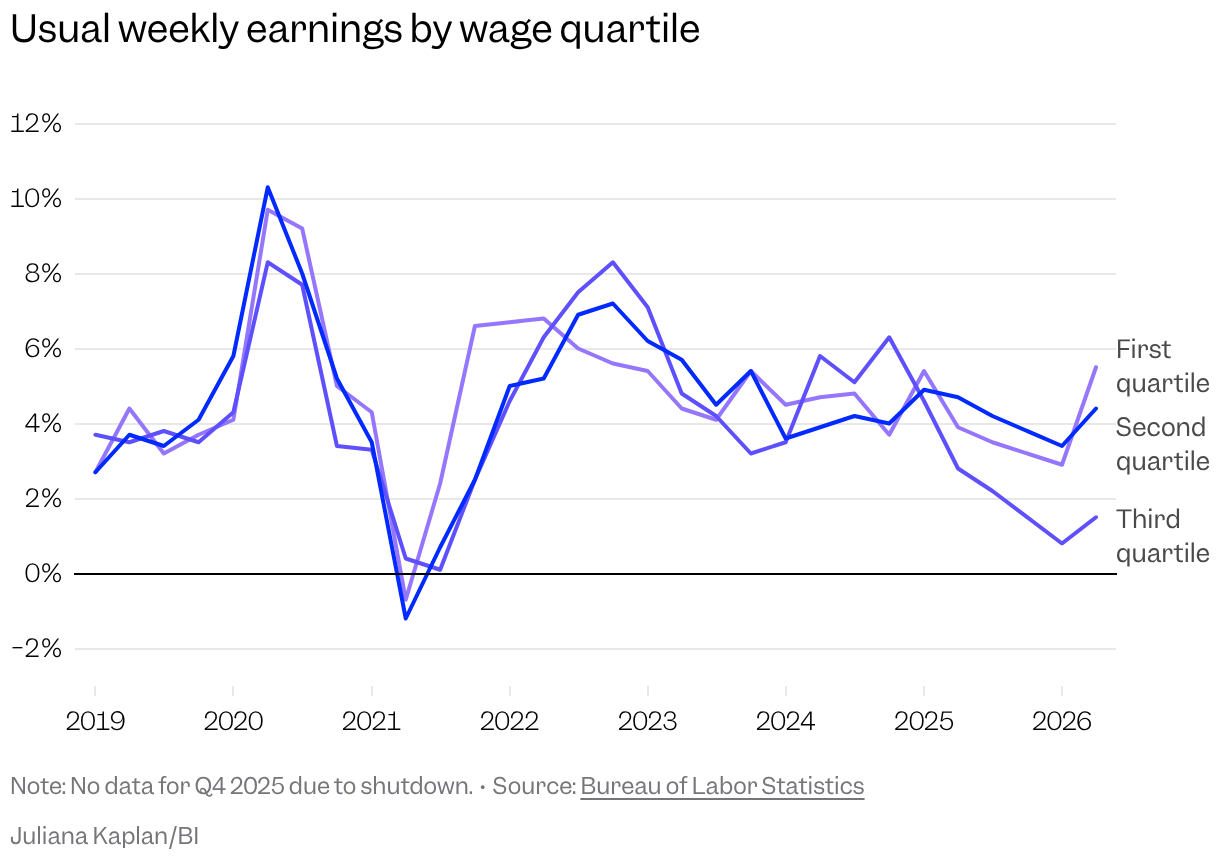
Bessent pointed out that wages for the lowest quartile of full-time workers grew 5.5% year over year. That tracks with Bureau of Labor Statistics data that tracks wage growth among full time wage and salary workers. Higher-paid full-time workers saw much slower wage growth — an indicator of a possible C formation.
Line chart

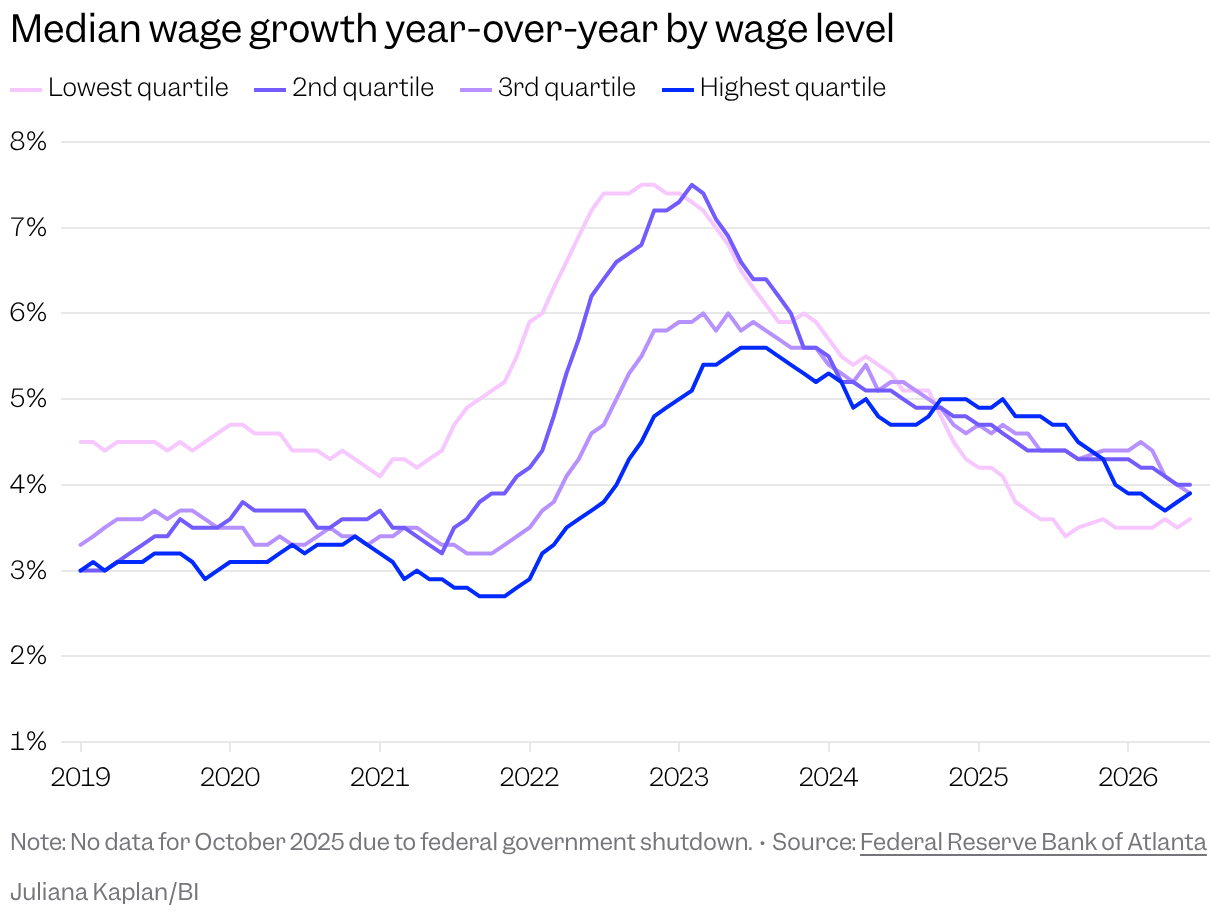
But including hourly or part-time workers in the analysis changes the picture. Earnings data analyzed by the Federal Reserve Bank of Atlanta, which includes such workers, shows that the lowest earners have seen the smallest gains since late 2024.
Line chart

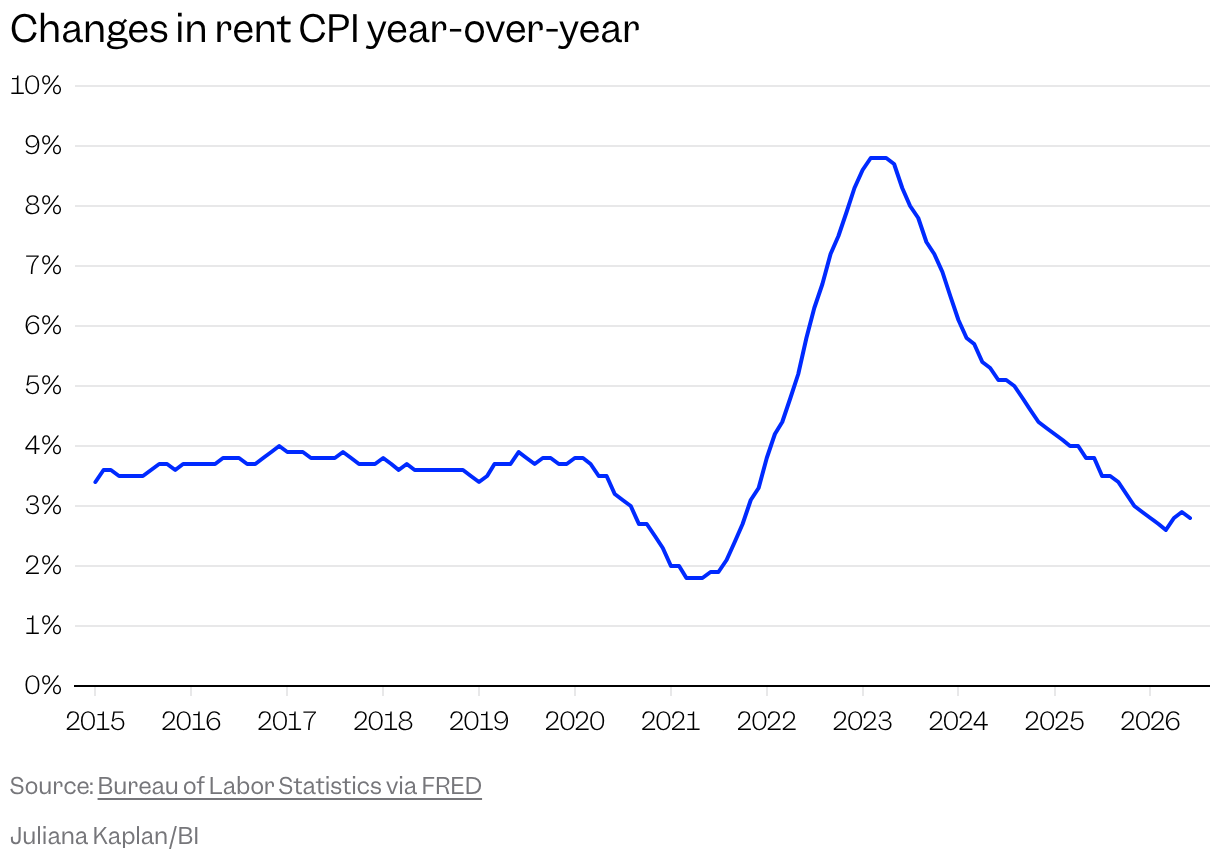
Bessent cited rent as an example of falling inflation. But housing costs for renters and homeowners continue rising, despite recent tempering. Rent CPI is slowing, but is likely not having a huge impact on bending the K.
Line chart

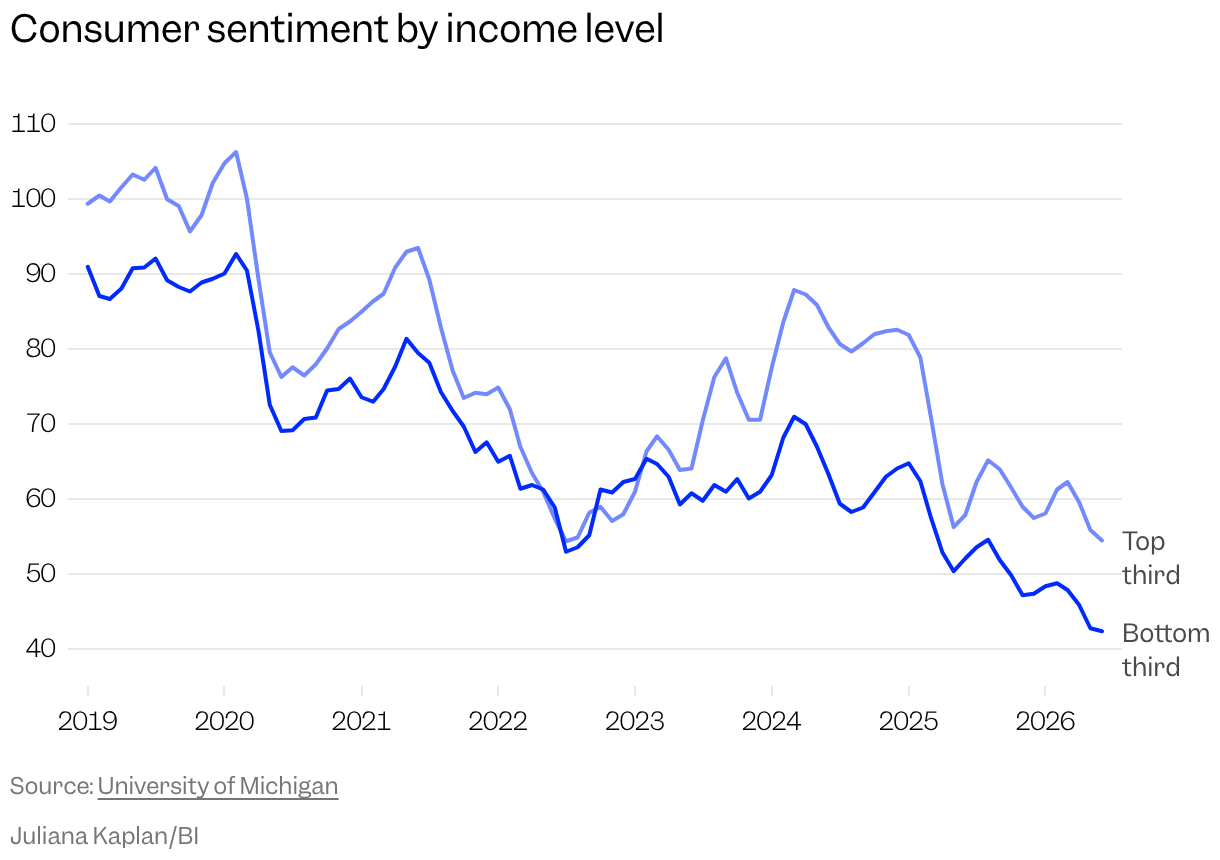
Higher-and lower-earners both feel dreary about the economy, with consumer sentiment for both groups falling in a similar shape since late 2024. Even so, lower earners continually feel worse.
Line chart

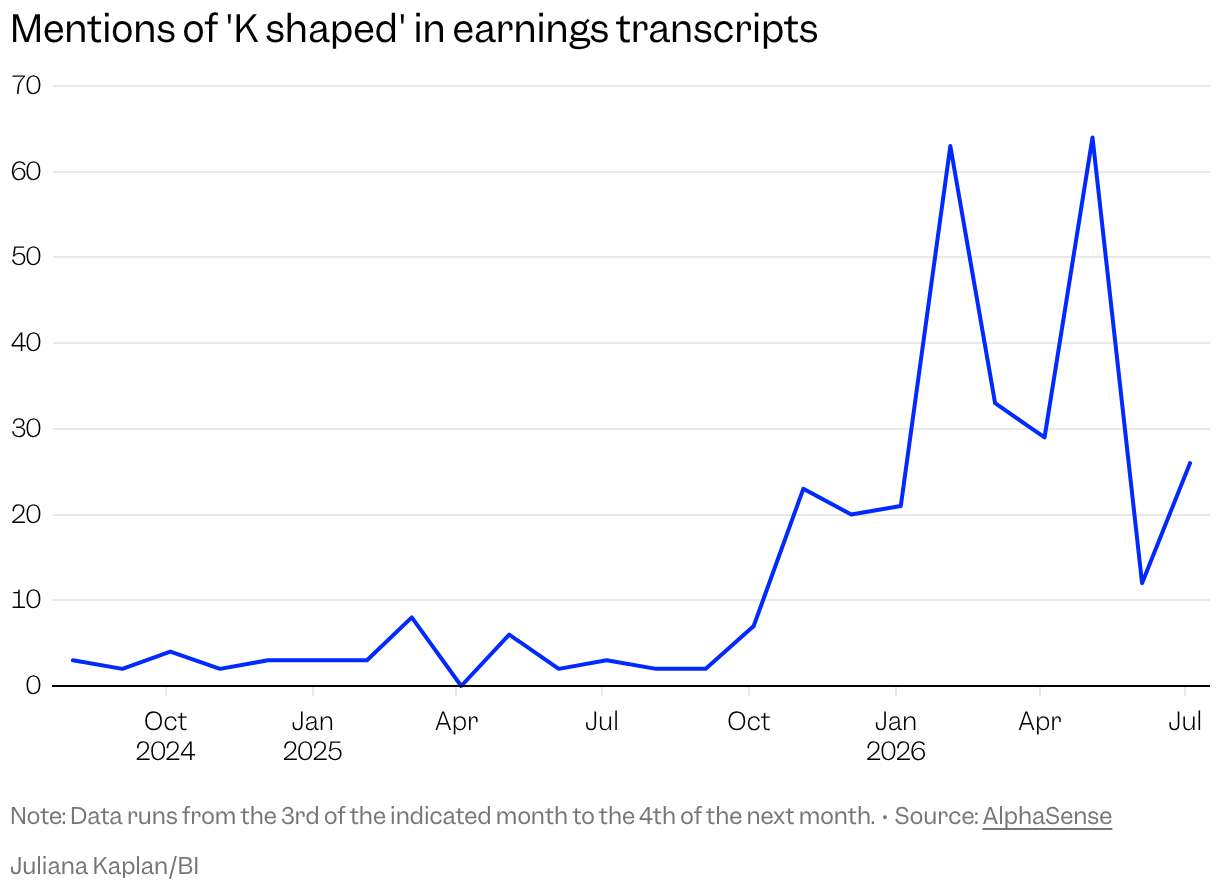
While firms are still mentioning the dynamic in earnings calls, the number of mentions has fallen from early and mid-year peaks. Conversely, there have been just eight mentions of a “C shape” in the past two years.
Line chart

Finally, the K-shape still shows up clearly in consumer spending. A study from the Federal Reserve Bank of Atlanta found that, from 2021 through its most recent data in 2025, spending among the top 40% of earners grew the fastest, while spending among the lowest quintile grew the slowest.

“I think that in general, high income, high wealth consumers are doing just fine,” Pancotti said. “They have no issue buying first-class airfares even when they have doubled over the past few months.”

Instead, the dynamic that’s been shaping up is more akin to a K with slightly softer prongs: The trajectory for high earners hasn’t changed, and the lowest earners are seeing slightly more stability.

Ultimately, trying to describe the economy with a letter shape might just be alphabet soup.

“I don’t think we’re in a K-shaped economy when it comes to the consumer,” said Ernie Tedeschi, the chief economist at Stripe. “By definition, the rich always have more money. They’re driving some amount of consumer spending growth, and it just doesn’t look like the story in 2024 or 2025 or 2026 is meaningfully different from any other solid economy with a roughly 4% unemployment rate.”

Read the original article on Business Insider

Bank of America spends more than $250 million on GLP-1s

Brian Moynihan sits in a television studio wearing a dark suit and purple tie.
Brian Moynihan said Bank of America spends more than $250,000 on GLP-1s.
  • Bank of America spends more than $250 million on GLP-1s for its employees.
  • CEO Brian Moynihan said it’s part of a long-term investment in employee health.
  • GLP-1s are not only transforming corporate healthcare budgets, but also introducing HR nightmares.

Weight-loss drugs are costing Bank of America more than a quarter of a million dollars a year.

CEO Brian Moynihan said that the more than $250 million is a worthwhile investment in benefits for his more than 210,000 employees.

“We see a great impact on employees,” he told CNBC on Wednesday at the Aspen Economic Strategy Group annual meeting, noting that the bank has other health initiatives. The firm’s annual healthcare budget is around $2 billion.

As Moynihan sees it, the payoff is in short- and long-term health benefits, like a reduced risk of heart disease. He said that though some people might leave Bank of America before benefiting from the medication, “it’s still the right thing to do.” The firm, he added, is working to get the drugs as cheaply as possible, especially now that the medication is available as pills.

Not all employers have adopted the same strategy. Only 36% of companies cover GLP-1 costs for diabetes and weight loss, according to a 2026 survey from the International Foundation of Employee Benefit Plans. Some big employers, including PwC, have reportedly stopped covering the drugs for weight loss.

Yet GLP-1s are transforming more than corporate budgets. Business Insider’s Juliana Kaplan recently reported on how employers are grappling with demand for GLP-1s, as well as the HR nightmares arising from the drug’s prevalence among employees. Some Americans who rely on the drugs have struggled to pay after changes in their insurance, creating a precarious balancing act between financial and physical health.

Have a tip or a story? Contact this reporter via email at atecotzky@insider.com or Signal at alicetecotzky.05. Use a personal email address and a nonwork device; here’s our guide to sharing information securely.

Read the original article on Business Insider

Jack Ma quietly invested $30 million in Corgi, one of Y Combinator’s hottest startups

Alibaba co-founder Jack Ma.
Alibaba cofounder Jack Ma.
  • Jack Ma’s private equity firm, Yunfeng Capital, quietly led Corgi’s latest funding round.
  • Corgi, a San Francisco AI insurance startup, saw its valuation quadruple over the last few months.
  • Corgi marks Yunfeng’s first known US deal, as it mostly touts Chinese investments.

Jack is back.

Chinese billionaire Jack Ma’s private equity firm secretly led the latest funding round for Corgi, marking the first time the firm is known to have invested in a startup founded in the US.

Yunfeng Capital, co-founded by Jack Ma and businessman David Yu, funded Corgi with about $30 million, according to a source familiar with the matter and correspondence seen by Business Insider. That round valued Corgi at $4 billion, Forbes previously reported last month.

Corgi is an AI business insurance startup that was part of Y Combinator’s summer 2024 cohort. It’s one of the hottest startups in San Francisco, with its valuation almost quadrupling over the last three months. It’s best-known for operating a 24-hour café in San Francisco and touting a 7-day workweek.

Corgi and Yunfeng Capital didn’t respond to requests for comment. Ma’s charitable foundation and Alibaba also didn’t respond.

Geopolitical tensions between Washington, D.C., and Beijing have made cross-border tech investment increasingly fraught.

Publicly, Yunfeng Capital largely touts Chinese companies in its portfolio.

It’s also a rare overseas bet from Ma, who has kept a much lower profile in recent years. The Alibaba cofounder disappeared from public view after criticizing Chinese regulators in 2020. Last year, Ma reemerged in China as the country’s government embraces AI.

China has exerted greater control over outbound capital and technology, for example, ordering Meta to unwind its acquisition of AI agent startup Manus.

The US has also tightened scrutiny of Chinese investment through the Committee on Foreign Investment in the United States.

Prior to the tensions, Alibaba actively invested in US companies, including Lyft in 2014 and Magic Leap in 2016. Ma stepped down as Alibaba’s chairman in 2019.

Have a tip? Contact Charles via email at crollet@businessinsider.com or on Signal and WhatsApp at 628-282-2811. Contact Ben via email at bbergman@businessinsider.com or on Signal at @BenBergman.11. Use a personal email address, a nonwork WiFi network, and a nonwork device; here’s our guide to sharing information securely.

Read the original article on Business Insider

Microsoft is retiring its peer-feedback tool as it overhauls employee reviews, an internal message shows

Satya Nadella microsoft
Microsoft CEO Satya Nadella.
  • Microsoft is retiring a peer-feedback tool once lauded as a sign of a “kinder, gentler Microsoft.”
  • The change comes as the company overhauls performance reviews.
  • The internal message suggests the tool will be replaced by informal discussions.

Microsoft is retiring a peer-feedback tool as it overhauls employee reviews, according to an internal message viewed by Business Insider.

The tool, called Perspectives, allowed employees to request input on their performance from peers that would be visible to the employee and their managers. Microsoft has been using this tool since 2018.

“The Perspectives tool is being retired,” the message says. “Feedback remains an important part of our growth mindset, and we heard from employees and managers that feedback is most valuable when shared through ongoing, in-the-moment conversations rather than formal requests.”

The tool is no longer available for new feedback requests, though employees can respond to active requests and export feedback history until September 15, according to the message. The message suggests the tool will be replaced by informal discussions with an employee’s peers.

The change comes as Microsoft overhauls its performance review system, simplifying ratings into five categories while making performance distinctions significantly sharper.

At the same time, managers have been instructed to reduce the number of employees in higher-level engineering roles as Microsoft continues flattening parts of the organization, emblematic of a broader hardcore work culture that’s spread across Big Tech in the last few years.

The Perspectives tool had replaced the company’s previous Feedback Tool, which allowed managers to collect, review, and summarize peer feedback for employees. Perspectives was intended to be “less intimidating,” as reported by Quartz in 2022, as a sign of a “kinder, gentler Microsoft.”

A Microsoft human resources executive told Quartz at the time that Perspectives deliberately omitted the word “feedback,” which she said triggered negative impressions.

Have a tip? Contact this reporter via email at astewart@businessinsider.com or Signal at +1-425-344-8242. Use a personal email address and a nonwork device; here’s our guide to sharing information securely.

Read the original article on Business Insider

‘This place is crazy’: Ex-Apple engineer’s texts highlight OpenAI’s AI-centric workplace

OpenAI logo on a phone.
Apple has filed a trade secrets lawsuit against OpenAI.
  • A former Apple engineer said OpenAI uses AI “all over the place” in newly released texts.
  • OpenAI released the messages as part of its defense against Apple’s trade secrets lawsuit.
  • Apple has accused OpenAI and former employees of stealing Apple’s confidential information.

One notable detail to emerge from the brewing legal battle between Apple and OpenAI isn’t about trade secrets at all — it’s about workplace culture and internal AI use.

In a series of iMessages released Tuesday as part of OpenAI’s public response to Apple’s trade secrets lawsuit against it, a former Apple engineer-turned-OpenAI staffer at the center of the case suggested that working at OpenAI was markedly different from working at Apple.

“This place is crazy… hahahah we use Ai all over the place,” Chang Liu said in a text message to one of his former Apple colleagues shortly after he left the iPhone maker earlier this year to join ChatGPT creator OpenAI.

Liu, who spent eight years at Apple as a senior system electrical engineer and is named among the defendants in Apple’s lawsuit, said in another text made public by OpenAI: “This startup style company is a funny and will be very hard in a couple months😁😁.”

The messages offer a rare glimpse into one engineer’s inside perspective on Apple, a 50-year-old company, and OpenAI, a decade-old startup, as the tech companies race to build the next generation of AI.

The texts were among a collection of messages and emails that OpenAI published in a blog post titled “Apple is getting this wrong,” as it defended itself against the company’s lawsuit.

Text messages released by OpenAI.
OpenAI released text messages it said were from Chang Liu.

Apple’s federal lawsuit accuses OpenAI, along with Liu and Tang Tan — a former Apple employee and current OpenAI hardware chief — of stealing Apple’s confidential information.

The lawsuit accuses the defendants of “exploiting Apple’s confidential information to advance OpenAI’s efforts to enter the consumer hardware market.”

In the Tuesday blog post, OpenAI slammed Apple’s July lawsuit as “careless, aggressive and oddly personal” and said, “We do not have, nor want, any of their trade secrets.”

“Apple accuses Chang Liu of accessing Apple confidential information after leaving the company, but only now admits that Apple employees reached out to him and asked for his help to locate this information,” OpenAI wrote.

Beyond the legal fight, Liu’s text messages underscore a seemingly broader contrast between Apple and OpenAI’s internal approaches to artificial intelligence.

While Apple executives have publicly described AI as increasingly integrated across the company, they have offered relatively few details about how employees use large language models in their day-to-day work.

On an earnings call last year, Apple CEO Tim Cook said the company sees AI “as one of the most profound technologies of our lifetime,” adding, “We are embedding it across our devices and platforms and across the company.”

OpenAI execs, on the other hand, have openly detailed how AI is integrated across the business. Former OpenAI chief product officer, Kevin Weil, said on “Lenny’s Podcast” last year that company employees use AI “a lot.”

“I mean, every one of us is in ChatGPT all the time summarizing docs, using it to help write docs with GPTs that write product specs and things like that — all the stuff that you would imagine,” Weil said.

Representatives for OpenAI and Apple did not immediately respond to requests for comment by Business Insider on Tuesday.

Read the original article on Business Insider

What smart people are saying about OpenAI’s ‘Apple is getting this wrong’ rebuttal

Left: Tim Cook, Apple's CEO, speaks onstage. Right: Sam Altman, OpenAI's CEO, is interviewed.
OpenAI posted a letter on Monday, hitting back at Apple’s recent trade secrets lawsuit.
  • Apple filed a lawsuit against OpenAI in July, accusing the AI lab of stealing trade secrets.
  • OpenAI has denied wrongdoing. On Monday, the AI firm published a blog post saying the suit was “careless.”
  • Several voices across tech weighed in on the heavyweight back-and-forth.

OpenAI is clapping back against Apple’s lawsuit.

On Monday, the AI company published a blog post titled “Apple is getting this wrong,” accusing the iPhone maker of presenting a misleading account of the events behind its trade-secret lawsuit. OpenAI highlighted what it said were errors in Apple’s legal correspondence and released messages that it said provided important context about the dispute.

“Apple is one of the greatest companies of all time, and built a reputation for obsessing over the smallest details,” the post says. “This careless, aggressive and oddly personal lawsuit sadly doesn’t live up to that reputation.”

Apple sued OpenAI in July, alleging that the ChatGPT maker benefited from trade secrets taken by former Apple employees. The lawsuit alleges, among other things, that Chang Liu, a veteran Apple engineer, improperly retained and accessed confidential company information after leaving for the AI lab in January.

OpenAI — which is trying to develop its own hardware products — previously denied wrongdoing, saying it is not interested in Apple’s secrets.

Monday’s post takes the AI lab’s defense a step further. It said that Apple employees reached out to Liu after he left for OpenAI in January and said Apple is “failing to properly manage system access when people leave.”

Here is what smart people are saying about the post:

Elon Musk, CEO of Tesla and SpaceX
Elon Musk.
Elon Musk was on the witness stand for the third day in his court case against OpenAI.

Apple is seeking expedited discovery and a preliminary injunction, per Monday court filings. That suggests that the company believes other former employees may have retained or accessed confidential information after joining OpenAI.

Elon Musk, the outspoken Tesla and SpaceX CEO who lost a lawsuit against OpenAI and its leaders earlier this year, reposted screenshots of Apple’s latest court filings on Tuesday.

“Can’t trust OpenAI,” he wrote.

Neil Cybart, Founder of Above Avalon

Neil Cybart, the founder of the independent Apple analysis firm Above Avalon, dismissed OpenAI’s response in a post on X.

He described the post as “nonsensical” and accused OpenAI of using the classic “hey, look over there” strategy to draw attention away from Apple’s central allegations.

“OpenAI must be really nervous about Apple’s trade secret theft lawsuit because this silly attempt at PR spin is nonsensical,” Cybart wrote.

Jim Cramer, host of CNBC’s “Mad Money”
Jim Cramer on a red carpet.
Jim Cramer said Apple’s new filing was “gloves off.”

Jim Cramer, CNBC’s host of “Mad Money,” also commented on Apple’s preliminary injunction in a post on X.

“Gloves off,” he wrote.

Todd Dailey, former Apple enterprise marketing manager

Todd Dailey, a former Apple enterprise marketing manager who spent 22 years at the company according to his LinkedIn, said his own departure made OpenAI’s statements about Apple’s offboarding problems seem plausible.

On X, he wrote that he still had two unreleased Apple prototypes.

“Old Apple wouldn’t have let an ex-employee hold a prototype for more than 24 hours and would have sent someone to my door to get it,” Dailey wrote.

He said the experience reflected how stretched Apple’s employees had become and made it easier to understand how the company’s lawyers could have made mistakes in their correspondence with OpenAI.

“I’m not surprised at all that busy, harried lawyers could make this mistake,” he wrote.

Harpal Singh, founder of Blimpp

Harpal Singh, the founder of the generative-engine-optimization platform Blimpp, told Business Insider that OpenAI’s post was written to directly contradict Apple’s account.

That tactic, he said, could affect how journalists, search engines, and AI tools describe the lawsuit.

“OpenAI is not just defending itself in court,” Singh said. “It wants to present the narrative that journalists, search engines, and other AI Response Systems will mirror.”

Read the original article on Business Insider