
Author: admin

This startup founder says he works 7 days a week, keeps a mattress in the office, and sleeps 3 hours a night

A corgi is pictured.
Corgi cofounder Nico Laqua (not pictured) said he has a mattress in the startup’s office and often showers at Equinox.
  • Corgi cofounder Nico Laqua said he sleeps in the office, often gets 3-4 hours of rest, and doesn’t take weekends off.
  • “I would rather measure my lifespan in victories than years,” he said on the “20VC” podcast.
  • Laqua is one of many AI founders flaunting their hardcore work schedules.

Nico Laqua said he’d rather shave years off his life than see his startup fail.

He cofounded Corgi, an AI insurance company, in 2024. Corgi became a unicorn in May, raising its Series B at a $1.3 billion valuation — before raising a Series B1 round at a $2.6 billion valuation three weeks later.

To reach such heights, Laqua said he keeps an unusually strict schedule, where he works seven days a week, sleeps in the office, and gets around three hours of shut-eye.

On an episode of the “20VC” podcast released Saturday, host Harry Stebbings asked Laqua: “Would you rather Corgi was a trillion-dollar company, but you died at 50, or it was a fail, and you live till you were 80?”

“The answer to that is pretty easy,” Laqua said. “I’m dying either way.”

Laqua’s outlook is part of a bigger trend in tech: the locked-in, “grindset” style of work. Founders are embracing the ‘996’ schedule — 9 a.m. to 9 p.m., six days a week — and cutting out alcohol and sex.

But Laqua takes it to an extreme. Here’s what he told Stebbings on the podcast:

He isn’t sleeping much

Laqua said he has a mattress on the floor of the Corgi office. His employees call it “Nico’s room.”

“I don’t spend every single night there anymore,” he said. “I used to shower at the Equinox one street over, and they close very early, like 8 p.m. on Fridays. So, that was unpleasant.”

Other startup founders are also embracing the office bed. When Business Insider toured young founders’ apartments in September, several pointed to couches and blow-up mattresses in their offices.

While the fusion of work and life may work for some, it can also cause burnout.

Laqua also said that he isn’t sleeping much. He said that he gets three to four hours of sleep a night. “I would rather measure my lifespan in victories than years,” he said.

The 7-day workweek

Some leaders want a four-day workweek. Laqua aims for seven.

“Whatever you can get done in five days, I promise you you’ll get more done in six and seven,” Laqua said. “You should go all out.”

Laqua said that high-growth startups in San Francisco have full offices on the weekends. “I don’t think it’s a coincidence.”

That doesn’t mean Corgi workers can’t take a rest day. Laqua said that its employees take a day off “every now and then” — but that they don’t have a ritualized weekend of rest.

“If your days off happen to be Saturday and Sunday every week, then you will not have a place at Corgi,” he said.

Linear cofounder Karri Saarinen wrote on X that Laqua’s thinking represented that of young founders “where the startup becomes their identity.”

“They have a hard time doing anything else, and cannot understand that your work is not the person that is you,” Saarinen wrote. “But activities outside of work can grow you as a person too and make you do better work.”

Laqua responded: “If you’re obsessed with a problem, you work hard.”

Those doggy tattoos

When Stebbings shared the interview online, he included one extra detail: that “2/3 of the first 30 team members have the Corgi logo as a tattoo.”

The statistic is not discussed in the interview. In September, Laqua told the Wall Street Journal that “two-thirds of our early employees got Corgi tattoos.”

Corgi has 177 employees, per PitchBook. Laqua and Corgi did not respond to requests for comments from Business Insider.

The tattoos stirred up debate online. “Imagine getting a tattoo all for building B2B SaaS,” wrote Coinbase’s Richard Wu. Former Lovable engineer Tiger Abrodi called it a “clown show.”

Others seemed intrigued. OpenClaw chief architect Vincent Koc quoted the line on X, added “Hmmmm,” and tagged the agent’s creator, Peter Steinberger.

On the podcast, Laqua emphasized the importance of strong branding.

“The cosmetic stuff does matter,” he said. “There’s a reason why governments and religions and all of the really important things tend to care about symbols.”

Would you work at a company with the expectation of a seven-day workweek? Let us know below:

Read the original article on Business Insider

5 Best HIPAA Compliance Software for Healthcare: Secure, Audit-Ready Platforms

5 Best HIPAA Compliance Software for Healthcare: Secure, Audit-Ready Platforms

5 Best HIPAA Compliance Software for Healthcare: Secure, Audit-Ready Platforms

This article compares five leading HIPAA compliance software platforms for healthcare organisations.

1. Vanta: best for automation-first healthcare tech teams (especially Business Associates)

Vanta is a trust management and compliance automation platform built for teams that want HIPAA to run like an always-on system check, not a once-a-year scramble. It is a strong fit for cloud-native healthcare SaaS companies and other Business Associates handling ePHI that also need to scale into SOC 2, ISO 27001, or HITRUST over time.
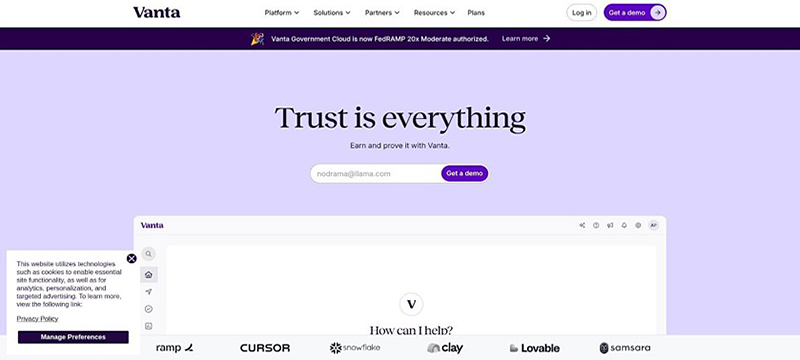
screenshot of the Vanta user interface
HIPAA coverage note: Vanta supports the HIPAA Security Rule and Breach Notification Rule, but it does not cover the HIPAA Privacy Rule. That distinction matters. If you are a Covered Entity (like a hospital system, health plan, or clearinghouse) and need Privacy Rule workflows in the platform, you will likely need a different tool.

Where Vanta stands out is automation depth. It connects to 400+ cloud and DevOps services and runs tests on a frequent cadence (about every 1 to 2 hours), using a HIPAA program mapped to 73 controls with roughly 123 automated and manual tests. In practice, that means you can continuously verify common requirements like MFA, encryption, access provisioning, and device posture, receive instant alerts whenever a control test fails—a workflow detailed in Vanta’s risk tracking module—and route issues into tools like Jira for remediation.

Vanta also covers the administrative side that tends to eat up time:

  • Policies: 18 total policies, including 6 HIPAA-specific, with tooling to customize and manage updates.
  • Training: Built-in HIPAA training is included, with an option to integrate with KnowBe4 if you want deeper security-awareness content.
  • Vendor and BAA tracking: BAAs and vendor risk can be managed through Vanta’s vendor risk management workflows, so third-party compliance does not live in scattered folders.
  • Breach readiness: Includes templates and workflows aligned to breach-notification obligations for Business Associates.

If you are running more than one framework, Vanta’s control mapping can materially reduce rework. For many teams, HIPAA overlaps meaningfully with SOC 2, ISO 27001, and HITRUST, so you can reuse evidence and controls rather than rebuilding your program from scratch.

Implementation and audit readiness: HIPAA in Vanta is self-attested, so there is no external HIPAA audit timeline to manage. Teams starting from zero typically get stood up in a few weeks to a few months, and organisations with an existing SOC 2 program can often move faster because a portion of controls are already satisfied.

Pricing: HIPAA can be included as a package framework or priced as a $5,000 per year add-on, with total first-year costs commonly landing in the $10,000 to $15,000+ range depending on company size and add-on modules.

Pros: deepest automation in this list (400+ integrations and frequent test cycles), strong cross-framework reuse if you are doing HIPAA plus SOC 2 or HITRUST, and self-attestation avoids audit fees and scheduling bottlenecks.

Cons: no Privacy Rule support (a deal-breaker for many Covered Entities), no native EHR integrations like Epic or Cerner out of the box, and it can be overkill for small clinics that do not run a cloud-heavy stack.

Customer proof: Hummingbird Healthcare achieved SOC 2 Type 1 plus HIPAA in 3 months. Other reported outcomes include Modern Health saving 100+ hours annually, Vibrent Health reducing vendor review time from 100 hours to a few hours per week, and ITx Companies seeing 41 per cent of HIPAA controls pre-populated from an existing SOC 2 program.

2. Compliancy Group (The Guard): best for clinics that want hands-on coaching

Compliancy Group’s platform, The Guard, is built for healthcare organisations that want a guided path to HIPAA compliance with a real person in the loop. If your biggest bottleneck is not tooling, but knowing what to do next and how to document it correctly, this is one of the most straightforward options on the market.
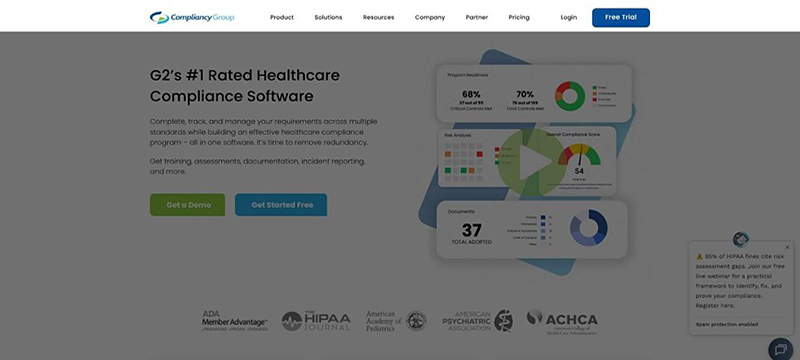
screenshot of the Compliancy Group user interface
Best for: small to mid-sized healthcare practices that want a step-by-step workflow and ongoing support, especially teams without dedicated IT or compliance staff.

Unlike many “compliance automation” platforms that focus primarily on technical evidence collection, Compliancy Group emphasises complete HIPAA program coverage. The Guard supports the Security Rule, Privacy Rule, and Breach Notification Rule, and also offers an OSHA add-on for healthcare organisations.

Core capabilities centre on helping you build and maintain the administrative backbone HIPAA expects:

  • Security Risk Analysis (SRA): guided risk assessments with corrective action planning, typically completed in 30 days or less on average (vendor case-study data), with your coach helping you keep momentum.
  • Policies and procedures: a library of 500+ templates you can customize to your environment.
  • Workforce training: built-in training with completion tracking, so training records are not trapped in spreadsheets.
  • Vendor and BAA tracking: tools to manage vendors and agreements, plus reminders around renewals.
  • Incident management: workflows to document and track incidents and potential HIPAA violations.

Automation depth: high for documentation workflows, training tracking, and program management. It is not designed for real-time technical monitoring of your infrastructure (for example, continuously verifying MFA, encryption settings, or cloud configuration drift). If your main goal is automated technical evidence collection across cloud systems, you will still need additional security tooling or a different platform category.

Implementation and rollout: many organisations use the coach-led workflow to complete their initial SRA quickly, then expand into policies, training, vendor management, and incident documentation over the next 1 to 3 months depending on size and complexity.

Pricing: Compliancy Group introduced modular pricing in May 2025 starting at $99 per month, letting practices choose the pieces they need. Previous “full suite” pricing was often positioned closer to the mid-hundreds per month, so the new packaging is a meaningful shift for smaller clinics.

Pros: dedicated coach support throughout the process, full HIPAA coverage including the Privacy Rule, and a large policy template library backed by long healthcare compliance experience.

Cons: limited technical integrations and no continuous infrastructure control testing, plus a coach-driven model that can feel slower for teams that prefer fully self-serve execution.

Stand-out differentiator: the assigned live compliance coach. For many clinics, that is the difference between “we bought software” and “we finished the program.”

Customer proof: Compliancy Group positions itself as serving 4,000+ organisations and cites a 100% client audit pass rate claim, alongside strong category positioning on G2 for healthcare compliance.

3. Accountable HQ: best for a self-serve, tiered HIPAA program that grows with you

Accountable HQ is a practical choice when you want a single portal for HIPAA basics, but you are not ready for an enterprise GRC rollout. It is built for clinics and healthcare startups that prefer a self-serve workflow, with higher tiers adding more security-forward features as your program matures.
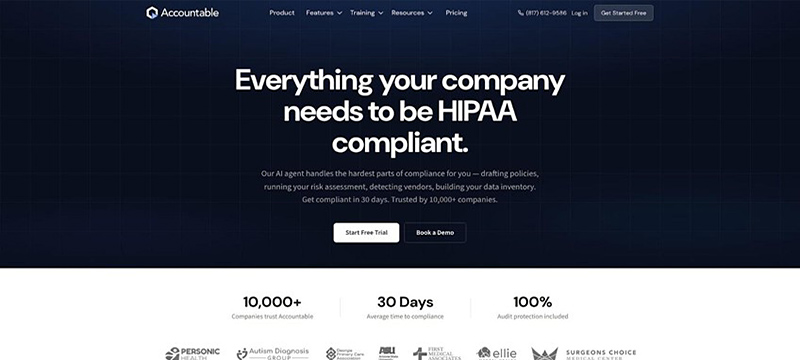
screenshot of the Accountable user interface
Best for: small to mid-sized practices and digital health teams that want full HIPAA coverage (including the Privacy Rule) with a clear upgrade path from “baseline compliance” to more proactive monitoring.

Accountable HQ covers HIPAA Security, Privacy, and Breach Notification requirements, and bundles the day-to-day components most teams need to prove they are operating a real program:

  • Security risk assessment: a guided Security Risk Assessment workflow included in all plans.
  • Policies and procedures: policy generation and management tools across tiers.
  • Training: HIPAA training plus security awareness training in the Basic tier, with additional courses available in higher tiers.
  • BAA and vendor management: BAA management is included, and the Plus tier adds vendor discovery and shadow IT detection.
  • Incident and breach readiness: incident-response tooling is included, with the Plus tier adding data breach monitoring.

Automation depth: moderate. Accountable HQ includes an AI Compliance Copilot across all tiers, and the Plus tier adds more “push-button” security workflows like phishing simulation, MFA and access controls review, and data breach monitoring. The Pro tier goes further with vulnerability scanning twice per year and penetration testing once per year. What it does not offer is the kind of deep, always-on evidence collection you get from platforms built around large-scale cloud integrations.

Implementation timeline: Accountable HQ advertises an average of 30 days to compliance (vendor claim), and you can start immediately via a 7-day free trial.

Pricing: Accountable HQ uses a tiered subscription model with included employee counts and per-seat add-ons:

  • Basic HIPAA: $169/month on annual billing ($199/month monthly), includes 15 employees, then $9 per additional seat
  • Plus: $254/month annual ($299/month monthly), includes 15 employees, then $15 per additional seat
  • Pro: $679/month annual ($799/month monthly), includes 20 employees, then $19 per additional seat
    Month-to-month pricing is listed as higher than annual, and plans are positioned as cancel-anytime.

Pros:

  • Full HIPAA rule coverage, including the Privacy Rule, which makes it viable for Covered Entities
  • Strong value in the Plus tier for the price point, including phishing simulation, vendor discovery, and breach monitoring
  • Clear pricing and packaging, with a fast way to trial the product

Cons:

  • Not a multi-framework platform (no SOC 2, ISO 27001, or HITRUST program mapping)
  • Limited deep technical integrations compared to cloud-native compliance automation platforms
  • Per-seat pricing can climb quickly as you scale headcount

Stand-out differentiator: the Plus tier bundles several proactive security features that many HIPAA tools reserve for higher-priced plans, including phishing simulation, vendor discovery/shadow IT detection, MFA review, and data breach monitoring.

Customer proof: Accountable HQ states 10,000+ companies use the platform (vendor claim) and positions the product around a 30-day average time to compliance (vendor claim), with “audit protection” included in plans.

4. HIPAA One (Intraprise Health): best for audit-grade risk analysis

HIPAA One, now part of Intraprise Health, is built for organisations that need a defensible, auditor-ready Security Risk Analysis (SRA) and want the output to match what regulators actually look for. This is less about lightweight policy wizards and more about producing a risk analysis that stands up under scrutiny across multiple facilities, business units, and affiliates—essentially functioning as a comprehensive risk assessment and management software approach.
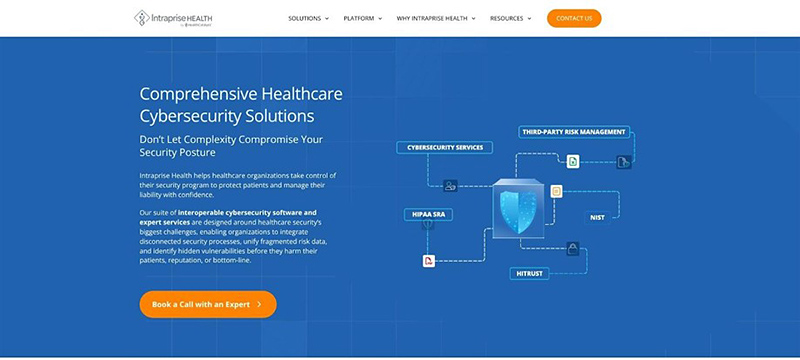
screenshot of the HIPAA One user interface
Best for: hospitals, health systems, and multi-site networks that want an OCR-aligned SRA with enterprise reporting, weighted scoring, and roll-up visibility.

HIPAA One’s core strength is that its SRA workflow mirrors the OCR audit protocol closely, and it is grounded in NIST methodology (including NIST SP 800-66 alignment). That gives compliance and security leaders a clear line from “requirement” to “evidence” to “remediation plan,” which is exactly what you need when leadership asks, “Are we audit-ready?”

What it covers depends on the modules you deploy, but the platform supports full HIPAA program needs across:

  • Security Rule: the SRA experience, including automated risk calculation, prioritisation, and remediation planning
  • Privacy Rule and Breach Notification: supported through dedicated modules (for example, Privacy and privacy/breach risk assessment functionality)
  • Business associate workflows: contract and agreement management via a Business Associate Manager (BAM) capability
  • Workforce training: a training module is available, with progress tracking and reporting

On the automation front, HIPAA One is strong at streamlining assessments and enterprise coordination. It can accelerate year-over-year work by carrying forward prior assessment data, and it supports parent-child roll-ups so multi-entity organisations can view results at the facility level and the system level. It is not positioned as a “connect to every cloud service and test controls hourly” platform. The automation is primarily assessment workflow, scoring, and reporting, not continuous technical control testing across your infrastructure.

Implementation: timelines vary by delivery model. Intraprise Health offers self-service, hybrid, and managed services approaches, which lets organisations choose between software-led execution and deeper expert involvement. Case-study data cited in the draft suggests meaningful time reductions after rollout (for example, a reported 65 per cent reduction in SRA preparation time in one deployment).

Pricing: enterprise pricing is typically quote-based, and overall cost depends on modules and whether you choose managed or hybrid services.

Pros:

  • OCR-audit-protocol alignment and NIST-based approach create a more defensible SRA
  • Built for multi-site complexity, including roll-up reporting across sub-entities
  • Flexible delivery models (self-service, hybrid, managed) to match internal resourcing

Cons:

  • Enterprise packaging and services can make total cost high for clinics and small practices
  • Monitoring is largely compliance-process and assessment focused, not real-time infrastructure scanning
  • Some functionality may be modular depending on your package, which can increase complexity during procurement

Stand-out differentiator: HIPAA One is purpose-built to generate an SRA in the format and depth auditors expect. If your priority is “audit-grade SRA with enterprise reporting,” it is one of the most direct fits in this list.

Customer proof: Intraprise Health positions HIPAA One as used by 16,000 users across 10,000+ healthcare organisations, and cites a 100% OCR acceptance rate claim, along with additional case-study improvements in SRA efficiency (vendor-stated metrics).

5. Clearwater IRM|Pro: best for enterprise-scale risk governance (plus managed security)

Clearwater IRM|Pro is built for healthcare organisations that need more than a HIPAA checklist. It is a fit when your program spans thousands of assets, multiple facilities, medical devices, and third parties, and you want a single partner that can deliver both the platform and the expertise to run it.
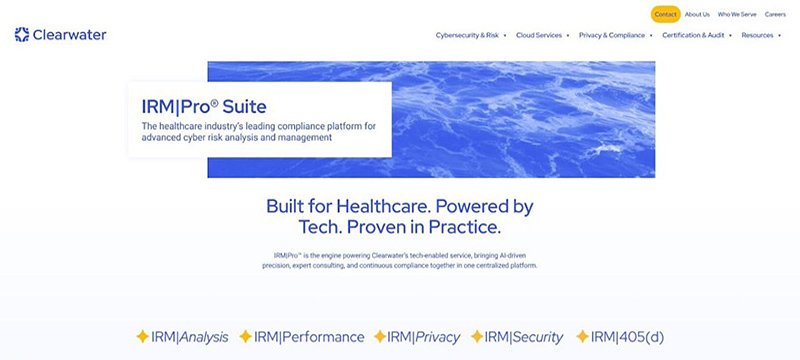
screenshot of the Clearwater user interface
Best for: enterprise health systems, IDNs, hospital chains, and large practice management groups that want healthcare-specific risk modelling and the option to pair it with advisory services and managed security.

Clearwater’s HIPAA coverage is delivered through a suite of modules designed to map to the real shape of a healthcare compliance and security program:

  • IRM|Analysis: Security Risk Analysis (SRA) aligned to NIST and designed to be OCR-quality, covering ePHI assets and medical devices.
  • IRM|Security: Security Rule compliance assessment workflows.
  • IRM|Privacy: Privacy Rule and Breach Notification Rule coverage.
  • IRM|405(d) HICP: alignment to the industry-recognised cybersecurity practices published under HICP.

Where Clearwater differs from lighter HIPAA tools is in how it treats “continuous monitoring.” The software supports enterprise-wide risk calculation, prioritisation, and executive reporting, but the always-on component comes from Clearwater’s broader delivery model. Clearwater also offers managed security services with a 24/7 SOC, plus managed cloud services for Azure environments. For CISOs, that means you can combine compliance reporting, risk remediation planning, and active security operations under one vendor relationship.

Automation depth: high for enterprise risk modelling and reporting, and operationally continuous when paired with the managed services layer. This is not a self-serve compliance automation product built around hundreds of plug-and-play integrations. It is a healthcare-focused platform that becomes most valuable when used alongside Clearwater’s advisory and managed security capabilities.

Multi-framework support: Clearwater’s software is healthcare and HIPAA centred, with additional alignment to NIST and 405(d) HICP. Broader frameworks like HITRUST and SOC 2 are typically supported through Clearwater’s compliance services rather than out-of-the-box cross-framework control mapping.

Implementation: expect a multi-month rollout for enterprise organisations. Deployment usually includes discovery and inventory, risk analysis, remediation planning, and establishing ongoing governance rhythms. Managed services run continuously once engaged.

Pricing: Clearwater is positioned at a six-figure total cost of ownership and is sold through a consultative process. The expert research notes an estimated annual investment in the $150k to $500k+ range for a mid-size health system depending on scope, modules, and services.

Pros:

  • Deep healthcare-specific risk modelling across servers, IoMT, third-party portals, and medical devices
  • Full HIPAA program coverage via dedicated modules, including Privacy and Breach Notification support
  • Option to pair compliance governance with a 24/7 SOC and managed security services for a unified operating model

Cons:

  • Cost and scope make it impractical for small clinics and early-stage startups
  • Value depends on time and engagement; it is not “buy it and you are done” software
  • Less oriented toward plug-and-play cloud evidence collection compared to automation-first compliance platforms

Stand-out differentiator: Clearwater is the only option in this list that combines enterprise compliance software with a full managed security practice, including a 24/7 SOC. If you want a platform plus a partner to help operate the program, that is the defining advantage.

Customer proof: Clearwater cites 500+ customers, 20+ years focused on healthcare cybersecurity, and recognition including 2026 Best in KLAS for Security & Privacy Consulting, Black Book #1 (survey of approximately 2,000 executives), and MSSP Alert Top 250, alongside a 100% OCR success rate claim (vendor-stated metrics).

Quick-scan comparison

Use this table to narrow your shortlist fast, then validate fit in demos based on your HIPAA rule coverage needs (especially Privacy Rule), automation expectations, and budget model.

Platform Ideal for Stand-out strength Deployment Starting price*
Vanta Cloud-native health-tech teams and Business Associates 400+ integrations, frequent automated testing SaaS HIPAA included as a package framework or $5,000/year add-on (total varies by add-ons)
Compliancy Group (The Guard) Clinics that want a human coach Dedicated coach plus full HIPAA (including Privacy Rule) SaaS from $99/month (modular pricing)
Accountable HQ Practices that want self-serve, tiered HIPAA Tiered plans with AI Copilot and strong Plus-tier add-ons SaaS 7-day free trial, then from $169/month (annual)
HIPAA One (Intraprise Health) Multi-site hospital networks OCR-aligned, audit-grade SRA with roll-up reporting SaaS Quote required
**Clearwater IRM Pro** Large IDNs and enterprises Enterprise risk governance plus managed security options SaaS or hybrid
*Prices reflect publicly listed rates where available, otherwise vendor quotes. Figures can vary by modules, organisation size, and service level.

Conclusion

HHS’s January 2026 draft HIPAA Security Rule update would make full encryption and multi-factor authentication (MFA) mandatory for every system that touches ePHI. The final text is expected later this year, with a 180-day compliance window, so you will need proof fast, not promises.

The threat side is moving just as quickly. Ransomware hit small providers six times more often in 2025 than in 2021, and the average healthcare breach now tops USD 10.9 million. Continuous monitoring is often cheaper than a single incident response.

Practical steps to stay ahead:

  1. Embed continuous risk monitoring. Connect your compliance platform to EHRs, cloud accounts, and mobile-device managers so drift triggers an alert, not a post-breach report.
  2. Run quarterly tune-ups. Block two hours each quarter to review the live risk dashboard, close red items, and export an audit snapshot. Four short sprints beat one frantic year-end scramble.
  3. Audit MFA and encryption coverage now. When the Security Rule is finalised, you will need evidence that every endpoint and user meets the standard.
  4. Map HIPAA controls to a second framework. Aligning with NIST CSF or HITRUST today earns “recognised security practices” safe-harbour credit if an OCR investigation follows a breach.

Next move: use the evaluation checklist above, pick two platforms that match your size and tech stack, and schedule demos this week. A small investment now can help you avoid seven-figure losses—and many sleepless nights—later in 2026.

The post 5 Best HIPAA Compliance Software for Healthcare: Secure, Audit-Ready Platforms appeared first on IoT Business News.

I thought I kept getting food poisoning. It turned out, a tick bite changed how my body reacts to red meat and pork.

The author poses  with his yard in the background.
The author has been living with alpha-gal syndrome for 18 months. The condition, usually caused by a tick bite, prevents him from being able to eat pork and red meat.
  • I was having frequent bouts of what I thought was food poisoning.
  • A blood test revealed that I had alpha-gal syndrome, which causes an allergic reaction to meat.
  • The condition, often caused by a tick bite, has caused me to change my routines drastically.

When I broke out in hives on a Friday afternoon, I didn’t know what was going on inside my body. This wasn’t the first time something like this happened, so I knew all the questions the doctor would ask: New detergent? No. New lotion? No. New soap? No. New food? No.

When it came to new foods, I had consciously decided to stay away them in recent months. This restriction came about because I kept being jolted awake in the middle of the night with what I thought was food poisoning.

These frequent sicknesses made me start to worry about food safety. When I did eat out, I always made sure the meat was fully cooked before taking a bite (which is especially challenging because I am colorblind). At home, I religiously used a meat thermometer when cooking to make sure the meat was cooked through. I always wash my hands after touching meat, and I never let food sit out for longer than two hours. No matter the steps I took, I was still getting sick.

With the arrival of hives, I was determined to figure out what was going on. After sending in pictures of my stomach full of hives to my dermatologist’s office, I was ordered to take a blood test. After that, I finally got my diagnosis: alpha-gal syndrome.

What is alpha-gal syndrome?

Alpha-gal syndrome is a meat allergy often caused by being bitten by a lone star tick. I live in Tennessee, where getting tick bites has been common my whole life. This tick bite likely happened when I was cutting my grass.

Unlike other food allergies, people with alpha-gal often do not have a reaction until several hours later, when food is being digested. That delayed reaction is why it is so hard to diagnose alpha-gal without a blood test. Looking back on that afternoon when I developed hives, I remember having had a burger for lunch. By the time I got home for work that day, the allergy had set in, and hives were appearing on my skin.

A person pushing a mower in a yard is shown.
The author (not pictured) suspects he was bitten by a tick while cutting his grass, which led to him contracting alpha-gal syndrome.

This syndrome is becoming more common

I was so happy to have a name for what was happening to me and I’ve learned that am not alone in experiencing these symptoms. According to the CDC, as many as 450,000 Americans might have alpha-gal, with many people not realizing they have it.

The number of cases is expected to continue to rise as more people become aware of alpha-gal and lone star ticks spread across more parts of the United States. At the end of May, the Department of Health and Human Services announced its intention to focus on reducing tick-borne illnesses, such as alpha-gal and Lyme disease.

A beware of ticks sign is posted on a tree in the woods.
With cases on the rise, the US Department of Health and Human Services announced its intention to focus on reducing tick-borne illnesses, such as alpha-gal and Lyme disease, in late May.

What it’s like to live with alpha-gal

Compared to others with alph-gal syndrome, I have it pretty easy. Some people are extremely sensitive to any type of mammalian byproduct, such as gelatin or milk. For me, I can still drink milk, eat ice cream, and be exposed to those byproducts.

I’m also lucky that when I have an allergic reaction, it just feels like I have food poisoning. While it is extremely uncomfortable, I have not experienced any type of anaphylaxis. However, that is always a risk every time I ingest my allergen, so I’ve been told to carry an EpiPen. I was diagnosed about 18 months ago, and I’m still getting used to keeping it with me. I’m trying to do a better job of remembering to bring it whenever I leave the house.

I no longer get hives when symptoms occur; now I just feel like I have food poisoning, which I treat with rest and hydration. After 24 to 48 hours, I am usually back to normal.

I rarely eat outside of my home now

The hardest part of living with this diagnosis has been my inability to eat outside my home.

I have learned the hard way about the potential for cross-contamination at restaurants. There are now only a handful of places I order food from, and most of those are fast-food places. Fast food places usually cook the food the same way across their locations, so it’s easier to find out if the air fryer they use is also being used for any type of red meat. Fast food places also do a great job with their allergen menus that you can easily find online.

In some ways, being diagnosed with alpha-gal has made my life better. I was forced to create new routines at home to drastically increase the number of homemade meals and reduce eating out. Creating new routines is something I especially struggle with. It takes a great deal of executive function and self-regulation to both plan ahead and follow through. I had told my wife for years that I would overhaul how we plan and make dinner, but I never did. As someone who studies executive function for a living, I knew that getting a new routine started would make my life easier in the end. Being forced to do it was the push that I desperately needed. It gave me the motivation to finally create a system.

Now, we eat almost exclusively at home. This allows me to control all the ingredients we’re consuming. I’ve become great at reading food labels. I already had practice because our kids have dealt with food allergies, but I’ve really had to pay attention to ingredients because red meat is not required to be listed as an allergen on packaging. Sometimes lard is in refried beans, tortillas, and pie crusts. So I am always on the lookout for ingredients that might trigger a reaction.

I’ve stepped up my cooking and baking game. For cooking, we strive to keep the freezer stocked with precooked chicken and ground turkey that can be easily added to a bowl with rice and vegetables. So when those times come when we would have ordered out, I can quickly defrost the meat and have a meal ready for my wife and me.

This has been the most helpful as dinner time is always chaotic with two little kids running around. Now that I can no longer eat ground beef or pork, we get all of our protein from chicken or turkey. When we’re looking for a burger, we eat turkey or chicken burgers. We quickly learned that imitation burgers do not taste good to us.

My life is different, but not bad

What started out as a huge inconvenience, and it still is, has led to some changes in my life that I’m proud of. Creating new routines is hard, especially while raising young children. It takes a while from starting a new routine to making the routine stick. But these new routines have made a huge difference in my life.

Thanks to the steps I have taken, I have not had an alpha-gal episode in 6 months. I’ve continued to learn about this disease, and I’m told that there’s a chance that my allergy will go away over time. If it does ever go my way, I don’t think I would change the good habits I have created.

Read the original article on Business Insider

Apollo’s chief economist says he sees ‘zero evidence’ of AI-related job losses, even as CEOs cite the tech in layoffs

Torsten Slok of Apollo Global Management
Torsten Sløk is the chief economist at Apollo Global Management.
  • Apollo’s chief economist said there’s “zero evidence of AI-related job losses.”
  • A parade of tech leaders celebrated that take over the weekend.
  • At least a dozen major companies, meanwhile, have cited AI in their decision to lay off workers this year.

Anyone worried that AI will replace them should take a deep breath, at least according to Apollo Global Management’s chief economist.

In a blog post on Friday, Torsten Sløk said there is “zero evidence of job losses because of AI,” citing the ADP National Employment Report. Instead, he said, companies are hiring candidates who have AI skills.

“Many firms are hiring AI implementation experts, and the data center buildout is putting upward pressure on salaries for AI experts and on prices of semiconductors, equipment, and energy,” Sløk said. “The bottom line is that the AI spending boom is stoking both employment and inflation.”

Sløk echoed that sentiment in an April blog post, writing that “cheaper inputs don’t shrink industries. Instead, AI is going to increase both productivity and employment.”

The latest ADP report found that private companies added almost 110,000 more people to their payrolls in April.

Anxiety that AI will eradicate the average job is everywhere, stoked in part by those behind the technology. While Anthropic CEO Dario Amodei and OpenAI CEO Sam Altman have recently changed their tune as they gear up for their respective IPOs, they have both warned for years that AI could upend entire job categories. Amodei famously said last year that AI could wipe out half of all entry-level white-collar jobs.

Sløk’s analysis resonated with some figures in the AI industry, including Box CEO Aaron Levie, Dell CEO Michael Dell, and White House AI and Crypto Czar David Sacks, who all agreed with his view in X posts over the weekend. David Solomon, CEO of Goldman Sachs, also made a similar argument last week in a New York Times opinion piece.

An EY survey of 240 financial service CEOs, meanwhile, found that about 60% thought investing in AI would maintain or increase their staff head count in 2026.

These optimistic takes, however, seem to clash with recent reality. At least a dozen major companies have cited AI as a factor in staff layoffs this year. In February, Block CEO Jack Dorsey said the company was slashing its workforce from over 10,000 to under 6,000.

“We’re already seeing that the intelligence tools we’re creating and using, paired with smaller and flatter teams, are enabling a new way of working which fundamentally changes what it means to build and run a company,” Dorsey said in a memo shared to X. “i had two options: cut gradually over months or years as this shift plays out, or be honest about where we are and act on it now.”

Cisco, Atlassian, Cloudflare, Coinbase, IBM, and Snap are also among the companies that have cited AI as a reason for layoffs.

Nvidia CEO Jensen Huang, one of the pillars of the AI industry, has criticized companies that blame AI for layoffs. “I think the narrative that connects AI to job loss for many of the CEOs that are doing it is just too lazy,” Huang told a media outlet in Singapore last week.

Altman has called the practice of blaming AI to reduce staff “AI washing.”

In his blog post on Friday, Sløk said that, in his view, the current employment climate is an example of the “Jevons paradox,” an economic theory that says as new technology increases the efficiency of a resource, the more that resource is consumed.

In this case, that resource would be human workers.

“It is Jevons paradox playing out in real time: cheaper technology is creating more demand and more jobs,” Sløk wrote.

Read the original article on Business Insider

I reinvented myself by losing 300 pounds and moving from the US to Spain. Now I have a happier and healthier lifestyle.

A woman with a laptop sitting in a café in Spain.
Erin Vlack has carved out a new life for herself in Spain.
  • Erin Vlack was 280 pounds overweight and resolved to get in shape and change her lifestyle.
  • She took things further when she moved from North Carolina to Spain to be closer to her son.
  • The single mom told Business Insider that she is much happier and healthier after the switch.

This story is based on an interview with Erin Vlack, 48, a pharmaceutical supply chain consultant living in Valencia, Spain. It has been edited for length and clarity.

In April last year, two months after leaving my steady job in pharmaceuticals, I was in discussion with another company about a full-time position.

It was tempting to accept the senior directorship they offered, but I dismissed the idea at the last minute.

My 25-year-old son, Gavin, was studying medicine in Spain, and I missed him so much. “What if I moved to Europe to be with him?” I asked myself.

I spoke to immigration lawyers

I reached out to immigration lawyers that very afternoon. I’m a great believer in striking when the iron is hot, before excuses creep in.

A mom hugging her son in a street
Vlack lives near her son, Gavin, in Valencia.

Now, just over 12 months later, I’m renting a three-bedroom house less than 20 minutes away from Gavin in Valencia, the happiest and healthiest I’ve ever been.

Still, I’m no stranger to reinvention. A decade ago, at 5ft 5in, I weighed 430 pounds — 280 pounds overweight for my height — and wore size 28 clothing. I struggled to catch my breath when I did anything active, like taking my kid to the park.

Both my parents died within a year of each other, and I binged and comfort ate out of grief. I was a single mom, and there were financial issues that left me unable to afford fresh food all the time.

I’d buy things from Walmart and the Dollar Store, which weren’t very healthy. Before long, I looked in the mirror and thought, “Oh my God, what have you done to your body?”

I had a mastectomy

The shock was enough to make me follow the Keto diet and start exercising. I lost 172 pounds before having gastric bypass surgery in 2022, which helped me get down to 140 pounds and size six jeans.

In 2024, I had a bilateral mastectomy and reconstruction because breast cancer runs in both sides of my family.

A split image of the same woman overweight and doing yoga after slimming down.
Vlack before and after her dramatic weight loss.

But the biggest change by far was selling my home near Raleigh, North Carolina, donating my property to charity, and arriving at the airport in Madrid with three suitcases.

I quickly found my bearings and my house with Gavin’s assistance. I traveled on a so-called “non-lucrative visa,” which means you come to Spain with only your passive income and savings.

Now, I’m waiting to convert to a highly qualified, high-value immigrant status that will allow me to be a digital nomad.

I’m fluent in Spanish now

As soon as I get my new visa, I’ll plow my energy into the clinical trials supply company I founded. It feels exciting to be working for myself.

I’m in it for the duration and plan to stay in Spain, where I’m fluent in the language, until I can apply for long-term residency. The only things I really miss about the US are my friends and my sports car.

A woman standing outside a coffee bar with a barista inside
Vlack enjoys the easygoing nature of Spanish life.

It’s great to be so close to Gavin again. Although he’s busy with his studies, we make time for meals and hugs.

We recently returned from a weekend trip when we talked, cooked, and enjoyed a couple of glasses of wine.

Food here is healthy

Everything is easygoing here. You’ll walk through a plaza where a group of kids is playing while parents enjoy a coffee and casually kick the ball back to them.

The produce is fresh, and people walk everywhere. I look after my health by going to the gym six times a week and doing yoga outside on my terrace.

Every morning, I wake to the magnificent views of the mountains near the city. I’ve never felt more content and settled in my life.

Read the original article on Business Insider

I swear by these 7 Trader Joe’s hair, skin, and hygiene products that feel high-end but cost less than $9

Pile of Trader Joe's beauty products
Although I follow a tight budget, I don’t cut corners when it comes to beauty. These low-cost skin, hygiene, and hair products from Trader Joe’s have become staples in my routine.
  • Many of my favorite hair, skin, and hygiene products are from Trader Joe’s and cost less than $10.
  • I use Trader Joe’s fluoride-free toothpaste and lemongrass-coconut body oil every day.
  • The best Trader Joe’s beauty products include Enrich moisturizing face lotion and hair oil.

I used to think I had to spend a lot on beauty products if I wanted quality, but Trader Joe’s has completely changed my mind.

Typically, I stick to food when I shop at the grocery chain, but on one trip, a $6 hair oil caught my eye. Although I follow a tight budget, it felt like a great price, and I decided to try it.

I couldn’t believe how much it seemed to improve the health of my hair after just one use.

After that, I became hooked on trying Trader Joe’s hair, skin, and hygiene products. Fortunately, many of them are under $10.

There have been a few misses, but here are the ones I’ve loved enough to make part of my daily and weekly routines.

Trader Joe’s hair oil is a key part of my morning routine.
Trader Joe's hair oil

Each morning, I massage a drop of this oil throughout my hair. It makes it look so shiny in between washes, rather than greasy.

The moisturizing mix of ingredients, including argan oil, moringa seed oil, chia seed oil, and vitamin E, has also been helping my hair recover from when I ironed it daily while I was teaching.

Speaking of ironing, the oil is also designed to help protect hair against heat damage up to 450°F.

Some beauty fans even say this is comparable to the popular Ouai hair oil that costs about $30 for 1.5 ounces. Meanwhile, a 1-ounce bottle of Trader Joe’s costs $6.

The Enrich moisturizing face lotion doesn’t break me out.
Trader Joe's enrich moisturizing facial lotion

At just $4 for a 4-ounce bottle, I was skeptical about Trader Joe’s Enrich face lotion.

However, I’ve lived in Florida my entire life and have never found a facial moisturizer with SPF that doesn’t break me out — until this one.

In addition to SPF 15, the fragrance-free lotion also contains vitamins A, C, and E.

I’ve been using Enrich under my makeup in the morning, and since it’s so inexpensive, I don’t feel bad applying it to my arms as well for some extra TLC.

Trader Joe’s lemongrass-coconut body oil doesn’t leave me feeling greasy.
Trader Joe's lemongrass and coconut body oil

I’ve been on the hunt for the perfect body oil to apply after the shower when my skin is damp. This is the first one I’ve tried that leaves me feeling moisturized, not like a layer of grease is sitting on top of my skin.

It’s made with lemongrass oil, virgin coconut oil, sweet almond oil, jojoba oil, and olive oil, and I appreciate the natural ingredients.

The scent feels cheery and uplifting, and many consider lemongrass oil to be a natural mosquito repellent. With summer around the corner, that’s a real perk.

Best of all, Trader Joe’s body oil feels super affordable at $4 for a 4.8-ounce bottle.

I use Trader Joe’s bonding shampoo and conditioners for a salon-level wash.
Trader Joe's bonding shampoo and conditioner

This shampoo and conditioner duo from Trader Joe’s leaves my hair feeling utterly healed from that aforementioned heat damage.

I wash my scalp first with a gentle dandruff shampoo, then shampoo and condition with Trader Joe’s bonding set. This is a strategy my dermatologist told me to try — the medicated shampoo cleans my scalp, while the regular shampoo nourishes my hair.

This routine makes my hair feel and look like I got a salon wash and blowout when it’s dry. It may be because these products contain ingredients like hydrolyzed keratin and silk, which can help strengthen hair and make it shine.

At $8 per 12-ounce bottle, this duo cost me $16 total, but the quality reminds me of the expensive salon sets I’ve bought from my hairdresser in the past.

Some shoppers even swear these are dupes for more expensive bonding shampoos, which can cost twice (or even three times) as much.

I’ve been using this $1 find as a luxurious hand soap.
Trader Joe's oatmeal-honey soap

I couldn’t believe how luxurious Trader Joe’s Next to Godliness oatmeal-and-honey vegetable soap feels when I wash my hands with it. After all, I paid only $1 for a 4-ounce bar.

Since I’ve started using this as a hand soap, I haven’t had to use as much hand lotion — it’s that moisturizing. I love the lather, too, but it’s the scent that stole my heart. This soap smells like oatmeal-spiced cookies right from the oven.

If I ever see this on shelves again, I’m stocking up.

This Trader Joe’s fluoride-free toothpaste feels like a treat that’s good for my teeth.
Trader Joe's toothpaste

I’ve been looking for an affordable fluoride-free toothpaste that leaves my mouth feeling just as clean as its fluoride counterparts for some time — and this one from Trader Joe’s has been a winner for me.

The 6-ounce bottle of peppermint toothpaste costs $4, and I appreciate that it has calcium hydroxyapatite, which some studies suggest can help protect teeth from erosion, cavities, and decay.

My favorite part is that it tastes like York Peppermint Pattie filling, but leaves my teeth feeling clean all day long.

Keep reading Trader Joe’s diaries to see what other must-haves shoppers have in their carts.

Read the original article on Business Insider