Keith Rabois shared advice for young professionals on “The Rise” podcast on Thursday.
Brendan SMIALOWSKI / AFP
Keith Rabois shared advice for young professionals interested in VC on “The Rise” podcast.
Rabois said young professionals should first create a startup or company to gain experience.
“I think it’s a bad idea for almost anybody right out of school to want to be a VC,” he said.
Longtime VC Keith Rabois has some advice for young professionals hoping to break into the industry.
“I think they should either join a startup or found a company with almost no exceptions — especially if they’re technical,” Rabois said Thursday on “The Rise” podcast.
“You’d ask the question, like, ‘Why are they interested in venture?’ and usually when I meet people like that, the answers are pretty superficial. Most people don’t even understand what venture really is versus what it looks like on TV,” he added.
Rabois said it’s essential for newcomers to either learn how to build their own companies or watch others do the same.
“First of all, it’ll make you more confident that you’re making the right decision. This is a 20-year job minimum. Secondly, you’ll be better suited to perform the job. And third, you’ll have more credibility, which also helps you perform the job,” Rabois said.
Rabois is a managing director at Khosla Ventures and has served on the boards of several companies, including Reddit and Yelp. He’s also the cofounder and chairman of Opendoor Technologies.
During the podcast interview, Rabois said it’s a “bad idea” for new graduates to want to become venture capitalists right after school.
“Doesn’t mean you can’t be an associate somewhere. You know, spend two years watching and learning, A: Is this right for me? Because you’ll see how the industry really works,” Rabois said. “Then, use the platform and vantage point of seeing 100 or 200 portfolio companies and choose the best company for you to join.”
“Then, if you really enjoy the experience of working a venture and think it’s what you want to do, then doubling or tripling down after you’ve built something is a very good move,” Rabois added. “If you do this right out of school, you know, by the time you’re 30, you’ll be you have maybe two shots at a startup,” Rabois said.
When contacted for comment, Rabois pointed Business Insider toward a blog post written by Founders Fund partner Delian Asparouhov, who previously shared five lessons he learned from Rabois, including on how to become a VC. Asparouhov writes that it boils down to: becoming a junior generalist, gaining experience at a “high-growth” startup, allocating resources with VCs, and learning from the best.
“Fundamentally, in order to get a job in venture, a current VC needs to think you will be a good VC,” Asparouhov wrote. “They need to think you have relevant expertise and they need to think you have great judgment. There are no shortcuts to developing expertise or judgment.”
Married couple Sandra and Jeff Mayernik were burned out and ready for a calmer, stress-free life.
They retired, sold their home, and set out to travel the world — they’ve been to 11 countries so far.
They’re currently in Albania, where they say they’re saving money and are happier.
This as-told-to essay is based on a conversation with married couple Sandra and Jeff Mayernik, 62-year-old retired realtors who left the US in 2023 to travel abroad. The couple, who run the blog The Mobile Retiree, are currently in Pogradec, Albania. This conversation has been edited for length and clarity.
Jeff: A couple of years after moving to central Oregon, we became empty nesters. We had a place outside Bend and lived on five acres. We had a couple of horses, a tractor, some project cars, and various storage buildings.
Sandra: Our property included two dwellings. A 1,000-square-foot double-wide manufactured home that came with the property. The second was a 1,700-square-foot custom-built, three-bedroom, two-bath house. It was gorgeous.
Jeff: Life was good in Oregon, but the political climate in the US was becoming uncomfortable for us, and the cost of living just kept rising.
Our property taxes went up, along with car and homeowner’s insurance. At first, it was just a couple of percent a year, and before you know it, it all added up. Meanwhile, our wages weren’t increasing at the same rate.
While the cost of living was probably a secondary concern. Our age and health were bigger factors in wanting a change of scenery. I’d had a couple of heart attacks and now have an ICD — an implanted cardioverter-defibrillator.
Eventually, we reached a point where we thought, “You know what? We don’t need the stress anymore.” We knew we wouldn’t be rich on the road, but we also wouldn’t be poor.
So we said, “Let’s just go see the world.”
We sold everything we owned
Jeff: Prior to retirement, my wife and I were both Realtors. Before that, I spent a couple of decades in commission sales positions, including several years as a salesman in retail automotive.
When we started planning our move abroad, we did the math, skinned it up, and figured out that we could travel the world full-time for around $40,000 a year.
Sandra: To financially prepare for the move, we sold everything we owned — our house, our cars, everything. Until we start receiving our Social Security benefits, we’re living off our savings and the proceeds from the sale of our house, which we’re investing.
Sandra and Jeff Mayernik.
Courtesy of Sandra Mayernik
Sandra: We left the States in November 2023. We knew we couldn’t establish residency anywhere without an income, but with tourist visas, you can stay 30 to 90 days in about a hundred different countries.
We’ve been to Panama, Costa Rica, Portugal, Spain, France, England, Canada, Chile, Mexico, and Argentina. And now we’re in Albania, where we can stay for a full year on a US visa. We spent two months in Durres, Albania. We’re currently in Pogradec, and we’re heading to Saranda next.
There’s something for everyone in Albania
Jeff:Albania is a compact country with every kind of geography. If you want mountains, there are mountains. If you want the coast, there’s the coast. And it has a Mediterranean climate along the shoreline.
It’s funny, we’ve visited so many countries, and there are some places where we just don’t feel comfortable right away. In Albania, within just a couple of days of wandering around, we felt like we belonged here.
Sandra: It felt like a gut instinct that this place was good for us. The culture here is all about taking care of each other.
Jeff: We were talking to a tourism official here in Pogradec the other day, and he said Albania is known as “the house of God and the house of guests.”
Sandra: They really do take care of their guests. For instance, when we first moved into our current apartment, the day after we arrived, there were a couple of things that needed to be fixed. Of course, the handyman came, but also the landlord’s aunt or cousin, and they brought over lunch for us.
There are pros and cons to living here
Sandra: Right now, we’re living in a three-bedroom, two-bath apartment in Pogradec.
It has a full kitchen, a washer, and three balconies overlooking Lake Ohrid. We’re on a short-term rental, and our monthly payment, including utilities and high-speed internet, averages about $1,100 a month, so it’s a huge apartment for the price. If we were to do a year lease, the rent would be even cheaper.
Pogradec, Albania.
Fani Kurti/Getty Images
Whenever we move somewhere new, we spend the first week getting our bearings — finding the grocery stores, pharmacies, parks, and coffee shops.
Jeff: Living abroad means adjusting to a new currency and a new language, so even simple errands take a bit more effort. Back in the US, I could walk into a Kroger, read every label, and instantly know what I was paying. Here, I once grabbed what looked like a package of ham — but it definitely wasn’t.
Sandra: Grocery shopping is more of a process — the butcher for meat, the farmer’s stand for vegetables, the store for packaged goods, and the bakery for bread.
Since we walk everywhere and don’t have a car, we can’t do one big monthly grocery run like we used to. Instead, we shop every couple of days, searching for ingredients or substitutes to make our favorite meals. All of that, day after day, wears on you a little.
Quality of life is more important to us than making money
Sandra: I miss a few things about the States, like going kayak fishing with my sisters and spending time with family — that’s about it.
Jeff: I do get cravings for certain things. Every now and then, you just want some brown gravy, mashed potatoes, and Skippy Super Chunk peanut butter.
Sandra: We have two months scheduled in Saranda. We’re not sure what we’ll do after, but we don’t plan on going back to the US.
There are a lot of things we don’t miss about living there, like being car-centric. I was always the driver back in the States, and now I don’t have to think about it — no oil changes, flat tires, or maintenance. I don’t miss the mental load of having a car at all.
Our quality of life has definitely improved abroad. Before we left, I was a workaholic. In fact, when we decided to leave, I arranged with my principal broker to keep me on, working in an administrative capacity, because I really loved my job. But after about six to nine months on the road, I realized I didn’t want to do that anymore, and the stress just evaporated.
Now, I spend my days walking along the promenade along Lake Ohrid, reading a book, or just relaxing.
Sandra walking along a beach in Durres, Albania.
Courtesy of Sandra Mayernik
Jeff: I’d say it’s a much lower-stress retirement. Healthcare is a lot more affordable; my medications usually cost less than my copay back in the States. And when we do decide to go out and do things, it’s a lot less expensive.
Although no financial advisor in their right mind would have advised us to do it, I think we were at the right stage of life for an early retirement. Our quality of life is way more important to us than making more money.
Mark Zuckerberg’s Launchpad, which set sail in 2024, cost a nine-figure sum and is one of the largest superyachts owned by a tech billionaire.
Sylvain Lefevre/Getty Images; Taylor Hill/Getty Images
As tech billionaires get wealthier, their superyachts are getting longer and more luxurious.
In recent years, Mark Zuckerberg and Jeff Bezos have each spent nine figures on their pleasure crafts.
These are the biggest superyachts owned by tech billionaires.
Size doesn’t always matter, but it absolutely does in the rarefied world of superyachts.
Palaces at sea have long been a status symbol for the masters of the universe, a place to live a life of excess and network, far removed from the prying eyes of ordinary people.
As the rich get richer — the world’s 10 richest people are $500 billion wealthier this year — their boats are getting longer.
The trend illustrates an unofficial yachting rule of thumb: The bigger the boat, the richer the owner. To own a 50-meter vessel, you likely have to be a billionaire. Over 100 meters long? You probably have a few billion to your name.
Over the past two years, three of the wealthiest people on the planet — Jeff Bezos, Mark Zuckerberg, and Sergey Brin — have taken possession of yachts over 100 meters long.
“It’s a bit of a celebration of your success in life, of wealth,” Giovanna Vitelli, the chair of the Azimut Benetti Group, one of the biggest producers of superyachts, told Business Insider.
Decked out with amenities like gyms, spas, pools, movie theaters, and helicopter hangars, these megayachts — broadly defined as over 70 meters long — are custom-built and cost hundreds of millions of dollars.
Over the summers, the superyachts criss-cross the Mediterranean, visiting the islands of Greece and stopping in St. Tropez, before making their way across the Atlantic for New Year’s in the Caribbean. (Mark Zuckerberg’s Launchpad reportedly took a pit stop on its annual migration this year, stopping at a shipyard in southern France for a multi-month tune-up.)
The comings and goings, customizations, and sheer size of superyachts give us insight into how today’s ruling class lives. After all, they’re about the most expensive asset money can buy.
Here are the largest yachts owned by tech billionaires, or at least those we know about.
In an industry governed by discretion, deciphering who owns what is an exercise in stringing together many clues. There are likely yachts that have not been publicly recorded or registered. Evan Spiegel, for example, is rumored to own the 94-meter megayacht Bliss. If you’re lucky, it turns out money can buy privacy.
Sergey Brin: Dragonfly
Butterfly, owned by Sergey Brin, is the smaller of his two yachts.
The largest, 142-meter-long Dragonfly, was delivered in December 2024.
Built by the prestigious German shipyard Lürssen, Dragonfly has been lauded for its design, which earned it the 2025 Yacht Style award in its length class.
It comes equipped with a full suite of amenities, including a glass-bottomed pool, cinema, spa, gym, business deck with a home office, and a helicopter hangar.
The superyacht is Brin’s second of the same name.
The former Dragonfly, 73 meters long, was listed for sale under a new name, Capricorn, with a $30 million asking price. It has since been renamed Capricorn.
Brin’s fleet also includes Butterfly, a 38-meter-long yacht often moored in the Bay Area. In its downtime, its crew members spend time kitesurfing and teaching swimming lessons to local kids.
The rest of the armada, which requires a team of 50 full-time employees, consists of a smaller boat named Firefly, Jet Skis, foil boards, dinghies, and kiteboards.
Jeff Bezos: Koru and Abeona
Jeff Bezos and his fiancée, Lauren Sanchez spent last summer on Koru, seen at left, with her support vessel, Abeona, seen at right.
The sailing yacht is hard to miss thanks to its massive size and unique design. It also travels with Abeona, its 75-meter support vessel, in tow.
“I heard back in 2018 or something that somebody had ordered a classic sailing yacht,” one superyacht aficionado told Business Insider. “You order 125 meters, that’s not really going to be classic. But it is. I think it’s pretty cool.”
The yacht has hosted several of Bezos and Lauren Sánchez Bezos’ famous friends for various occasions, including an engagement party that drew Bill Gates and Leonardo DiCaprio on board and a pre-wedding foam party to celebrate Sánchez Bezos’ son’s birthday.
Before its completion, Koru made headlines after it was announced that a historic bridge in Rotterdam would be taken apart to allow the Oceanco-built boat through. (Due to the backlash, the shipyard made alternative plans.)
The yacht has also been criticized for the liberal use of teak on its decks and interiors. The wood has gained a reputation for its connection to Myanmar, a country with a checkered human rights record.
In 2024, Oceanco was fined for violating the European Timber Regulation, and the shipyard has since apologized.
Mark Zuckerberg: Launchpad
Mark Zuckerberg’s Launchpad is among the largest superyachts owned by techbillionaires.
Ruben Griffioen/SuperYachtTimes
Following months of rumors, Zuckerberg debuted Launchpad in 2024. The 118-meter superyacht was originally designed for a sanctioned Russian businessman.
The ship made its maiden voyage in March 2024, going from Gibraltar to St. Maarten and mooring in Fort Lauderdale, Florida. It has since visited Panama for Zuckerberg’s 40th birthday and spent summers in the Mediterranean.
Little is known about its interior, but photos show a large swimming pool and helipad, and its shipyard, Feadship, has written about its “fully enclosed pod-like observation lounge” and two helipads.
Its price has been kept under wraps, but a yacht of that size would typically cost nine figures.
Eric Schmidt: Whisper
Eric Schmidt bought Kismet from the Jacksonville Jaguars owner Shahid Khan — hence the figurehead — last year and renamed her Whisper.
Jan Woitas/picture alliance via Getty Images
Former Google CEO Eric Schmidt purchased Kismet, a 95-meter-long superyacht formerly owned by billionaire Shahid Khan, the owner of the Jacksonville Jaguars, in 2023 and renamed the Lürssen-built vessel Whisper.
Schmidt had agreed to purchase the Alfa Nero, which formerly belonged to a sanctioned Russian oligarch, for $67 million in an auction. He backed out of the deal following legal issues over its true ownership.
Whisper can accommodate 12 guests and a crew of 28, according to Moran Yacht & Ship, which oversaw its construction. It features a master deck with a private jacuzzi, a full-service spa, a lap pool, a movie theater, and an outdoor fireplace.
While its final sale price was not public, it was listed forabout $158 million at the time of the sale.
Schmidt charters the yacht for about $1.4 million a week — an opportunity his fellow billionaire, Magic Johnson, has taken advantage of. In the summer of 2025, Johnson posted videos and photos from a weekslong Mediterranean vacation aboard Whisper, including workouts in the outdoor gym and a toga party with the crew.
Barry Diller: Eos
Barry Diller and Diane von Furstenberg’s Eos yacht has become a popular destination for celebrities.
Horacio Villalobos / Getty Images
Billionaire Barry Diller, the chairman of digital media company IAC, owns the megayacht Eos with his wife, fashion designer Diane von Furstenberg, who is immortalized in a figurehead sculpture by Anh Duong.
One of the largest private sailing yachts in the world, the three-masted Lürssen schooner measures 93 meters long. It took three years to build before being delivered to Diller in 2009, and little has been revealed about its interior and features since then.
The power couple has hosted many celebrities on the Eos, which spends its summers in the Mediterranean and New Year‘s Eve in St. Barts. Over the years, guests have included Oprah Winfrey, Emma Thompson, Anderson Cooper, and Bezos, leading some to believe it inspired Koru.
Jim Clark: Athena
Netscape founder Jim Clark has listed Athena for sale but is yet to find a buyer.
“I could easily have built a 50- or 60-meter motor yacht that would have had the same space as Athena, but I was never really interested in building a motor yacht,” he told Boat International in 2016. “To my eye, she’s one of the most gorgeous large sailing yachts, maybe the most gorgeous large sailing yacht in the world.”
The former Stanford professor tried to sell it at various points — listing it for $95 million in 2012, $69 million in 2016, and $59 million in 2017 — but it has yet to change hands.
Larry Ellison: Musashi
The Mushashi superyacht, seen here in Venice, is owned by Oracle CEO Larry Ellison.
Marco Secchi/Corbis via Getty Images
Oracle founder Larry Ellison has owned several superyachts over the years, including the Katana, the Ronin, and the Rising Sun, which he sold to fellow billionaire David Geffen.
He purchased his current boat, Musashi, in 2011 for a reported $160 million from custom-yacht giant Feadship.
Named after a famous samurai warrior, the 88-meter-long yacht has both Japanese and Art Deco-inspired design elements. It also boasts amenities such as an elevator, swimming pool, beauty salon, gym, and basketball court.
Ellison is known for his extravagant spending — private islands, jets, a tennis tournament — and yachting is among his favorite and most expensive hobbies. He took up racing them in the 1990s and financed the America’s Cup-winning BMW Oracle Racing team.
Laurene Powell Jobs: Venus
Venus was originally designed for Steve Jobs, though he never stepped foot on her.
After spending years vacationing on Ellison’s yachts — Venus and Musashi come from the same shipyard, Feadship — Jobs wanted one for himself. He designed Venus with French starchitect and decorator Philippe Starck, and it was worth $130 million upon completion.
“Venus comes from the philosophy of minimum,” Starck said of its design. “The elegance of the minimum, approaching dematerialization.”
Jobs and Starck began working together in 2007, the designer told Vanity Fair, and held monthly meetings over the course of four years. Venus was delivered in 2012 to Jobs’ specification: six identical cabins, a design to ensure spaces of absolute silence, and the most up-to-date technology.
“There will never again be a boat of that quality again. Because never again will two madmen come together to accomplish such a task,” Starck told the magazine.
Charles Simonyi: Norn
Early Microsoft employee Charles Simonyi traded in his first yacht Skat, pictured here, for the bigger Norn.
Delivered in 2023, Norn is full of luxurious features, including an outdoor cinema and a pool floor that lifts to become a light-up dance floor. It shares a militaristic style with Skat, which Simonyi sold in 2021 after listing it for €56.5 million.
“The yacht is to be home away from my home in Seattle, and its style should match the style of the house, adapted for the practicalities of the sea,” Simonyi once said of Skat.
Grace Kay and Sindhu Sundar contributed to an earlier version of this story.
Correction: May 6, 2024 — An earlier version of this story misstated Giovanna Vitelli’s title. She is the chair of the Azimut Benetti Group, not a vice president.
AI search engine startup Perplexity has been raising back-to-back funding rounds.
The startup got fundraise offers at valuations from $14 billion to $50 billion in just a few months.
Some investors worry that the startup is getting ahead of itself as the market fears an AI bubble.
In the new AI gold rush, startups aren’t raising money every year; they’re raising massive rounds every month. Perplexity, the buzzy AI search challenger to Google, has become the poster child for back-to-back fundraising, facing investor demand at valuations from $14 billion to as high as $50 billion in just a few months, Business Insider has learned.
The frenzy is fueling investor FOMO — and fears of a modern-day bubble.
Perplexity and its peers are buoyed by AI juggernauts like OpenAIand Anthropic, which continue to raise money at eye-popping valuations. OpenAI was most recently valued at $500 billion in a secondary deal, according to Bloomberg, a rising tide that’s lifting other AI boats.
Business Insider reported in August that Perplexity was raising more money at a $20 billion valuation, just a month after the startup had grabbed fresh funding at an $18 billion valuation, according to Bloomberg. Two months before that, Perplexity had raised at a $14 billion valuation, according to The Wall Street Journal.
Two people close to the company said Perplexity has recently fielded offers from outside investors at valuations as high as $50 billion. Those people didn’t say how serious the offers were or whether Perplexity engaged them.
“The demand to invest in that company is beyond anything that we’ve seen in our history,” one Perplexity investor said.
Perplexity’s head of communication, Jesse Dwyer, said Perplexity doesn’t comment on its fundraising efforts or valuation, but said the company has a “crystal-clear view of its value.”
“We have never considered any numbers other than the ones we know to be true,” he said in an email to Business Insider.
The constant comparison with other top AI companies and the endless stream of investor excitement may be both a blessing and a curse for surging startups like Perplexity.
The startup faces outsize demand from both primary and secondary markets — Perplexity ranked #7 on Forge Global’s list of companies attracting the most secondary investor interest on its platform in the third quarter, just behind Anthropic at #5, OpenAI at #2, and xAI at #1. Its fundraising pace is dizzying, and its valuation sizable, given Perplexity’s age and revenue — Perplexity is three years old and was bringing in over $150 million in annual recurring revenue by mid-2025, Business Insider previously reported.
“The benchmarking inevitably takes place in founders’ minds and in investors’ minds, and it’s kind of hard to escape that,” said Kevin Spain, a partner at Emergence Capital, of top AI startups in general. “If other comparable companies are raising at a certain price, that is going to be the expectation.”
At the same time, more investors have been sounding alarm bells about a bubble amid rising revenue multiples and circular AI deals. Another Perplexity investor said that as Perplexity’s valuation rises, its chances of being acquired or going public at that new price appear slimmer.
That creates a dilemma for investors in startups like Perplexity that raise back-to-back rounds, which open opportunities for early investors to sell some of their shares while simultaneously intensifying their FOMO: What if Perplexity’s valuation actually makes sense in an age where AI could rewrite entire economic playbooks?
Repeated markups can be especially conflicting for growth-stage investors, said Terrence Rohan, the managing director of Otherwise Fund, which invested early in Figma and Vanta.
“It can create internal debate and dialogue, 100%, if a startup is getting marked up beyond the firm’s internal conviction,” Rohan said. “It’s like, hey, they’re raising again. We need to commit another $50 million just to hold our ownership. We don’t quite have conviction here yet, but these other guys do. And if we don’t, we could look silly.”
Raising for name recognition
As constant fundraising pads AI companies’ balance sheets, it’s also helping them build brand power.
OpenAI’s recent fundraises have sent shockwaves across the tech ecosystem. Startups next in line are watching their valuations climb as OpenAI raises the ceiling.
“The zeitgeist right now is more about raising aggressively,” Rohan said. “That’s seemingly creating reputation and brands in itself, as opposed to raising just on the traction or the business case.”
Consumers make up the foundation of Perplexity’s business. The company’s consumer-facing search engine offers both free and $20-a-month tiers, and it’s begun branching into e-commerce, launching a shopping feature in November. Perplexity has multiple enterprise deals, too, selling its premium search engine to companies like Zoom (which also offers a Perplexity-powered AI companion to Zoom business customers) and Nvidia (an investor in Perplexity).
Perplexity cofounder and CEO Aravind Srinivas.
Kimberly White/Getty Images for TechCrunch
Perplexity also drew attention this year for making multiple public offers to acquire or merge with assets bigger than Perplexity itself. In July, the startup announced a $34.5 billion bid to buy Google’s Chrome browser in the midst of the tech giant’s antitrust brawl with the Justice Department. Earlier, in January, Perplexity submitted a bid to merge with ByteDance’s TikTok.
Wall Street analysts and investors largely viewed Perplexity’s Chrome bid as a publicity stunt, with some criticizing the move and others lauding it as marketing genius.
Dwyer rejected the idea that the Google Chrome bid was a stunt. “As much as I’d love to take credit for a publicity stunt, the reality is this was a very serious offer, he said. “Due to the ongoing trial, our role in it, and the centrality of Chrome to the upcoming ruling, it would have been inappropriate NOT to transparently share the offer with the press. It wasn’t publicity, it was integrity.”
When asked about criticisms from Perplexity’s investors on the bid, Dwyer said, “[existing] investors who consider our Chrome offer a publicity stunt are either miffed that they weren’t asked to participate in funding it, or they simply don’t understand the new importance of the browser layer in the age of AI (which would also explain why we didn’t ask them to help us fund it).”
Srinivas has further eschewed VC formalities by ditching pitch decks altogether, he said in an interview with Berkeley Haas earlier this month.
“I just write a memo and I tell them you can do a Q&A and ask whatever you want,” Srinivas said of potential investors. “Anything else that is not internal data, you can ask Perplexity. Like, it already knows everything.”
AI rewrites investing rules
Ballooning valuations with little accompanying revenue growth have become a particular concern for some bubble-wary investors.
In the wake of the 2021 venture boom, startup valuation-to-revenue ratios fell from triple-digit peaks to single digits. But AI has turned those standards upside down. With over $150 million in annual recurring revenue and a $20 billion valuation, Perplexity’s multiple easily exceeds 100x.
Perplexity said making Comet free would help users combat “AI slop” by offering a search tool that prioritizes higher-quality sources. It’s also a clear move to help Perplexity capture more users in its quest to overtake Google Search. Still, any resulting cut to Perplexity’s revenue could stretch its multiple even further.
Spain said high multiples tend to matter more to growth stage investors: “The closer you get to the point of exit, the more you care about the multiple you’re paying.” But at early stages, what matters most is how the startup’s revenue could grow and what valuation those investors believe the company could ultimately achieve, he said.
Perplexity’s proposed exit timeline would give those investors more room to breathe. Srinivas said in a March Reddit post that Perplexity has “no plans of IPOing before 2028.” And Perplexity is growing fast — its $150 million annualized revenue in mid-2025 was more than quadruple its ARR, a projection of a company’s annual revenue, a year prior, Business Insider reported in August. As Perplexity aims to eclipse Google Chrome, which some analysts estimate could be worth hundreds of billions of dollars, its markups aren’t without reason.
Plus, the advent of AI is prompting some investors to reevaluate what a “reasonable” valuation even is.
“In this era, there’s a belief that we might see exit valuations unlike any we’ve ever seen,” Spain said. “If you believe AI is going to be transformative in certain industries, you can see a world where you’re going to have exits that are just abnormally large relative to what we’ve seen historically. I think that’s the right conversation to have as an investor.”
Tom Occhino, chief product officer at Vercel, knows a lot about AI, open-source technology, and software development. He spent over a decade at Meta, where he helped build React, a wildly popular framework for developing web user interfaces and apps.
Tom was one of the first technologists to introduce me to the idea of “disposable apps.”
AI coding tools, including Vercel’s v0 service, are making software development easier and quicker. One outcome of this: You can build an app now and after you’ve used it, you can just throw it away. Why? Because the upfront investment in creating software has fallen so much lately.
Here are some “throwaway apps” Occhino has seen in the wild this year:
Folks will paste a CSV file or spreadsheet into v0 and get a quick and easy interactive dashboard.
Vercel had a hackathon kickoff and someone put all the information about the event into a v0 app that they used to present the details to their team.
Occhino’s wife organized a trip to Europe for her and some friends and turned a planning document into a bespoke travel app with day-by-day agendas.
Occhino has built a few of these himself. He has a web app that helps him count stuff, such as the number of light switches in his home, and the number of desks in Vercel’s office. You can check that one out here.
He spun up another app that gives him instant information on his location, wherever and whenever he needs it. Occhino said he uses this one all the time.
Why can you see these two apps, when they’re supposed to be disposable? “I actually use them so they’re not really ‘throw away,'” Occhino told me.
Apple is set to report its earnings for the fourth quarter on Thursday.
Justin Sullivan/Getty Images
Hot off its historic jump to a $4 trillion market cap, Apple will report earnings for its fiscal fourth quarter after the closing bell on Thursday.
Wall Street is highly bullish on iPhone demand, which analysts see as the key driver of a consensus-beating report. Investors should also be listening for updates on the company’s AI ambitions, as some commentators this year have feared that Apple’s mega-cap peers are pulling ahead in the AI race.
The iPhone maker will report results shortly after the closing bell, typically around 4:30 p.m. ET, with the analyst call scheduled for 5 p.m. ET.
The $1.1 billion tariffs question
While Tim Cook has managed to curry favor with President Donald Trump, Apple has still felt the bite of tariffs — $800 million in added costs in its fiscal third quarter, to be precise.
That number was expected to grow considerably in this most recent quarter, with Apple guiding that its tariff-related costs would be around $1.1 billion.
We’ll soon see if it managed to mitigate those costs down below that estimate — or whether the impact was worse than anticipated. Analysts will also be eyeing Apple’s tariff guidance for next quarter.
What’s Apple cooking up in the lab? Don’t expect any big announcements until next year.
With Meta’s Ray-Ban AI glasses selling well, Apple is rumored to be exploring its own smart glasses while it continues work to slim down its bulky Vision Pro headset.
When asked about the Vision Pro on Apple’s last earnings call, Cook signaled there was more to come.
“We continue to be very focused on it,” Cook previously said. “I don’t want to get into the road map on it, but this is an area that we really believe in.”
Apple is also reportedly working on some AI home devices, including one with a robot arm, as well as a foldable iPhone expected to launch as soon as 2026. Samsung, Google, and Huawei have already entered the foldable phone space.
Third-party data suggests a strong sales start to the iPhone 17 lineup
Demand for the iPhone 17 lineup appears strong, according to third-party data, with the entry-level 17 and high-end Pro models the early standouts.
Apple’s newest iPhone lineup is outperforming last year’s models in both the US and China, two of its most important markets, according to data from Counterpoint Research. Sales of the iPhone 17 series were estimated to be 14% higher than those of the iPhone 16 lineup during the first 10 days on the market.
In the US, Counterpoint estimates that demand was strongest for the iPhone 17 Pro Max, the priciest model in the lineup, through the first two weekends of its release.
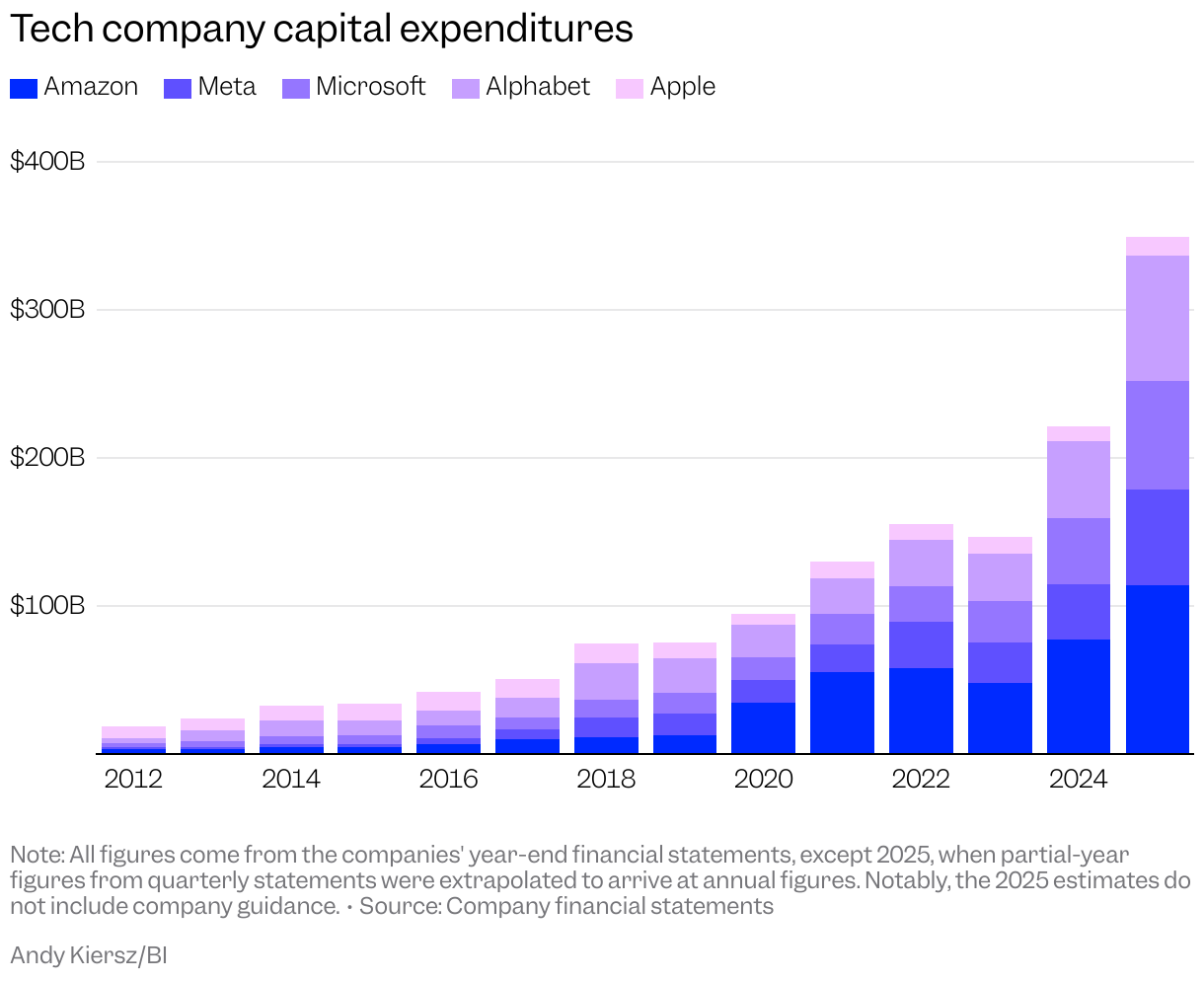
A look at tech companies’ rising capex
Don’t be surprised if analysts focus some questions around Apple’s capital expenditures and AI investments — it’s been a theme on other Big Tech earnings calls this week.
Tech companies are pouring more money than ever into AI, which has some investors worried. After all, the hot debate right now in Silicon Valley is whether we’re in an AI bubble…
Asked about capex growth on Apple’s last earnings call, CFO Kevin Parekh said that “a significant portion of the driver of growth that you’re seeing now is really driven by some of our AI-related investments.”
Apple can expect to hear more questions about the iPhone Air
At 5.6 millimeters — Apple’s thinnest iPhone yet — the frame comes with a smaller battery than Pro models and no physical SIM card. To make up for what it lacks in battery life, Apple released an external battery pack alongside the iPhone Air, which costs $99. But Apple’s battery-rich Pro models, with top-of-the-line cameras, are typically the company’s most popular, and reports have begun to emerge that Apple is cutting back on Air production.
A Keybanc survey of more than 2,000 iPhone owners found weak demand for the Air model compared to the strength of the Pro and Pro Max. Three percent of respondents said they upgraded to the iPhone Air, while 41% went for the iPhone 17 Pro Max.
While Apple’s most recent quarter will only include a week or so of sales from the 17 lineup, execs will likely provide some color on how the Air is doing so far.
Apple continues to show its ability to finesse its supply chain amid tariff pressures.
US shoppers discovered earlier this month that the M5 Vision Pro, a refreshed model, is labeled as being a product of Vietnam. A few creators noted the change online as they unboxed their new Vision Pros. It’s the latest example of Apple making changes to its supply chain for US-bound products to mitigate its tariff costs.
The original Vision Pro, with an M2 chip, was manufactured in China ahead of its 2024 release. Around the same time, Apple was exploring ramping up supply chain options outside of China.
Earlier this year, Tim Cook said Apple expects “the majority of iPhones sold in the US will have India as their country of origin” in the June quarter.
Tim Cook’s promotion of American production
Don’t be surprised if Tim Cook leans into Apple’s work in the US.
Earlier this year, Cook committed to investing $600 billion in US manufacturing amid President Donald Trump’s tariff push. In August, Cook presented Trump with a gift, an American-made glass plaque set on a 24-karat gold base.
Cook has proven to be a savvy political navigator — and it appears to be paying off. After receiving the gift, Trump said companies like Apple “will be treated really well.”
Cook, alongside other tech leaders, joined Trump for a dinner event in September. The Apple CEO addressed the president in a speech, praising his efforts to bring more manufacturing to the US.
Earlier this week, Nvidia CEO Jensen Huang gave an America-themed presentation during Nvidia’s GTC October keynote.
Apple (lacking) Intelligence
There’s an argument to be made that Apple’s slow start in AI hasn’t hurt it all that much — at least not yet. Yet with all the headlines around its AI talent departing, Apple would do well to reassure the market that big and exciting things are coming. One of those is a long-anticipated overhaul of Siri with Apple Intelligence, touted for next year.
Then there are reports of new home devices and AR glasses — all of which will need good AI. Don’t expect Tim Cook to break character and start gossiping about future products, but this would be a good time for a bit of extra candor.
CFRA Research eyeing More clarity on tariffs.
Apple looks like it’s in a better position heading into its earnings report than it has been in a year, according to Angelo Zino, a senior equity analyst at CFRA Research.
Zino pointed to how investors now have more clarity relating to Apple’s regulatory issues and the potential impact of tariffs.
“Recent comments about tariffs tied to the company from the Trump administration make us feel much more comfortable about the margin outlook ahead,” he added.
Demand for iPhones also looks solid heading into the print. CFRA said it was “conservatively” estimating that iPhone revenue was on track to grow 6% for the current quarter and 5% for the upcoming quarter.
CFRA issued a “Buy” rating on Apple and a $280 price target, implying 4% upside from the stock’s current levels.
Bank of America: Long-term growth in focus.
Bank of America has a strong outlook for Apple over the next five years. Analysts pointed to revenues potentially increasing due to AI and its possible impact on coming product offerings.
Analysts also said they saw “strength” in new iPhone demand, and estimated that total iPhone unit sales could reach 57 million for the current quarter, compared to consensus estimates of 54 million.
“Reiterate Buy on strong capital returns, eventual winner in AI at the edge & optionality from new products/markets,” BofA said on their rating of the stock.
Analysts lifted their price target for the stock from $270 to $320 a share, implying 19% upside from Wednesday’s price.
JPMorgan: Strong outlook through year-end.
JPMorgan said it expected Apple earnings to “track modestly better” from September through the end of the year, thanks to strong demand for the iPhone 17.
The bank also said it expects Apple to post solid revenue growth in the first quarter of its 2026 fiscal year.
“AAPL shares are heading into the upcoming earnings print with a greater halo of positivity than any time in the past year,” analysts wrote in a recent client note, adding that they believed that chatter around Apple’s investment thesis had narrowed down to the strength of new iPhone sales.
Melius Research analysts see Apple ‘getting its groove back’
Apple stock could be boosted by a few catalysts contained in its report, Melius Research said.
The research firm said it believed that the company’s sales in China would pick up over the near term. Profit margins could also improve on demand for Apple’s new lineup of iPhones, analysts said, adding that they believed Apple was “getting its groove back.”
“We think there is more to go as a beat and raise could be on the horizon when it reports,” analysts wrote of the stock’s momentum.”Bottom Line: Apple is on a mission to silence its critics. We see upside to sales in China into CY26 and momentum in new models overall.”
The firm reiterated its “Buy” rating on the stock and issued a price target of $290 a share, implying 8% upside from current levels.
Goldman Sachs predicts an iPhone-driven earnings beat.
Analysts at Goldman said they expect Apple to beat on earnings for the quarter, driven largely by strong demand for its new iPhones.
The bank estimated that iPhone product revenue could see a 10% year-over-year increase to $50.8 billion, compared to the consensus estimate of $49.8 billion in revenue for the quarter.
Apple could also see its services revenue grow 13% year-over-year, thanks to continued momentum across subscription services like iCloud+ and AppleCare+, analysts added.
Still, “key areas of debate” among investors include the sustainability of iPhone demand due to trade policy uncertainty, as well as risks to the company’s App Store revenue, the bank said.
Goldman reiterated its “Buy” rating for the stock and issued a price target of $279 a share, implying 3% upside from current levels.
Wall Street is expecting Apple to report $102.1 billion of revenue for Q4.
Fourth Quarter
Revenue estimate $102.19 billion
Products revenue estimate $73.49 billion
Mac revenue estimate $8.55 billion
iPad revenue estimate $6.97 billion
Wearables, home and accessories estimate $8.64 billion
Services revenue estimate $28.18 billion
Greater China rev. estimate $16.43 billion
Americas rev. estimate $44.45 billion
Europe revenue estimate $26.36 billion
Japan revenue estimate $6.41 billion
Rest of Asia Pacific revenue estimate $8.08 billion
EPS estimate $1.77
Total operating expenses estimate $15.75 billion
Research and development operating expenses estimate $8.8 billion
SG&A operating expense estimate $6.96 billion
Gross margin estimate $47.41 billion
Cash and cash equivalents estimate $51.67 billion
Cost of sales estimate $54.47 billion
Total current assets estimate $144.92 billion
Total current liabilities estimate $159.68 billion