
Author: admin

After decades of swearing by workout classes, I switched to weightlifting. I never expected to be so impressed by the results.

Alexandra Frost and her partner selfie
After doing workout classes for decades, I decided to switch to a strength-training program.
  • Despite doing frequent workout classes for over 20 years, I felt weak at 37 years old.
  • I started weightlifting at my local gym and gained strength surprisingly quickly.
  • Eight months into my regimen, I feel better in my body and have a healthier perspective on fitness.

For as long as I can remember, I’ve been a workout-class enthusiast.

When I was 17, I followed my mom to Jazzercise classes, and at 30, I was in boot-camp classes trying to figure out how anyone “bounces back” after pregnancy.

I was still loyal to group fitness in my late 30s, but at 37, I felt weaker than I’d like to. I wondered: For someone doing so many classes, shouldn’t I be — or at least feel — a lot stronger?

I’d been lifting the same 10-pound weights for decades, never progressing to a heavier set. And when one of my five kids asked for a piggyback ride up the stairs, my husband was always the one to oblige (partially due to my pesky back condition).

Eventually, I took a more critical look at my workouts, examining their frequency and the actual movements I was doing. I thought about the strong, fit people I knew my age and realized they lifted weights.

So, I researched the closest gym and chose one purely based on proximity to my house, ready to try something new.

I walked into the gym as a complete beginner

Alexandra Frost working out at gym
After years of group fitness classes, I focused on weightlifting.

On my first day at the gym, the owner convinced me that I was exactly where I should be, walking me through a slow and steady onboarding program.

I tried not to compare myself to the extremely fit people, who looked like they came straight out of a Navy SEALs brochure, and did my best to ignore the clank of the heavy weights hitting the ground.

The staff logged my baseline abilities as I bench pressed, squatted, and performed other strength-training moves.

Although I had done countless leg lifts, crunches, and planks, I’d rarely done traditional weightlifting. Knowledge came with time.

Soon, I learned about one-rep maxes (the maximum amount of weight a person can lift for a single exercise), bought proper lifting shoes from Puma, and started studying form tips on Instagram after class.

The muscle soreness I felt after each gym session reaffirmed that I was working my body in ways that I hadn’t during my group fitness classes.

Although I had plenty of moments when I questioned whether I was in the right place, I told myself that being the least experienced person in the room was a good thing. As I’d learned in the business world, this can be the best place to learn.

Shortly after I started lifting regularly, I felt better in my body

I began taking weightlifting seriously last summer and noticed results fairly quickly.

I didn’t lose weight or have a dramatic visual transformation, but my body felt different; I had a structure that supported my frame rather than just a weak core that felt like it went somewhat dormant between pregnancies.

I considered my weight less important than my ability to pick up heavy things without feeling pain. Another benefit I didn’t expect? I left the gym each day with a weightlifting high that lasted at least 24 hours.

Lifting weights changed my definition of what it means to be fit

Alexandra Frost doing assisted pull-up in gym
My local gym draws members of all ages, from teenagers to retirees.

The biggest surprise of joining a weightlifting gym was seeing who I was exercising next to.

Although some of the mega-fit athletes initially intimidated me, I came to understand that my gym was for everyone. I’ve lifted with retired women over 70, teenagers, moms, and people fighting off medical conditions.

As I watched all of them lift heavier weights than I thought possible, I realized that a fit, strong body comes in many different shapes.

I also learned that weightlifting is about doing big, powerful moves along with exercises that work smaller muscles to fortify my joints.

By following a consistent program and surrounding myself with people who held me accountable, I gradually built strength, going from bench pressing 80 pounds to 115 pounds.

Eight months into my regimen, I no longer feel out of place at the gym. My knees don’t hurt and creak on stairs. Most importantly, when my preschooler asks for a piggyback ride up the stairs, I no longer have to say, “Go ask Dad.”
Read the original article on Business Insider

Americans are more frustrated with the economy than ever and sky-high gas prices could be a big reason why

a gas station shows prices above $8
Gas prices have soared nationwide.
  • Gas prices are climbing rapidly, unsettling Americans’ economic perceptions.
  • The Consumer Sentiment Index, which gauges how people feel about the economy, hit a new low in March.
  • Geopolitical tensions and inflationary pressures are heightening Americans’ concerns over gas prices.

Americans are feeling despondent about gas.

It’s a dour time for consumers — in April, the University of Michigan’s Consumer Sentiment Index, which surveys consumers on how they feel about current and future economic conditions, hit an all-time low.

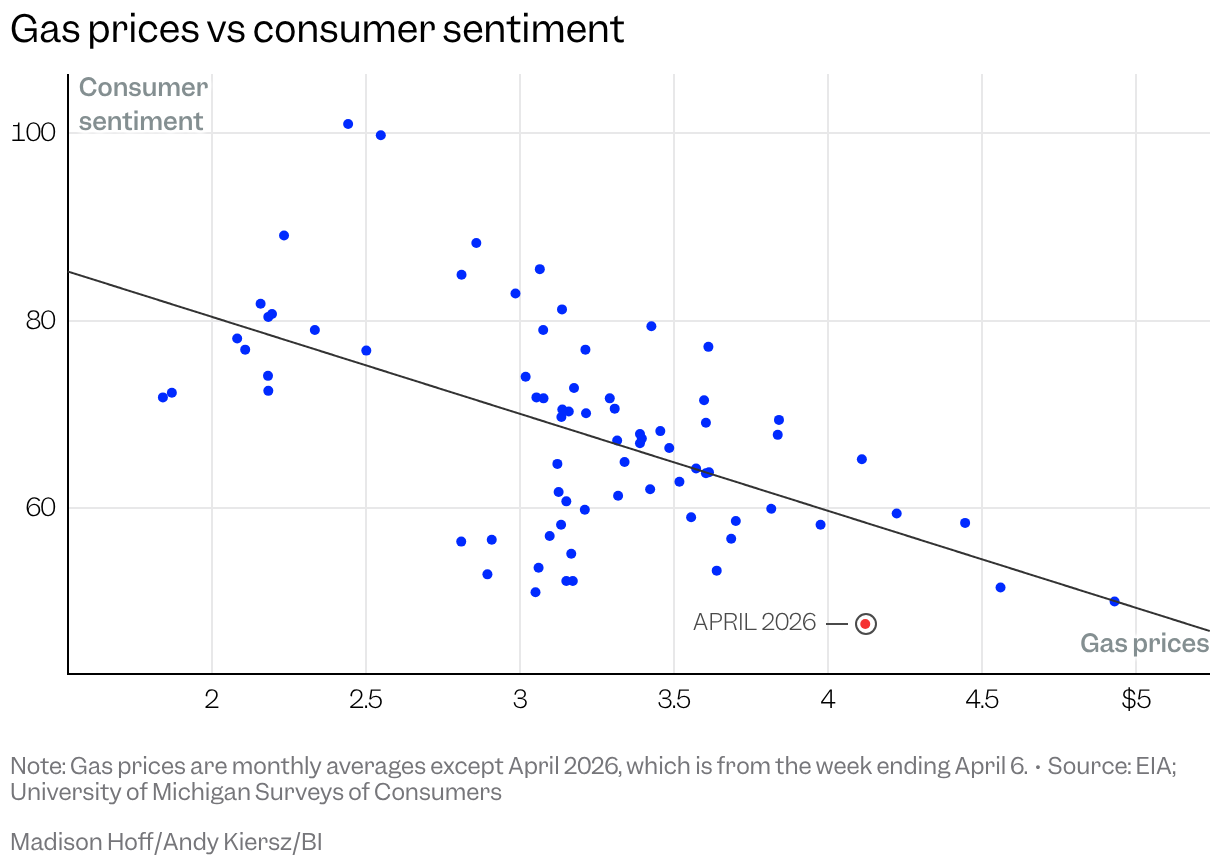
It turns out that one small (or not-so-small) number has a lot of sway over how Americans feel about the economy: Gas prices. In recent years, there’s been a pretty solid relationship between gas prices and consumer sentiment: When it’s more expensive to fill up the tank, Americans tend to report more dire feelings about economic conditions and where they’re going. A Business Insider analysis of retail gas prices from the Energy Information Administration and consumer sentiment from the University of Michigan showed a moderate negative correlation between the two.

Scatter Plot

Gas prices are a hyper-visible economic marker for many Americans, who might experience immediate sticker shock every time they drive past their local gas station or stop to refill on the way to work. After all, only a small share — under 4% — of Americans use public transportation to get to work, according to Census Bureau data on commuting. A touch over 69% of workers drove alone to work in 2024, meaning that gas prices are likely omnipresent in calculating their commutes and daily expenses.

“Prices at the pump hold a very uniquely salient point in people’s minds,” Matt Colyar, an economist at Moody’s Analytics, told Business Insider. “Maybe it’s the big signs with the big luminescent numbers that everyone drives by constantly. They’re very aware of these prices.”

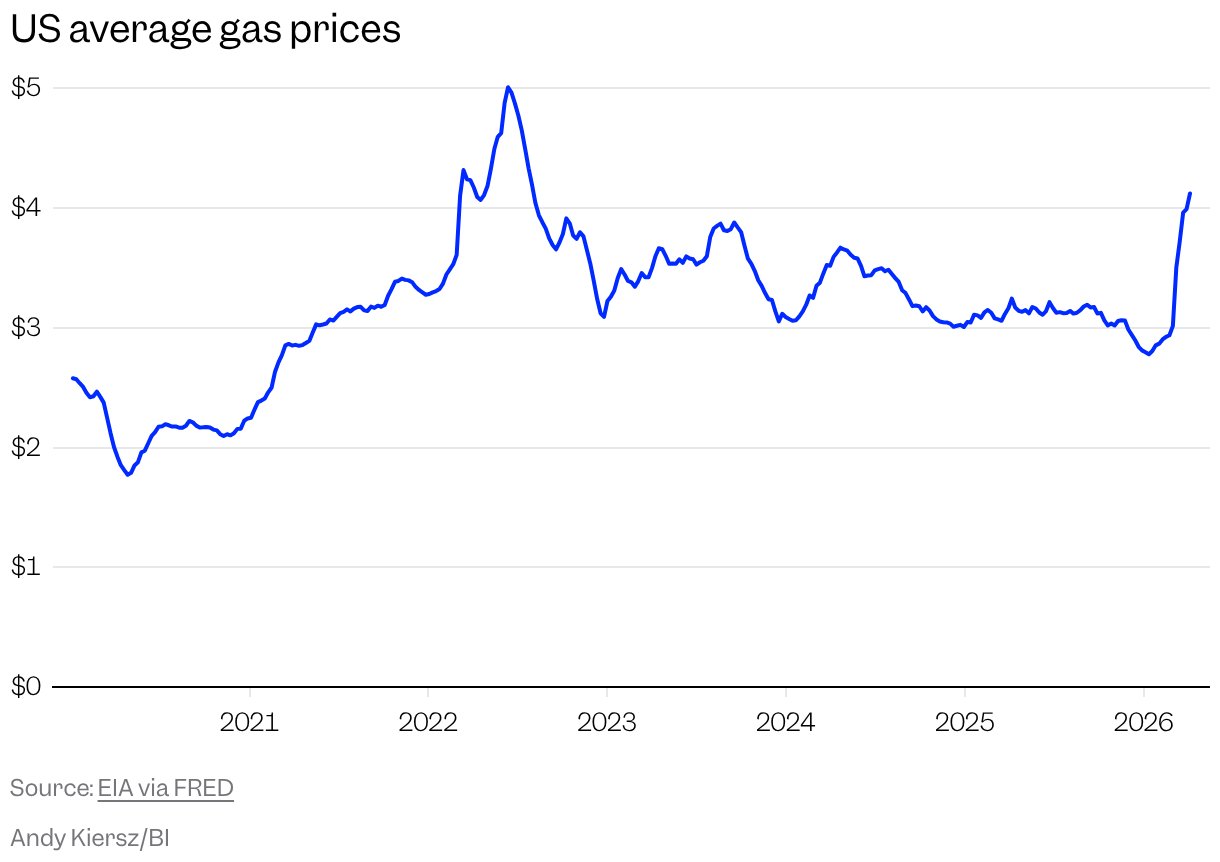
The last time sentiment was close to being this low was in June 2022. That might seem counterintuitive; it would stand to reason that the depths of the COVID-19 pandemic or the 2008 financial crisis and its aftermath might trump the current fluctuations. But June 2022 marked record-high gas prices amid soaring inflation and the fallout from Russia’s war in Ukraine.

Now, as sentiment hits that record low, gas prices are rising at the fastest pace on record, with last week’s consumer price index report showing a 21% month-over-month increase. As of the week ending April 6, the most recent date for which the Energy Information Administration has data, gas prices hit $4.12 a gallon; as of April 13, they were hovering around the same level, and up 50 cents over the month, per AAA.

Line chart

The bad vibes might only continue, especially as President Donald Trump signaled that prices might remain high through the November 2026 midterms and tensions between the US and Iran remain high over the Strait of Hormuz and the roughly 20% of global oil production that passes through it.

“Gas prices are highly visible, highly salient prices that consumers use to gauge their feelings about the economy,” said Alex Jacquez, the chief of policy and advocacy at the left-leaning think tank Groundwork Collaborative. “People have to fill up weekly; they often don’t have much of a choice whether they pay or not.”

Indeed, pump prices are top of mind for Americans as the Iran conflict drags on: 69% of 3,507 Americans surveyed by the Pew Research Center at the end of March said they were very or extremely concerned about higher gas or fuel prices when thinking about US military action in Iran.

That’s already led to changes in how American workers are navigating daily life — rideshare drivers, for instance, are prioritizing the most profitable trips to make their gas expenditures worthwhile. EV owners have taken a victory lap as they plug in. One Business Insider reporter strategically switched to the Costco credit card for gas savings.

Of course, there are plenty of factors that weigh on how Americans view the overall economy, and gas prices alone don’t determine sentiment. For example, the job market has been locked in a low-hire, low-fire “great freeze” for over a year, and the difficult prospects for job seekers are likely weighing on economic opinion as well.

Gas is still likely a looming factor, though. Jacquez said research has shown that “gas prices, consumer sentiment, and political approval all tend to move together, so it’s not surprising to see a sudden rise in gas prices coincide with a crash in consumer sentiment.”

Do you have a story to share about how rising prices and volatility are affecting your economic outlook? Contact these reporters at jkaplan@businessinsider.com and mhoff@businessinsider.com.

Read the original article on Business Insider

At 18, I was managing a Wendy’s. Years later, I earned a record $496,900 in a single bowling season.

Kyle Troup playing bowling
Kyle Troup stars on the new HBO documentary “Born to Bowl”
  • Kyle Troup, 34, has been a professional bowler since he was 16.
  • In 2021, he set a bowling earnings record, making $496,900.
  • Troupe stars on the new HBO documentary “Born to Bowl” and is glad the sport is getting attention.

This as-told-to essay is based on a conversation with Kyle Troup. It has been edited for length and clarity.

Growing up, my parents used to pay me if I could beat them at bowling. I got $5 if I beat my mom, and $20 if I beat my dad, Guppy. He was a professional bowler with the Professional Bowlers Association (PBA), and my brother and I often went to PBA events with him.

Around the time I was 13 or so, I started beating my dad so often that he dropped my pay down to $10 per victory, then $0. I figured I must be getting pretty good.

I wanted to be just like my father — and not because he was a professional bowler. People loved him, whether he was bowling or not. He was a cool, popular guy who often hung out at the bowling alley bar after his games. He loved his life and career, and it was clear he was having a lot of fun.

I started working at Wendy’s early in my bowling career

At 16, I started bowling with the PBA. In the first few years, I didn’t win much money at all. Still, the experience of bowling for money and spending my own income to bowl taught me a lot.

Around the same time, I started working at Wendy’s. By 18, I was a manager there, and still making next to nothing bowling. I’ve always been good with money, so I was getting by, but one time when money was tight I remember thinking “What could I be doing if I wasn’t chasing the dream of being a professional bowler?”

After a minute, I realized I didn’t need that answer. I was going to be a professional bowler, and that was that.

A record-setting year helped establish my financial future

By my early 20s, I started winning more tournaments and, therefore, earning more. By 2016, I made about $44,000 — enough to leave my job at Wendy’s.

Then, in 2021, I had a great year. I won the PBA Player’s Championship and earned a record-setting $496,900 that season. That’s not much compared to many other professional sports, but for me, it was a blessing.

I worked with a financial advisor and invested a lot of that money to build the foundation for my future. Bowling is a physical activity, and I know I won’t be able to do it forever. Since 2021, I’ve felt financially set. That allows me to go out and be the best version of myself each week I’m on tour.

Becoming a dad has given me purpose beyond bowling

About five years ago, I met Breanna, and we got married last year. She had two kids who were about 6 and 11 when we met. Becoming a dad to them has given me perspective about what’s important in life. My life isn’t about bowling anymore; it’s about my kids.

Couple getting married

The PBA tour schedule can be hard on the family. I’m gone for about three to four months, traveling around the country for competitions. I’ve always had that schedule, but being away from my kids took some emotional adjustment.

I used to stay in hotels while I was on the road, but that was draining: I was always in a hotel, a restaurant, or a bowling alley. Now, I stay at Airbnbs with my best friend, who’s also a professional bowler. Being in a house means we can cook healthy meals and generally feel more at home, even when we’re on the road.

I’m happy with what I’ve achieved

I would love to win a title again, since it’s been a few years. At the same time, I can see that I’ve already achieved a lot, from winning Player of the Year to providing for my family to raising money to help more kids explore the sport.

Now, I want to give back to this sport. I’m happy it’s getting more attention, including the new HBO series. I get to play a game for a living, and I really enjoy what I do. That’s a blessing in my life.

Read the original article on Business Insider

We gave my grandma an iPhone when she was 80. I learned a lot about her from what she started watching on YouTube.

Woman watching youtube videos
The author’s grandmother discovered YouTube.
  • My grandma got her first iPhone after a brief health scare and became hooked on YouTube videos.
  • She slipped farther away from the family store, old friends, and the dinner table.
  • Seeing her blush at silly romance videos made me realize that she wasn’t wasting time.

On the day my Taiwanese grandma A-Ma turned 80, she complained about a lingering dizziness.

When she got up from the floor mat, she fainted. Though the blackout lasted only two seconds and the doctor ruled the trigger to be temporary low blood pressure, my aunt was worried enough to dust off an old iPhone in case of an emergency.

Being illiterate, it took my grandma a full week to master punching in the four-digit passcode. I was worried during my entire visit home in Taiwan.

My cousin helped her figure out her phone

Everything changed when my 6-year-old cousin came home from kindergarten with a new obsession with Minecraft videos. Not having a phone to his name, A-ma became my cousin’s easy target. He downloaded YouTube onto her phone. A thread of over-the-top romance videos popped up on my grandma’s feed. She clicked on one after another.

Grandma and little boy
The author’s grandma learned about YouTube through the author’s cousin.

Turns out, my grandma’s taste in entertainment was 30-second dramatic YouTube Shorts with ridiculous premises filmed on a low production budget: a housekeeper starved by her boss, who eventually fell in love with her. A college senior slept with dad’s best friend, who has a BDSM lair. A high school girl endured bullying, then revealed she is an heir to a kingdom. Everything that made me cringe made her giggle.

Then the effects of her phone permeated into real life. The family store she started with my grandpa in 1975 began seeing her less. Instead of stocking the shelves with my aunt in the morning, she opted for a long breakfast: two boiled eggs dipped in soy sauce with an endless side of YouTube Shorts.

The situation briefly looked up when A-ma’s friend, who ran a sticky rice shop, stopped by the store with some fresh gossip. The friend brought hot-off-the-press news about a local’s son and daughter. My grandma played the attentive listener, given that she did not have the skills to scour the market for scandals. Yet, not even 20 minutes in, I noticed A-ma started glancing at her phone. No longer a top-tier audience, the friend retreated to the sticky rice shop, defeated.

I noticed she was paying less attention

As a writer in New York who used my phone sparingly, I flew back to Taipei every three months to see family. Each time, I noticed her attention span suffered more than the last.

Her dining table was once the place I brought her behind-the-scenes anecdotes of working in a New York City ad agency, but not anymore. Last time we ate together, her eyes were glued to her screen. I sighed and threw my finished plates into the sink. She glanced at me, then back to her original program, completely mesmerized by the content.

Instead of being angry, I caught a glimpse of A-ma blushing from the corner of my eye. Like a girl reading a coming-of-age story, her cheeks flushed pink. Then she turned the screen toward me, relaying the plot of a cringey romance. Her smile stretched up to her eyes.

I finally understood her

That was when I realized it was not YouTube Shorts with horrible storylines she was watching. It was a window into what young adulthood could’ve been like if she were given the chance to be a normal girl.

As my mother told me, A-ma grew up in a war-torn time in Taiwan, where her childhood consisted of running into bunkers during air-raid drills. By 15, she was at the fishing port helping her family haul fresh catches into the local market. Years later, her parents arranged for her to marry the neighborhood boy. Then, together, they had six kids. They took a leap of faith, left the village, and set up shop in Taipei City, selling handmade beef jerky and pork floss.

Never having the chance to go to school, dress up for a party, or sneak out at night to steal a kiss from a cute boy — she didn’t get to live, not like a young girl. Before anyone or herself knew, she became an adult.

I realized, 65 years later, after a brief health scare, A-ma got this iPhone that served as a portal into a world she never had access to. Filling a void she didn’t know existed.

Last time I visited, I showed her how dictation works. With her callused thumb, she hit the microphone button and uttered: “Young. Stories.”

However, her accent, thick with a dialect, was too much for Siri to understand. For the first time, I felt like I did.

Read the original article on Business Insider

I spent decades in a stressful job that paid $30,000. At 53, I left to become a mailman and nearly tripled my salary.

A man wearing glasses against a background of photos on the wall.
Jim Lexa quit journalism after 30 years and now works as a mailman, earning over twice his previous salary.
  • Jim Lexa worked as a journalist for 30 years and saw his salary plummet as print journalism faded.
  • He quit without another job at 53, worked as a handyman, then got a job with the Postal Service.
  • He now earns up to $85K a year — nearly three times his old salary — and can walk 40K steps a day.

This interview is based on a conversation with Jim Lexa, 63, a letter carrier from West Seneca, New York. It has been edited for length and clarity.

I never started out in journalism because of the money. I could have earned higher wages by staying in my job straight out of college, working in the kitchen of a diner chain.

Instead, I was bitten by the writing bug as a high schooler, when I was hired by a local town newspaper in Lily Lake, Illinois, to cover all high school sports, particularly football.

Those were the years I learned basic journalism rules, such as spelling people’s names correctly and getting the scores right.

I got my journalism degree and, after a brief stint working at the diner, landed a sports reporter job at a regional newspaper group in Amarillo, Texas. My salary in 1984 was $230 a week.

The popularity of newspapers dropped

It was exciting to write about teams like the Dallas Cowboys, and there was a lot more to it than game coverage. I enjoyed meeting people and telling their stories.

In 1998, I moved to the copy desk, where my responsibilities included clearing the front page and assigning tasks.

Then the popularity of newspapers began to dwindle. Circulation dropped. The publishers stopped hiring people, and you’d see offices being closed off. Then came the pay cuts.

Management always said they were for the good of the company. Still, when my $37,500 annual base salary was reduced to $30,000, I started to seriously worry.

A man holding a cat
Lexa with one of his pets.

I’d go to the grocery store with a calculator to figure out what kind of food I could afford. If one of my pets got sick, I’d be concerned about paying the vet bills.

By early 2015, I was feeling burned out. Constantly meeting deadlines and filling the pages was getting to me. The stress wasn’t worth the amount I was paid.

I took a deep breath and quit, moving to DeKalb, Illinois, where I did handyman, painting, and cleaning work.

I was promoted within 2 years

Still, I felt like I needed a proper, new direction. It felt late in the game to make a career change at 53, but I heard they were hiring at the post office and was hired in November 2015.

My entry-level job as a clerk was the brief stepping stone to becoming a city carrier assistant in January 2016. About two years later, I was promoted to letter carrier after I moved to Buffalo, New York.

You have a few days’ training, and then you’re out on your own, which was scary. At first, I’d spend ages poring over maps, but as time passed, I got to know my routes well.

A man and woman on vacation standing in front of the ocean.
Lexa enjoys eating out with his wife, Charlotte, now his salary is higher.

In my current position, I earn $34.26 per hour, with overtime at time-and-a-half after eight hours and double time after 10 hours. During COVID, I was putting in 60 hours a week.

This past year, I topped $85,000 — nearly three times as much as my base salary in newspapers. My wife and I don’t have to worry about dining out, and we enjoy nice vacations together.

I’m much less stressed

One of the best things to come out of all this is feeling the fittest I’ve ever been. I use a postal vehicle, but I walk 12 to 18 miles a day. If it’s just my route, it’s probably around 30,000 steps daily.

During the winter, when it’s really snowy, and I get a lot of overtime, I can get in as many as 40,000 steps. I’m 5’8″ tall and weigh 160 pounds.

I’m so glad that I made the switch. I’ve got a decent salary with less stress, good benefits, a friendly relationship with my regular customers, and a spring in my step at 63.

Read the original article on Business Insider

An entrepreneur is transforming a Cold War-era nuclear silo into an underground data center. Look inside.

Panoramic view from the top of the silo.
Halik’s decommissioned nuclear silo is 165 feet deep.
  • Entrepreneur Nik Halik bought a defunct nuclear missile silo in Colorado for over $10 million.
  • The US government once used the facility to power, house, and potentially fire nuclear missiles.
  • Halik plans to turn the 200,000-square-foot facility into a data center to power AI.

A decommissioned nuclear silo near Denver, Colorado, that could once launch three 4.5-megaton nuclear missiles at a moment’s notice is now an entrepreneur’s pet project.

Nik Halik, an Australian venture capitalist, purchased the decommissioned Cold War-era nuclear missile silo from the US government in 2021 for more than $10 million. For the past five years, Halik has been overseeing its transformation into a modern, renovated facility, where he plans to house an AI data center.

The project is on brand for Halik, a self-described “thrillionaire” whose past endeavors have included skydiving over Mount Everest, training in Russia as a civilian cosmonaut, and diving 5 miles deep to the deck of the Titanic.

He said his interest in these types of structures pairs with his vision for what they could become.

“I’m immersed in the world of castles and underground bunkers,” Halik told Business Insider. “I’m a value-facturer. I like things that I can add value to.”

Halik took Business Insider on a tour of the facility. See what it looks like inside the roughly 75-year-old nuclear silo.

The facility was built in Colorado in 1959 for $47 million, or $350 million in today’s dollars.
Missile silo under construction.
Other Titan I silos like Halik’s were built in Colorado.

At the beginning of the Cold War, the US began developing intercontinental ballistic missiles (ICBMs) at a rapid pace. Following the US’ first operational ICBM, the SM-65 Atlas, the Titan I went under development in the mid-1950s.

According to the National Park Service, the Titan I missiles were 98 feet tall and could deliver a nuclear warhead over 6,000 miles.

Eighteen silos, like Halik’s and the one pictured, were built across the US to house these missiles during the Cold War.

Four large diesel engines powered the facility.
A person walking into a Titan I facility.
Another Titan I silo near Denver. Thanks to diesel power, the facilities could be powered without the grid.

Thanks to the silo’s use of diesel fuel, it had the ability to stay running without being connected to the electrical grid. The amount of fuel in the silo was enough to fuel around 2,000 houses for roughly 2 weeks.

Just one of the silo’s three diesel tanks has the capacity to hold about 50,000 gallons of fuel, Halik told Business Insider.

The missiles were removed from the silo less than a decade later.
A construction worker attached to a crane touching the tip of a missile.
All Titan I missiles were decommissioned in 1965.

In all, 54 Titan I missiles were operational between April 1962 and January 1965, according to the National Park Service.

Despite the impressive stature of the Titan I silos, they proved to be short-lived. All were removed by early 1965, becoming obsolete due to rapid technological developments that led to the Titan II and Minuteman I ICBMs.

In the years that followed, the US government removed valuable materials from the silos and sold off most of the facilities to public and private owners. Halik said after his bunker was decommissioned, it was used by government defense contractors and The Defense Advanced Research Projects Agency.

Today, Halik is renovating the silo at an estimated cost of $30 million.
Outdoor view of Halik's facility,
Halik’s facility is in an isolated area near Denver, Colorado.

Halik, with help from others, has been renovating the facility, located in a top-secret location in Colorado, for over four years.

Aside from the facility’s rusty metal scraps and loose wires, other hidden dangers lurk throughout the complex. The basement level, Halik said, is riddled with cyanide, lead paint, mercury, and asbestos.

The entrepreneur has taken a hands-on role in exploring and renovating the facility.
Halik holds a flashlight and points.
Halik has taken a large role in the renovation process despite safety risks.

He’s documented every step of his journey in the facility on the YouTube channel Nuclear Bunker Living. The first episode, uploaded in September 2021, shows him exploring the bunker by himself for the first time.

As Halik’s videos show, he often jumps into the exploration and renovation headfirst, despite the safety risk. On one occasion, he crawled through a rusty pipe, only to realize later that it had a live wire running through it that he said could’ve electrocuted him instantly.

“There are so many variables of danger here,” Halik said in a video. “This place is unforgiving, and it always reciprocates with interest.”

The bunker totals 200,000 square feet.
View from the bottom of the bunker's stairs.
The bunker needed to be deep enough to house the 98-feet-tall Titan I missiles.

The silo descends 165 feet below the surface, deep enough to house the missiles and the equipment necessary to launch them.

Seventeen distinct chambers make up the facility, connected by a network of tunnels spanning 4,500 feet.
A tunnel in Halik's complex.
A network of tunnels connects the complex’s rooms.

Different launcher rooms, control domes, a power dome, and other areas make the facility a sprawling complex.

The most secure part of the complex can withstand a nuclear blast.
A sign reading "Launcher Area No. 1." One part of the facility has strong concrete walls reinforced with steel.
One part of the facility has strong concrete walls reinforced with steel.

One portion of the facility was built by what Halik called “Hoover Dam-type engineering.” Featuring multiple layers of steel-reinforced concrete, each square inch of the wall could withstand roughly 15,000 pounds of pressure.

In this room, operators would stand ready to launch the missiles at a moment’s notice.
A desk from the control room of the facility.
Operators for the missiles would stand ready for a call from the Pentagon.

The control room was where the missile operators would have pressed the fateful buttons to launch missiles that were 300 times more powerful than the bomb dropped on Hiroshima.

“The fate of the Western world was in the hands of these 21- to 22-year-olds who had the keys to the missiles, ready to employ them on the instructions of the Pentagon from the president,” Halik said.

Halik wants to turn one part of the facility into a museum.
An up-close shot of the launch deck.
Halik and his team found papers pertaining to the missile’s launch in the bunker.

Many relics still remain in the control room and other areas, including pieces of the desk where a launch would’ve been programmed.

Recently, Halik and his team discovered papers containing launch codes, times, and other protocols.

For other rooms, he has more creative plans.
A large room that Halik said could be turned into a night club.
Halik wants to turn one room into a night club.

In another room, Halik envisions a nightclub, complete with a DJ, bar, consumption lounges, and Cirque du Soleil dancers.

At a different decommissioned missile site in New Mexico, this vision may already be a reality. The Twistflower Nuclear Missile Silo in Roswell will host the ATOMIKA festival in November.

The festival, promoted by Halik, describes itself as an “experimental, annual gathering that fuses immersive art, deep inquiry, and powerful music.”

Chief among Halik’s plans is to turn part of the facility into a data center.
The facility's power dome
The facility’s power dome could once again be used to power a data center.

Since AI requires large amounts of power, as well as a safe and reliable space for data, underground locations like Halik’s facility could prove to be prime locations.

A critical factor is the bunker’s cool temperature of 52 degrees Fahrenheit, even during the summer, which is optimal for the interior of a data center to prevent servers from overheating.

At some data centers, it can take more than 30% of a facility’s electricity to keep servers cool, the Pew Research Center reported.

“AI needs power,” Halik said. “AI needs safe environments to basically have all their computational processing power.”

The data center could be powered entirely in-house, without the grid.
Halik said he would install small nuclear reactors for power.

Halik said that to power the data center, he would swap the facility’s diesel infrastructure with small nuclear reactors in an attempt to avoid the hassles of refueling.

Halik said he has already gotten the attention of tech and AI companies.
View of one room with light bulbs and wires.
Companies are increasingly looking to house data centers underground.

Although Halik didn’t disclose the specific companies interested, it aligns with a growing trend of underground data centers becoming more commonplace.

One company, called Iron Mountain, utilizes a former limestone mine in Pennsylvania for data processing and storage. The 220-foot-deep facility stretches 40 acres, about nine times the size of Halik’s bunker.

Read the original article on Business Insider