
Author: admin

The spread of the 2x playback button is a sign of brainrot — and I love it

italian brainrot images
“Italian brainrot” character plushes, popularized on short-form video, and now your kids can snuggle them.
  • YouTube Shorts is finally adding a 2x playback speed option.
  • I watch almost everything sped up now — TikToks, Reels, and listen to podcasts and audiobooks sped up.
  • Are our brains so rotted that we can’t deal with normal speeds? Yes!

I am a screentime maximalist. I make no apologies and feel no guilt about how much time I spend staring at my phone. I’m a grown adult who pays taxes and makes my own choices about how I spend my precious free time on this blue marble. And what I want is to spend as many of those moments as possible consuming short-form vertical video on my phone.

My need to consume more and more inane content reminds me of the famous photo of the Florida Everglades python whose stomach exploded while trying to eat an alligator. I identify with the insatiable snake; the alligator is the endless scroll I can never get enough of, knowing there’s always something more to watch.

My goal is to maximize consumption of video hours, and obviously, I can’t add more hours to the day. I’m already shaving the time I waste on sleeping (boring, overrated) by watching TikToks in bed.

So the problem needs to be solved on the supply side: I need those videos to go faster so I can get more in.

Thankfully, TikTok and Instagram Reels both have buttons that make videos play at 2x speed. There have been some bumps along this road. TikTok added the 2x-speed feature in 2023, but only recently added the crucial feature that lets you “lock” 2x speed without having to hold your finger on the screen (press the screen to start 2x speed, then drag your finger down to lock it). Reels was later to the party, adding the 2x speed in 2025.

Just this week, YouTube Shorts is finally adding a 2x speed feature. Thank god, I say! Honestly, I am not a huge Shorts consumer, but I imagine this is huge news for like, 12-year-olds.

The ability to speed up content has probably become one of the most-used features across the apps I use daily. I speed up podcasts and non-fiction audiobooks to at least 1.25x (lately, I’ve been bumping fiction audiobooks to at least 1.4x). The idea of listening at actual speed is torture to me at this point.

At first, I thought the idea of speeding up a Netflix show was an abomination, but then I realized it’s the only decent way to consume reality shows like “Love Is Blind.” In the last few weeks, I’ve found myself annoyed that I can’t speed through the six (!!!) episodes per week of “Love Island” on the Peacock app (though apparently there are Chrome extensions that let you do so).

Does it say something sort of sad about our society that we need to speed-watch through a 90-second video? Yes, yes it does. I’m not going to deny that. Our attention spans are so decimated, and our brains so rotted, that we can’t listen to someone speaking at normal speed anymore.

And what’s to blame for that? The firehose of content itself, of course. Short-form videos have rotted our brains in such a way that we crave more short-form videos. It’s almost like toxoplasmosis, the disease from handling cat poop that makes rats obsessed with cats.

I’m sure that there’s a way to wean yourself off all this and reset your attention span. Log off, touch grass, dopamine reset, etc… But I have no interest in that. I’ve made my choices, and I’ll be speeding through videos until all the platforms have to add 3x speeds.
Read the original article on Business Insider

I took my kids to a family-friendly pub to watch the World Cup. It’s more socially acceptable now.

A dad is sitting in a bar wearing a soccer uniform with his two young children.
Jonathan Stone with his kids, Jameson, 3, and Parker, 6, watching the World Cup.
  • Jonathan Stone and his kids are die-hard soccer fans and have been glued to the World Cup.
  • The dad enjoys taking them to family-friendly pubs and bars to watch the games on big screen TVs
  • He was concerned that other customers might judge him, but found them to be welcoming and warm.

This story is based on an interview with Jonathan Stone, 44, of New Canaan, Connecticut, who works in event marketing. It has been edited for length and clarity.

My kids and I have been looking forward to the 2026 World Cup for months.

Parker, 6, and her 3.5-year-old brother, Jameson, inherited my love of soccer and, like me, are rooting for England this summer.

I’m American, but got hooked on European football at college, where two of my best friends were from the UK.

One supported Newcastle United, and it became my English Premier League side. The kids started wearing the kit as soon as they were born because everyone sent us themed onesies.

The pub was family-friendly

I couldn’t wait to buy them those little England shirts and shorts for this year’s competition.

They proudly wore them for the last two England matches, particularly when I took them to a pub in Norwalk, Connecticut, to cheer the team.

It was a family-friendly place that had World Cup soccer players’ coloring sheets to keep the kids happy if their attention wandered. We also brought some Lego bricks for them to build with.

I ordered their favorite Shirley Temples and chicken tenders with fries, and they got really into the game.

A dad in a bar with his daughter wearing soccer jerseys.
Stone and his daughter, Parker, cheered on the England national team.

They recognized a lot of the players because I’m always pointing them out. And they joined in some of the chants and songs unique to soccer fans and appropriate for their age.

I was also impressed by how much they know about the rules. Parker has always been keen to learn about things like offside, fouls, tackles, and yellow and red cards.

I knew some people disapprove of taking children to a bar, particularly Americans, because it’s not so much a part of our culture as in the rest of the world.

It was still in the back of my head that someone would judge me and give me a piece of their mind. Not that I cared.

It’s becoming more socially acceptable to bring kids to bars

Kids aren’t harmed by being in a pub environment where alcohol is served. You go to the movie theater these days, and there’s a full bar. It’s not going to corrupt anyone.

Luckily, it’s becoming more socially acceptable in the US to bring kids to pubs, and the attitude is shifting toward a more European one.

The shared experience of watching the World Cup has bonded the kids and me. They get excited when they see me, and other supporters in the bar go crazy about a goal.

We’re really hoping England goes through to the next round so we can repeat the fun.

Read the original article on Business Insider

House committee subpoenas Leon Black in the middle of closed-door interview about Jeffrey Epstein

Leon Black Congress
The House Oversight Committee interviewed Leon Black behind closed doors Friday.
  • The House Oversight Committee subpoenaed Leon Black while interviewing him about Jeffrey Epstein.
  • The billionaire paid over $150 million to Epstein for what Black said were financial services.
  • The committee said it issued subpoenas after Black declined to answer questions about NDAs.

The House Oversight Committee subpoenaed billionaire Leon Black in the middle of a closed-door interview on Friday about his interactions with sex offender Jeffrey Epstein.

The committee chairman, Rep. James Comer, said the committee issued two subpoenas after the former Apollo Global Management CEO declined to answer questions about non-disclosure agreements.

One subpoena requires Black to produce copies of any NDAs he has agreed to, said Comer, a Republican. A second subpoena requires Black to appear before the committee again, on July 16, for a deposition, Comer said.

“The NDAs are between him and other women. We want to know, was Jeffrey Epstein involved in the NDAs?” Comer told reporters. “Was he involved in writing? Was he involved in awarding funds to the women in the NDAs? What was the reason for the NDAs? We want to know everything about the NDAs.”‘

Susan Estrich, an attorney for Black, called the subpoenas “a planned political stunt.”

“Mr. Epstein had no involvement with any NDA’s, whether they exist or not,” she said in a statement. “Let me reiterate, the Committee did not ask a single question about the legitimate payments to Epstein for professional services on tax and estate matters.”

Business Insider reported Thursday that members of the committee had discussed issuing subpoenas to people who might be able to testify about confidential settlements between Epstein’s friends and accusers who had accused the men of misconduct.

Some of Epstein’s accusers have signed pre-litigation settlements with Epstein associates whom the women have also accused of misconduct, according to three people with knowledge of such settlements, including Brad Edwards, an attorney who has represented more than 200 of Epstein’s accusers. These settlements include NDAs that prohibit them from speaking publicly about their experiences, the people said. One person told Business Insider they had knowledge of settlements with four of Epstein’s friends who were accused of sexual misconduct by more than 20 women between them.

A subpoenaed deposition would legally require Black to answer any questions asked of him, even if he has signed a non-disclosure agreement.

Jeffrey Epstein
Epstein sometimes introduced women to his friends, Justice Department records show.

House Members were interviewing Black on Friday as part of the committee’s inquiry into the Justice Department’s handling of its investigations surrounding Epstein, and his relationships with powerful people.

“I completely support Chairman Comer’s decision here” on issuing subpoenas to Black, Rep. Robert Garcia, the committee’s top Democrat, told reporters. “The NDAs are central to us understanding what actually happened.”

Black initially agreed to the interview on a voluntary basis, which permitted him to decline to answer questions. He said in his opening statement, a prepared copy of which his spokesperson shared with Business Insider, that he would not answer questions about personal relationships.

“I am not here to answer questions about my personal life which would be hurtful to my wife, children and family,” he said. “And I will not speak about the personal lives of adult women who have not chosen, and do not deserve, to be connected, by me or anyone else, to Epstein.”

Black paid Epstein more than $150 million for what Black said were estate and tax-planning services. Black told the committee that he cut ties with Epstein after discovering that he had lied about his fees and refused to repay most of a loan.

The billionaire avoided a deposition earlier this year in a court case related to Epstein. A scheduled deposition was canceled after a group of Epstein victims settled a class-action lawsuit with Bank of America, which housed some accounts Black had used to pay him.

Black has long said that he wasn’t aware of Epstein’s sexual misconduct. The Manhattan District Attorney’s office and the US Attorney’s office for the Southern District of New York examined sexual misconduct allegations against Black but did not bring criminal charges against him.

Black told the committee he had never abused a woman himself, according to his prepared remarks.

“This was a side of him I didn’t know,” he said. “I knew Jekyll. I didn’t know Hyde.”

Read the original article on Business Insider

Mamdani’s rent freeze is official. One chart shows who stands to benefit.

Zohran Mamdani
Mayor Zohran Mamdani’s rent freeze will take effect for leases beginning October 1, 2026.
  • NYC Mayor Zohran Mamdani achieved his promised rent freeze, affecting 1 million rent-stabilized homes.
  • The rent freeze aims to control costs for NYC renters, starting October 2026, amid rising expenses.
  • Critics argue the rent freeze may increase landlords’ financial strain and impact property upkeep.

Zohran Mamdani’s rent freeze is now official, a big win on a central campaign promise six months into his term as New York City Mayor.

The city’s Rent Guidelines Board approved a citywide rent freeze for one- and two-year leases in about 1 million rent-stabilized apartments, after a 7-to-1 vote Thursday. The vote will prevent price increases on more than 40% of all apartments across the city as of October 1, 2026, and will cover leases that begin on or after that date.

Landing a rent-stabilized apartment can be life-changing in a city where 43% of renter households spend more than 30% of their income on rent, including 25% that spend more than half, according to the 2023 New York City Housing and Vacancy Survey (NYCHVS).

Affordable housing was a key part of Mamdani’s campaign for mayor. Along with the rent freeze, he is also advancing the Block by Block Housing Plan, which aims to construct and preserve affordable housing over the next decade.

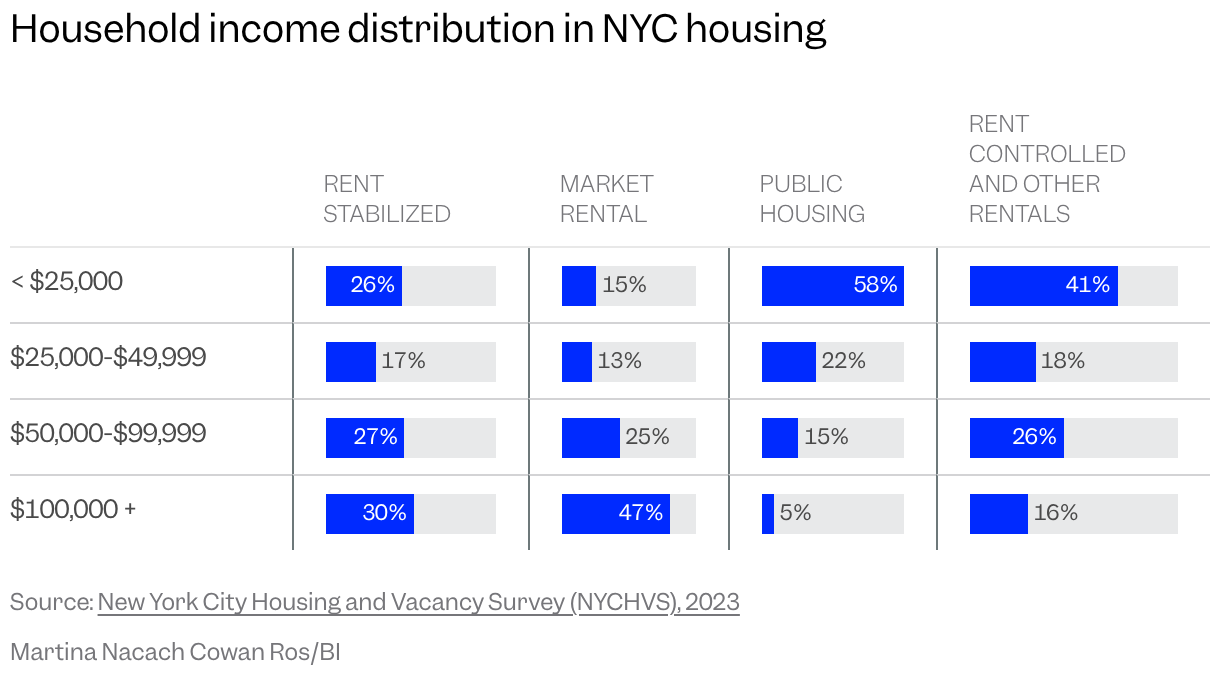
The policy might help a surprising set of higher-income New Yorkers, as 30% of rent-stabilized apartments are in the hands of households with incomes above $100,000, according to the NYCHVS.

Table

Households earning between $50,000 and $99,999, and less than $25,000 trail close behind, at 27% and 26%, respectively.

Not everyone is celebrating Mamdani’s win. Jake Krimmel, Realtor.com senior economist, commented that while the policy will provide short-term benefits for tenants who are rent-burdened, the freeze will also impact landlords and real estate groups as they struggle to meet rising operating costs.

“Building owners are simultaneously cost-burdened, squeezed by rising insurance premiums, fuel costs, and property taxes that the rent guidelines process doesn’t control,” he wrote. “Frozen revenues against rising costs is a math problem.”

Critics also say the freeze could leave landlords with fewer resources to maintain their buildings and claim the regulation could put more pressure on market rents, resulting in higher costs for other market-priced units.

Arpit Gupta, a public member of the Rent Guidelines Board and an assistant professor of finance at NYU Stern, voted against the freeze and wrote in an article published Friday that longer tenancies and the challenge of finding stabilized units will make it harder to find housing and push many into higher-priced market-rate housing stock.

“The city’s housing market is effectively breathing with only one lung,” he wrote. “That pressure drives up market-rate rents.”

Jumaane D. Williams, the New York City Public Advocate, applauded the board’s decision and argued that while it is true there are rising costs, tenants must not take on that burden.

“Some property owners, particularly of smaller buildings, have legitimate concerns about rising costs — the solution cannot be to demand more money from tenants who simply do not have it,” he wrote. “Instead, government on all levels should work to strengthen programs aimed at maintaining housing quality and providing property owners with support when needed.”

Thursday’s vote also met with some turbulence, as Christina Smyth, a member of the Rent Guidelines Board, resigned the morning before the vote. In a statement, she wrote the board’s decision was “decided last year on the campaign trail.” She questioned the board’s research methodology and stated that since Mamdani appointed six of the nine board members, “everything since then has been theatre.”

In a statement, Mamdani said the board had gone through “thoughtful consideration of the data.” He wrote the board analyzed tenants’ ability to pay, living costs, and building operating costs.

“This is a historic victory for New York City tenants,” he wrote. “I’ll continue working to deliver a more affordable city by building and preserving affordable housing, lowering building operating costs like insurance, and ensuring tenants know their rights.”

Read the original article on Business Insider

OpenAI says access to its new GPT-5.6 model is limited at the US government’s request

OpenAI
OpenAI launched a limited preview of its new GPT series on Friday.
  • OpenAI is now previewing its new model, GPT-5.6.
  • OpenAI said access is limited to a few “trusted partners” at the US government’s request.
  • GPT-5.6 was developed with OpenAI’s “most robust safeguards” so far, the company said.

OpenAI is limiting preview access to its latest GPT models at the request of the US government.

The company said it previewed the capabilities of its new series of GPT-5.6 models, which includes Sol, Terra, and Luna, to the US government ahead of Friday’s launch.

“At their request, we are starting with a limited preview for a small group of trusted partners whose participation has been shared with the government, before releasing more broadly,” the company said.

OpenAI said they were complying as part of its earlier agreement with the Defense Department, which allows the Pentagon to use its AI models.

OpenAI said the new models will become available to the wider public in the coming weeks.

The limited GPT-5.6 release comes after OpenAI’s chief rival, Anthropic, was forced to revoke access to its latest models, Mythos and Fable, on June 12 following the Trump administration’s imposition of broad export controls. Anthropic has yet to restore access to either model.

The debate around AI model safety has surged since Anthropic announced the limited release of Mythos Preview in April. At the time, Anthropic said it would release its most powerful model only to a limited number of cybersecurity firms and trusted companies due to Mythos’s advanced hacking capabilities. The disclosure that an AI model could easily find vulnerabilities in existing software and cyber infrastructure spooked investors and world leaders.

When Anthropic initially released Fable 5 on June 5, it said the model was in the “Mythos-class” but had enough safeguards in place to make it suitable for a broader public release.

President Donald Trump ultimately decided to take a light federal touch, warning that onerous federal regulations could cost the US its lead over China in the global generative AI race. His executive order, which he signed on June 2, allows leading AI model makers to voluntarily submit advanced models for federal review up to 30 days before public release.

In its statement, OpenAI expressed hope that government limitations will not become a permanent feature.

“We don’t believe this kind of government access process should become the long-term default,” the company said. “It keeps the best tools from users, developers, enterprises, cyber defenders, and global partners who need them.”

Read the original article on Business Insider

Canceled trains, early closures, and ice cream shortages: Photos show the impact of the European heat wave

A woman uses an umbrella for shade outside the Louvre Museum during hot weather.
Several European countries experienced a record-breaking heat wave this week.
  • A heat wave in Europe caused record-breaking temperatures across several countries.
  • Much of Europe doesn’t have air conditioning, so people used fountains and ice cream to cool off.
  • The heat affected public transportation, grocery shopping, and other aspects of daily life.

Over 120 million people across 18 European countries are caught in a heat wave, with record-breaking temperatures exceeding 113 degrees Fahrenheit in some areas.

The extreme conditions, which began last week and continued to spike on Thursday, were caused by a heat dome, a high-pressure system that traps heat and humidity.

The World Meteorological Organization reported in April that Europe is warming at a rate that is twice the global average due to the climate crisis, with 95% of the continent experiencing above-average annual temperatures last year.

With no air conditioning in much of Europe, there is little relief to be found from the sweltering weather. Several European governments issued health warnings advising the public to minimize unnecessary travel and carry water while outdoors.

The heat has also proven fatal, with five dead from heat exposure in Italy and 40 drowning deaths reported in France, where many young people have taken to swimming unattended in lakes and canals, The New York Times reported.

Photos show how extreme heat is affecting businesses, infrastructure, and daily life across Europe — and how locals and tourists are doing their best to beat the heat.

On Tuesday, a thermometer in Brussels displayed a temperature of 45 degrees Celsius, or 113 degrees Fahrenheit.
A thermometer shows 45 degrees Celsius in Brussels, Belgium.
BRUSSELS, BELGIUM – JUNE 23: A thermometer shows 45°C (113°F) in front of the Berlaymont, the EU Commission headquarter on June 23, 2026 in Brussels, Belgium. Various European governments issued health warnings this week in relation to the high temperatures, which were nearing 40 degrees Celsius in many large cities.
Dogs and humans alike splashed in sidewalk sprinklers and fountains around Brussels for a break from the heat.
A dog plays with water in Brussels.
A dog plays with water sprays during a heatwave in Brussels on June 25, 2026. At least 101 million Europeans were expected to experience temperatures of over 35C on June 25, 2026, in a punishing and increasingly deadly heatwave hotter than weather in parts of Africa.
Billboards in Venice, Italy, issued heat wave alerts on Tuesday, when temperatures reached 95 degrees Fahrenheit.
A billboard warns of a heat wave alert in Venice, Italy.
VENICE, ITALY – JUNE 24: An illuminated sign warns of a heatwave alert, on June 24, 2026 in Venice, Italy. Venice is hit by a severe heatwave, with temperatures reaching 35°C today, as an African anticyclone grips northern Italy and the Po Valley, pushing temperatures well above the seasonal average.
Tourists on the Ponte della Paglia bridge in Venice carried umbrellas for some relief from the sun.
Tourists in the sun in Venice.
VENICE, ITALY – JUNE 24: Tourists in the sun on the Ponte della Paglia, opposite the Bridge of Sighs, at the height of a severe heatwave, on June 24, 2026 in Venice, Italy. Venice is gripped by a severe heatwave, 34°C at 12:30, with highs of up to 38°C forecast across the Po Valley this weekend, and its very fabric makes it a hotspot: stone and masonry, narrow alleys that trap heat, almost no greenery, and lagoon humidity that deepens the mugginess and blocks night-time cooling. The cost falls above all on an ageing, shrinking resident population, now below 48,000 in the historic centre. The city is ill-equipped: no network of climate shelters, few drinking fountains, poorly distributed and absent from crowded hubs such as St Mark’s and Rialto, and little relief beyond stepping into bars, museums or churches; air conditioning is limited and contentious, between heritage limits on external units and the heat they would pour into the alleys. This fragility is set against better-equipped Po Valley cities such as Bologna, with its network of climate shelters. Venice features in Padus as the most vulnerable urban face of the eastern Po Valley, where the Po system meets the sea and the same heat-and-water crisis striking the farmland also hits the cities. Italy’s Po Valley, shaped by the river Po – known as Padus in ancient times, is one of Europe’s most intensively cultivated and densely populated regions. It is characterised by extensive irrigation networks, high concentrations of livestock farming and major food distribution systems. It is also known for being among the most polluted areas in Europe; increasingly affected in recent years by droughts, extreme weather events and shifting seasonal patterns, the region provides a representative case study of how climate variability interacts with highly developed production systems, shaping both vulnerabilities and adaptive responses at an international scale.
The UK experienced its hottest June day on record on Wednesday, with temperatures reaching 97 degrees Fahrenheit, causing train cancellations.
Canceled trains in Liverpool.
IVERPOOL, UNITED KINGDOM – JUNE 24: Train cancellations cause chaos to services due to the heatwave in Liverpool, United Kingdom on June 24, 2026. The United Kingdom experienced its hottest June day on record, as an intense heatwave pushed temperatures beyond a benchmark that had stood for five decades.
Signs at King’s Cross station in London advised train passengers to “only travel if absolutely necessary” on Wednesday and Thursday.
Hot weather rail travel advice at Kings Cross station.
A sign shows hot weather travel advice at Kings Cross station in central London on June 24, 2026. The UK’s meteorological office has issued an extremely rare red heat warning — only issued once before — for June24 and 25, as temperatures could soar to 40C, unprecedented for the time of the year.
Riders on the tube in London carried fans to cool themselves off.
People hold fans on the tube in London.
As the hottest ever day in June is recorded with the breaking of a fifty-year record of 36 degrees Celcius recorded in southern England, two women use fans on a tube train, on 24th June 2026, in London, England. A Red Warning, the most severe high temperature weather alert was issued by the Met Office meaning there is a ‘high risk to life and substantial disruption to infrastructure’.
Sainsbury’s supermarket locations covered their refrigerated sections with blinds to help keep food cold.
Blinds covering fridges in a supermarket in England.
Signs on blinds covering fridges in the chilled food aisle of a Sainsbury’s supermarket, alert customers that they have been pulled down to keep food cool during the extreme heat, in Guildford, on the south coast of England on June 25, 2026, during a heatwave. The UK recorded its hottest ever June temperature on June 24 with the mercury rising to 36.1C in southern England, breaking the previous record of 35.6C set in 1976.
In Paris, the Louvre announced it would close early through June 27 due to the extreme temperatures.
The Louvre Museum with a sign closing early in a heat wave.
PARIS, FRANCE – JUNE 24: An announcement of the Louvre Museum’s (Musee du Louvre) early closure due to a heat wave is shown as the Louvre Museum is seen in the background in Paris, France, on June 24, 2026.
Ice cream sold out at supermarkets across Paris amid skyrocketing demand for frozen treats.
Sold out ice cream in Paris.
A nearly empty frozen food aisle at a Franprix store during a heatwave, with depleted freezers and high demand for ice cream, in Paris, France, on June 24, 2026. A scene of everyday consumer life reflecting the sporadic shortages associated with heatwaves in Paris.
Sea lions snacked on ice cubes at Paris Zoological Park.
A zookeeper gives ice to a sea lion.
A zookeeper gives a piece of ice to a sea lion at the Paris Zoological Park in Paris on June 24, 2026, as a heatwave hits France.
Zookeepers at Safaripark Beekse Bergen in the Netherlands provided giraffe-friendly ice cream.
Giraffes eat ice cream.
Giraffes eat ice cream to cool down at Beekse Bergen animal park in Hilvarenbeek on June 24, 2026, as an early-summer heatwave smothered much of western Europe.
In Tilburg, the Netherlands, locals stocked up on fans.
A woman holds a box with a fan in the Netherlands.
A woman holding a box with a fan walks in the centre of Tilburg on June 25, 2026 during a heatwave in Europe. A code orange warning is in effect in the central and southern Netherlands due to extreme heat. At least 101 million Europeans were expected to experience temperatures of over 35C on June 25, 2026, in a punishing and increasingly deadly heatwave hotter than weather in parts of Africa.
In Germany, winter maintenance vehicles in Unstrut-Hainich-Kreis sprayed down roads to keep the asphalt from softening.
A winter maintenance vehicle sprays water on roads in Germany.
25 June 2026, Thuringia, Unstrut-Hainich-Kreis: A winter maintenance vehicle is spraying water on the L2038 road between Lengefeld and the B247 in the Unstrut-Hainich district to cool it down. Due to the high temperatures, the top layer of asphalt has softened. Photo: Jacob Schröter/dpa
Parts of Germany’s A2 highway still had to close on Thursday after the high temperatures damaged the road’s surface.
Road repairs due to heat.
dpatop – 25 June 2026, Saxony-Anhalt, Burg: Hot air shimmers over the A2 highway, where the lane heading toward Hanover has been closed. The road surface is currently being repaved there. The high temperatures had damaged the road surface. A closure has become necessary on the important east-west A2 highway near Burg. A wide-area detour has been set up.
A farm in Oberried, Germany, utilized a misting system to help alleviate heat stress for its cows.
Cows in a barn under a misting system.
24 June 2026, Baden-Württemberg, Oberried: Cows stand in a barn under a misting system, surrounded by a mist of water. The barn’s misting system is designed to lower the temperature inside the barn and thereby help alleviate heat stress in the animals. Photo: Philipp von Ditfurth/dpa
Across Europe, government organizations advised people to stay hydrated.
A man fills a plastic water bottle in Piazza della Scala in Milan, Italy.
MILAN, ITALY – JUNE 25: A man fills a plastic bottle with water at a public drinking fountain – known in Milan as “drago verde” or “vedovella” – on June 25, 2026 in Piazza della Scala, Milan, Italy. As Milan endures a grueling 15-day streak near 40 °C (104 °F), a formidable “heat dome” fueled by climate change has shattered all-time meteorological records across 18 European nations, plunging over 120 million people into unprecedented red-alert emergencies and severe energy grid strain
Read the original article on Business Insider