
My partner and I live in different homes. Our son moves between, and we each enjoy having time to ourselves each week.

Luana Ribeira headshot
Luana Ribeira and her partner live in separate houses.
  • Luana Ribeira has been with her partner since 2017, and they share a son.
  • They lived together initially, but moved into separate houses earlier this year.
  • She says the arrangement allows each family member to have time to themselves.

This as-told-to essay is based on a conversation with Luana Ribeira, founder of Dauntless PR. It has been edited for length and clarity.

Little about my relationship with Al is traditional. For starters, Al was my former husband’s best friend. After my husband and I divorced, I moved to Portugal, where Al was living. I was planning on spending time with Al as a friend, but the second time we hung out, he called my ex to say, “There’s something here.” Luckily, my ex gave his blessing.

I started dating Al soon after, in 2017. In 2020, we moved to the UK, where I’m from. That’s when we decided to have separate bedrooms. We both were having trouble sleeping at the time, and enjoyed having our own space. We had a spare room, so Al started sleeping in there.

Eventually, we wanted even more space from each other. At the time, my two teenage daughters were living with us, and the house was loud. Al craved quiet, and that was fine with me — I wanted him to take care of himself. He converted an existing warehouse on our property into a bedsit (similar to a studio apartment). He slept there and used it when he needed quiet time to create art or watch TV.

We wanted different settings for our home

Last June, we moved back to Portugal, with our 4-year-old son, Celyn. By that point in our relationship, Al and I recognized that we live completely opposite lifestyles at home. I like creature comforts and wanted my dream lakeside home in Portugal. Al was interested in becoming even more self-sufficient, living off-grid if possible.

Al already owned about an acre of land in Portugal. He put a yurt on the land, and now lives there without running water and with only limited solar power. The one modern amenity I insisted on was wifi, so I can get a hold of him and Celyn.

I meanwhile rent a two-bedroom home with a pool. I can see a nearby lake from my windows. I’m still in a rural area, but nowhere near as rural as Al.

We follow a strict weekly schedule

We have a family schedule that might look familiar to separated parents, though Al and I are very much together. On Sunday nights, Al and Celyn go to the yurt. I work long days on Monday and Tuesday, and also have time to swim and make any appointments I need to.

On Wednesday morning, I pick Celyn up. That’s my favorite part of the week, seeing him run down the lane toward me. I have Celyn on my own until Friday night, when Al comes to spend the weekend with us. That family time always happens at my house, since it’s more comfortable.

Our weekends as a family are sacred to us. It’s also nice to have one-on-one time with our son and to have alone time built into the week.

This arrangement lets us be ourselves

Our homes are about 50 minutes apart right now. If something pops up with work, I can’t just send Celyn to his dad’s on a whim. Sometimes I feel like I’m driving all the time, so I’ll probably move closer to Al in the future.

Financially, there’s not a huge expense involved with having two homes. Al already owned his land. I’m the sole earner in our relationship, so I bought the yurt, and I finance projects on the land as they come up. Luckily, there are a few bills with an off-grid homestead.

I know this isn’t for everyone, but I’m glad that Al and I can do what’s right for us. We want to support each other, and don’t want to ask our partner to change who they are. Living apart gives us the space we need to be ourselves, while still being a family.
Read the original article on Business Insider

The US is sending a new drone-killer to the Middle East. It’s logged over 1,000 Shahed intercepts over Ukraine.

Two soldiers prepare the AS3 Surveyor interceptor.
A Polish Army soldier prepares an AS3 Surveyor interceptor drone.
  • A new counter-drone system with a proven record defending Ukraine’s skies is headed to the Middle East.
  • The US Army is deploying the Merops system, which has scored over 1,000 Shahed kills in Ukraine.
  • The propeller-driven interceptors are reported to cost about $15,000 each.

The US Army is deploying an American-made counter-drone system that has intercepted more than 1,000 Shahed-type drones in Ukraine to the Middle East, two defense officials confirmed on Saturday to Business Insider.

One of the US officials, who spoke on the condition of anonymity to discuss military developments, said that the Merops system will arrive in the Middle East within a week. Once it arrives, it’ll be ready for combat in a matter of days.

They declined to say how many systems the US is sending to the Middle East, only that the deployment will include a large quantity of interceptors.

The Associated Press first reported the Merops deployment.

The counter-drone system, which uses a roughly $15,000 interceptor, would give US and allied forces a much cheaper air defense option against Iranian drones, compared to expensive surface-to-air missiles.

The weapon’s deployment to the region comes as Iran has launched thousands of cheap attack drones at the US military and its allies across the Middle East after the US and Israel began Operation Epic Fury on February 28.

The Shahed drones, which cost roughly $20,000 to $50,000 according to available estimates, complicate the air defense picture.

In significant quantities, they can overwhelm even advanced air defense systems, or at the very least force Patriot and Terminal High Altitude Area Defense (THAAD) crews to expend millions of dollars in interceptors to defeat a threat only a fraction of that cost.

How the Merops works

The Merops counter-drone system launches a propeller-driven drone called the Surveyor, which is a few feet long, can be carried by a single soldier, and uses artificial intelligence to navigate in jammed environments.

The overall system includes the Surveyor interceptor, a ground control station, and launch stations — all operated by a four-man crew with a commander, a pilot, and two technicians.

Its developer, the American initiative Project Eagle, says the Merops is tailor-made for taking down propeller-driven and jet-powered drones like the Shahed. So far, it’s logged over 1,000 kills against such uncrewed aircraft.

The Surveyor can fly at speeds of over 175 mph, meaning it’s more than fast enough to catch Iran’s commonly used propeller-driven Shahed-136, which flies at around 115 mph. Jet-powered versions of the Shahed reportedly fly as fast as 230 mph and are more challenging threats.

If the Surveyor, which can be mounted with a small explosive warhead, fails to hit its target, it can deploy a parachute to allow retrieval and relaunch of the drone.

A Surveyor drone descends while suspended from a parachute.
A Surveyor drone can be retrieved if it fails to hit any targets.

When Business Insider observed a demonstration of the Merops in Poland last year, one of the launchers was mounted on the back of a pickup truck.

A push for interceptor drones

According to one of the defense officials Business Insider spoke with, US forces in the Middle East are to be trained by Army soldiers from Europe to operate the Merops. The system is also being sent to countries in the region where US troops are not deployed.

The second defense official said that Merops’ use in Ukraine has provided the Army with air defense information that has already proven valuable in Eastern Europe and will now be useful for the Middle East.

US Army soldiers in Europe have taught NATO allies how to operate the Merops system, which was deployed to the alliance’s eastern flank following Russian drone incursions into Polish airspace.

Meanwhile, Ukrainian President Volodymyr Zelenskyy said on Thursday that his country had received a direct request from the US for help with countering Shahed drones.

Zelenskyy shared that he “gave instructions to provide the necessary means and ensure the presence of Ukrainian specialists who can guarantee the required security.”

Over the past year, Kyiv has focused heavily on building and deploying an arsenal of cheap interceptor drones to counter Russia’s versions of the Shahed, which the Kremlin launches in hundreds-strong waves at times.

Ukrainian interceptor drones cost around $2,500 each, and Zelenskyy has said that his country makes 1,000 of them a day.

All of these broader developments come amid the backdrop of President Donald Trump saying in an early morning TruthSocial post on Saturday that Iran had agreed to stop attacking US allies in the region.

“Iran, which is being beat to HELL, has apologized and surrendered to its Middle East neighbors, and promised that it will not shoot at them anymore,” he wrote. The president also threatened additional action against Iran, warning that the US is going to hit it harder.

Read the original article on Business Insider

Traveling taught me to let some parenting rules slide, even when we’re at home

The author poses with two of her children.
The author, shown with two of her children, says that traveling has helped change how she parents at home and abroad.
  • Traveling extensively with my kids changed my approach to parenting for the better.
  • I learned that kids don’t need much to thrive by observing children in Marrakesh and India.
  • Traveling also made me more flexible with food and schedules, both at home and abroad.

I love showing my kids the world and learning alongside them. It’s one of my greatest joys as a parent, and the ability to do so is a privilege I don’t take for granted. So far, I’ve taken my children to 26 countries across six continents.

Over time, traveling with my kids has changed the way I parent, whether we’re at home or thousands of miles away. Here are six ways traveling has influenced the way I parent.

I realize how little my kids actually need

I used to be obsessed with getting my children the right type of toys to promote learning and development. I wondered if they had enough layers for playing in the snow and the best shoes for climbing at the playground. Through traveling, I saw firsthand how little children really need to be happy and thrive.

In Marrakesh, my son played soccer in the winding streets of the ancient medina with kids wearing worn, off-brand Crocs. They barely stayed on their feet, but the game went on, full of laughter. In India, I saw children in threadbare clothing happily playing with no special toys required.

I realized that, despite my incredible fortune to be able to get my children nearly whatever I wanted, they would be fine with the basics. I now know that my entire family is better off free from the pressures of always chasing more things and wanting more.

I’m not as hung up on what my children eat

Travel often involves unexpected cultural differences that require my family to adapt on the fly — especially when it comes to food. For breakfast in South Korea, we found ourselves with bowls of soup rather than cereal. In Egypt, we ate spaghetti mixed with lentils, rice, and chickpeas instead of meatballs. In Japan, our pizza came topped with honey.

Traveling has taught me that many of the food rules I once accepted as gospel are really arbitrary cultural practices. I no longer care if my children want grilled cheese for breakfast. If they want to experiment in the kitchen and mix items that don’t seem to go together, like putting jelly on samosas, I let them try it. I still care about nutrition, but I’m a lot less hung up on what they eat and when.

The author poses with two of her children.
The author says that traveling internationally with her children helped her realize that her kids need fewer things to be content.

I’m more flexible with my children

I used to be hung up on strict bedtimes and mealtimes. While traveling, I witnessed parents around the world following very different rules than I did.

In Europe, I saw children out to dinner at 10:00 at night with even later bedtimes. These children were happy and thriving. I realized that the sky wouldn’t fall if I allowed my kids to stay up past their bedtime or if we didn’t eat lunch exactly at noon. Letting go of strict schedules has been incredibly freeing.

I handle stress better

When it comes to travel, changes in plans are par for the course. Trains get canceled. Attractions may be sold out. Kids still get sick, even far from home. Traveling with my children has forced me to keep a level head as I navigate these challenges.

At home, I put these lessons into practice. If I have to deal with a last-minute change in plans because my son gets the flu or a playdate is called off, it’s no longer a big deal. When I am on the verge of panic, I remember the time I discovered the train I had planned on taking out of Venice wasn’t running. It could have been a catastrophe, but with some creative thinking, I got us to our next destination on time.

Once, I was told (incorrectly) that my son needed emergency surgery in Jamaica. I had to make sure he was well cared for in a country with a vastly different medical system than the one I am used to. He recovered in a couple of days with minimal intervention. Having the experience of navigating complex issues in countries where I don’t speak the language and must deal with cultural and administrative differences makes everyday problems easier to handle.

The author's children hike along the water.
The author says that she’s learned to let traditional schedules go and embrace being in the moment.

I make more time for fun with my children

My role as a parent is often purely managerial. I drive my children to various activities and pick them up from school. I make their doctor’s appointments and feed them dinner.

When we travel, many of these responsibilities vanish. My children and I spend more time having fun and enjoying each other’s company. We play endless rounds of Uno and laugh at inside jokes. It can be challenging to find time to create joy amid the relentless pressures of everyday life. However, traveling has shown me that doing so is essential to building a strong, lasting relationship with them. It also helps provide moments of respite from the daily grind.

I look for new experiences closer to home

If it were up to me, I would travel full-time. However, I need to work, and my children need to attend school, so that’s not feasible. Instead, I look for more interesting experiences closer to home. I’ve learned that it’s possible to experience something new and joyful just about anywhere.

Even when I can’t travel, I try to act like a tourist in my hometown. I seek out new hikes, museum exhibits, plays, and events every month. This keeps life interesting, even when work and school schedules keep us closer to home.

Read the original article on Business Insider

My husband and I dread filing taxes. To help motivate us, we treat ourselves to a date night after we file.

Ashley Archambault and her husband
The author (right) and her husband (left) hate filing taxes every year.
  • I’ve always hated filing taxes, and now it’s even more difficult as a couple.
  • To help incentivize us, my husband and I treat ourselves to a date after we file.
  • This year, since money is tight, our date night is a simple, home-cooked meal.

My husband and I took over four hours to file our taxes the first time we filed jointly. We each dreaded the task as single adults, but together it was somehow even more unbearable. Not only is there more paperwork to submit, but the vibe can turn tense — and anything but romantic — when it comes to dealing with our finances.

To mitigate this, we each gather our tax documents in advance. We learned the hard way that getting organized beforehand cuts our time spent sitting at the computer by literal hours. When we each take time to gather what we need to file, it only takes us about an hour to file online.

When we finally hit “submit,” we head to our yearly tradition to celebrate.

We hate doing our taxes, so we came up with a reward system

Having something to look forward to after filing really helps us focus on just getting it done with minimal anxiety.

The first few times we did our taxes this way, the reward was takeout from one of our favorite places and a movie night in with “Gilmore Girls“- level treats.

This is not only our ideal date night, but it’s also nostalgic as we started dating during the pandemic. All of our first dates involved a nice takeout dinner or a movie night at one of our places, so our tax reward dates remind us of those times.

This year looked a bit different

I am no longer working full-time due to health issues this year, and so our joint income has been slashed in half. Couple that with the rising cost of nearly everything, and things have gotten tight for us.

We’ve had to reexamine our budget periodically and cut costs where we can. We’ve saved the most money by hardly ever eating out.

That’s why I wanted our reward to look a bit different this year. Instead of takeout, I immediately thought of all the things I haven’t been getting from the grocery store because we don’t “need” them. I wanted the Talenti gelato I never let myself buy. I was also craving my two favorite items from the Publix bakery: guava pastelitos and black-and-white cookies.

My husband, on the other hand, just wanted to make his favorite comfort meal: tacos. After getting stressed out during the filing process, I think the tacos helped us both re-regulate afterward. We eat tacos almost every week, so it wasn’t out of the norm. But I found it really interesting that after cutting back on eating out this year, we’ve each really grown to prefer our home cooking, so much so that my husband’s own tacos were his reward.

We also had to reframe the task of filing our taxes

No matter what our return was this year, we decided beforehand to put it toward the summer vacation we’re taking anyway. This helped us feel like we’re getting a “free” trip, but it also removes any expectation from our return. Whether it’s great this year or not, looking at it ahead of time as a coupon for our summer vacation removes any disappointment if the return is awful, as well as any guilt about the cost of our trip.

Based on my initial experience, filing taxes with a spouse can really suck the love out of a room. Knowing this was something we’d have to go through each year, I felt that we’d benefit from a survival plan.

Our predetermined reward system helps separate the chore of taxes from our marriage and makes us a more effective team.

I wouldn’t say our system is romantic, but it definitely helps in the big picture of our relationship.

Read the original article on Business Insider

Quiz: Do you have what it takes to be the McDonald’s CEO?

toys looking like mcdongalds
You’re not the McDonald’s CEO, but you can test your skill with our quiz!
  • The McDonald’s CEO is getting roasted for an awkward taste test of the new “Big Arch” burger.”
  • Do you think you could really do so much better, huh, tough guy?
  • Take our fun quiz to see if you really CAN do a better job as McDonald’s CEO.

Poor Chris Kempczinski. What should’ve been a joyous occasion — the launch of the new “Big Arch” burger — has turned into a public drubbing for the McDonald’s CEO.

An Instagram video Kempczinski posted, where he takes a bite of the Big Arch, has been roundly mocked — with people saying his small bite of the burger showed he didn’t really like McDonald’s food, which he also referred to as “product.”

The memes flowed like ketchup.

To make matters worse, other fast-food CEOs piled on, posting their own versions of the video and enthusiastically tasting their own burgers.

When you’ve got a bunch of adults performatively chomping down burgers in an effort to roast you … let’s just say things probably aren’t working out the way you’d hoped.

McDonald’s hasn’t returned my requests for comment. I’ve been asking to interview Kempczinski. I’ve been watching his Instagram Reels for months now, fascinated by how he talks directly to his audience.

It turns out, enjoying a burger is easy. Running a company is hard. McDonald’s stock is up more than 6% so far this year, far outpacing the broader market, which is down by more than 1.3% — but even so, lots of people on social media are saying they think they can do a better job than Kempczinski.

Oh yeah, peanut gallery?! Prove it! (Just kidding. This literally proves nothing.)

Take this quiz to answer a bunch of questions to see if you really could do a better job than the current McDonald’s CEO:

Read the original article on Business Insider

Tech jobs are getting demolished in ways not seen since 2008 and the dot-com bust

A person wearing a black shirt has their hands on their head while sitting at a desk, and there are lines of code on the computer monitors in front of them
Tech jobs are showing weakness in the US labor market.
  • Tech industries are losing their strength.
  • One economist said tech job losses outpaced the past two recessions.
  • Still, there is weakness in other areas of the job market.

It’s a tech bloodbath in the job market.

Friday’s shockingly weak jobs report showed a loss of 92,000 jobs in February across the broader economy, far below the expected gain of 55,000 jobs. After the release, economist Joseph Politano posted on X that the tech sector has had an especially rough couple of years.

“For a while, you could at least say we’re not gaining jobs the way we used to, but we’re not losing them. Everything’s kind of stagnant,” Politano told Business Insider. “That has, over the last year, completely changed, where it’s losing jobs again at one of the most rapid rates of the last 20 years.”

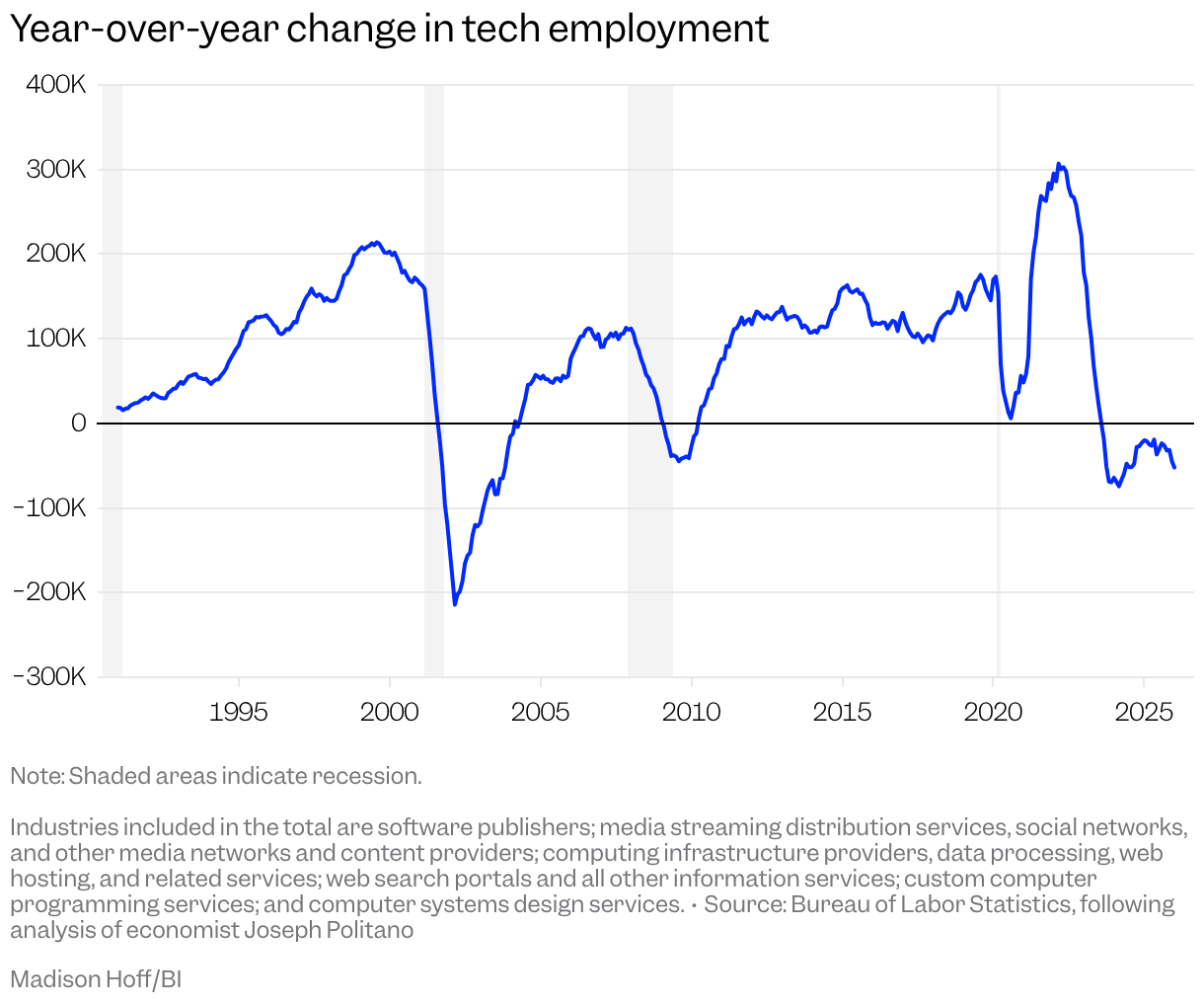
Tech job losses now outpace past downturns in 2008 and 2020, per Politano. Historically, Politano said, the US would usually be adding around 100,000 to 300,000 jobs in tech annually; even when there have been some pullbacks, there’s generally a quick rebound. But not this time.

Line chart of the year-over-year change in tech employment since 1991

Already, Politano said, this moment is clearly and significantly worse for the sector than the 2020 recession, and slightly worse than 2008. He thinks the most apt comparison is to the dot-com bust, although today’s situation still isn’t quite as dire.

“The fact that the only thing that you can compare it to is the worst tech job recession of all time is pretty bad,” Politano said. “The length is really important here. It’s been three years of job losses. It took only about four years for recovery to start from the dot-com bust, for tech to start rehiring at a semi-normal rate again. The fact that we’re now three years into this and it’s actually getting worse is a really big deal.”

Of course, as Cory Stahle, an economist at the Indeed Hiring Lab, notes, it’s not just tech that’s down in the dumps. Manufacturing, which has been cooling for the last couple of years, saw employment fall, as did the government sector. Healthcare, which had been propping up the job market, lost jobs in February, exacerbated by a roughly monthlong Kaiser Permanente strike. “Everything was looking pretty weak by different industries,” Stahle said.

ZipRecruiter economist Nicole Bachaud said February’s losses in tech-related sectors were similar to recent trends. “When we look at information continue to see a decline, and then the professional and business services, a little bit soft, but I wouldn’t say that was necessarily an out-of-place movement for that industry,” Bachaud said. “There’s been a lot of headlines looking at layoffs in tech or big changes at certain employers in tech, but overall, the layoff rate has been very low and stable.”

New college grads who leaned into STEM and other people seeking their first jobs could be especially hard hit by the tech hiring downturn.

“We’ve seen a lot about recent graduates struggling to find jobs,” Stahle said. “You really feel for those people who started studying computer science four or five years ago and were told that, ‘Hey, this is a surefire way to get in the labor market, make a good salary,’ and now we’re seeing just a continuation of this trend of fewer and fewer hires being made in the tech sector,” Stahle said.

The latest job numbers also don’t yet reflect the sweeping layoffs from Block, which excised nearly half its workforce last week. In his announcement outlining the cuts, CEO Jack Dorsey cited AI as a reason, saying that “the intelligence tools we’re creating and using, paired with smaller and flatter teams, are enabling a new way of working.” Some laid-off Block employees were skeptical about AI claims; many told Business Insider that they had already been using AI at work, and didn’t believe it could replace them outright.

Politano said that, in his view, AI is likely behind at least some of the tech labor market’s losses.

“How much of it you want to ascribe is really hard to tell, but I don’t think it’s a coincidence that computer system design is one of the industries that’s losing the most jobs,” Politano said. And, while AI firms are hiring, they’re bringing on far fewer employees than Big Tech behemoths. The types of jobs lost, and the timing of those losses, point, for Politano, to at least some impact from AI.

“We clearly haven’t seen the end of this right now,” Politano said of the future of the tech sector. “I expect that it will be this dribble of bad news for the near term going forward, but I just think that there’s no positive evidence that we’re breaking out of this post-2022 cycle that tech has been stuck in. Until you see that kind of evidence, I think there’s very little chance of a reversal.”

Read the original article on Business Insider