Sundar Pichai has completed a major turnaround in the AI race.
CAMILLE COHEN/AFP via Getty Images
Google’s Gemini 3 AI model has helped fuel a major turnaround for the company.
But it’s not the only thing that has put the company and its stock on an absolute tear.
Its custom chips, antitrust win, and backing from Warren Buffett have all strengthened its position.
Google is on a tear right now — but its success in the AI race wasn’t always guaranteed.
In late 2022, OpenAI captured the moment with the release of ChatGPT. After a number of fumbles as Google struggled to get its own chatbot out the door, some of the closest Google watchers were calling for CEO Sundar Pichai to step down.
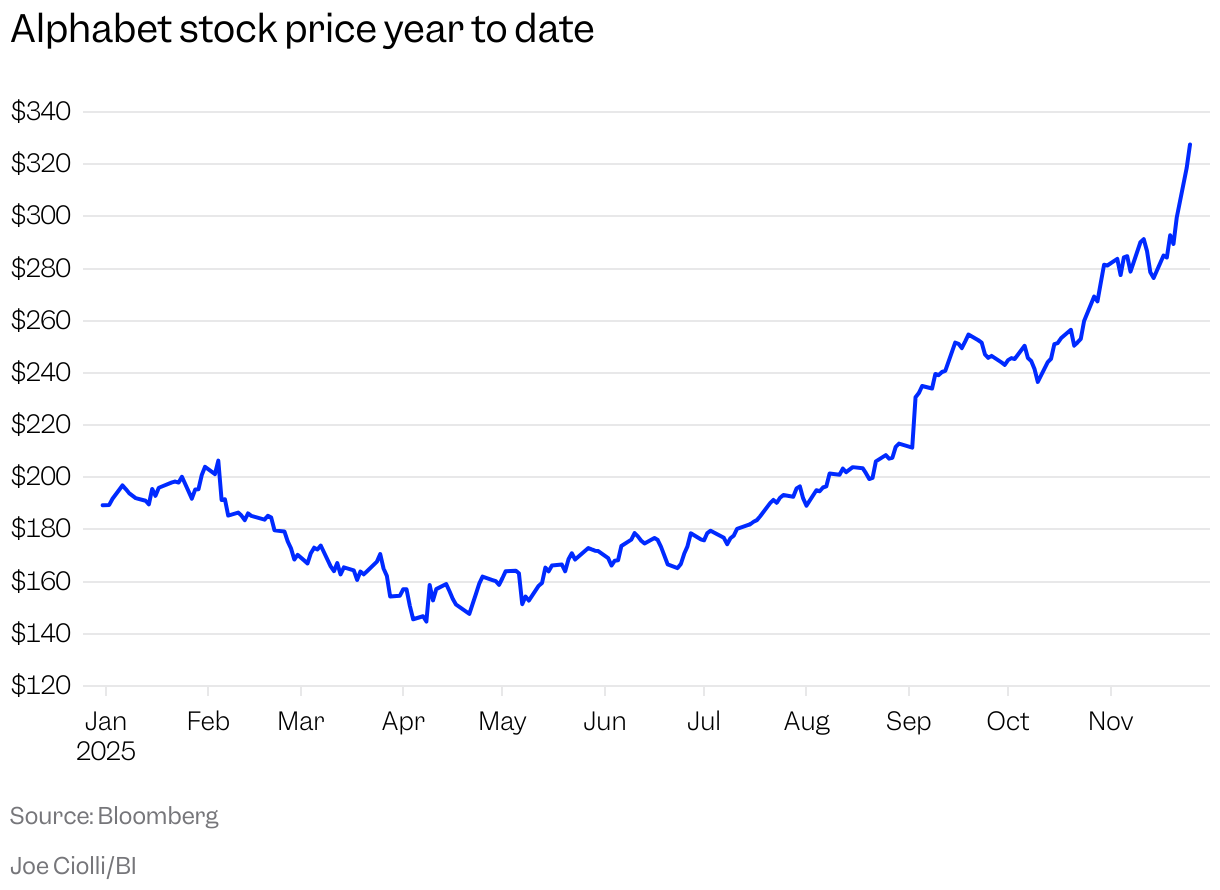
Nearly three years later, Google has performed a miraculous turnaround. Its new AI model, Gemini 3, is proving such a win that Marc Benioff said he’s switching from ChatGPT. Google has just surpassed Microsoft’s market cap and is on its way to a $4 trillion status. Its stock price is up nearly 70% this year.
It’s a signal that Google — which has always held the various pieces to compete — has finally got everything working in harmony, all the way from the models up to the platforms like Search that put them in users’ hands.
In the fast-moving AI race, no victory is secure — but Google has never looked stronger. Here’s why.
1. Gemini 3 is a hit
Google DeepMind CEO Demis Hassabis.
CAMILLE COHEN/AFP via Getty Images
Gemini 3 rolled out to the public last week with rave reviews. It outperforms its predecessor in coding, design, and analysis, and surpasses competing models in benchmark tests. As we at Business Insider discovered, it’s highly adept at designing websites and basic video games, giving it broader use beyond coding.
The new model has allayed some fears that Google was too far behind rivals and that scaling laws — rules that say AI models improve with more data and compute — were slowing down. The company’s stock price has increased by more than 12% since the rollout of Gemini 3 on November 18.
2. When the chips are up
Joan Cros/NurPhoto via Getty Images
Google has spent over a decade developing its own chips for internal use. Known as Tensor Processing Units (TPUs), Google has used these chips to train its Gemini models. That’s a great advertisement as Google hopes more companies will adopt the chips for their own models.
Google sells access to its TPUs through its cloud business and has made a significant internal push in recent months to attract more customers. That could pose a long-term threat to Nvidia’s business. Google is currently in discussions for a blockbuster deal with Meta worth billions of dollars, which would potentially host some of Google’s chips in one of Meta’s own data centers, according to a person familiar with the discussions. The Information first reported on the arrangement, which sent the shares of chip companies like AMD and Nvidia tumbling on Tuesday.
3. Google’s monopoly win
Drew Angerer/Getty Images
In September, a federal judge handed down penalties for an antitrust lawsuit brought against Google’s search business in 2020. Those penalties, which threatened to tear up Google’s lucrative search empire, amounted to little more than a slap on the wrist. Google was told it could continue making payments to partners such as Apple for default status, but could not do so exclusively. It was also ordered to share some search data with rivals.
At one point, Google’s Chrome browser was on the chopping block, which could have severed a crucial part of Google’s search-advertising flywheel. Despite the judge ruling that Google had acted as a monopoly, the company came away relatively unscathed.
4. Warren Buffett takes a stake
Warren Buffett, the CEO of Berkshire Hathaway.
Nati Harnik/AP
Warren Buffett’s Berkshire Hathaway built a $4.3 billion stake in Google parent company Alphabet last quarter, a regulatory filing revealed. That’s notable for two reasons. Other than Apple, Buffett has tended to avoid tech stocks. He has also historically avoided expensive, high-growth companies.
As Buffett prepares to step back as CEO, the decision to finally bet on Google — something he said he wished he’d done long ago — suggests strong confidence in the search giant.
5. Search is surviving its AI makeover… so far
CAMILLE COHEN/AFP via Getty Images
Google’s core moneymaker is still search advertising, and one of the big investor fears has been how Google’s self-disruption might hurt its cash cow. Not a lot, apparently: Search revenues jumped 15% in the third quarter, suggesting that even if AI is hurting some websites’ traffic, it’s not harming Google’s business.
In fact, Google says generative AI is causing people to search more than ever. The company is currently testing ads in AI Mode, its chatbot-like version of search that is gradually feeling like less of an experiment and more like Google’s vision for how search will eventually work.
A 55-year-old health business founder marked his 55th birthday by sharing 55 reasons he feels healthy.
Kevin Dahlstrom’s viral X post promoted quality sleep and strong social connections.
Dahlstrom told Business Insider his health has been his priority since he fell ill in his 20s.
A health founder marked his 55th birthday by sharing 55 reasons he believes he’s his “fittest, sharpest, and happiest” — but you probably only need to follow five to improve your health.
Kevin Dahlstrom, the founder of Bolt. Health, an online testosterone replacement therapy clinic based in Colorado, shared his advice in an X post on Monday. It amassed 4.1 million views and was reposted by Bill Ackman.
In the post, Dahlstrom said that his vitality wasn’t down to a secret formula or winning the DNA lottery, but “a million tiny choices, compounded over decades.”
While factors such as our genetics and environment play a role in how long we live, research suggests lifestyle factors are also hugely important.
Stacy L. Andersen, co-director of the New England Centenarian Study and an associate professor at Boston University Chobanian and Avedisian School of Medicine, boiled Dahlstrom’s tips into five must-follows.
She told Business Insider via email: “These tips point to what has been seen in many scientific studies — healthy behaviors such as maintaining an ideal body weight, keeping moving, eating a high-quality diet, getting enough sleep, and keeping your brain active are the best ways to optimize your aging.
“Moreover, evidence shows that doing all of these together can add 10 years to your life!”
Dahlstrom told Business Insider via email Tuesday that his health and fitness have been a priority since his 20s, when he experienced chronic illness, and the list is a result of what he’s learned over time.
“Birthdays (especially after the age of 50) are a good time to reflect on life,” he said.
Here are five of Dahlstrom’s tips that are science-backed.
1. Walk around 5,000 steps a day
Dahlstrom walks upward of 15,000 miles a week, or approximately 2.5 miles a day. “It’s critical to longevity,” he said.
If you break it down, that adds up to around 5,000 steps a day, half the famous, and arbitrary, 10,000 steps recommendation that originated in a Japanese marketing campaign.
But research does link walking daily to healthy aging. One study published October in the American Journal of Preventive Medicine found that people who walked for 15 minutes a day at a fast pace were 20% less likely to die early.
2. Take exercise and mobility seriously
While Dahlstrom’s recommendation to get “hardcore” about mobility and exercise may not work for everyone, being active is crucial to aging well.
One 2022 study published in the British Journal of Sports Medicine found that of the 99,713 participants aged 55 to 74, those who did regular aerobic exercise and strength training were 41% less likely to die from any cause a decade later.
Business Insider previously reported that making a workout routine fun and talking to close friends and family about it helped people stay consistent for three years in a study.
3. Find your purpose
Andersen said the New England Centenarian Study has shown that longevity is associated with greater feelings of purpose in life, while other studies have found that it is also related to a lower risk of dementia and resilience to Alzheimer’s disease.
“Filling your day with activities that are meaningful to you and having things that you want to accomplish keep you invigorated and engaged in life,” she said. Referring to Dahlstrom’s list she added: “Finding hobbies (#21) and being a lifelong learner (#41) are great ways to also find purpose!”
Keeping active is linked to longevity.
mixetto/Getty Images
4. Get 8 hours of quality sleep each night
Getting enough sleep is crucial for our health. Adults should aim to sleep for between 7 and 9 hours per night, according to the Centers for Disease Control and Prevention.
Anything less can have a negative impact on health over time. In one 2022 study published in PLOS Medicine involving over 10,000 British civil servants, those who reported getting less than five hours of sleep a night at the age of 50 had a higher risk of developing chronic diseases, such as cardiovascular disease and cancer, and dying from long-term health conditions.
5. Stop drinking alcohol
Drinking alcohol regularly increases your risk of chronic disease and impacts almost every organ in the body. Experts increasingly agree there is no safe amount to drink.
The previous US Surgeon General, Dr. Vivek Murthy, published a report in January 2025 warning of the links between alcohol and cancer risk.
Don’t blindly follow health advice online
Some of Dahlstrom’s tips aren’t in line with evidence-based health advice, for instance: “avoid mainstream medicine except as a last resort” and “don’t take antibiotics except in emergency situations.”
Dr. Kurt Hong, a professor of clinical medicine at the University of Southern California, told Business Insider via email that while antibiotic overuse is “very real” and can impact the gut microbiome, patients only using them in situations they deem an “emergency” is “dangerous.”
Hong added that while functional and integrative health can be helpful, one should not avoid mainstream medical practices such as preventive care, cancer screenings, and vaccinations. “This is a dangerous recommendation by the author,” he said.
And while research indicates psychedelic drugs could be used to treat chronic mental illness in a controlled, clinical setting, Hong said Dahlstrom’s recommendation to “try psychedelics” is dangerous, particularly for patients with mental health issues, which can be worsened with psychedelics, such as PTSD, depression, and bipolar.
Dahlstrom’s said: “I believe that everyone should take responsibility for their own health and make their own decisions. The mainstream medical system is fantastic for acute illness and injury, but equally bad at chronic illness.”
Comacchio offers Venice-like canals and charm without the crowds or overtourism issues.
The town features tranquil lagoons, pink flamingos, and eel cuisine.
This article is part of “Undiscovered Europe,” a series exploring overlooked travel gems.
Roughly 20 million tourists visit Venice, Italy, each year, shuffling shoulder to shoulder over tired bridges, crowding alleyways lined with souvenir shops, and snapping selfies from gondolas in congested canals.
Enter Comacchio — an Italian city less than two hours away with a similar landscape and vibe that most tourists have yet to discover.
Comacchio
Max Cavallari for BI
Like Venice, Comacchio is made up of islands, where you’ll find canals rather than streets and historic, colorful buildings lining the waterways. But unlike Venice, this floating city is a hidden gem.
“It’s a very relaxed, frozen-in-time atmosphere,” Bologna-based blogger Andrea Chierici told Business Insider. “It’s a place that is calm with no crowds, no noise, and no big groups with the umbrellas.”
Historic lagoons home to pink flamingos
A flamingo in Delta po Park
Max Cavallari for BI
The proximity to Po Delta Park — which includes the Comacchio Lagoons, one of Italy’s largest wetland complexes, according to Po Delta Tourism — is one of many reasons to visit Comacchio. The park is part of a protected biosphere reserve and a UNESCO World Heritage site. A representative of the locally owned tour company, Comacchio Experience, said it’s a must-see for visitors.
“You can imagine the lagoon like a big lake, so you cannot see the horizon on the other side of this lagoon, but it’s not totally water,” the representative told Business Insider. “Inside the water, we have a lot of banks and houses of ancient fishermen.”
Delta po Park
Max Cavallari for BI
You’ll find many waterbird species in Po Delta Park, including the pink flamingo. Both experts recommend taking a walk, bike ride, or boat tour of the lagoons.
The representative of Comacchio Experience also recommends relaxing at the area’s wild beaches, which haven’t been taken over by tourists.
“This is a very different experience because in Italy, we have a lot of beaches, but there are umbrellas everywhere and loud music,” he told Business Insider. “But here, you can find a quiet and very free place.”
Eels are a seasonal delicacy
Stewed eel and marinated anchovies: the three dishes that characterize Comacchio’s cuisine.
Max Cavallari for Bi
“If you like food, the main reason to go to Comacchio is the eel,” Chierici said.
The eel is a historic delicacy in Comacchio, celebrated with annual festivals.
“The original food of Comacchio, the eel, is a prehistoric fish that comes here naturally, and we’ve fished for 1,000 years,” the Comacchio Experience rep said. “This fish is so important because it was the only economy here until the last 70 years.”
Interior of Al Cantinon restaurant
Max Cavallari for BI
The eel is a seasonal food that’s fresh in the fall but is preserved to eat all year long. Chierici said that the town has a fishing system that allows all of the smaller eels to go free.
“We keep the life cycle of the eel alive, which is very important because they make a long trip to come to Comacchio,” he told Business Insider. “They come from the Sargasso Sea to the unique landscape of the Po Delta Valley, especially near Comacchio, to reproduce.”
Chierici said that restaurants around town serve eel in various ways — from grilled entrées to sandwiches and risottos.
Nearby places
Comacchio
Max Cavallari for BI
Comacchio is conveniently located about an hour away from many other historical cities, like Ravenna, Bologna, and Ferrara, making it a great base for a longer trip to Northern Italy, the Comacchio Experience representative said.
Within a half-hour drive, Chierici also suggests visiting Pomposa and Tresigallo for entrancing architecture.
6 things to do in Comacchio
Take a sunset boat tour. Both experts say the best way to explore Comacchio is by boat. According to the Comacchio Experience representative, sunset is the best time to go.
Go bird watching at Po Delta Park. Chierici suggests taking a bird-watching tour to find pink flamingos in the lagoon.
Tour the eel factory. Chierici suggests touring theManifattura dei Marinati to see how eel is marinated and preserved.
Try eel in all its forms. Eel is prepared various ways in Comacchio. Try it at one of Chierici’s favorite restaurants: Vasco e Giulia, La Barcaccia, and Al Cantinon.
Attend the fall food festival. Both experts suggest visiting in the fall to attend the annual Sagra dell’Anguilla, a food festival celebrating the eel.
Visit nearby cities and towns. Both sources say it’s worth visiting nearby places like Tresigallo, Pomposa, Ravenna, Bologna, and Ferrara.
And if you must go to Venice, it’s just an hour and a half away.
Business Insider’s reporter expected an Instagram-like backpacking adventure in Europe, but the reality was much less glamorous.
Joey Hadden/Business Insider
I spent two weeks backpacking through Europe for the first time in October 2022.
I found that it wasn’t the glamorous, romantic adventure it often looks like on Instagram.
While backpacking, I was disappointed by overnight train rides and crowds of tourists in each city.
Epic photos of backpackers posing in otherwise empty cityscapes and natural scenes are all over Instagram. The captions often say something about life being an adventure.
But traveling with just a backpack never appealed to me before 2022. There were always too many layers, shoes, and baseball caps I wanted to pack.
Since I began taking more trips as a travel reporter for Business Insider four years ago, I’ve realized I needed to lighten my load to make it easier to hit the road for longer periods.
I prioritized the minimalist travel style in August 2022, when I spent a week backpacking for the first time through Eastern Canada. It turned out to be much easier — and more efficient — than I’d originally thought.
So, when I planned a two-week train trip through four European countries two months later, I pushed myself to fit everything I needed into my backpack again.
I spent two weeks backpacking across Germany, Austria, Italy, and Switzerland while exploring the cities of Berlin, Vienna, Venice, Rome, Milan, and Zurich. It was my first time visiting each country and backpacking in Europe.
I slept in shared train cabins and budget Airbnbs, and initially, I felt like I was living the life of young adults on a gap year. But I quickly realized it wasn’t as glamorous as I expected it to be.
After backpacking Europe, I found that the travel style was full of hardships I rarely see posts about.
First, I found that my biggest backpack couldn’t squeeze in all the clothes I wanted to bring.
Everything the author packed for her two-week trip to Europe.
Joey Hadden/Business Insider
I picked my largest bag — a 32-liter backpack — for my trip to Europe.
I wasn’t sure how well this bag would work for a two-week trip, so I practiced packing as lightly as possible to ensure I could fit everything.
I started with my essential work gear — a laptop, cameras, lenses, and a notebook. Then, I packed chargers, toiletries, and snacks before realizing my work gear and other essentials were taking priority over clothes.
I hoped to bring two packing cubes full of clothing, but I could only fit one. This cut my proposed wardrobe in half.
I ended up packing two polos, one T-shirt, one long-sleeve T-shirt, three pairs of pants, a sweater, a blazer, a dress, and two light jackets.
Although I impressed myself by packing lighter than ever while still having everything I needed for the longest trip I’d ever taken, I couldn’t help feeling disappointed in my limited outfit choices.
Because I could only bring a few garments, I had to do laundry at nearly every accommodation.
The authors laundry in Germany (left), Austria (top), and Italy (bottom).
Joey Hadden/Business Insider
I’ve never seen a backpacking social-media post about doing laundry, but I found myself washing my clothes at nearly every Airbnb I stayed in.
I stayed in each accommodation for just one or two nights, so to ensure my clothes would be dry before checking out, I had to prioritize doing laundry as soon as I checked in.
I brought my own laundry soap and used sinks and bathtubs to wash each garment before hanging them up to dry.
This was a bummer since I often arrived at each accommodation feeling exhausted from travel, and washing my clothes was the last thing I felt like doing.
Coming home to tiny Airbnbs with wet clothes everywhere stressed me out after a day of exploring.
The author’s messy accommodations in Austria (L) and Germany (R).
Joey Hadden/Business Insider
From a converted wine barrel outside Zurich to an Airstream trailer in Vienna, most of my Airbnbs were tiny homes with less than 100 square feet of space. So, the slightest bit of clutter made them look like a total mess. Having my clothes hanging to dry made the spaces feel even more chaotic.
Each time I returned to my accommodations, I was greeted with a disheveled space that made me feel stressed out. Since I’d worked hard to keep my apartment looking spotless at home, I wasn’t used to living in a cluttered space. I found it hard to relax in these rooms after tiring days of exploring.
I thought a sleeper train would be a smart way to arrive in new cities and maximize my time, but these shared cabins felt cramped and uncomfortable.
The author rides a Nightjet sleeper train in Europe.
Joey Hadden/Business Insider
I booked two overnight trains during my trip to free up daylight hours for exploring.
But I didn’t anticipate how challenging it would be to get a good night’s rest in a small, shared space.
To get from Vienna to Venice, I booked a bunk in a shared cabin on an overnight train run by the Nightjet rail line, which operates overnight routes between Austria, Italy, France, and the Netherlands.
Since I booked a shared room with up to five others, I expected to feel slightly cramped, but I still thought I’d have some space to move around the room.
However, the 74-square-foot cabin didn’t feel like enough space for myself and the other travelers, especially with everyone’s luggage. Our cabin only had four people in it, and I thought it would have been even more uncomfortable had it been fully booked with six people.
There was space for bags above the beds, but not enough for everyone. I couldn’t do much more than sit in my bunk and quickly became disappointed by my choice to travel this way.
I was also surprised by the lack of privacy inside the shared bunk cabin on the train.
The author’s shared sleeper cabin on an overnight train from Austria to Italy.
Joey Hadden/Business Insider
Before my trip, I imagined each bunk in the shared cabin on the sleeper train would have a curtain for privacy. However, the beds were completely exposed, so I had to go to the bathroom to change into my pajamas privately.
I also had to wake another traveler using the top bunk in the middle of the night to use the bathroom since the room’s lock was only accessible from their bunk.
After this experience, I don’t think I’ll ever bunk with strangers on an overnight train again, especially since some Nightjet routes have private cabins.
“Offering our passengers a high level of travel comfort is an important concern for us,” a representative for OBB Nightjet told Business Insider. “We are constantly working on improvements to our product and also take into account the requirements of our customers.”
My experience was even worse on the other overnight train I took, where I booked a regular seat and didn’t sleep at all.
The author restless on an overnight train from Germany to Austria.
Joey Hadden/Business Insider
On my other overnight train from Berlin to Vienna, I had an even harder time sleeping. I sat in a seating carriage room with six seats facing each other, which is Nightjet’s version of standard coach seating.
During my leg of the journey, three travelers were already there when I boarded, and two others arrived within the first few hours. Right away, I thought the room was cramped and lacked enough legroom for each traveler.
The seat appeared slightly wider than a typical train coach seat, with two cushions. It also reclined, though not fully. I reclined mine as much as possible, but I thought the gap between the seat back and the bottom of the seat made it tough to get comfortable.
When I tried to sleep, I found it impossible with the constant bumps on the ride and so many people around. I ended up staying up until the morning and regretted traveling overnight.
“The quality of travel depends not only on the carriages but also on the route,” OBB Nightjet wrote in a statement to Business Insider. “We recommend the sleeper or couchette car for night travel. There is enough space to stretch out. Seated carriages are recommended for shorter journeys.”
While some influencers might like this type of travel, I’ll stick to daytime routes next time if I can’t sleep flat on a bed in a private room.
I often arrived in each country feeling exhausted from lack of sleep, which made it harder to enjoy my time in each place.
The author arrives in Vienna.
Joey Hadden/Business Insider
Because I had so much trouble sleeping on both overnight train rides, I often arrived in a new city feeling depleted instead of excited and ready to start exploring.
When I got to Vienna at 7 a.m. after a sleepless night in the seating carriage, I was so exhausted that I looked for any hotel that would take me in so early in the morning. I thought this made the overnight ride ultimately not worth the time saved, since I didn’t do anything when I arrived other than sleep.
When I got off the train in Venice, I had enough energy to explore since I had gotten some sleep in the bunk, but I still felt fatigued, and it took away from how much I could enjoy that first day.
As a result, my first day in both cities felt disappointing, and my plan to save time and energy backfired. I couldn’t help thinking I wasted two days that could have been spent feeling more appreciative of the city surrounding me had I gotten enough rest.
In fact, a lot of my trip was more physically draining than I anticipated because my backpack made my body sore.
The author sores her back from carrying her bag.
Joey Hadden/Business Insider
On travel days, I had to carry my backpack for long periods. I wore it on the go to catch my train. When I arrived in a new city, I had to keep it on my back until I could check into my accommodation. And then, I’d repeat the entire process when I checked out before catching a train to my next destination.
Each day, after wearing my backpack while walking for extended periods, my muscles felt incredibly sore.
In these moments, I was surprised to find myself questioning if a backpack really is more convenient than a carry-on suitcase. Sure, a carry-on suitcase is larger and often needs to be wheeled around, but after lugging around my backpack all day, I felt it would have been easier and better for my body. Plus, I’d be able to pack more.
Large crowds made having a backpack even harder. I thought traveling in October — the end of shoulder season — would help me avoid this, but I was wrong.
Narrow alleys were filled with people in Europe.
Joey Hadden/Business Insider
In most photos of backpackers I see on Instagram, it looks like they’re completely alone in a dramatic scene, whether it’s a scenic landscape or a major tourist attraction.
However, even though I visited during the shoulder season, this was not the case. From Rome to Zurich, I trudged through places that were overrun with tourists.
Throughout my trip, I stood on tippy toes to see popular historic sites above rows of heads obscuring my view. Even getting just one photo of myself at tourist hot spots, like the Colosseum in Rome, felt nearly impossible. And since I’m 5-foot-3, I found it hard to see over the heads and smartphones of the people around me.
I also wasn’t used to the weight and size of my backpack, which made it challenging to get around. In crowded spaces, I kept forgetting that the backpack made me about a third larger than I typically am. I bumped into people with my pack in busy streets and train stations before realizing I needed to reconsider how I was taking up space.
Next time I plan a trip to Europe, I’ll visit in the offseason for fewer crowds.
While it wasn’t a picture-perfect adventure, backpacking through Europe made me realize that you can’t plan out every second, and maybe that’s a good thing.
The author backpacks in Europe.
Joey Hadden/Business Insider
While there were a handful of hardships, backpacking in Europe was also full of good surprises.
For example, I initially thought seeing so many new places in a short time would make them blend together in my mind, but each city felt genuinely unique and left me with distinct memories. And without my backpack, I probably wouldn’t have been able to travel to as many places in one trip.
I’ll never forget how alive Berlin felt with its lush pockets of greenery, dramatic murals, and street performers, or how Vienna’s garden mazes and fairy tale architecture made me feel like royalty — even with a turtle shell on my back.
Ultimately, I thought the good surprises outweighed the bad, so I would definitely backpack in Europe again. But next time, I’ll avoid shared accommodations, overnight rides, and the busy season.
Walt Disney Animation Studios started as the Disney Brothers Cartoon Studio in 1923.
Since then, the studio has produced over 50 fully animated, theatrically released films.
“Zootopia 2” is set to be released on November 26.
Walt Disney Studios has come a long way since its inception in the 1920s, when two brothers, Walt and Roy Disney, began animating an impish mouse named Mickey.
Now, Disney is one of the largest movie studios on the planet and controls properties such as “Star Wars,” Marvel, Pixar, “Planet of the Apes,” and more.
But first and foremost will always be Disney Animation. Since its first feature-length animated movie was theatrically released in 1937, Disney has been the gold standard for animated films.
Business Insider used Rotten Tomatoes’ critics’ scores to rank every one of the studio’s fully animated films — that means no “Fantasia,” “Mary Poppins,” or “Song of the South,” which have live-action components. This list also does not include movies like “A Goofy Movie” and “Return to Never Land,” which were produced by a division of the company, Disney MovieToons.
The scores were accurate as of November 2025, prior to the release of “Zootopia 2.”
Here’s how the animated Disney films stack up against each other from worst to best.
Based on the folk tale of the same name, “Chicken Little” is about a fearful little chicken who becomes convinced the sky is falling. While the adults in his life dismiss him, it becomes clear that something is certainly afoot in his small town.
“When Disney can’t hit a tried-and-true fairy-tale adaptation out of the park, maybe it’s time to give up the ghost and get Pixar back on the phone,” wrote the Orlando Sentinel’s Roger Moore.
After the success of the studio’s 1999 movie “Tarzan” and its soundtrack, which featured Phil Collins, Disney attempted to recapture that magic with “Brother Bear,” a story of brotherly love that also included Collins’ music.
However, Nell Minow of Common Sense Media called this film a “lackluster story only for kindergarteners.”
“Wish” is filled to the brim with Easter eggs referring to Disney’s 100 years of magic, but the studio seems to have forgotten to add a compelling story, lovable characters, or well-written songs.
Asha had the potential to be an all-time Disney princess, but the rules of this universe are confusing, and Magnifico’s heel turn seemingly comes out of nowhere.
“This fairy tale feels more like a corporate product than a magical event; it’s a limp dissertation on Disney’s motto that, ‘When you wish upon a star, your dreams come true,'” wrote The Boston Globe’s Odie Henderson.
There’s not a cute animal sidekick or a show tune to be found in “Atlantis.” Instead, Milo, a passionate archaeologist, unwittingly exposes the people of Atlantis to the corporate greed of the surface world in this slightly depressing story.
“It’s so oppressively tedious at times that you almost wish the cast would break into a chorus of ‘Under the Sea,'” wrote Lou Lumenick for The New York Post.
“Home on the Range” is a simple story of three cows who decide to take matters into their own hands (hooves?) to save their farm by collecting a bounty put on the head of Alameda Slim, a cattle rustler and thief.
Richard Roeper called it “a serviceable time-killer” on “At the Movies.”
This cartoon is a loose adaptation of the Charles Dickens story “Oliver Twist,” but instead of a down-on-his-luck orphan, Oliver is an adorable stray kitten.
For most people, this is remembered as the Disney movie with songs by Billy Joel.
“With its captivating characters, sprightly songs and zap-happy animation, ‘Oliver & Company’ adds up to a tip-top frolic,” wrote Peter Travers for People.
“The Black Cauldron” is based on Welsh mythology — hence why characters have names like Princess Eilonwy and Fflewddur Fflam. It tells the story of a teenager named Taran who longs to become a hero. He gets his chance when he sets out to prevent the Horned King from using the Black Cauldron to raise an evil army.
“This is the 25th full-length animated feature from Walt Disney studios, and professionally put together as it is, many of the ingredients may seem programmed to those who have seen some of the others,” wrote Walter Goodman of The New York Times.
Pocahontas was a real Native American woman. but her life did not follow the fairy tale story put forth by Disney. No matter how good “Colors of the Wind” is, this film is flawed and best left in the past.
“All Disney has really done in its disappointing 33rd animated feature is revive the stereotype of the Noble Savage,” wrote Rita Kempley for The Washington Post.
In this version of the classic tale, Robin Hood and Maid Marian are foxes, his best friend Little John is a bear — who looks suspiciously like Baloo from “The Jungle Book” — and the dastardly Sheriff of Nottingham is a wolf.
“The washed-out, muted colors are a mistake, and if Robin Hood is sometimes hilarious, it has little memorable magic,” wrote Alan R. Howard of The Hollywood Reporter.
You’ll find “Moana 2’s” predecessor much higher on this list.
“Moana 2” sees the return of Moana, a newly minted wayfinder, as she tries to reconnect the people of her island, Motunui, with their ancestors from other islands. To do this, she reunites with demigod Maui on a new adventure across the sea.
“Much like the hermit crab who kicks things off by attempting to trade in his new shell for an ill-fitting larger one, there’s simply not enough to fill out ‘Moana 2,'” wrote Andrea Thompson for the Chicago Reader.
“The Aristocats” is essentially the tale of “Lady and the Tramp,” but this time with cats. Duchess, a pristine cat and mom of three precocious kittens, meets the alley cat Thomas O’Malley and falls in love.
“Before the disastrous aughts, was there a worse decade for Disney animated features than the 1970s?” asked Matt Brunson of View From the Couch.
“Dinosaur” is the story of Aladar, a dinosaur who was orphaned and then raised by lemurs. Aladar and his adopted family join up with other dinosaurs to find a safe place after a natural disaster devastates their home.
If this sounds just like the other animated dinosaur film, “The Land Before Time,” to you, you’re not alone.
Michael Sragow of Salon wrote, “Well, Bambi meets Godzilla again in the new computer-cartoon epic ‘Dinosaur,’ but the results aren’t so witty.”
Notably, this was the last Disney film to be released before Walt Disney’s death in 1966.
“The Sword in the Stone” is King Arthur’s origin story — he meets legendary sorcerer Merlin and pulls out Excalibur, the sword lodged inside the stone.
‘There is still some life in the characterizations, though the animation is turning stiff and flat,” wrote Chicago Reader’s Dave Kehr.
In “Meet the Robinsons,” Lewis is desperate to find his birth mother, who gave him up for adoption. Instead, he’s brought to the future by the mysterious Wilbur, who claims he’s a time cop.
“Charming as all these surface layers are — and even in 2D, it’s more than passable family fare — ‘Meet The Robinsons’ really flowers with the extra dimension, which makes an already neato cinematic universe feel palpably inhabitable,” wrote Scott Tobias for the AV Club.
“Treasure Planet” updates the setting of the famed pirate story “Treasure Island” to the future. Instead of hitching a ride on a pirate ship, Jim Hawkins hops on a spaceship — and instead of looking for buried treasure, Jim and his friends are searching for a missing planet made entirely of treasure.
“Akin to an extremely well-made Saturday morning cartoon — great for hyperactive four-year-olds or hungover students, not worth a trip to the pictures,” wrote Nev Pierce for the BBC.
Not even the A-list voice talent of Jake Gyllenhaal, Dennis Quaid, Jaboukie Young-White, Gabrielle Union, and Lucy Liu could save this movie — which isn’t bad! — from flopping.
“Strange World” is about the Clades, a family of legendary explorers who must venture into a subterranean world to see if they can save their planet.
“So much of ‘Strange World’s’ audaciousness is front-loaded into its concept, and so little of it comes through in the execution,” wrote Alison Willmore for Vulture.
“The Fox and the Hound” is one of the rare Disney movies that doesn’t have a totally happy ending. Tod, a fox, and Copper, a bloodhound, meet when they’re young and become best friends. But when they grow up, they learn they’re natural enemies.
It ends on a bittersweet note, as the two friends acknowledge that they probably won’t see each other again, but are at peace in the forest.
“All charmingness aside, this cute but rather thinly plotted yarn exposes the cracks that were present in the pre-renaissance Disney empire,” wrote William Thomas of Empire.
“Frozen II” picks up soon after where “Frozen” left off — Elsa is now queen and in control of her ice powers, Anna and Kristoff are in love, and Olaf is just happy he’s not melting.
But when Elsa begins to hear a mysterious voice calling out to her, our characters leave Arendelle behind to discover the source of Elsa’s power.
“The songs, perhaps not as compelling as in the original, still make the heart beat faster now and then,” wrote Stephen Romei for The Australian.
“Peter Pan” is based on the 1904 play of the same name by J.M. Barrie.
In it, the Darling children are whisked away to Neverland, a magical world where children never grow up, fairy dust lets you fly, and an evil captain with a hook for a hand terrorizes the seas.
But Neverland is also home to Tiger Lily and her tribe, who are drawn in the most stereotypical way possible — so much so that Disney has added an apology before the film plays on Disney+.
“It is still a lush, bright feature that happily clicks along with rollicking songs by Sammy Cahn, Sammy Fain, and others,” wrote Dolores Barclay for the Associated Press.
In this story, Basil and Dawson are the mice stand-ins for Sherlock and Watson, while Professor Ratigan (a rat) is based on Sherlock’s arch-nemesis Professor Moriarty.
“‘The Great Mouse Detective’ reflects the energy and enthusiasm of a talented group of young artists stretching their wings for the first time,” wrote Charles Solomon for the Los Angeles Times.
“The Rescuers” focuses on Bernard and Bianca, two mice who are sent to help Penny, a young orphan who has been kidnapped by the evil Madame Medusa, who plans to use her to steal a precious jewel.
“Although not one of the studio’s classics, it has warmth, humor and delightful characterization,” wrote Victoria Mather for The Daily Telegraph.
Based on the 1831 Victor Hugo novel of the same name, “Hunchback” centers on sweet Quasimodo, a physically deformed man who is orphaned after the villainous Judge Frollo murders his mother.
To atone for his sins, Frollo adopts Quasimodo but keeps him hidden atop Notre Dame’s bell tower. But when Quasimodo catches sight of Esmeralda, he vows to enter the world below.
“You’re quickly won over by the movie’s subversive wit, swept along by its narrative bravado and its enormous visual energy. This new ‘Hunchback’ is a triumph on its own terms, and on any other terms that might come to mind.” wrote Joe Morgenstern of The Wall Street Journal.
“Hercules” is a loose re-telling of the Greek myth of the hero Heracles. After getting kidnapped and turned (almost) mortal by Hades’ henchmen, Hercules goes on a quest to prove to his father, Zeus, and the rest of the gods that he’s worthy of immortality and godhood.
“Jumps into the ancient legends feet-first, cheerfully tossing out what won’t fit and combining what’s left into a new look and a lighthearted style,” wrote Roger Ebert.
Based on Lewis Carroll’s 1865 novel “Alice’s Adventures in Wonderland,” this adaptation follows Alice as she falls down the rabbit hole and meets unforgettable characters like the Cheshire Cat, the Mad Hatter, Tweedledee and Tweedledum, and the Queen of Hearts.
“If you are not too particular about the images of Carroll and [illustrator John] Tenniel, if you are high on Disney whimsy, and if you’ll take a somewhat slow, uneven pace, you should find this picture entertaining,” wrote Bosley Crowther for The New York Times.
At the time, “The Rescuers” was one of Disney’s most popular films (even if its reputation has been somewhat diminished since its release in 1977), which is why our two favorite mice, Bernard and Bianca, returned for this film — the first sequel ever theatrically released by Disney.
This time, Bernard and Bianca are sent to Australia by the Rescue Aid Society to help a young boy who’s been kidnapped.
“A gorgeously drawn myth made for plucky children and very brave mice,” wrote The Washington Post’s Rita Kempley.
“The Princess and the Frog” updates the setting of the Brothers Grimm fairytale “The Frog Prince” to 1920s New Orleans. Tiana is a determined young woman who wants more than anything to open her own restaurant.
When she kisses prince-turned-frog Naveen to revert him back to humanity, the opposite happens: Tiana turns into a frog, too.
“This has a lot to commend it, and it isn’t just nostalgia for the Disney past. It’s a visual treat,” wrote The London Evening Standard’s Derek Malcolm.
In “The Emperor’s New Groove,” David Spade stars as Kuzco, the self-absorbed, clueless Incan emperor, who is turned into a llama by his evil advisor Yzma, who wants to steal the throne for herself. To get his throne back, Kuzco must team up with the kindly peasant Pacha, whose house he has marked for destruction.
CNN’s Paul Tatara called Kuzco’s tale “a silly little movie that’s smarter than most of the self-important features that came out this year.”
Newly orphaned sisters Lilo and Nani are struggling to adjust to their new normal when Lilo adopts Stitch, a rambunctious alien who she thinks is just a weird dog. When two agents of the Galactic Federation come looking for Stitch, chaos erupts on Kauai.
“It’s one of the most charming feature-length cartoons of recent years — funny, sassy, startling, original, and with six songs by Elvis,” wrote Roger Ebert.
“Wreck-It Ralph” is the story of Wreck-It Ralph, the villain in the classic arcade game “Fix-It Felix Jr.” But when Ralph is sick of being the bad guy in everyone’s story, he goes on an epic journey visiting other video games to become a hero.
“‘Wreck-It Ralph’ is a must-see for anyone who grew up playing 1980s arcade games — and their kids will love it too,” wrote Larushka Ivan-Zadeh for Metro UK.
This film is based on the Rudyard Kipling book of the same name, published in 1894 — and was the last film Walt Disney himself worked on. He died during its production.
It’s the simple story of Mowgli, an orphaned human raised by wolves. But when it becomes clear that the evil tiger Shere Khan will stop at nothing to kill Mowgli, a panther named Bagheera and a bear Baloo agree to take Mowgli back to the human village he came from.
“It’s a slight tale, of course, and incredibly short, but the characters and songs are pretty much perfect viewing time and again,” wrote Empire’s Ian Nathan.
Six years after “Wreck-It Ralph,” in which Ralph discovers that even though he’s a villain in his game, he doesn’t have to be a bad guy; he’s on another adventure with his friend Vanellope. This time, our duo heads to the internet to find a part that’s needed to fix Vanellope’s game, “Sugar Rush.”
“‘Ralph Breaks the Internet’ works because it doesn’t pander, and it doesn’t simplify,” wrote Brian Tallerico for RogerEbert.com.
22 (tie). “The Adventures of Ichabod and Mr. Toad” (1949)
Running at just 68 minutes long, this is an anthology film. First up is “The Wind in the Willows,” which is the story of J. Thaddeus Toad, who is trying to save his home from bankruptcy.
The second story is “The Legend of Sleepy Hollow,” in which Ichabod Crane arrives in Sleepy Hollow and is stalked by the terrifying Headless Horseman.
Chicago Reader’s Jonathan Rosenbaum called this film “engaging and lively.”
“Tangled” is a classic Disney princess film, but made with modern 3D animation, a first for the studio. It tells the tale of Rapunzel, a teenager with magical hair who longs to see the world outside her tower — and when the charming thief Flynn Rider happens upon her home, she seizes the chance to break free.
“If this is what old-fashioned means, then bring it on,” wrote Derek Malcolm of The London Evening Standard.
While it doesn’t seem like it now, a Disney princess story where the true love story is between two sisters was groundbreaking. Add in some of the catchiest songs ever written by the House of Mouse and a lovable (if somewhat grating) snowman, and you have one of the studio’s biggest and most beloved films, raking in more than $1.3 billion at the worldwide box office.
“‘Frozen’ feels like it’s breaking new ground in telling a story where the women are actually in control, and where the clichés of their narratives are turned inside out, almost as a sly commentary on what has come before,” wrote Jason Bailey for Flavorwire.
Based on the 1912 novel “Tarzan of the Apes” by Edgar Rice Burroughs, “Tarzan” tells the story of the titular character being raised by apes after his parents are killed. Although he feels out of place, he doesn’t know any different until Jane and her crew of explorers arrive at Tarzan’s jungle and begin to show him a different way.
“Tarzan” is a fun time at the movies, but its lasting legacy is the multiple songs on the soundtrack written and performed by Phil Collins.
In June 1999, Peter Stack of The San Francisco Chronicle called it “so far, the most entertaining film of the year.”
For all the talk about how poorly this relationship has aged — sure, it’s true love’s kiss, but can someone under a sleeping curse really consent? — this movie is a wonder to look at. Maleficent, the evil witch, remains a high point of Disney’s character designs.
“‘Sleeping Beauty’ is a masterpiece. In my opinion, it’s not just the best animated film to ever come out of Walt Disney Studios, but it is also the finest animated motion picture I’ve ever seen, period,” wrote Sara Michelle Fetters for MovieFreak.
In the 16 years since its release, it seems like “Bolt” has been somewhat forgotten. But it’s fun! It stars John Travolta as the voice of Bolt, the star of a hit TV series who doesn’t realize his superpowers on the show aren’t real. When he believes his owner is kidnapped — but really, it’s just a cliffhanger in the show — he embarks on a cross-country journey to rescue her.
“While it may lack a certain amount of bite, there’s plenty of bark to recommend this winning animated adventure,” wrote The Sydney Morning Herald’s Eddie Cockrell.
Everyone’s favorite honey-loving bear, who starred in 1977’s “The Many Adventures of Winnie the Pooh,” returned to the big screen in “Winnie the Pooh.”
This time, Pooh and the rest of the Hundred Acre Wood crew team up to save Christopher Robin from a monster they’re calling the Backson — in reality, Christopher Robin is just at school and will be “back soon.”
“It’s a pleasure to sink into an animated family movie from Disney that radiates charm with a gentleness that seems damn near revolutionary,” wrote Peter Travers for Rolling Stone.
After years of criticism regarding its Disney princesses and their lack of agency, audiences were given Mulan, a young woman who secretly takes her father’s place in the Chinese Imperial Army by disguising herself as a boy.
Mulan is a warrior through and through. No one could ever call her a typical damsel in distress.
“Overall, this is a lovely film, ranking with the best of Disney’s animated features while taking on rather serious issues of war, honor, gender roles and family pride,” wrote Moira MacDonald for The Seattle Times.
“Bambi” is a straightforward story about a young deer growing up in the forest and learning how to protect the forest creatures from hunters known only as Man.
The New York Times’ Theodore Strauss wrote, “In colors that would surprise even the spectrum itself, Disney’s cartoon craftsmen have re-created a woodland that shimmers and glows and darkens altogether magically.”
“Lady and the Tramp” is another Disney film that now comes with a disclaimer due to the problematic nature of its two Siamese cats, Si and Am.
If you’re able to move past that, though, “Lady and the Tramp” is simple and sweet. Lady is a dog who’s barely left her house, but due to a misunderstanding, she ends up on the street and meets the stray Tramp.
Their spaghetti kiss is still being referenced to this day.
“The quintessential American love story — the one between the spoiled heiress and the spontaneous, fun-loving guy from the wrong side of the tracks — has seldom been more elegantly and entertainingly told,” wrote The Chicago Tribune’s Dave Kehr.
Disney went through a rough period in the ’70 and ’80s — when “The Little Mermaid” was released in 1989, it was a return to form for the studio. It’s a classic love story with beloved songs like “Part of Your World,” “Under the Sea,” and “Kiss the Girl.”
“‘The Little Mermaid’ — impudent, grandiose, a multilevel crowd-pleaser — almost returns the Disney animated features to their glory traditions of the ’30s and ’40s,” wrote the Los Angeles Times’ Michael Wilmington.
“Encanto” is about the Madrigal family, who each receives a magical power when they turn 5 — all except Mirabel, who was mysteriously skipped over. When the magic in their home starts failing, Mirabel makes it her mission to save her family, powers or not.
“You will be humming ‘Welcome to the Family Madrigal’ — expositional but infectious — all the way home. The characters are infectious, too, and well-drawn, enriching ‘Encanto’s’ world with gifts that extend far beyond their bestowed powers,” wrote Time Out’s Whelan Barzey.
“The Lion King” combined breathtaking visuals, amazing songs composed by Elton John, Tim Rice, and Hans Zimmer, and an epic coming-of-age story to cruise to $978 million at the box office.
Jay Carr wrote in The Boston Globe, “Make no mistake, the magnitude of the achievement here far outweighs any shortcomings. ‘The Lion King’ is both populist blockbuster and royal treat.”
Kelly Marie Tran stars as Raya, a young woman who goes on a quest to find the last dragon to reunite her fractured country, Kumandra.
“As an overall throwback, and as a return to the streamlined storytelling upon which Disney built its supremacy, ‘Raya and the Last Dragon’ is a welcome expansion of the Disney universe,” wrote Pajiba’s Roxana Hadadi.
“Beauty and the Beast” is based on, well, a tale as old as time: a French fairy tale from the 1700s. In it, Belle is taken hostage by a prince-turned-beast who lives in a castle filled with talking furniture.
When you take it out of context, as with many animated films, it’s … weird. But songs like “Be Our Guest,” “Beauty and the Beast,” “Gaston,” and “Belle” are all-time favorites. And the Academy agreed — it was the first animated movie to ever be nominated for best picture.
“The set pieces are narcotically pleasing, especially the Busby Berkeley-style dancing-kitchenware spectacular, ‘Be Our Guest,’ and the romantic ballroom centerpiece that brings Beauty and her Beast together,” wrote Lisa Schwarzbaum for Entertainment Weekly.
“Dumbo” has some problematic elements, including a flock of stereotypical crows — one of whom was originally named Jim Crow — a drunk baby elephant, and “Song of the Roustabouts.”
But Dumbo’s design makes him one of the cutest characters in the Disney canon, and “Baby Mine” is a tearjerker.
“Perfection, thy name is Dumbo,” wrote Slant Magazine’s Rob Humanick.
“Moana” is another modern Disney princess film that eschews a love story for a story of personal growth. Moana ventures out to the sea to save her island and, along the way, learns that she’s capable of leading her people and exploring the open ocean.
Victoria Luxford called “Moana” “great fun” and “a traditional Disney Princess film but with a little more depth to it, being about personal discovery and bravery” for BBC CWR.
“Aladdin” is anchored by the iconic voiceover performance by Robin Williams as the Genie. But there’s lots of other stuff to love, like Princess Jasmine and her pet tiger Rajah, the bumbling Sultan, and the sweet “street rat” Aladdin.
While its depiction of the Middle East has been criticized, as the BBC noted, “Aladdin” remains one of the most loved Disney films of the last 40 years.
“The magical, the mystical, the mysterious — all those powers that lurk within movies but are rarely tapped are unleashed in Disney’s latest magnificent animation, ‘Aladdin,'” wrote Duane Byrge for The Hollywood Reporter.
Almost 90 years later, the tale of Snow White, her seven dwarf friends, the Evil Queen, the Huntsman, and her handsome (unnamed) prince, remains the blueprint — it was the first Disney movie, after all.
“It was the dearest picture I have ever seen. The characters were so sweet that I just wanted to hug them,” wrote the Miami Herald’s Elizabeth Hemphill.
“Cinderella” is one of the most frequently adapted fairy tales of all time, but Disney’s animated version of the rags-to-riches story is the most beloved. And it’s been said that Cinderella’s transformation was one of Walt Disney’s favorite pieces of animation.
“The musical numbers woven into the fantasy are generally solid, with at least two or three likely hit tunes standing out in the half-dozen songs,” Variety wrote in 1949.
This movie did more for Dalmatians than any best-in-show title could — and its villain, the puppy-napping, fur-obsessed Cruella de Vil, is still one of Disney’s best-known villains.
“Among the many contributions of Disney and his team to the cinema, this is perhaps the strangest: they have made us watch with heart in mouth the adventures of beings who exist only as the projection of photographs and colored drawings,” wrote Dilys Powell for the Sunday Times.
“Zootopia” takes place in a world without humans, where anthropomorphic mammals have built their own society, complete with laws, organized crime, and tax evaders like Nick Wilde (a fox voiced by Jason Bateman).
“The fictional universe it presents — a human-free world where mammals have evolved into a bustling, civilized society — is vividly realized, richly detailed, and very funny,” wrote John Nugent for Empire.
1 (tie). “The Many Adventures of Winnie the Pooh” (1977)
“The Many Adventures of Winnie the Pooh” is three shorts starring Pooh as he combats a blustery day, bees, Heffalumps, and Tigger’s inability to stop bouncing.
“You’ll enjoy reuniting with childhood friends, and for the next-generation fans of The Book of Pooh, this batch of honey couldn’t be sweeter,” wrote Entertainment Weekly’s Dalton Ross.
“Pinocchio” is based on an Italian children’s story from 1883. It’s a heartwarming (if a bit creepy) story of a wooden puppet who comes to life after its creator, Gepetto, wishes upon a star.
Why has “Pinocchio” remained at the top of the pack? Well, “When You Wish Upon a Star” is Disney’s official theme, distilling everything we love about Disney movies into a 3-minute and 15-second song.
Otis Ferguson wrote in The New Republic that “Pinocchio” is “a delight and at times will take your breath away, for the limits of the animated cartoon have been blown so wide open that some of the original wonder of pictures — wonder and terror too, as when that train roared up into the camera — is restored.”
Helicopters like the Soviet-era Mi-8 have been key for both Russia and Ukraine, but have been very vulnerable.
YURIY DYACHYSHYN/AFP via Getty Images
Ukraine’s special operations forces said they downed a Russian Mi-8 helicopter with a long-range strike drone.
They said the move was a first and that they’re “changing the rules of the game: now we hunt!”
Both sides need helicopters in this war, but they are increasingly vulnerable to drones and other threats.
Ukraine’s special operators said Saturday they took down a Russian Mi-8 helicopter with a long-range “deep strike” drone for the first time.
The update didn’t say where it happened, but it stressed the significance. They described the move as “changing the rules of the game: now we hunt!”
Video released by Ukraine’s Special Operations Forces appears to be footage from the drone as it flew over an enemy helicopter, drawing steadily closer before the clip cuts off. Business Insider could not independently verify the SOF’s account of the engagement, and the video did not show the final moments for the helicopter.
You can watch the video here:
For the first time, a russian Mi-8 helicopter was shot down in mid-air by a Ukrainian Special Operations Forces “deep-strike” drone!
Every mission requires creativity — from the technical characteristics of the system to planning and pilot training.
Ukraine’s own defense industry has developed new types of deep strike drones, along with a host of other drone types, that it has used to target Russian troops and weaponry, to gather intelligence, and to hit deep into Russia. Now, apparently, they’re taking on other missions.
Russian Mi-8 Soviet-era helicopters have often been tasked with hunting Ukrainian drones in this war. They also fly troop transport and air assault missions, cargo and logistical support flights, evacuation runs, and armed support missions.
Ukraine also flies the Mi-8 and uses its helicopters to hunt Russian drones. It is forming a new helicopter unit dedicated to stopping them.
Helicopters, in this war, have been used for air defense and for low and fast missions, including ones where they may fly just a few feet above the ground. The counter-drone mission for these helicopters has been critical for Ukraine as it battles huge barrages amid persistent shortages in overall air defense capacity.
Ukraine’s military commander in chief, Oleksandr Syrskyi, said in September that helicopters can shoot down up to 40% of the Russian drones in their coverage areas, depending on the weather.
Russia has used both Mi-8 helicopters and Ka-52 attack helicopters regularly in this war, but their use has come at a cost, as it has for Ukraine. These aircraft are slower than fighter jets and vulnerable to not just traditional air defenses, but also other threats. Ukraine previously claimed a strike against a Ka-52 Alligator with a US-made rocket artillery system.
New technology created during this war has also proved deadly for Russian helicopters. Ukraine said last year that it destroyed a Russian Mi-8 with a missile that was launched from a naval drone, a weapon Ukraine developed initially for hunting Russian warships. It said that it was also a battlefield first when it engaged the helicopter.