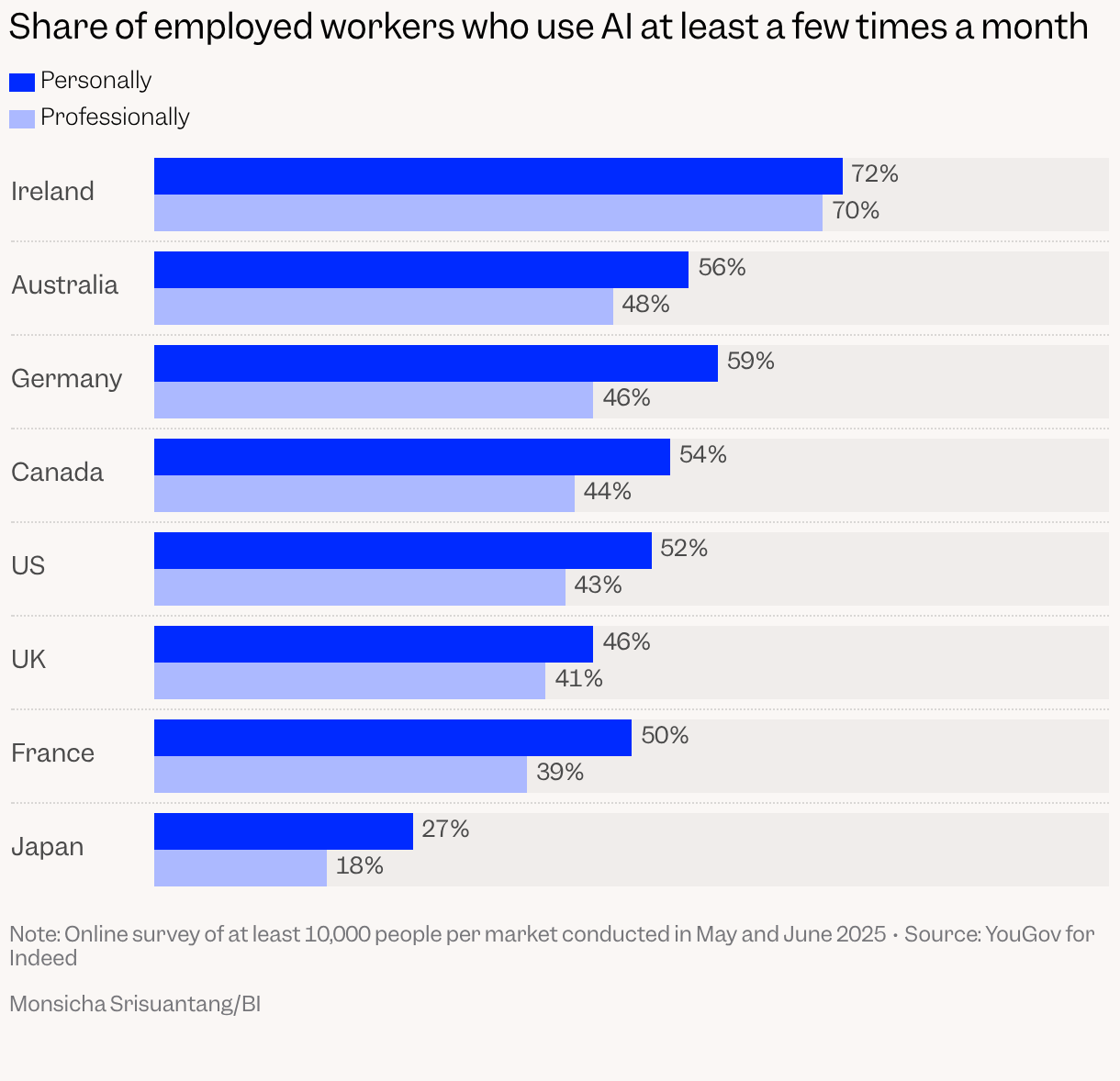
Indeed survey data paints a stark picture of uneven AI engagement across advanced economies.
The chart below shows a clear frontrunner: Ireland stands out, with roughly seven in ten workers using AI at least monthly for work, followed by Australia, Germany, and North America.
At the other end sits Japan, where fewer than one in five workers report professional AI use — less than half the level seen in the US or UK.
One striking pattern cuts across all countries: personal AI use consistently outpaces professional use.
Even in high-adoption markets, workers are experimenting with AI on their own faster than employers are embedding it into workflows. That gap is narrowest in Ireland, suggesting workplace norms and encouragement matter.
Techniques like supersets and periodization can help you build more muscle in the gym, according to exercise science pro Jim Stoppani.
Courtesy of Jim Stoppani
Exercise researcher Jim Stoppani has been studying the science of muscle-building for over a decade.
He recommends time-saving techniques to maximize muscle gains without wasting time and energy.
For best results, aim for well-rounded fitness to prevent injury and improve your health long-term.
Jim Stoppani has been lifting weights for longer than most fitness influencers have been alive.
“I’v been training since I was a young kid, probably 7 or 8,” he told Business Insider. “My father built an amazing gym in our basement and I wanted to hang out with my dad, so I was down there learning the principles of weightlifting.”
Now at 58, with a PhD in exercise physiology, his own supplement brand, and a renowned research career, Stoppani has learned from decades of scientific study and first-hand experience what it takes to pack on lean muscle.
He recommends three strategies everyone should know to make the most of every workout for optimal gains.
Diversify your fitness portfolio
One thing Stoppani has learned over his years in fitness is that progress will plateau — unless you make smart training decisions and plan ahead.
The human body has natural limits in how much strength or muscle mass we can achieve. As you work out and get stronger, you’ll get closer to those limits, but additional gains become increasingly more difficult to earn.
Instead of fighting for diminishing returns, diversify your fitness with different elements like power, agility, mobility, and stamina to get the most bang for your buck in the gym.
“I’m not going to put on 20 pounds of muscle at my age and with so many years under my training belt,” Stoppani said. “So why should I come in here and train like a bodybuilder every day?”
Building muscle is just part of the equation for health. Well-rounded fitness can help you live longer and better.
MilanMarkovic/Getty Images
To free up time to work on different skills without losing gains, Stoppani often uses a technique called a superset. A superset involves alternating between two exercises that recruit different muscles, with little to no break in between. Doing so allows one muscle group to rest while the other is working, cutting out your downtime in the gym (and potentially burning more fat in the process).
Stoppani uses the extra time to work on yoga, stretching, and cardio, to avoid any weak points in his fitness.
“The thing that I recommend as you get older is to be less singular in your goals and more well-rounded,” he said.
Hit the right intensity
A concept called “reps in reserve” can help make sure you’re pushing hard enough to make the most of your workouts, according to Stoppani.
At the end of each set, think about how many more reps you could do, if you really had to.
Too many reps in reserve, and you’re leaving gains on the table. For instance, if you finish a set of 10 reps, and feel like you could easily do 10 more, you should increase your weight or reps until it feels challenging.
However, you don’t have to push to your absolute limit with every set. Working to total muscle failure, the most you can possibly lift, comes with a risk of injury, and isn’t necessary if you aren’t a competitive athlete.
He recommends waiting until the last set to push closer to failure, and ending the set when you’re too tired to complete the exercise with proper form.
“The key to turning on muscle growth is getting closer to muscle failure,” he said.
Change your rep range
Forget what you’ve seen from fitness influencers. There’s no magic number when it comes to making your muscles bigger or “toning” them.
Building muscle is all about challenging your body, whether you’re lifting heavy weights for a few reps, or light weights for a lot of reps, according to Stoppani.
You can build muscle with heavy weights or light weights, as long as they’re challenging, but they may have slightly different results.
dusanpetkovic/Getty Images
But your choice of weights can lead to slightly different results over time: heavier weights are ideal for getting stronger, while lighter weights help to maximize the signal for muscle tissue to grow.
As a result, using a variety of strategies can help you make better progress in the long run.
“The biggest misconception is that you can just use one rep range and stick to that forever,” Stoppani said. “You’re eventually going to stop getting the same results because you’re providing the body the same stress over and over and over again.”
Prevent your gains from stalling with a periodization plan, breaking up your training into sections of 6 to 12 weeks each. For instance, you might start with sets of six to eight reps, focusing on building strength, and after two months, switch to sets of 10 to 12 reps help boost muscle growth.
“The best way to build muscle is with change,” Stoppani said.
Comcast’s NBCUniversal sued Group Black, a firm created to direct ad dollars to Black-owned media.
The suit alleges Group Black owes NBCU $35.8 million, stemming from an ad partnership.
“We dispute the claims made by NBCUniversal and intend to respond through the appropriate legal process,” Group Black said.
Comcast’s NBCUniversal has sued Group Black, a firm created to direct ad dollars to Black-owned and Black-led media, alleging it owes the media giant $35.8 million in unpaid invoices and guaranteed payments.
The suit, filed February 11 in New York Supreme Court, stems from a partnership that gave Group Black exclusive rights to sell ads in Black-led shows on NBCU’s streamer, Peacock, with Group Black and NBCU sharing the revenue.
“We dispute the claims made by NBCUniversal and intend to respond through the appropriate legal process,” Group Black said in a statement. “Group Black remains focused on its mission and serving its partners.”
NBCU has said that more than 30 brands signed on to the partnership in its first year, which began in September 2023. Group Black had predicted that NBCU would be its largest source of revenue in 2024, according to a board document dated November of that year, which was submitted in a separate court case.
NBCU’s lawsuit alleged that Group Black failed to fulfill the terms of the contract in the months after it began in September 2023, despite selling more than $30 million worth of advertising.
The suit alleged that in 2024, Group Black agreed to shift its revenue share to zero to pay down the shortfall.NBCU says in the lawsuit that it repeatedly demanded payment, and that Group Black cofounder Bonin Bough had acknowledged the company’s liability multiple times, emailing at one point that he took it “very seriously.”
The partnership ended in September 2025.
Group Black has faced internal and market challenges
Group Black was launched in 2021 after the George Floyd protests that led to a national reckoning and prompted big advertisers like Coca-Cola and Walmart to increase their spending on Black-owned media. In the years that followed, the company faced a mix of internal struggles, executive departures, and broader market challenges. It pivoted last summer to focus on a wider audience with the launch of a new venture, Portrait Media Group.
Group Black has faced other legal action alleging nonpayment. Two companies owned by Essence Ventures, part of a venture led by a second Group Black cofounder, Richelieu Dennis, sued Group Black in 2024, alleging it owed them about $20 million. Group Black said in a court filing that Essence loaned it money but otherwise denied the allegations in the suit. The suit is ongoing.
In another case, Audiomob, an ad agency that provided mobile app advertising inventory for Group Black to sell to its clients, demanded about $181,000 from Group Black for invoices it alleged the company had failed to pay. The suit was terminated in August after Audiomob sought dismissal, saying Group Black had made a “partial payment” of the money owed, per court filings.
Ukraine has used long-range drones to carry out strikes against targets deep inside Russia.
Valentyn Ogirenko/REUTERS
Ukraine’s internal security agency carried out two drone attacks inside Russia on Monday night, an official said.
The SBU attacks targeted a major Black Sea oil terminal and a plant making components for explosives.
They mark Ukraine’s latest long-range strikes as it continues to target Russian military and energy sites.
Ukraine carried out long-range drone attacks overnight against a key Black Sea oil terminal and a plant making components for explosives located deep inside Russia, a security official told Business Insider on Tuesday.
The twin attacks mark Ukraine’s latest long-range strikes and come as Kyiv’s forces continue to target facilities inside Russia that directly and indirectly help the country sustain its full-scale invasion.
Drones struck the Tamannaftogaz oil terminal in Russia’s Krasnodar region, hitting one of the largest ports in the Black Sea region, a source in the Security Service of Ukraine (SBU) said. They were only authorized to speak on the condition of anonymity to discuss military operations.
The attack on the port, the second in less than a month, caused a fire at the facility, the source said, adding that the earlier Ukrainian drone strikes on January 22 damaged several tanks and pipelines at Tamannaftogaz, causing an estimated $50 million in losses. The facility is recognized as an important piece of Russian oil logistics in the Black Sea.
The source said that the SBU, Ukraine’s main internal security agency, “systematically” targets Russia’s energy and export infrastructure, striking at a major revenue source fueling Moscow’s war efforts against its neighbor.
Since August, Ukraine has intensified its long-range drone attacks on Russia’s energy sector, striking oil refineries, terminals, tankers, and platforms across the country, and in the Black, Caspian, and even the Mediterranean seas.
Ukrainian officials have repeatedly described the deep-strike campaign as “long-range sanctions” on Moscow. The attacks have led to a slight decline in Russian oil refining over the past year.
The deep strikes have also targeted other infrastructure associated with Russian military operations, including factories, weapons storage facilities, and air bases.
Overnight, for instance, Ukrainian drones struck the Metafrax Chemicals plant in the Perm region more than 1,600 kilometers (roughly 1,000 miles) inside Russia.
A Ukrainian soldier prepares a long-range drone.
Valentyn Ogirenko/REUTERS
The sanctioned plant — one of the largest producers of methanol in Russia and Europe — is used to make chemical components for explosives and other military-related materials, the SBU source said. Several blasts were reported at the facility.
In a translated statement, the source said “the SBU continues to systematically work on enterprises that provide the Russian military-industrial complex with raw materials and components for the production of weapons.”
“The destruction of such objects reduces the pace of ammunition production, complicates the supply of resources for the army, and directly affects the reduction of the intensity of hostilities against Ukraine,” they added.
Neither Russia’s defense ministry nor its US embassy responded to a request for comment on the attacks. Moscow said its air defenses shot down 334 Ukrainian fixed-wing drones over the past 24 hours.
The two attacks overnight on Monday were carried out by the SBU’s Alpha group, an elite unit considered to be among the best of Ukraine’s special forces.
The Alpha group is regularly behind long-range drone attacks against Russian targets. Forces within the unit also carry out ground operations, including in eastern Ukraine’s embattled Donetsk region.
Meanwhile, the Ukrainian military said on Tuesday that it had carried out an attack on the Ilsky oil refinery in Russia’s Krasnodar region, which is not far from the Tamannaftogaz terminal that the SBU targeted.
“The defense forces of Ukraine will continue to systematically carry out measures aimed at weakening the combat potential of the Russian aggressor,” the military said in a statement published to the Telegram messaging app.
Edie Leong for The Washington Post via Getty Images
Tesla eliminated the option to purchase Full Self-Driving with a one-time fee over the weekend.
Previously, Tesla offered FSD as an $8,000 one-time purchase option.
Musk has said he plans to hike FSD subscription prices as its capabilities improve.
Tesla has shifted its Full Self-Driving feature to a subscription model.
Over the weekend, the company removed the option to purchase the feature in the US via a one-time flat fee of $8,000.
For years, Tesla owners have been able to purchase the service with a one-time payment that would allow them to use it for the full lifespan of their vehicle. Now, the driver-assist feature is available only via a $99-per-month subscription.
Tesla CEO Elon Musk first announced in January that the change would take effect the following month. In the past, Musk has said that Teslas would serve as “appreciating assets,” suggesting owners could benefit as the software became increasingly more autonomous.
The decision to remove lifetime FSD purchases comes shortly after the carmaker stopped offering Autopilot as a free feature for new Tesla purchases. Previously, Autopilot acted as a free driver-assist feature on the expressway, while FSD was an additional paid feature for navigating city streets.
Tesla first introduced FSD in 2016, and the pricing has swung dramatically over time. In its early days, FSD cost around $5,000, later climbing to a peak of $15,000. In 2024, Tesla reduced the upfront price to $8,000. The carmaker first introduced a subscription option in 2021 for $199 per month, but the price was later lowered to $99 per month.
Musk said in a post on X last month that the carmaker will raise FSD subscription prices as its “capabilities improve.”
Tesla’s move to a more subscription-focused model reflects a broader industry trend. Under an executive performance plan approved last year, Musk’s compensation depends in part on reaching 10 million active FSD subscriptions.
ElevenLabs is a $11 billion voice cloning AI startup.
Smith Collection/Gado/Getty Images
ElevenLabs set “ruthless” sales quotas for its representatives, one of its execs said.
VP Carles Reina said sales reps are expected to meet quotas equivalent to 20 times their base salary.
He said ElevenLabs adopts a small team model for higher sales success.
At $11 billion AI startup ElevenLabs, the message to sales reps is simple: Hit 20x your base salary, or you’re out.
Speaking on the 20VC podcast on Friday, Carles Reina, VP of sales at the voice-cloning startup, talked through its “ruthless” quotas.
“So if I pay you $100,000 a year, your quota is $2 million. That’s it. If you don’t achieve your quota, then you’re going to be out, right?” Reina said. “And we’re ruthless on that end.”
ElevenLabs — which was recently valued at $11 billion after closing a $500 million funding round — operates in micro-teams of five to ten people each, according to CEO and cofounder Mati Staniszewski, who spoke on a separate 20VC podcast episodein September.
Reina said he prefers to operate in smaller teams that hit their quotas, and pay them more.
Small teams have become a growing trend in tech, with AI startups touting their ability to scale with far fewer employees by working alongside AI agents.
LinkedIn cofounder Reid Hoffman wrote in January that a team of 15 people using AI can rival a team of 150 who aren’t.
Meanwhile, Mark Zuckerberg said on a Meta earnings call in July that he has “gotten a little bit more convinced around the ability for small, talent-dense teams to be the optimal configuration for driving frontier research.”
Reina said the “ruthless” quota has been successful at ElevenLabs, saying on the 20VC podcast that more than 80% of reps hit their sales quota.
ElevenLabs did not respond to a request for a comment.
He added that the firm compensates both the account executive and customer success manager if they upsell a company within the first 12 months.
“I’m paying double, but I don’t care,” Reina said. “It makes perfect sense because then I have these two people busting their ass to make sure that they actually can make more money, which is fantastic for me as a company.”
The push for higher performance isn’t limited to AI startups.
In April, Google said it was restructuring its compensation structure to increase rewards for top performers. “High performance is more important than ever,” Google’s head of compensation told staff at the time.