Do you think you could really do so much better, huh, tough guy?
Take our fun quiz to see if you really CAN do a better job as McDonald’s CEO.
Poor Chris Kempczinski. What should’ve been a joyous occasion — the launch of the new “Big Arch” burger — has turned into a public drubbing for the McDonald’s CEO.
An Instagram video Kempczinski posted, where he takes a bite of the Big Arch, has been roundly mocked — with people saying his small bite of the burger showed he didn’t really like McDonald’s food, which he also referred to as “product.”
The memes flowed like ketchup.
To make matters worse, other fast-food CEOs piled on, posting their own versions of the video and enthusiastically tasting their own burgers.
When you’ve got a bunch of adults performatively chomping down burgers in an effort to roast you … let’s just say things probably aren’t working out the way you’d hoped.
McDonald’s hasn’t returned my requests for comment. I’ve been asking to interview Kempczinski. I’ve been watching his Instagram Reels for months now, fascinated by how he talks directly to his audience.
It turns out, enjoying a burger is easy. Running a company is hard. McDonald’s stock is up more than 6% so far this year, far outpacing the broader market, which is down by more than 1.3% — but even so, lots of people on social media are saying they think they can do a better job than Kempczinski.
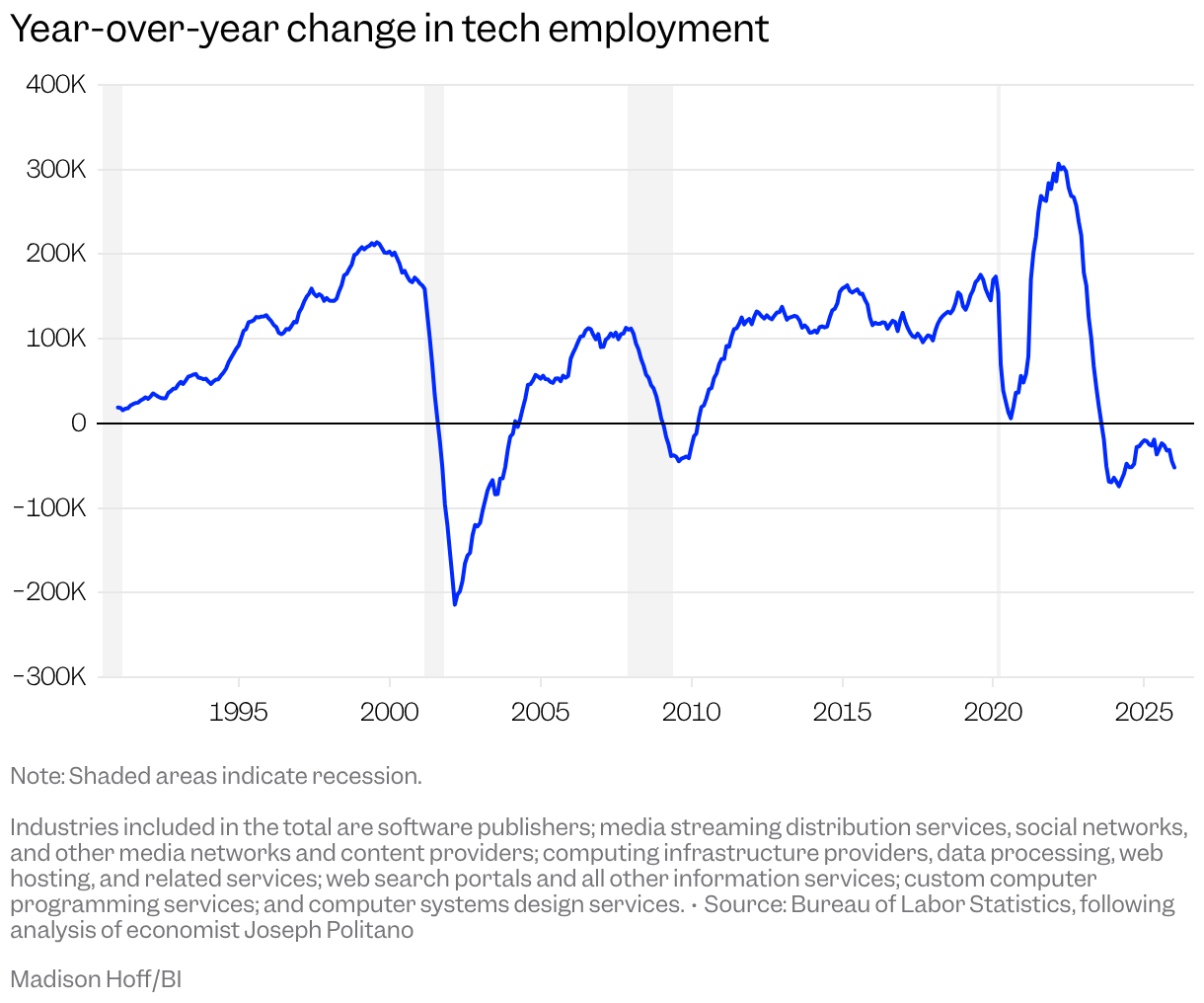
Friday’s shockingly weak jobs report showed a loss of 92,000 jobs in February across the broader economy, far below the expected gain of 55,000 jobs. After the release, economist Joseph Politano posted on X that the tech sector has had an especially rough couple of years.
“For a while, you could at least say we’re not gaining jobs the way we used to, but we’re not losing them. Everything’s kind of stagnant,” Politano told Business Insider. “That has, over the last year, completely changed, where it’s losing jobs again at one of the most rapid rates of the last 20 years.”
Tech job losses now outpace past downturns in 2008 and 2020, per Politano. Historically, Politano said, the US would usually be adding around 100,000 to 300,000 jobs in tech annually; even when there have been some pullbacks, there’s generally a quick rebound. But not this time.
Already, Politano said, this moment is clearly and significantly worse for the sector than the 2020 recession, and slightly worse than 2008. He thinks the most apt comparison is to the dot-com bust, although today’s situation still isn’t quite as dire.
“The fact that the only thing that you can compare it to is the worst tech job recession of all time is pretty bad,” Politano said. “The length is really important here. It’s been three years of job losses. It took only about four years for recovery to start from the dot-com bust, for tech to start rehiring at a semi-normal rate again. The fact that we’re now three years into this and it’s actually getting worse is a really big deal.”
Of course, as Cory Stahle, an economist at the Indeed Hiring Lab, notes, it’s not just tech that’s down in the dumps. Manufacturing, which has been cooling for the last couple of years, saw employment fall, as did the government sector. Healthcare, which had been propping up the job market, lost jobs in February, exacerbated by a roughly monthlong Kaiser Permanente strike. “Everything was looking pretty weak by different industries,” Stahle said.
ZipRecruiter economist Nicole Bachaud said February’s losses in tech-related sectors were similar to recent trends. “When we look at information continue to see a decline, and then the professional and business services, a little bit soft, but I wouldn’t say that was necessarily an out-of-place movement for that industry,” Bachaud said. “There’s been a lot of headlines looking at layoffs in tech or big changes at certain employers in tech, but overall, the layoff rate has been very low and stable.”
New college grads who leaned into STEM and other people seeking their first jobs could be especially hard hit by the tech hiring downturn.
“We’ve seen a lot about recent graduates struggling to find jobs,” Stahle said. “You really feel for those people who started studying computer science four or five years ago and were told that, ‘Hey, this is a surefire way to get in the labor market, make a good salary,’ and now we’re seeing just a continuation of this trend of fewer and fewer hires being made in the tech sector,” Stahle said.
The latest job numbers also don’t yet reflect the sweeping layoffs from Block, which excised nearly half its workforce last week. In his announcement outlining the cuts, CEO Jack Dorsey cited AI as a reason, saying that “the intelligence tools we’re creating and using, paired with smaller and flatter teams, are enabling a new way of working.” Some laid-off Block employees were skeptical about AI claims; many told Business Insider that they had already been using AI at work, and didn’t believe it could replace them outright.
Politano said that, in his view, AI is likely behind at least some of the tech labor market’s losses.
“How much of it you want to ascribe is really hard to tell, but I don’t think it’s a coincidence that computer system design is one of the industries that’s losing the most jobs,” Politano said. And, while AI firms are hiring, they’re bringing on far fewer employees than Big Tech behemoths. The types of jobs lost, and the timing of those losses, point, for Politano, to at least some impact from AI.
“We clearly haven’t seen the end of this right now,” Politano said of the future of the tech sector. “I expect that it will be this dribble of bad news for the near term going forward, but I just think that there’s no positive evidence that we’re breaking out of this post-2022 cycle that tech has been stuck in. Until you see that kind of evidence, I think there’s very little chance of a reversal.”
I’m an American who fell in love with a Frenchman, now my husband, while living abroad in Berlin.
The start of our relationship was a breeze, but we soon discovered some cultural differences.
We don’t always agree when it comes to hosting and meal times, but we find ways to compromise.
I moved from New York to Berlin as a single woman in 2017.
Finding love wasn’t at the top of my to-do list, but I was open to the possibility — and aware that the odds of making a dating-app match with someone of another nationality were much higher than if I had stayed stateside.
So I wasn’t exactly surprised when a dashing Frenchman, who’d eventually become my husband, whisked me off my feet.
We managed to ignore the cultural divide during those first six months of honeymoon-phase bliss. It was easy since he was fluent in English and I had a basic knowledge of French, but the longer we went on, the harder it became to pretend we hadn’t had upbringings in countries thousands of miles apart.
We’re lucky to have a lot of common interests and have agreed on our major values since day one — but we’ve come to accept that there are some ways I’ll always be a little too American for him and he a little too French for me.
That meant that we’d often treat illnesses on our own when possible, keeping the medicine cabinet stocked at all times with Costco-sized bottles of every over-the-counter painkiller you can imagine.
I didn’t think twice when I packed my suitcase with several bottles of ibuprofen, but they were a shock to my husband the first time I took one out in front of him.
In France, painkillers like ibuprofen and acetaminophen aren’t easy to buy in bulk or get at the grocery store — and even at pharmacies, you can’t grab them off the shelf yourself.
Instead, you have to get them straight from the pharmacist, who will then typically debrief you on proper usage and dosage.
From his point of view, I take way too much ibuprofen … but on the other hand, the natural remedies he has always used often don’t cut it for me.
Just this week, I came down with a cold, and he brought me a homeopathic essential-oil treatment when I asked him to pick up medicine. I’ve been using it to appease him, but you better believe I also sent him back to get the ibuprofen I really needed.
My husband’s French dining habits are different from my laid-back, American approach
My husband and I often have trouble aligning when and what we eat because of our different appetites and cultural approaches to dining.
In France, eating routines tend to be pretty rigid. Lunch happens at noon sharp, breakfast is always sweet, and the only time of day most people snack is at 4 p.m. for their “goûter” — the childhood habit of taking a sugary, late-afternoon treat that many French folks, including my husband, carry with them long after they’ve left the schoolyard.
My approach, meanwhile, mirrors the free-form way I ate in the US. Snacks are always on hand, breakfast is often skipped, and dinnertime could easily take place early one night and late the next.
Neither of us has been able to fully adapt to the other’s eating style, but we try to make time to enjoy at least one meal together a day — usually dinner. That way, we can find something we agree on, and a time to eat it, and get what we both want the rest of the time.
We often don’t agree on how or when to share our personal space
captiontk
Audrey Bruno
I’ve always had an open-door policy for friends and family, and welcomed the opportunity to hire a housesitter or leave my apartment to a friend to watch my cats when I’m out of town.
I don’t mind if they make themselves at home while they’re at it — whether that means sleeping in my bed or using my shampoo and conditioner — possibly because I grew up watching my own parents always offer the same.
This, however, is out of the realm of possibility for my husband. The first time I proposed such an idea before a long vacation, he shut it down.
“In France, people don’t do that,” he said. “We want to sleep in our own beds at the end of the day.” Friends will swing by to feed the cats and change the litter, but that’s it.
There’s also a limit to how long he feels comfortable hosting guests when we are on the premises — but he’s learned to adapt to longer stays in order to accommodate my loved ones who have to travel from afar.
When we first met, the longest stretch he could tolerate was a long weekend, but we’ve since hosted my California-based siblings for several weeks with no complaints on his end (OK, maybe just a few).
So, although we may both never be totally on board with each other’s cultural quirks, at least we know that we’ll always try to meet in the middle.
Laura Behnke didn’t know she had colorectal cancer when this photo was taken.
courtesy of Laura Behnke
A woman in her early 40s thought the blood she saw in the toilet was hemorrhoids.
More than a year later, she was diagnosed with stage 3b colorectal cancer.
Experts say rectal cancer is on the rise in people under 50, and destigmatizing toilet talk is key.
Laura Behnke did not have time to worry about cancer when she first saw blood in the toilet.
She was trying in vitro fertilization for the fourth and final time, and her focus was on getting pregnant after three failed rounds with no healthy embryos. Everything else could wait.
A few days before the implantation was scheduled, she saw a kind of red mucus coating her stool, and thought: “‘I have been under an immense amount of stress. I know I’ve been straining. This has to be hemorrhoids, right?'”
“I just told myself, ‘You know what? Calm down, take some deep breaths, stop straining, and this will all go away, and it’ll be fine, and you can go on and have a baby,'” Behnke told Business Insider.
It would be over a year before she discovered she had rectal cancer, joining a growing cohort of younger adults being diagnosed with the disease decades earlier thanexpected.
Cancer was not on her radar
“I felt good,” she said. “There was no way I could have cancer.”
courtesy of Laura Behnke
After that fourth round of IVF, at age 41, Behnke did get pregnant. At first, she was shocked. Hearing a heartbeat at five weeks made it finally feel real. She was overjoyed.
Behnke continued to see some blood in the toilet intermittently, but it was easy to brush off because hemorrhoids are common during pregnancy. She didn’t know the difference between the drops of blood typical for hemorrhoids, and the red mucus she saw that she now knows was characteristic of colorectal cancer.
“Nobody at any point asked me: ‘What’s the bleeding like? How often is it happening?'” Behnke said. “We all just said, ‘Oh, hemorrhoids, cool. Moving on. We have other things to worry about.'”
In her third trimester, Behnke did develop a swollen external hemorrhoid, which made it hurt to sit down. For two days, she tried not to put any pressure on her bottom. In the car, she sat on a donut pillow. On the couch, she laid on her side. This bleeding looked and felt different, like bright red food dye coloring the toilet bowl. She took medication to manage the pain, and got on with the business of getting ready to be a new mom. A few months later, her daughter was born.
Behnke was enjoying being a new mom, and felt fine. She assumed the blood she saw in the toilet was caused by hemorrhoids, swollen veins that can develop around the anus, which are a common side effect of pregnancy.
courtesy of Laura Behnke
After six months of sleepless nights and newborn feedings, Behnke was finally starting to feel like herself again. She was regaining her strength, losing weight, and feeling in control of her body after years of IVF treatments and a pregnancy.
By now though, Behnke saw bloody mucus in the toilet even when she didn’t have a bowel movement, which she attributed to that pesky external hemorrhoid. Her bowels were also changing shape, and her stools sometimes coming out pencil thin.
Behnke decided to see a colorectal surgeon to get the swollen hemorrhoid removed. The doctor asked her about all of her symptoms, sparing no details about the blood or the poop, and then, to her surprise, told Behnke she urgently needed a colonoscopy.
“It could be a whole lot of things other than cancer, but we need a colonoscopy to find out for sure,” Behnke remembers her doctor saying.
After over a year of bloody stools, that was the first time Behnke heard the word “cancer” uttered.
Rectal cancer is on the rise among people in their 40s
Behnke went through radiation, chemotherapy, and then surgery to remove part of her colon.
courtesy of Laura Behnke
When the doctor told Behnke she had late-stage 3b colorectal cancer, she broke down crying. “But we have a seven-month-old!” she wailed into her husband’s shoulder.
“How could I be that sick and feel that good?” she wondered. “I had just had a completely normal and healthy pregnancy.” Suddenly, she felt a debt of gratitude to that annoying little hemorrhoid that led to her diagnosis.
The colonoscopy revealed that cancer had spread to some of the lymph nodes around her rectum, and was edging closer to other parts of her body. She was thankful that the prognosis was still relatively good. With radiation, then chemotherapy, and surgery afterwards to remove part of her colon and rectum, doctors were confident they could wipe the organ clean.
At 42-years-old, Behnke was diagnosed with what has quickly become the deadliest cancer for people under 50 in America.
“The landscape of colorectal cancer is changing rapidly,” Rebecca Siegel, an epidemiologist and the senior scientific director of surveillance research at the American Cancer Society, told Business Insider.
Experts don’t know why, but many of these new, young-onset colon cancer cases are rectal, prompting bloody stools. Other common symptoms in this age group include persistent stomach cramping or severe abdominal pain, low iron levels, and changes to bowel movements, including the narrower stools Behnke saw.
Research suggests that bloody stools are an early warning sign for about 40% of rectal cancer patients. “There’s an opportunity for earlier diagnosis, but the problem is, especially for younger people, they’re not aware of the symptoms and they don’t want to talk about the symptoms,” Siegel said. “And sometimes they even do go to the doctor with these symptoms, and they’re diagnosed with hemorrhoids or something else.”
A couple of weeks after Behnke had her first dose of radiation, she stopped bleeding into the toilet.After 25 sessions of radiation, then four months of chemotherapy, and finally, surgery that removed parts of her colon and rectum, she landed in diapers alongside her daughter for a few weeks. Doctors said every visible trace of the cancer was gone.
Slowly, over time, her colon has healed and she’s readjusted to a more normal bathroom routine, but she says things will never be quite the same down there. She prioritizes getting plenty of fiber in her diet from colorful vegetables, and also takes fiber pills twice a day, to help with the lingering symptoms.
“I am alive and I am healthy and all of this is workable,” she said.
This is not an ‘old man’s disease’ — talk to your doctor about bloody stools or unexplained stomach pain
Her daughter will start going in for colonoscopies at age 32, since that is 10 years younger than Behnke’s age at diagnosis.
courtesy of Laura Behnke
Colorectal cancer, Behnke said, is not an “old man’s disease” anymore. After her diagnosis, she urged her younger brother to get a colonoscopy, and doctors discovered he had precancerous polyps developing. Her young daughter, she said, will start having colonoscopies in her early 30s, because of her increased risk of developing colorectal cancer.
Behnke said she’s grateful she met “the right surgeon at the right time,” a doctor who asked the right questions, and didn’t dismiss her symptoms because she was too young or postpartum.
“No rectal bleeding is okay,” she said. “If you do have any sort of symptoms, any sort of concerns, anything that doesn’t feel right, you have every right to go ask a doctor about it and to demand some answers.”
When boarding the ship, my bag was checked and brought to my stateroom later that night, leaving me with just the backpack for my first day of cruising.
Joey Hadden/Business Insider
So I had to be thoughtful about what I packed in each bag.
Without access to my suitcase on day one, I also strategically packed my Brevite Jumper backpack.
The author’s camera backpack by Brevite.
Joey Hadden/Business Insider
I like how my Brevite backpack holds and protects my camera gear while also being large and versatile enough to carry everything else I might need.
In the main pocket, I kept essentials like camera gear, sunglasses, and a swimsuit.
A peek inside the author’s backpack.
Joey Hadden/Business Insider
I included a bathing suit in my backpack so I could swim on the first day of my cruise before my suitcase arrived at my stateroom.
I also stuffed a fanny pack full of medication in my backpack.
The author stored medicine in her fanny pack.
Joey Hadden/Business Insider
I brought the fanny pack so I could have a smaller bag to carry around when I didn’t need the whole backpack. I stored medications in there to save space while traveling.
I used the front and back pockets of my backpack for my electronics, planner, and a notebook.
The author’s gear inside her backpack.
Joey Hadden/Business Insider
I also stuffed my phone charger in the front pocket.
I used an Away carry-on suitcase for this trip.
The author’s packed suitcase.
Joey Hadden/Business Insider
My Away carry-on luggage has a protective shell, and I think it’s roomier than any other carry-on suitcase I’ve used.
I used packing cubes for my clothing and bathing suits.
The author’s swimsuits in a packing cube.
Joey Hadden/Business Insider
The packing cubes kept my belongings consolidated and organized.
I also packed toiletries and a pair of sandals that could get wet for the pool and beach.
The author’s toiletries.
Joey Hadden/Business Insider
I didn’t pack shampoo, conditioner, or body wash because I knew these toiletries would be provided in my cabin.
For clothing, I packed versatile pieces so I could make multiple outfits with the same items.
Clothing in the author’s packing cube.
Joey Hadden/Business Insider
I brought four pairs of shorts (to wear each pair twice), six shirts (to have a fresh one most days), nine pairs of underwear (so I always had extra), one dress for formal nights on the ship, and one pair of pants.
I also packed three bathing suits and a rash guard.
The author’s swim wear.
Joey Hadden/Business Insider
I was glad I had multiple swimsuits since I had to let each dry for about a day before wearing it again.
In the zip pocket of my suitcase, I packed essentials like sunscreen and a magnet for my stateroom door.
The author made sure to pack a magnet for her stateroom door.
Joey Hadden/Business Insider
The magnet helped me easily find my room in a hallway of identical doors.
I also packed a rain jacket.
Joey Hadden/Business Insider
While it didn’t rain during my cruise, the jacket came in handy on windy nights on the ship’s top decks.
I wore a pair of sneakers while traveling, on the ship, and at most port stops, so I didn’t have to pack them.
The author wears sneakers on the ship
Joey Hadden/Business Insider
I wore a light pair of canvas sneakers so my feet wouldn’t get too hot.
I also wore my sun hat during my travels.
The author poses at a port in front of the world’s largest cruise ship
Joey Hadden/Business Insider
Wearing my big, floppy hat saved space in my luggage and kept the brim from getting damaged.
I think I did a pretty good job packing for my first cruise, aside from a few items I missed.
Joey Hadden/Business Insider
I longed for a waterproof phone case to take pictures underwater, earplugs to help me sleep, and more pants for cold mornings and evenings. I think these items would have fit in my suitcase — had I thought to bring them.
Here’s my full packing list for the cruise, which I thought worked well with limited space.
The author’s Caribbean cruise packing list.
Joey Hadden/Business Insider
I’d use this packing list again to avoid having to check a suitcase at the airport.
A split image showing a US Navy submarine torpedoing an Iranian warship.
US Department of Defense
A US Navy submarine sank an enemy vessel for the first time since World War II in combat with Iran.
A WWII expert told Business Insider the attack looked “remarkably similar” to a 1945 US submarine engagement.
The video suggests that a Virginia-class submarine carried out the attack before dawn.
For the first time since World War II, a US Navy submarine has sunk an enemy vessel in combat.
Earlier this week, a US Navy fast-attack submarine torpedoed an Iranian warship in the Indian Ocean in an attack that appeared “remarkably similar” to the last time a Navy submarine sank an enemy ship in 1945, World War II battleship expert Ryan Szimanski told Business Insider.
Szimanski, the curator at Battleship New Jersey in Camden, said that video of the attack released by the Department of Defense on Wednesday strongly resembled the Navy’s last submarine combat engagement 81 years ago, when the USS Torsk sank two Japanese destroyer escorts with acoustic torpedoes on August 14, 1945.
“Much like what we saw with this ship, or what I believe that I saw with the footage from this ship, the torpedo goes right up their tailpipe, homes in on their propeller sounds, and detonates at the stern of each of those ships, sinking them,” he said.
The Navy has not released the name of the submarine that fired the torpedo and sank the Iranian warship, but the video may have provided a clue about the type of sub, Szimanski said.
“My guess is it was a Virginia-class attack submarine that did it because it seems like we’re looking through a photonics mast, i.e., a camera on a pole, as opposed to a traditional submarine periscope,” he said. The older Los Angeles-class fast-attack submarines typically have traditional periscopes unless they’ve been retrofitted.
The black-and-white video could offer additional insight into the military action.
“My best guess is it happened before dawn because it looks like we’re looking through an infrared lens,” Szimanski said. “That’s why it’s a black-and-white video.”
The Department of Defense referred Business Insider to the transcript of Secretary of Defense Pete Hegseth’s press conference on Wednesday and declined to comment further. Business Insider also reached out to the US Navy and did not immediately receive a response.
Gen. Dan Caine, the chairman of the Joint Chiefs of Staff, said in a press briefing that the US submarine fired a Mark 48 heavyweight torpedo to sink the Iranian ship. The torpedoes feature a 650-pound warhead and can use both active and passive sonar, or sound navigation and ranging, to hit their targets as far away as 25 nautical miles. The range in the 20-second video released Wednesday suggests a much closer range and shows the submarine’s position broadside.
170210-N-DA434-133 SANTA RITA, Guam (Feb.10, 2017) Sailors assigned to the weapons department aboard the submarine tender USS Frank Cable (AS 40), stabilize a Mark 48 heavyweight torpedo during a weapons on-load. Frank Cable is one of two forward-deployed submarine tenders in the U.S. 7th Fleet area of operations and conducts maintenance and support of deployed U.S. naval force submarines and surface vessels in the Indo-Asia-Pacific region. (U.S. Navy photo by Mass Communication Specialist 3rd Class Alana Langdon/Released
U.S. Navy photo by Mass Communication Specialist 3rd Class Alana Langdon
Szimanski said the video appeared to indicate the use of an acoustic torpedo, a move straight out of World War II.
“When you would fire an acoustic torpedo, typically your boat would be stopped and dead quiet,” he said. “You fire this torpedo, and it will go for the nearest sound source. My guess is our submarine could hear them so well on passive sonar that they fired the torpedo using sonar, knowing it was going to be able to score a hit.”