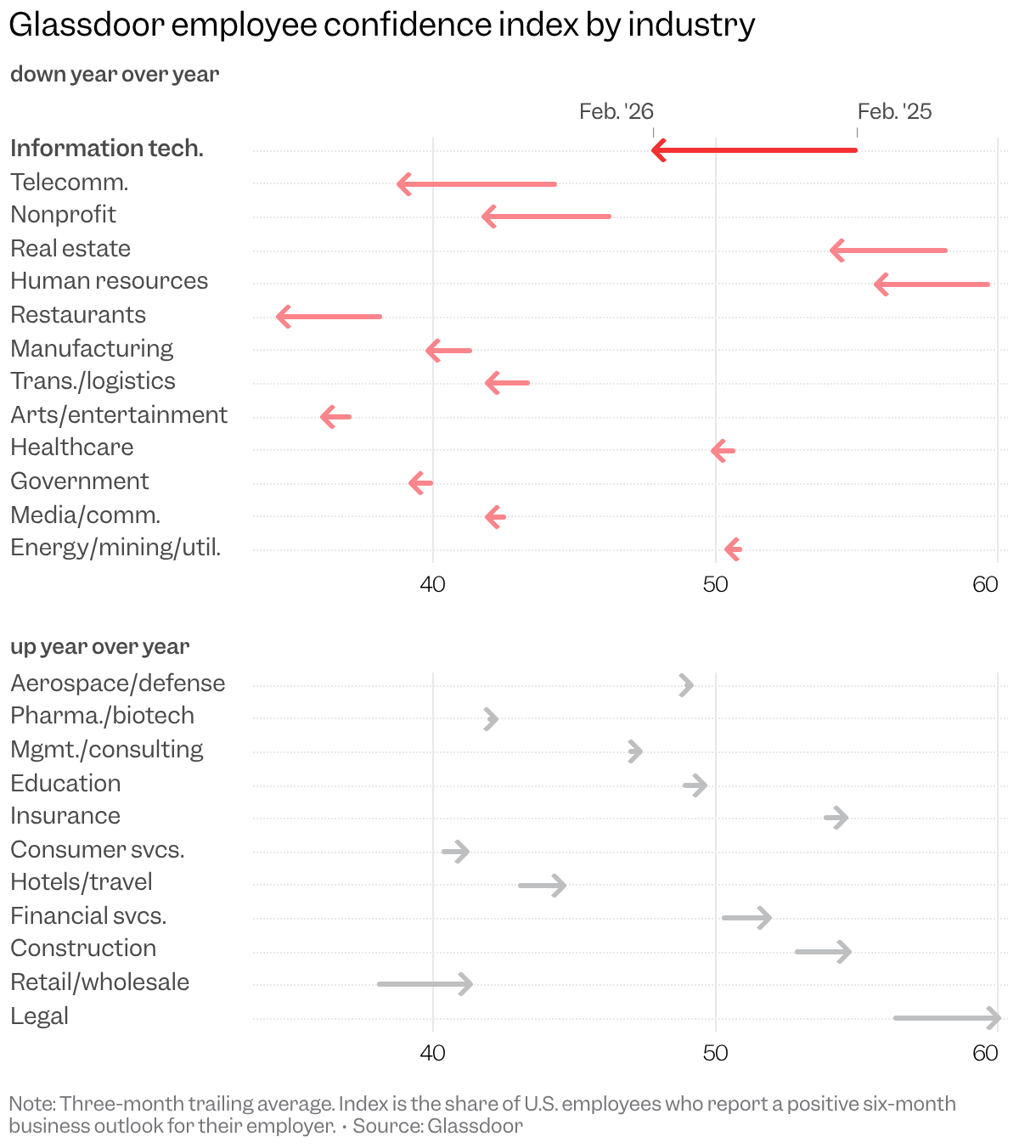
That’s according to Glassdoor’s latest Employee Confidence Index. Each month, the job listing and review website calculates the share of US employees who feel positive about their companies’ six-month outlooks.
The share of employees reporting a positive outlook fell to 44.3% in February, down from 45.9% in January. The report described “more weeks of winter for workers,” as confidence continues to cool despite scattered signs of improvement in the broader job market.
Among all industries tracked, technology stands out for its sour mood. Tech has experienced the largest year-over-year drop in employee confidence, with a 7.1 percentage point decline. In February, 47.8% of IT workers reported a positive outlook, down from 55% a year earlier. Confidence in the sector also fell 1.6 percentage points from January.
Glassdoor noted that despite rapidly increasing investment in AI and data centers, tech employees remain hesitant about their prospects after several years of cost cutting and layoffs. Big job cuts at Block and Amazon certainly don’t help the mood.
The sentiment downturn comes as the industry continues to adjust from what, in hindsight, appears to have been a period of massive over-hiring during the 2020 to 2022 pandemic boom.
At the same time, advances in artificial intelligence are raising fresh questions about job security. AI tools are beginning to automate portions of coding, threatening the once comfortable job prospects of some software engineers.
For now, even in a sector driving the AI revolution, workers appear to be bracing for a prolonged chill.
Harvey cofounders Winston Weinberg and Gabe Pereyra.
Harvey
Harvey partners with The LegalTech Fund to invest in emerging legal-tech startups.
Harvey CEO Winston Weinberg spoke of AI’s potential to disrupt the $1 trillion legal market.
Harvey secured $1 billion in funding from investors like Sequoia Capital, A16z, and OpenAI.
Harvey’s CEO Winston Weinberg thinks the $1 trillion legal market is too big and too fragmented for any one software company to sweep it. So the $8 billion legal-tech startup is trying a different play: bankroll whatever comes next.
Harvey said Wednesday that it will begin investing in young legal-tech startups, partnering with venture capitalist Zach Posner’s The LegalTech Fund to scout and back the next wave of tools for law firms and in-house legal teams.
Speaking at the Legalweek conference, Weinberg said the pace of change in AI means there’s still room for new category leaders to be minted.
“Everything can get disrupted,” he said.
Harvey’s move reflects a broader trend in Silicon Valley. Today’s hot startups sometimes also act like mini-venture capital firms, using their balance sheets to back younger, early-stage startups. OpenAI, Coinbase, and Anthropic each have funds dedicated to investing in startups.
Harvey can’t vet every legal tech startup, so it will outsource that work to people who do it for a living. The LegalTech Fund gets leverage, too. It can dangle access to Harvey’s brand halo and client base, making the fund more attractive to founders and increasing the likelihood that its startups will succeed.
“We’re out there as aggressively as you can be, talking to hundreds of different startups on a monthly basis,” Posner said. “We want to be able to help these startups reach their full potential.”
Harvey says it will invest using the company’s revenue rather than raising a stand-alone fund. It expects to write checks of less than $2 million each.
Weinberg says customers routinely ask for tools tailored for very specific jobs — patent drafting or client intake — use cases Harvey isn’t necessarily positioned to build itself. Investing lets Harvey point steer those clients to vendors it trusts while keeping a hand on the wheel as it tries to build the main tech hub.
Some investments could turn into partnerships, allowing customers to access those tools directly through Harvey’s product. The gating issue, Weinberg said, is security. Any vendor has to clear Harvey’s bar before it can integrate. Other investments could be a first step toward an acquisition.
More than $4 billion flowed into startups building tech for lawyers in 2025, nearly double the previous year’s total, according to Crunchbase. That money piled up at the top: more than a third of the total went to just three companies — Harvey, legal case management startup Filevine, and legal software startup Clio. Harvey has raised a total of $1 billion in funding from investors.
Already, that cash is reshaping the market. Some companies are buying. Legora, Harvey’s chief rival, said Wednesday that it had acquired Walter, a startup developing autonomous software for routine legal work, as it pushes deeper into agentic systems. Harvey, too, has been on the hunt, buying the sales-tech startup Hexus in January. Others are pouring money into hiring and sales, racing to get trials inside firms before competitors lock them up.
Some founders have told Weinberg that fundraising can be tough because investors worry a bigger player will “eat” them.
“I’ve heard that from a lot of small-scale startups,” Weinberg said.
Having Harvey invest, he said, can neutralize that anxiety for founders.
For Harvey, the move into investing is also a full-circle moment. The company traces back to a cold email its founders — Weinberg, a former junior lawyer, and former Google DeepMind engineer Gabe Pereyra — sent to Sam Altman and Jason Kwon, who was the general counsel at OpenAI. That outreach helped land one of Harvey’s earliest institutional checks from the OpenAI Startup Fund.
Have a tip? Contact this reporter via email at mrussell@businessinsider.com or Signal at @MeliaRussell.01. Use a personal email address and a non-work device.
Amazon is prepping for customer questions following its $50 billion investment in OpenAI.
Amazon employees are instructed to stress its continued commitment to Anthropic and Nova models.
It also warns against saying customers can “access” OpenAI models through AWS.
When Amazon announced a $50 billion investment and sweeping cloud partnership with OpenAI recently, a question surfaced inside the cloud giant: What does this mean for Anthropic?
Amazon is one of Anthropic’s biggest investors, and has a deep cloud partnership with the startup. OpenAI and Anthropic are arch enemies, so there are potential tensions and conflicts from Amazon working so closely with both AI labs.
The tech giant addressed some of this in internal talking points it prepared recently for sales and marketing teams at Amazon. Business Insider reviewed a copy of the guidelines.
The document is the latest example of how intertwined relationships have become at the leading edge of the generative AI field. This technology requires a massively expensive rewiring of the cloud industry and the tech sector in general.
That’s led to tech giants investing heavily in many of the top AI startups. For instance, Anthropic has taken billions of dollars from Google and Amazon, which are themselves arch rivals in cloud computing and online product search.
“Within the guardrails”
AWS CEO Matt Garman
Noah Berger/REUTERS
The Anthropic issue is just one of several delicate topics covered in the memo. The guidance lays out approved language, prohibited phrasing, and prepared responses to questions ranging from competitive dynamics to accusations that the OpenAI arrangement amounts to a circular financing.
Taken together, the materials reveal how deliberately Amazon is shaping the narrative around one of the most consequential AI alliances in the industry.
“It is very important that all our marketing stays within the guardrails,” the memo said. An Amazon spokesperson declined to comment.
Reassurance for AWS customers
In its guidance, Amazon instructed employees to reassure AWS customers that it maintains “strong relationships” with Anthropic as well as other AI model providers including Meta, Mistral, and Cohere.
“We will continue to work closely with all model providers and only expect these partnerships to strengthen over time as customer demand for multiple models increases,” the document stated.
Not “OpenAI on AWS”
As part of Amazon’s new deal with OpenAI, the companies created an AI system architecture called Stateful Runtime Environment, or SRE. The new service is powered by OpenAI models and available on Amazon Bedrock, the cloud giant’s platform for customers to access various models.
Amazon is tightly controlling how employees describe the SRE offering.
AWS employees may say the SRE “is powered by OpenAI models,” “is enabled by OpenAI models,” or “integrates with OpenAI models,” according to the talking points in the document reviewed by Business Insider.
However, AWS staff are explicitly told not to say SRE “enables access to OpenAI models” or allows customers to “call OpenAI models.” The document warns against describing the SRE as a “passthrough” to GPT models or suggesting that OpenAI’s frontier models are generally available on AWS.
AWS employees are also told not to imply that OpenAI is “offering” the SRE. Instead, the companies are “jointly collaborating to offer” it.
The distinction is deliberate. OpenAI models will underpin the SRE, but customers can’t directly call them through existing Bedrock APIs. (Application Programming Interfaces, or APIs, are a common way for applications to access and share data).
That positioning by Amazon separates its new deal from Microsoft’s arrangement of hosting OpenAI models on its Azure cloud service. It also reinforces that AWS is not merely reselling OpenAI models, but embedding its models inside a specific infrastructure service.
Many operational details still remain undisclosed. Pricing, technical limits, and regional availability are all listed internally as “stay tuned.”
Is this a circular deal?
The internal memo also addresses the question of whether Amazon’s $50 billion investment in OpenAI amounts to a circular deal. Such concerns have become common in the AI industry where tech giants invest in startups, only to see a lot of that money come back in the form of cloud spending.
In Amazon’s case, OpenAI is expanding its existing AWS cloud agreement by $100 billion over 8 years and committing to use 2 gigawatts of AWS Trainium chips as part of last month’s deal.
AWS employees are instructed to push back on any circular financing claims. The document argued that companies frequently invest in and do business with one another, particularly in capital-intensive industries. It says Amazon’s reasons for investing in OpenAI are distinct from OpenAI’s reasons for using AWS infrastructure.
Giving up on Nova?
The talking points further prepare teams to respond to concerns that the arrangement could sideline Amazon’s own Nova AI models or its Quick agentic AI application offering. As part of the deal, Amazon will become the exclusive provider of OpenAI’s Frontier service, which has enterprise technology features that are similar to Quick.
The guidance emphasized Amazon’s continued commitment to Nova and Quick, and the importance of providing choice to clients. Customers use multiple AI models even within the same application, the guidance stated.
The talking points also address chip supply concerns.
Given OpenAI’s massive infrastructure needs, AWS anticipates customers asking whether Trainium capacity will be constrained. Amazon has previously said AWS growth would have been stronger if not for tight capacity issues.
The guidance, however, reassures teams that many customers will still have access to Trainium for their own AI workloads.
Citi said on Wednesday that it evacuated multiple offices in the Middle East amid reports of threats toward financial institutions by Iranian military leaders.
Mike Campbell/NurPhoto via Getty Images
Citigroup is among US firms warning staff to evacuate or stay in safe locations in the Middle East.
The firm has turned to a “fully remote model” as the crisis in the Middle East continues.
On Wednesday, reports suggested Iran could strike regional banks and financial targets.
Citigroup evacuated three of its buildings in the United Arab Emirates on Wednesday, as the crisis in the Middle East is prompting US banks to issue updated security guidance to employees.
Representatives for Citi confirmed to Business Insider on Wednesday afternoon that the company implemented a “fully remote model” as it assesses the situation in the UAE, which is separated from Iran by only the narrow Strait of Hormuz.
The bank had previously instructed employees to work from home.”The vast majority of our people in the UAE have been working remotely, and we have now moved to a fully remote model for all UAE-based colleagues,” representatives said. “We are continuing to serve our clients without interruption. The decision to evacuate three of our buildings in the UAE was responsive to information we received and is consistent with our commitment to prioritize the safety of our colleagues. All colleagues are accounted for and are safe,” the representatives added.
The move comes after Iranian military leaders warned on Wednesday that they would attack banks and financial institutions in the region, according to reports in the Associated Press, Reuters, and Al Jazeera, following US strikes on the country that began in late February and resulted in the death of longtime Supreme Leader Ali Khamenei.
Some of the UAE’s major cities, like Dubai and Abu Dhabi, are key regional industrial and financial centers.
Other financial firms are monitoring the situation closely as well. A person with close knowledge of the policies at the Wall Street giant Goldman Sachs said the firm’s main priority was employee safety and that it had instructed all its teams, regionally, to work from home and adhere to local guidance.
Most of Iran’s best air defense systems are no longer factors, Gen. Caine said Tuesday.
US and Israeli forces are achieving air superiority and conducting deeper strikes in Iran.
Both the US and Israel have suppressed and targeted Iranian air defenses.
Most of Iran’s best air defenses are no longer factors in mission plans for American air operations, giving US and Israeli air forces space for strikes deeper in the country, the top US general said Tuesday.
US Air Force Gen. Dan Caine, chairman of the Joint Chiefs of Staff, gave an update on the US war in Iran on Tuesday morning and answered a question on the status of Iran’s air defense capabilities and the threat to American aircraft. “Most of their higher-end surface-to-air missile systems are not factors at this point,” he told reporters.
“We’re able to move around fighters that are moving deeper with relative impunity,” the general said.
The Department of Defense shared a map on Tuesday after the press briefing showing the timeline and targets for the first 10 days of Operation Epic Fury. US and Israeli strike points cover nearly all the designated “Iranian Air Defenses.”
TK
US Department of Defense
In the early days of the fighting, Caine and other US officials pointed to Iranian air defenses and missiles as primary targets alongside Iran’s naval forces and nuclear sites.
The US and Israel have struck Iranian air defense systems with physical munitions, but separately, the Pentagon has indicated that cyber, space, and electronic warfare assets were used to blind Iranian defenses and disrupt their communications.
In October 2024, Israel carried out a significant strike targeting Iran’s missile production and air defenses, saying it could operate “with greater freedom in Iranian airspace.”
Israel conducted another preemptive strike in June 2025, destroying Iranian air defenses so its air forces could attack Iran’s nuclear facilities. Days later, the US carried out Operation Midnight Hammer aimed at destroying major Iranian nuclear sites.
After that operation, Caine said it didn’t look like Iran got a shot off at the strike package.“It appears that Iran’s surface-to-air missile systems did not see us,” he said.
He added that US fourth- and fifth-generation aircraft flew ahead of the B-2 Spirit bombers carrying massive 30,000-pound munitions, “sweeping in front of the package for enemy fighters and surface-to-air missiles.”
tk
US Air Force photo
Air Force officials have said Iranian air defenses were unable to target US forces during the operation.F-35 Lightning II stealth fighters were tasked with suppressing air defenses.
Iran possesses a layered air defense network including a mix of its own systems and Russian ones, including the Bavar-373, an advanced, long-range system, and a variant of the Russian-made S-300.
At Monday’s press briefing, Caine said that with the degradation of Iran’s air defense network, aircraft can move with impunity. It’s an indication that the localized air superiority achieved early on in the fighting has expanded.
The danger isn’t totally removed though. “Always some risk out there,” Caine said. “I don’t want to say there isn’t.”
Since the war began late last month, the US and Israel have conducted over 5,000 strikes on targets. Nearly 2,000 of those were struck in the first 100 hours of the conflict, and the US has recorded major drops in the number of Iranian missiles and drones and the rate of fire.
Mark Zuckerberg and Alexandr Wang, head of Meta’s AI superintelligence.
Jon Putman/Anadolu / LUDOVIC MARIN / Contributor / Getty
Mark Zuckerberg posted a photo to Threads with the Scale AI founder after rumors of tension.
Meta has created a new AI engineering team, separate from Wang’s AI team at the company.
Meta denies that Zuckerberg is “done with” Wang.
Folks, it’s just a totally normal day over at Meta HQ. Nothing to see here, no unsubstantiated rumors of a feud, no billion-dollar breakup. Just two totally happy, smiling colleagues.
See? Meta’s CEO, Mark Zuckerberg, just posted this photo of himself linking arms with Alexandr Wang, the founder of Scale AI and now head of AI Superintelligence at Meta. Just two happy dudes!
View on Threads
You, a normal person who happened to stumble across this photo while browsing Threads — where it’s been widely circulated — might be confused. What’s the deal with this photo?
Here’s the backstory:
Recently, The Wall Street Journal reported that Meta reorganized its AI structure, creating a new group of applied AI engineers. Meta had brought in Alexandr Wang as chief AI officer last summer, after investing more than $14 billion for a 49% stake in Wang’s data-labeling company, Scale AI. This brand new applied AI team, however, is separate from Wang’s team, and reports up to CTO Andrew Bosworth, the Journal reported.
Here’s where things get weird. Last week, the Times of India ran a headline saying “Mark Zuckerberg may be ‘done with’ Meta’s highest-paid employee as company’s reorganization shows.” That story went mildly viral on Reddit and was aggregated by IDN Financials. Meta’s spokesperson, Andy Stone, disputed the story on X, and as of Tuesday, the headline has been changed.
Totally false. The Times of India wrongly published something similar, then corrected. Now it’s being recycled by IDN Financials. It’s still false. The truth: Alex helped create the new team, still runs MSL and TBD, has growing not waning influence. This is all so silly. https://t.co/paCwOXoCSC
So is Zuckerberg’s photo designed to help quash rumors of tension between the two men? That Wang isn’t being pushed out, and they’re working together as normal?
While the whole blowup around the Times of India story was a big deal on X, where lots of people are interested in discussing news about the AI industry, Zuckerberg chose to post the photo to Threads, where chatter on AI office politics is much more muted.
Of course, Mark Zuckerberg has a lot of followers on Threads, but it seems most of them had no idea about what was going on. One of the top comments I saw was someone posting the “context?” guy meme, then more replies mistook Wang for Roy Lee of Cluely (oof), and someone replied asking Grok who was in the photo (oops).
And so here you have photographic evidence of two happy, normal guys — and now you know the backstory if you didn’t already. Now move along, nothing to see here!