
LinkedIn is quietly moving into the AI training business

LinkedIn CEO Ryan Roslansky.
  • LinkedIn is paying up to $150 an hour for people to train AI on coding, nursing, finance, and more.
  • It’s conducting early tests to launch an “AI labor marketplace,” LinkedIn confirmed.
  • The move would put LinkedIn in direct competition with startups like Mercor and Scale AI.

AI training is booming — and LinkedIn wants a piece of the pie.

The careers networking site is in the early stages of launching an “AI labor marketplace” where people can make up to $150 an hour training AI chatbots to get better at everything from coding to nursing to finance, LinkedIn confirmed to Business Insider.

A spokesperson for LinkedIn, which is owned by Microsoft, said AI training is one of the fastest-growing jobs in the US right now and that it’s doing early testing.

AI trainers are humans who help improve chatbots by rating their answers and testing their limits. It’s a new type of gig work spurred by the AI boom and has led to the creation of several rapidly-growing AI training startups that serve clients like Anthropic.

LinkedIn has over a dozen public listings asking for AI trainers.

Someone with expertise in Excel and finance can make up to $100 an hour, while a nurse can make similar rates. The highest-paid position, for a senior software engineer AI trainer, pays up to $150 an hour. Other roles include a Germanic and Nordic Linguists trainer, which pays up to $100, and someone who “red teams” — or tests — AI systems for $40-$50 an hour.

LinkedIn has also rolled out a feature that lets people receive notifications whenever an AI training opportunity pops up.

The move puts LinkedIn in direct competition with a host of fast-growing AI training startups that match frontier AI labs like OpenAI with human talent to improve their models.

Mercor quintupled its valuation in less than a year to $10 billion. Another AI training startup, Surge AI, which owns the human-expert marketplace Data Annotation, is valued at $24 billion, Forbes reported.

The sector’s breakneck growth — and vast armies of contributors — have also contributed to serious cybersecurity issues.

Scale AI, for example, left confidential contractor and client information wide open across hundreds of Google Docs last year, locking them down after Business Insider revealed the practice. Mercor was recently hit by a serious data breach that compromised its contractors’ data and led to five class-action lawsuits in a single week.
Read the original article on Business Insider

Justin Bieber was reportedly paid $10 million to do the bare minimum at Coachella. Somehow, it worked.

Justin Bieber performs at Coachella in 2026.
  • Justin Bieber headlined Coachella on Saturday for his first major performance in years.
  • Bieber was reportedly paid $10 million for the two-weekend gig, more than past headliners.
  • He opted for a laid-back set that rejected pop-star spectacle and paid tribute to his roots.

On Saturday, Justin Bieber arrived on the main stage in Indio, California, as one of Coachella’s highest-paid headliners ever, with a reported $10 million payday for the two-weekend gig.

Given his track record of canceling his tours, the crowd was lucky he even showed up.

The festival marked Bieber’s first headline performance since his 2022 Justice World Tour, which was canceled about halfway through its scheduled run. His previous outing, the 2016-2017 Purpose World Tour, was also canceled early with little explanation.

Over the past few years, Bieber has confined his bookings to a few minutes apiece. He’s performed at a handful of award shows — including the 2026 Grammys, where he sang a stripped-down rendition of “Yukon” (literally) in just his socks and underpants — and popped up as a surprise guest in other artists’ festival sets.

When he was announced as a Coachella headliner this year, speculation swirled as to how much effort he’d dedicate to the ever-hyped and expensive event. Would he honor his commitment? Would he only do the bare minimum? Would he make it worthwhile for the loyal fans trekking to the desert, those who’ve been around since “Baby” and the height of Bieber Fever?

The answers to those questions turned out to be yes, yes, and, surprisingly, also yes.

Bieber delivered a performance as low-energy and low-effort as any Coachella headliner could get away with. Wearing a simple, baggy uniform, Bieber loafed around the stage, mostly alone. His set list leaned heavily on tracks from his 2025 sister albums, “Swag” and “Swag 2,” several of which he delivered acoustically. He rarely interacted with the crowd; instead, he often retreated to an open laptop onstage, where feedback and song requests poured in from the livestream. For roughly one-third of his 90-minute performance, Bieber sat onstage and doomscrolled on YouTube — searching for old memes, reenacting his own viral moments (“It’s not clocking to you that I’m standing on business”), and singing karaoke-style versions of his older hits.

The performance ran counter to the pomp and spectacle of Coachella, which is a haven for brand activations and an aspirational photo backdrop as much as a music festival. Bieber’s fellow headliners, Friday’s Sabrina Carpenter and Sunday’s Karol G, rose to the occasion with dazzling costumes, high-energy dance numbers, and ambitious stage designs. With Bieber sandwiched between them, the contrast was striking.

As a result, Bieber’s performance has been criticized as lazy and underwhelming. But it’s not as if he’s incapable of pulling off those pop-star feats. If anything, the YouTube segment was a stark reminder of Bieber’s beginnings in the music industry, when Scooter Braun plucked him from pre-pubescent obscurity after seeing him perform an acoustic cover of “So Sick” by Ne-Yo on YouTube.

When Bieber broadcast that video at Coachella nearly two decades later, duetting with his younger self for a crowd of millions, what could have been pure nostalgia bait felt more like a practice in reflection and self-respect — especially for an artist who’s publicly struggled with superstardom. It was an homage to how far he’s come, and how much he can do with just his voice and a microphone.

Read the original article on Business Insider

After decades of swearing by workout classes, I switched to weightlifting. I never expected to be so impressed by the results.

Alexandra Frost and her partner selfie
After doing workout classes for decades, I decided to switch to a strength-training program.
  • Despite doing frequent workout classes for over 20 years, I felt weak at 37 years old.
  • I started weightlifting at my local gym and gained strength surprisingly quickly.
  • Eight months into my regimen, I feel better in my body and have a healthier perspective on fitness.

For as long as I can remember, I’ve been a workout-class enthusiast.

When I was 17, I followed my mom to Jazzercise classes, and at 30, I was in boot-camp classes trying to figure out how anyone “bounces back” after pregnancy.

I was still loyal to group fitness in my late 30s, but at 37, I felt weaker than I’d like to. I wondered: For someone doing so many classes, shouldn’t I be — or at least feel — a lot stronger?

I’d been lifting the same 10-pound weights for decades, never progressing to a heavier set. And when one of my five kids asked for a piggyback ride up the stairs, my husband was always the one to oblige (partially due to my pesky back condition).

Eventually, I took a more critical look at my workouts, examining their frequency and the actual movements I was doing. I thought about the strong, fit people I knew my age and realized they lifted weights.

So, I researched the closest gym and chose one purely based on proximity to my house, ready to try something new.

I walked into the gym as a complete beginner

Alexandra Frost working out at gym
After years of group fitness classes, I focused on weightlifting.

On my first day at the gym, the owner convinced me that I was exactly where I should be, walking me through a slow and steady onboarding program.

I tried not to compare myself to the extremely fit people, who looked like they came straight out of a Navy SEALs brochure, and did my best to ignore the clank of the heavy weights hitting the ground.

The staff logged my baseline abilities as I bench pressed, squatted, and performed other strength-training moves.

Although I had done countless leg lifts, crunches, and planks, I’d rarely done traditional weightlifting. Knowledge came with time.

Soon, I learned about one-rep maxes (the maximum amount of weight a person can lift for a single exercise), bought proper lifting shoes from Puma, and started studying form tips on Instagram after class.

The muscle soreness I felt after each gym session reaffirmed that I was working my body in ways that I hadn’t during my group fitness classes.

Although I had plenty of moments when I questioned whether I was in the right place, I told myself that being the least experienced person in the room was a good thing. As I’d learned in the business world, this can be the best place to learn.

Shortly after I started lifting regularly, I felt better in my body

I began taking weightlifting seriously last summer and noticed results fairly quickly.

I didn’t lose weight or have a dramatic visual transformation, but my body felt different; I had a structure that supported my frame rather than just a weak core that felt like it went somewhat dormant between pregnancies.

I considered my weight less important than my ability to pick up heavy things without feeling pain. Another benefit I didn’t expect? I left the gym each day with a weightlifting high that lasted at least 24 hours.

Lifting weights changed my definition of what it means to be fit

Alexandra Frost doing assisted pull-up in gym
My local gym draws members of all ages, from teenagers to retirees.

The biggest surprise of joining a weightlifting gym was seeing who I was exercising next to.

Although some of the mega-fit athletes initially intimidated me, I came to understand that my gym was for everyone. I’ve lifted with retired women over 70, teenagers, moms, and people fighting off medical conditions.

As I watched all of them lift heavier weights than I thought possible, I realized that a fit, strong body comes in many different shapes.

I also learned that weightlifting is about doing big, powerful moves along with exercises that work smaller muscles to fortify my joints.

By following a consistent program and surrounding myself with people who held me accountable, I gradually built strength, going from bench pressing 80 pounds to 115 pounds.

Eight months into my regimen, I no longer feel out of place at the gym. My knees don’t hurt and creak on stairs. Most importantly, when my preschooler asks for a piggyback ride up the stairs, I no longer have to say, “Go ask Dad.”

Read the original article on Business Insider

Americans are more frustrated with the economy than ever and sky-high gas prices could be a big reason why

a gas station shows prices above $8
Gas prices have soared nationwide.
  • Gas prices are climbing rapidly, unsettling Americans’ economic perceptions.
  • The Consumer Sentiment Index, which gauges how people feel about the economy, hit a new low in March.
  • Geopolitical tensions and inflationary pressures are heightening Americans’ concerns over gas prices.

Americans are feeling despondent about gas.

It’s a dour time for consumers — in April, the University of Michigan’s Consumer Sentiment Index, which surveys consumers on how they feel about current and future economic conditions, hit an all-time low.

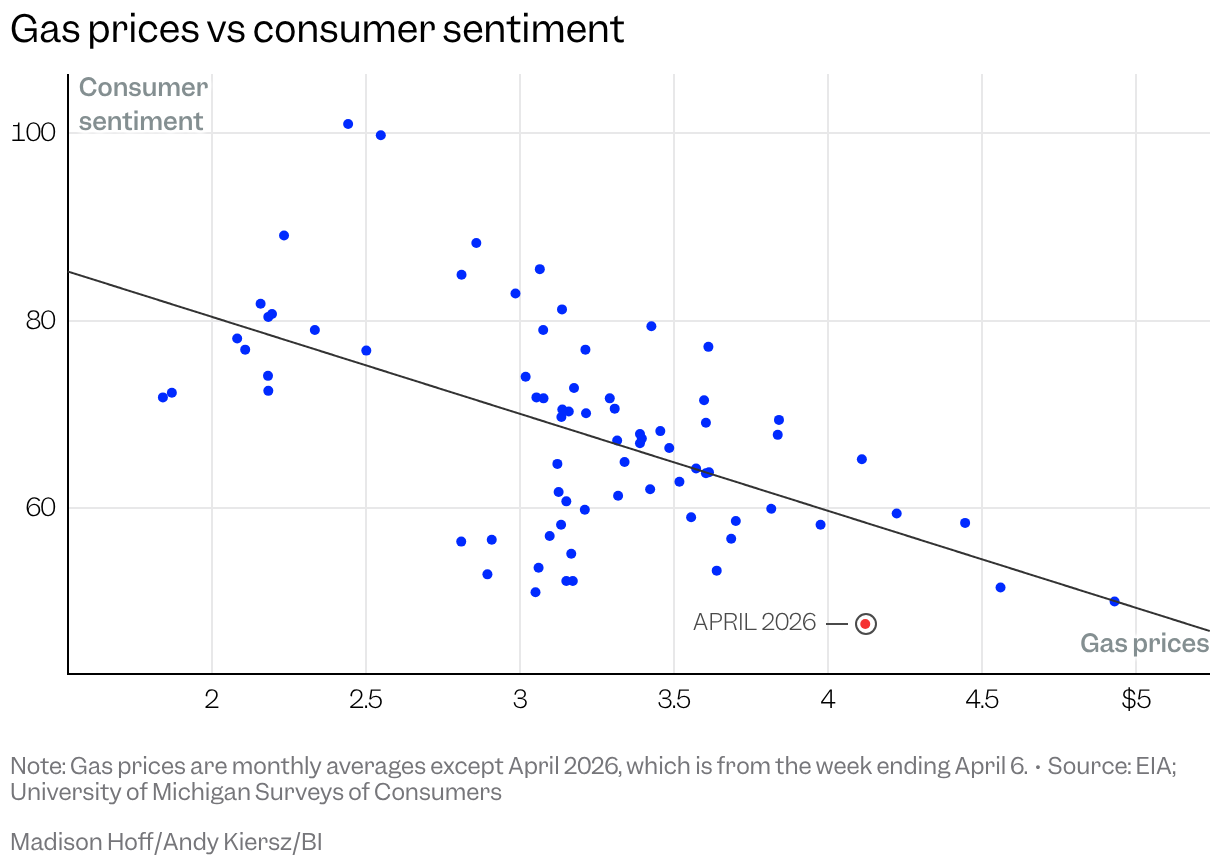
It turns out that one small (or not-so-small) number has a lot of sway over how Americans feel about the economy: Gas prices. In recent years, there’s been a pretty solid relationship between gas prices and consumer sentiment: When it’s more expensive to fill up the tank, Americans tend to report more dire feelings about economic conditions and where they’re going. A Business Insider analysis of retail gas prices from the Energy Information Administration and consumer sentiment from the University of Michigan showed a moderate negative correlation between the two.

Scatter Plot

Gas prices are a hyper-visible economic marker for many Americans, who might experience immediate sticker shock every time they drive past their local gas station or stop to refill on the way to work. After all, only a small share — under 4% — of Americans use public transportation to get to work, according to Census Bureau data on commuting. A touch over 69% of workers drove alone to work in 2024, meaning that gas prices are likely omnipresent in calculating their commutes and daily expenses.

“Prices at the pump hold a very uniquely salient point in people’s minds,” Matt Colyar, an economist at Moody’s Analytics, told Business Insider. “Maybe it’s the big signs with the big luminescent numbers that everyone drives by constantly. They’re very aware of these prices.”

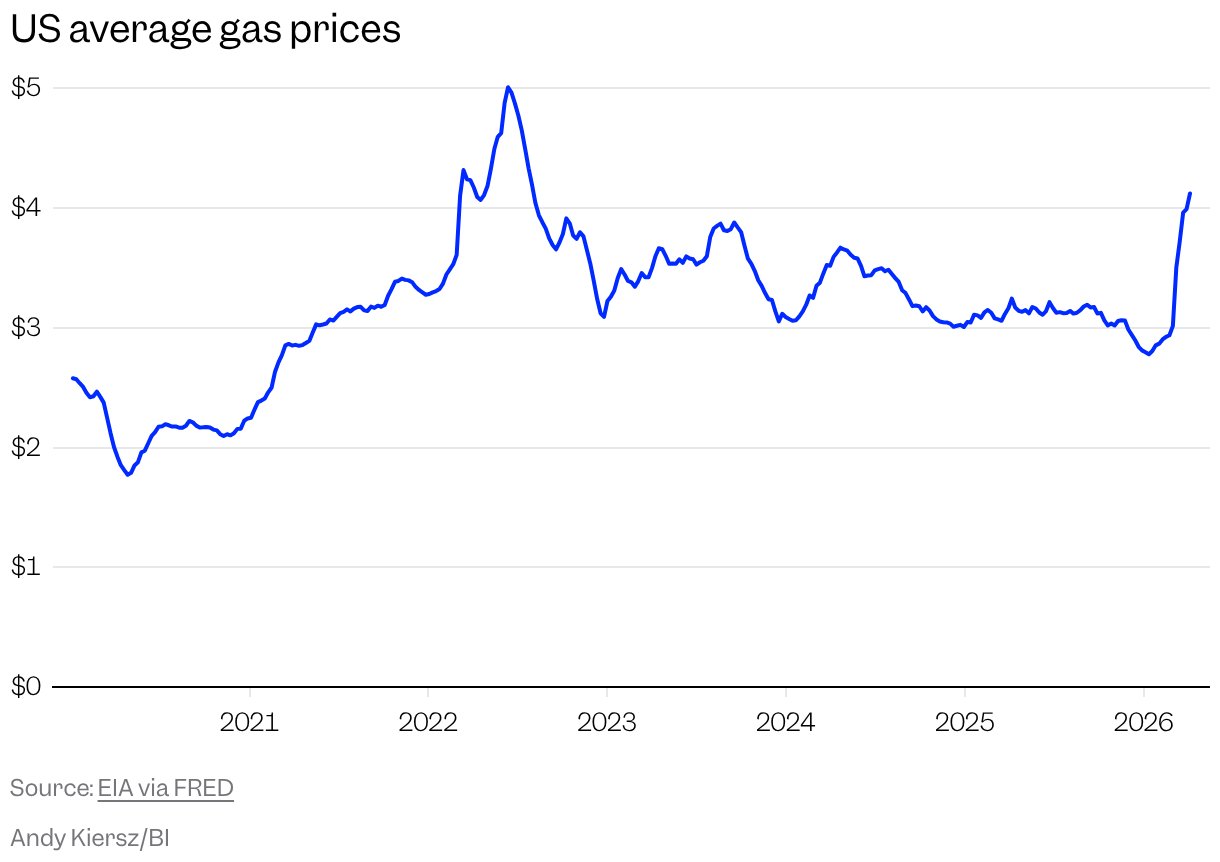
The last time sentiment was close to being this low was in June 2022. That might seem counterintuitive; it would stand to reason that the depths of the COVID-19 pandemic or the 2008 financial crisis and its aftermath might trump the current fluctuations. But June 2022 marked record-high gas prices amid soaring inflation and the fallout from Russia’s war in Ukraine.

Now, as sentiment hits that record low, gas prices are rising at the fastest pace on record, with last week’s consumer price index report showing a 21% month-over-month increase. As of the week ending April 6, the most recent date for which the Energy Information Administration has data, gas prices hit $4.12 a gallon; as of April 13, they were hovering around the same level, and up 50 cents over the month, per AAA.

Line chart

The bad vibes might only continue, especially as President Donald Trump signaled that prices might remain high through the November 2026 midterms and tensions between the US and Iran remain high over the Strait of Hormuz and the roughly 20% of global oil production that passes through it.

“Gas prices are highly visible, highly salient prices that consumers use to gauge their feelings about the economy,” said Alex Jacquez, the chief of policy and advocacy at the left-leaning think tank Groundwork Collaborative. “People have to fill up weekly; they often don’t have much of a choice whether they pay or not.”

Indeed, pump prices are top of mind for Americans as the Iran conflict drags on: 69% of 3,507 Americans surveyed by the Pew Research Center at the end of March said they were very or extremely concerned about higher gas or fuel prices when thinking about US military action in Iran.

That’s already led to changes in how American workers are navigating daily life — rideshare drivers, for instance, are prioritizing the most profitable trips to make their gas expenditures worthwhile. EV owners have taken a victory lap as they plug in. One Business Insider reporter strategically switched to the Costco credit card for gas savings.

Of course, there are plenty of factors that weigh on how Americans view the overall economy, and gas prices alone don’t determine sentiment. For example, the job market has been locked in a low-hire, low-fire “great freeze” for over a year, and the difficult prospects for job seekers are likely weighing on economic opinion as well.

Gas is still likely a looming factor, though. Jacquez said research has shown that “gas prices, consumer sentiment, and political approval all tend to move together, so it’s not surprising to see a sudden rise in gas prices coincide with a crash in consumer sentiment.”

Do you have a story to share about how rising prices and volatility are affecting your economic outlook? Contact these reporters at jkaplan@businessinsider.com and mhoff@businessinsider.com.

Read the original article on Business Insider

Free Spins Terms You Must Check Before Claiming Any UK Offer

Free Spins Terms You Must Check Before Claiming Any UK Offer

Why the Small Print Decides What Your Spins Are Really Worth

Free spins have become the default welcome gift at UK-licensed casinos, and the headline number is often the least important detail. A “100 free spins” banner can translate into a very different experience depending on the terms attached to it. Some offers arrive with no wagering requirements at all, while others tie every penny of winnings to turnover conditions that can run to 40x or more. For more details, visit 100FreeWelcomeBonus 50 free spins no wager.

The scale of the market makes this worth understanding. Research by the Gambling Commission has consistently shown that slots account for the largest share of online gambling activity in Great Britain, and free spins promotions are the primary acquisition tool used to attract players to those games. With so many competing offers, the difference between a genuinely valuable bonus and a decorative one usually comes down to a handful of clauses buried in the terms page.

This guide breaks down the specific conditions you should read before opting in. None of it requires legal training, but it does require a few minutes of patience. Treat the terms as part of the offer itself, because in practice they are.

One useful benchmark comes from no deposit options. A free welcome bonus no deposit required arrangement can be a low-risk way into a new site, but only if you know whether the spins carry a wager and what the maximum withdrawal is. Check those two figures first and the rest of the terms become much easier to interpret.

The Core Terms That Shape Your Winnings

Wagering requirements sit at the top of the list. A 20x wagering requirement on spin winnings means you must stake the value of those winnings twenty times before requesting a withdrawal. At 40x, the same winnings demand double the play. A no wager spin offer, by contrast, credits winnings as withdrawable cash, subject to the other conditions.

Spin value is frequently misunderstood. A pack of 100 spins valued at 10p each is worth £10 in total stakes, not £100. Check whether the offer is described in spins or in pounds, and confirm the stake per spin before you judge the size of the package.

Eligible games matter just as much. Many promotions restrict spins to a specific title, or exclude certain high-volatility slots entirely. If the terms name a single game, your spins work only on that game. If they list a category, read carefully for exclusions.

Expiry windows are another common trap. Spins might need to be activated within seven days of registration and used within a further 24 or 48 hours. Miss the window and the offer simply disappears from your account.

Maximum win caps limit how much you can take from spin winnings. Caps of £20, £50 or £100 are common on no deposit packages, while deposit-linked spin deals often carry higher or no caps. Knowing the ceiling tells you the realistic value of the offer.

A Practical Checklist Before You Opt In

Work through the following points in order. Each one takes seconds to confirm and collectively they tell you whether an offer is worth your time.

  • Wagering requirement, expressed as a multiplier, and whether it applies to winnings only or to the spin value as well
  • Value per spin in GBP and the total number of spins in the package
  • Eligible games, plus any excluded titles or game categories
  • Expiry dates for activation and for using the spins
  • Maximum win or maximum withdrawal cap attached to the winnings
  • Minimum deposit where the offer requires one, and qualifying payment methods
  • Whether a deposit is needed at all, or whether the package is genuinely no deposit

Payment method restrictions catch out plenty of players. Several UK casinos exclude e-wallets and prepaid cards from bonus eligibility, so a deposit made with a popular e-wallet could void the offer entirely. Check the accepted methods before funding your account.

Term Typical Range What to Watch For
Wagering requirement 0x to 40x No wager offers are rare and usually capped
Value per spin 5p to 50p Low spin values reduce real worth
Maximum win cap £20 to £100 Common on no deposit packages
Expiry period 24 hours to 30 days Shorter windows on daily spin offers

Finally, confirm the licence. Every legitimate operator serving players in Great Britain displays a Gambling Commission licence number in its footer. If you cannot find one, walk away regardless of how attractive the spin package looks.

At 18, I was managing a Wendy’s. Years later, I earned a record $496,900 in a single bowling season.

Kyle Troup playing bowling
Kyle Troup stars on the new HBO documentary “Born to Bowl”
  • Kyle Troup, 34, has been a professional bowler since he was 16.
  • In 2021, he set a bowling earnings record, making $496,900.
  • Troupe stars on the new HBO documentary “Born to Bowl” and is glad the sport is getting attention.

This as-told-to essay is based on a conversation with Kyle Troup. It has been edited for length and clarity.

Growing up, my parents used to pay me if I could beat them at bowling. I got $5 if I beat my mom, and $20 if I beat my dad, Guppy. He was a professional bowler with the Professional Bowlers Association (PBA), and my brother and I often went to PBA events with him.

Around the time I was 13 or so, I started beating my dad so often that he dropped my pay down to $10 per victory, then $0. I figured I must be getting pretty good.

I wanted to be just like my father — and not because he was a professional bowler. People loved him, whether he was bowling or not. He was a cool, popular guy who often hung out at the bowling alley bar after his games. He loved his life and career, and it was clear he was having a lot of fun.

I started working at Wendy’s early in my bowling career

At 16, I started bowling with the PBA. In the first few years, I didn’t win much money at all. Still, the experience of bowling for money and spending my own income to bowl taught me a lot.

Around the same time, I started working at Wendy’s. By 18, I was a manager there, and still making next to nothing bowling. I’ve always been good with money, so I was getting by, but one time when money was tight I remember thinking “What could I be doing if I wasn’t chasing the dream of being a professional bowler?”

After a minute, I realized I didn’t need that answer. I was going to be a professional bowler, and that was that.

A record-setting year helped establish my financial future

By my early 20s, I started winning more tournaments and, therefore, earning more. By 2016, I made about $44,000 — enough to leave my job at Wendy’s.

Then, in 2021, I had a great year. I won the PBA Player’s Championship and earned a record-setting $496,900 that season. That’s not much compared to many other professional sports, but for me, it was a blessing.

I worked with a financial advisor and invested a lot of that money to build the foundation for my future. Bowling is a physical activity, and I know I won’t be able to do it forever. Since 2021, I’ve felt financially set. That allows me to go out and be the best version of myself each week I’m on tour.

Becoming a dad has given me purpose beyond bowling

About five years ago, I met Breanna, and we got married last year. She had two kids who were about 6 and 11 when we met. Becoming a dad to them has given me perspective about what’s important in life. My life isn’t about bowling anymore; it’s about my kids.

Couple getting married

The PBA tour schedule can be hard on the family. I’m gone for about three to four months, traveling around the country for competitions. I’ve always had that schedule, but being away from my kids took some emotional adjustment.

I used to stay in hotels while I was on the road, but that was draining: I was always in a hotel, a restaurant, or a bowling alley. Now, I stay at Airbnbs with my best friend, who’s also a professional bowler. Being in a house means we can cook healthy meals and generally feel more at home, even when we’re on the road.

I’m happy with what I’ve achieved

I would love to win a title again, since it’s been a few years. At the same time, I can see that I’ve already achieved a lot, from winning Player of the Year to providing for my family to raising money to help more kids explore the sport.

Now, I want to give back to this sport. I’m happy it’s getting more attention, including the new HBO series. I get to play a game for a living, and I really enjoy what I do. That’s a blessing in my life.

Read the original article on Business Insider