I waited an hour in line for the soufflé pancakes at Micasadeco & Cafe in Tokyo, and it was worth it.
Courtesy of Micasadeco & Cafe
I tried Japan’s famous soufflé pancakes during my first trip to Tokyo.
I waited an hour in line at Micasadeco & Cafe in the city’s Harajuku neighborhood.
The cloud-like pancakes tasted as fluffy as they looked. The special sakura flavor was my favorite.
As a food writer, I sometimes find myself waiting in long lines in the name of good investigative journalism, like spending five hours in the hopes of trying a Something About Her sandwich on opening day.
But I wasn’t on assignment when my fiancé and I waited over an hour for Japan’s famous soufflé pancakes at Micasadeco & Cafe during our first trip to Tokyo. I just wanted to know if they were as good as everyone said.
The pancakes were so delicious, I knew I had to write about them.
Soufflé pancakes are known for their fluffy, cloud-like texture.
Courtesy of Micasadeco & Cafe
The texture is achieved by using whipped egg whites, as you would for a soufflé. There’s debate over who launched the trend, although Nathan Tran, a restaurant owner in Hawaii, has said it started at his business.
“We’re the originators of that item,” Tran told Honolulu Magazine in 2021. “We were the first ones, period, to do it.”
Tran told the magazine that he was inspired to combine pancakes and soufflés after opening his restaurant Cream Pot in 2008. Tran initially kept pancakes off the menu because he wasn’t a fan of the classic breakfast dish. When tourists kept requesting them, he decided to make pancakes using the soufflé technique instead. They were an instant hit.
“We separate 1,300 to 1,400 eggs every day; it’s very laborious,” Tran told the magazine, which noted that his restaurant now calls itself the “original place for soufflé pancakes.”
Soufflé pancakes have become especially popular in Japan, where there’s no shortage of cafés and restaurants offering the iconic treat.
Oscar Wong/Getty Images
Flipper’s and Gram Cafe have become the most famous of the bunch, even opening locations in California and New York. But my fiancé Peter and I decided to try the soufflé pancakes from Micasadeco & Cafe, which came highly recommended from a friend.
We visited Micasadeco & Cafe while spending the day in Tokyo’s Harajuku neighborhood.
Sebastian Kahnert/picture alliance via Getty Images
Harajuku is known for its bustling Takeshita Street, which features animal cafés — where you can pet everything from fluffy samoyeds to baby pigs — as well as a variety of shops selling everything from rainbow cotton candy to sky-high tornado potatoes.
Micasadeco & Cafe is about an eight-minute walk from Takeshita Street, tucked away in a much quieter part of the neighborhood. The restaurant opened in Tokyo in 2013 and now has locations in Kyoto and Osaka.
There was already a line around the block when we arrived at Micasadeco & Cafe just before noon.
Anneta Konstantinides/Business Insider
Peter and I groaned when we saw the massive line, but quickly decided to stick it out.
After thinking about pancakes all morning, our hearts were set on those pillowy clouds.
After almost an hour on the dot, we were led inside the small but cheerful turquoise restaurant.
Courtesy of Micasadeco & Cafe
As we sat down, a server told us that the famous soufflé pancakes are made to order and take about 30 minutes.
We quickly sped through the short menu, which included traditional pancakes and eggs. We knew we wanted to stick to the soufflé variety, ordering the most popular flavor and a seasonal special.
I sipped on a sakura jelly soda, one of the restaurant’s seasonal drinks, while we waited.
Anneta Konstantinides/Business Insider
We went to Japan just as the famous cherry blossoms were beginning to bloom, a time known as sakura season. From cocktails to Starbucks coffee, it seemed almost everywhere we went had a special sakura drink — and I wanted to try all of them.
Micasadeco & Cafe’s sakura jelly soda was delightfully fizzy and refreshing, with just a hint of that floral sakura flavor. It was perfect for spring.
We could also watch the chefs at work from the restaurant’s open kitchen.
The open kitchen at Micasadeco & Cafe in Tokyo.
Anneta Konstantinides/Business Insider
The chefs expertly mixed and flipped their pancake batter as a row of orders waited on the counter.
Our jaws dropped as the first plate of pancakes arrived.
Anneta Konstantinides/Business Insider
These ricotta cheese pancakes are the most popular order at Micasadeco & Cafe. The dish, which cost us 1,750 yen, or about $12, featured three plump pancakes with a side of cream, plus maple syrup served in a mini beaker.
Our dish arrived with “Merci” spelled out in powdered sugar, a sweet thank you from the chef. The pancakes, topped with a perfectly square butter knob, looked so plump you could rest your head on them.
Peter and I couldn’t resist moving the plate around, laughing like kids as we watched the pancakes jiggle. Micasadeco & Cafe says on its website that soufflé pancakes are known as the “dancing pancakes.” I couldn’t think of a more fitting nickname.
The soufflé pancakes were as delicious and fluffy as they looked. Their texture was light as air, melting in my mouth, and the ricotta cheese and fresh cream added a lovely hint of sweetness.
Peter and I were also huge fans of the maple syrup. I was shocked to learn it was from Costco’s Kirkland brand, a discovery I made when I spotted the bottle on the way to the bathroom.
We also tried the seasonal sakura pancakes, which looked stunning on the plate.
Anneta Konstantinides/Business Insider
The pancakes, which cost us 1,950 yen, or about $14, were infused with sakura powder and topped with matcha and strawberry cream, as well as fresh strawberries. Matcha syrup and fresh strawberry-infused cream were also provided on the side.
The texture was just as light and cloud-like as the ricotta cheese pancakes, but tinged with that subtle sakura flavor. The pancakes tasted surprising and sweet, pairing perfectly with the fresh strawberry cream.
I loved the flavor of the pancakes so much that I didn’t even use the matcha or maple syrups.
We loved trying Japan’s famous soufflé pancakes in Harajuku.
Anneta Konstantinides/Business Insider
Micasadeco & Cafe promises to deliver food that’s “Delicious! Cute! Fun!” and its soufflé pancakes were all of the above. They were delightful and playful, but also super delicious. This is not a dish that just looks good on social media.
Our lunch was a good reminder that sometimes the “tourist trap” can still be worth trying. It’s a lesson we embraced as we walked through Takeshita Street and tried glazed strawberries on skewers and tornado potatoes — both delicious!
So, if you’re heading to Japan, seek out the hidden gems, but don’t be afraid to try a few of the TikTok spots. Sometimes waiting in line is worth it.
Affected Oracle employees were notified of layoffs via email early Tuesday morning.
Severance includes 4 weeks’ base salary plus 1 week per year of employment.
Oracle offered laid-off US employees four weeks’ base salary plus one week per additional year of employment up to 26 weeks as severance, according to an excerpt of internal severance terms viewed by Business Insider.
The company started notifying affected workers in the U.S. about the layoffs early Tuesday morning. Those who spoke to Business Insider said they received a notification email and were locked out of the company’s internal system at 3 a.m. Pacific.
Oracle declined to comment.
“After careful consideration of Oracle’s current business needs, we have made the decision to eliminate your role as part of a broader organizational change,” copies of layoff notification email viewed by Business Insider stated. “As a result, today is your last working day.”
People familiar with the matter told Business Insider that, in 2025, during layoffs at Meta, the company’s severance package included 16 weeks of pay and an additional 2 weeks for every year of service, plus 6 months of health insurance coverage.
Oracle’s offer is similar to Amazon’s, which said in January it would cut 16,000 corporate jobs and give affected employees full pay and benefits for 90 days, plus an additional severance package.
Oracle has a standard severance plan for US employees, a separate severance explanation viewed by Business Insider states.
“The Oracle America, Inc. Severance Pay Plan defines the severance pay benefits that you are eligible to receive,” the explanation states. “Per the Plan, you are eligible for Enhanced severance pay benefits of: four weeks of base salary for your first year of employment, plus one week’s salary for each additional year of employment, based on your most recent hire date, up to a combined maximum of 26 weeks of base salary.”
The payout will be adjusted for employees in states with a WARN notice period, the explanation states, and employees must have worked six or more months in the last year of their employment for it to be considered a full year for the purposes of the severance calculation.
Oracle employed around 162,000 full-time employees as of May 2025, according to its most recent 10-K filing. According to LinkedIn posts from laid-off employees, the cuts affected staff across Oracle Health, Sales, Cloud, Customer Success, and NetSuite.
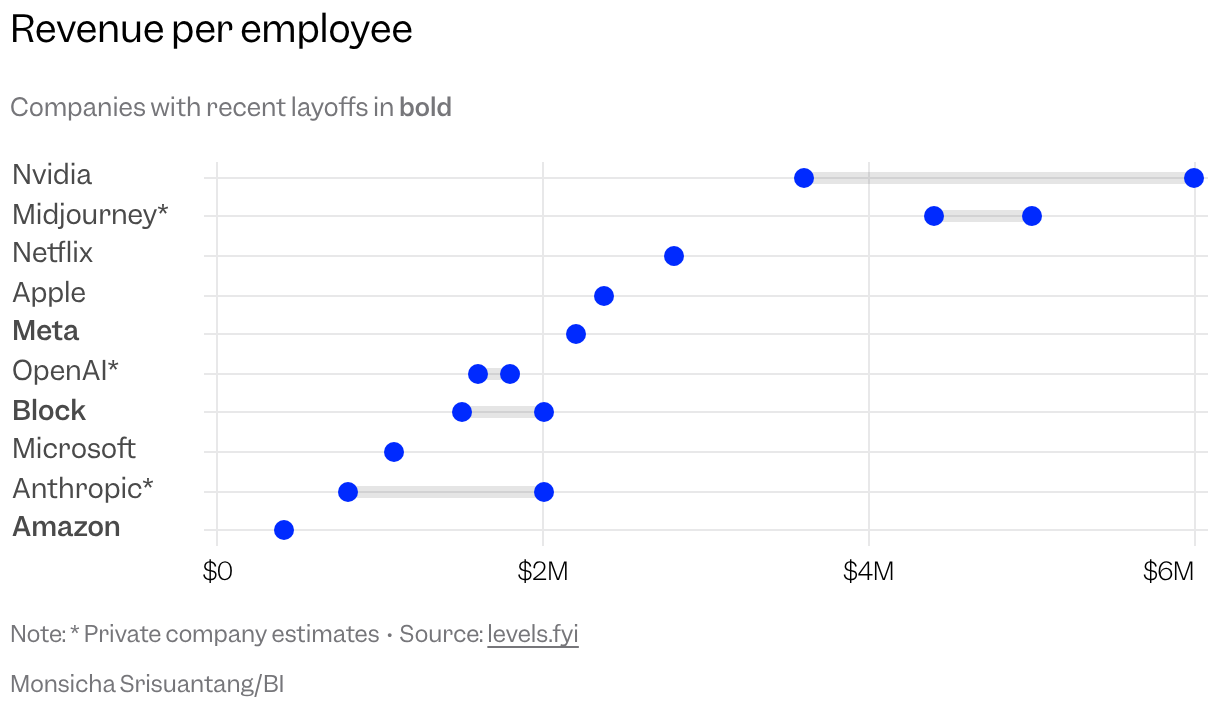
Revenue-per-employee is back, and it’s becoming one of the most telling metrics in tech.
Back in my Bloomberg News days, Mike Bloomberg obsessed over this number. The logic was straightforward: how much revenue does each employee generate?
It’s a discipline that keeps hiring tied to real business growth and forces companies to scrutinize roles that don’t clearly contribute to bringing in the Benjamins.
During the pandemic-era tech boom, that discipline slipped. Tech companies hired aggressively and headcount became a proxy for momentum. But when growth normalized, the mismatch became obvious. Layoffs followed, and many companies are still correcting for that overexpansion.
Now, AI is accelerating the shift back. With AI coding tools boosting productivity, companies are questioning whether they need thousands more software engineers.
See the ranges below. The data is striking. As Levels.fyi cofounder Zuhayeer Musa puts it, tech companies are no longer competing on headcount, they’re competing on efficiency. Growth is being redefined, and revenue per employee is becoming the scorecard.
Scott Houdashell invented an egg-decorating tool while celebrating with his friend’s kids.
His friend lent him $150,000, borrowed from his children’s college funds.
Nine years later, their company does over $8 million in annual revenue.
This as-told-to essay is based on a conversation with Scott Houdashell and his cofounder, Curtis McGill, co-founders ofHey Buddy Hey Pal. It has been edited for length and clarity.
Back in 2015, I was hanging out at my friend Curtis’s house, dying Easter eggs with his kids. All of a sudden, I looked around and thought, “Where did the kids go?” Curtis told me they were bored with watching hard-boiled eggs slowly turn colors.
I told Curtis to get me a hot glue stick, a drill, and some markers. I had an idea for how to get the kids off their tablets and back to the table. Using those rudimentary items, I created a system to spin the egg, letting the kids decorate it with markers.
Soon, Curtis’ kids — who I consider my nieces and nephews — were mesmerized. They couldn’t wait to have a turn. As I drove home that night, I had a feeling that this was my lightning-in-a-bottle moment: an idea that would change our lives.
I didn’t hesitate to take my friend’s loan
When I told Curtis I was serious about making the egg-decorating toy, he didn’t tell me I was nuts. Instead, he offered to invest. It wasn’t the first time Curtis had invested in a friend. He trades commodities and has more financial wiggle room than I do, since I run my own insurance company.
Curtis borrowed $150,000 against his kids’ college funds and loaned it to me at 10% interest. While Curtis worked on the finances, I spent time in my wood shop, creating a rough prototype and breaking many eggs along the way.
The egg decorator now makes over $8 million in sales annually.
Courtesy of EggMazing
I wasn’t worried about taking a loan from Curtis and his wife. We’d met about 15 years before that, playing music together. We had a deep relationship. We both knew I would work my tail off to make sure he was paid back, even if I had to sell the toys door-to-door.
A viral video helped kick-start our success
In March 2017, a shipping container with 10,000 Eggmazing Egg Decorators arrived at the building that housed my insurance company. Curtis and I stacked the boxes everywhere, leaving only a pathway to my office and one to the bathroom.
We brought some to local toy shops, where owners agreed they were cool. One shop owner connected us with the toy retail association, which boosted sales. Then, a video featuring the Eggmazing decorator went viral.
That’s when I learned, be careful what you hope and pray for. Within 23 days, we’d sold all 10,000 units, and we were in the toy business.
Our finances have changed, but our relationship hasn’t
That summer, we went to a toy trade show and left with more than $1 million in purchase orders. From there, things moved quickly. We went on “Shark Tank” — a show Curtis and I had been watching together for years — and made a deal with Lori Greiner.
The brand has made partnerships with iconic Easter brands suchs as Peeps.
Courtes of EggMazing.
Our company, Hey Buddy Hey Pal, is named for the way Curtis and I have always greeted each other. Today, it does over $8 million in annual revenue.
I paid back Curtis’ loan within seven months, then said to him, “I can’t wait until you become a millionaire.” I’m the majority owner, so that would mean I was a millionaire too, but saying that wasn’t selfish; I was just so grateful to be on this journey with my friend.
The Eggmazing decorator has changed our lives. I lived in a townhouse for most of the time I knew Curtis. Now, I own a house and two planes. Curtis’ three kids — who probably would have gone to college in-state — have had access to an outstanding education.
Through it all, our relationship hasn’t changed. We’re brothers. Even if this all blew up tomorrow, I know I can always call Curtis and say, “Hey buddy,” and he’ll reply, “Hey pal.”
The new A321XLR will have doors but they can’t be used until certified by the FAA.
United Airlines
United Airlines will debut its highly anticipated Airbus A321XLR this summer.
The specially-designed long-haul plane is expected to replace Boeing 757 routes.
It has doors and beds in business class and a snack bar in economy.
United Airlines is set to roll out its newest long-haul plane — and it’s billing it as ultra-premium.
The highly anticipated Airbus A321XLR — a specially designed extra-long-haul plane that United says will deliver a “widebody experience on a narrow-body jet” — is expected to debut this summer, opening new international routes that don’t require a larger aircraft.
The premium-heavy jet will feature sliding doors and beds in a suite-style Polaris business class and a walk-up snack bar in economy. All 150 seats — a fifth of which are business or premium economy — will have Bluetooth connectivity for pairing with the in-flight entertainment system.
It’s part of United’s new line of “Elevated” cabins, which will also be installed on its Boeing 787s, A321neo “Coastliners,” and CRJ450 regional jets. The redesign reflects United’s continued bet on premium long-haul demand as more travelers show they’re willing to pay up for better comfort.
United said the A321XLR will replace flying that’s now handled by the Boeing 757 — a dated plane from the 1980s that the A321XLR can outperform with better range and fuel burn. Thanks to an extra gas tank in the belly, the jet can fly about 5,400 miles — or roughly 11 hours nonstop — across oceans and continents.
Its extended range and lower operating costs allow it to serve lower-demand routes that were previously out of reach for older narrowbodies or uneconomical for larger widebodies.
For United, the A321XLR is expected to enter service on select international 757 routes this summer before expanding into Europe, South America, and beyond. It’s unclear what the specific inaugural destination will be.
“You can’t really get much further than Spain with a 757,” Patrick Quayle, United’s SVP of global network planning and alliances, previously told Business Insider. He said to expect far-flung destinations in places like Northern Italy, France, Scandinavia, and West and North Africa.
United has 50 A321XLRs on order and plans to have more than half in service by 2028. Here’s a closer look at what the A321XLR will offer:
Business class will have doors, but flyers can’t use them quite yet.
The door creates a cocoon for flyers.
United Airlines
United gave Polaris business class a facelift by adding what is among the industry’s most popular perks: sliding doors. Airlines like American and Air India have recently adopted doors, too.
However, United’s have yet to earn regulatory approval and will remain open at launch. The FAA is expected to certify them as airworthy, but it’s uncertain when it will make that decision.
Polaris passengers will also get the usual plush linens, elevated meals, an amenity kit, and a 19-inch television screen with Bluetooth. connectivity for headphones. The bed will stretch up to 78 inches.
The Polaris seats face inward instead of forward.
The seats will angle in, making it more difficult for travelers to see out the window.
United Airlines
Because widebody Polaris seats can’t fit in a forward-facing configuration on narrowbodies, United has to angle them inward.
This means they will face the aisle rather than the window — something that could frustrate frequent flyers accustomed to a full bird’s-eye view.
The new Premium Plus has more privacy and no middle seat.
Premium Plus will be in a 2×2 layout between business and coach.
United Airlines
United has rolled out a new Premium Plus design — its most noteworthy upgrade being the privacy dividers. Unlike its widebody counterpart, the A321XLR version won’t have a middle seat.
Otherwise, the revamped A321XLR cabin sports 12 large reclining loungers, a 16-inch Bluetooth-enabled screen, and a foot and legrest. It also gets nicer meals and linens compared to regular coach.
Overall, the A321XLR’s 32 high-dollar seats between business and Premium Plus are 16 more than the 757 has.
There’s a self-serve snack bar in the back of economy.
The snack bar will have snacks and drinks.
United Airlines
A snack bar will be situated behind the economy cabin. United had to remove several rows of coach seats to make room.
The walk-up perk, which is already available on the airline’s CRJ550 and A321neo, is available to all passengers.
Coach will otherwise use the typical 3×3 layout with 118 seats, including 36 with extra legroom. The seats have 13-inch Bluetooth screens.
Large overhead bins mean fewer gate checks.
An example of Airbus’ Airspace XL bins on an A320neo.
Bloomberg/Bloomberg via Getty Images
United said its A321XLR will feature larger overhead bins — designed by Airbus as part of its Airspace XL cabin — to accommodate more roller bags and reduce gate-checking during boarding.
The same bin design is already in service on United’s A321neo aircraft.
The A321XLR will complement United’s new “Coastliner.”
The “Coastliner” will have its own special livery.
United Airlines
The “Coastliner” is an A321neo exclusively flying transcontinental routes between United’s hubs in San Francisco, Los Angeles, and Newark, New Jersey.
The NEO has less range than the A321XLR but will sport the same coach snack bar and lie-flat Polaris cabin with doors.
American Airlines, Australia’s Qantas, Ireland’s Aer Lingus, Hungary’s Wizz Air, and Uzbekistan’s Qanot Sharq all also fly the plane. There have been more than 500 total orders for the A321XLR.
Beds on long-haul narrow-body planes aren’t new.
JetBlue’s Mint business class has lie-flat beds and doors that are certified to close.
LHR
United has long operated its lie-flat Polaris cabin on Boeing 757s flying across the Atlantic; so has Delta.
JetBlue Airways has similarly flown its bed-equipped Mint cabin to Europe on Airbus A321LR aircraft — the A321XLR’s predecessor.
“Being a heritage brand, brand awareness wasn’t an issue,” Coach’s VP of marketing for North America, Kimberly Landry Wallengren, said at YouTube’s IAB NewFronts presentation this month. “What we needed was to build brand relevance with the younger generation.”
Content creators became a crucial part of Coach’s marketing plan, Wallengren said. One partnership she highlighted was Coach’s collaboration with Gen Z YouTube creator and author Haley Pham (who has millions of subscribers and Instagram followers).
Vivian Tu interviewed Coach’s Kimberly Landry Wallengren, Unilever’s Ryu Yokoi, and YouTube’s Brian Gargan.
Sydney Bradley
Promoting one of the brand’s signature styles, the Tabby bag, Coach ran a commercial starring Pham. The brand also worked with Pham as an ambassador on other platforms, including TikTok and Instagram. Wallengren said that Coach has evolved its creator strategy to have longer-term partnerships rather than “one-off” or “transactional” collaborations.
The Pham partnership increased brand consideration among Gen Z female shoppers, Wallengren said, which is one of Coach’s core KPIs.
“We’re seeing an impact not only on brand, but also on those business metrics,” Wallengren said. “This is translating into incredible supercharged acquisition of Gen Z in like month over month, quarter over quarter business growth.”
Big Tech’s pitch to brands
YouTube’s big pitch to advertisers during its NewFronts presentation was heavily anchored in the trust between YouTube’s content creators and their loyal viewers.
During the NewFronts, YouTube unveiled its revamped BrandConnect platform, now called YouTube Creator Partnerships, which helps connect advertisers with creators by leveraging Google’s Gemini AI.
“Invest in the creators that can authentically represent your brand,” said Brian Gargan, YouTube’s director of premier ads, creators, and content. “When you do it right, the performance and the equity are there.”
Meanwhile, over at Meta’s NewFronts, the Big Tech company pitched advertisers on tools to help brands follow cultural moments, discover creators, and drive shopping on its platforms — including new affiliate tools on both Instagram and Facebook.