Police in Le Chesnay, France, guard a Swatch store on Saturday as crowds gathered to buy its new pocket watch, a collaboration with luxury watchmaker Audemars Piguet.
Henrique Campos / Hans Lucas via AFP
Audemars Piguet and Swatch dropped their new collaboration on Saturday.
Police responded to Swatch stores worldwide due to large crowds.
Some fans camped outside the Times Square Swatch store days ahead of the debut.
Throngs of enthusiasts and resellers, who hoped to turn a profit, swarmed Swatch locations around the world this weekend for a chance to snag a piece of the Royal Pop collection.
Hype around the release — a mashup between Audemars Piguet’s sleek Royal Oak and Swatch’s POP line from the ’80s — has been building since the companies unveiled it on Tuesday. Audemars Piguet watches can cost tens of thousands of dollars, making its partnership with Swatch, an affordable brand, all the more enticing.
The excitement around the collaboration was so intense that dedicated fans camped outside stores for days in advance.
By Saturday morning, the furor had reacheddangerous levels, forcing Swatch to close several stores across the United States and Canada due to “public safety considerations.” As the day went on, the company announced additional store closures.
“Some of our stores had to be closed in accordance with our security staff and local authorities to ensure a safe environment for everyone,” the company said in a statement shared online.
That list included a Swatch store at Roosevelt Field shopping mall in Long Island, where one TikTok user at the scene captured footage and shared it on social media. The video showed a large, jostling group of people gathered inside the parking garage. TheTikTok user, who asked not to be named, told Business Insider that police officers used pepper spray on the crowd.
A spokesperson for the Nassau County Police Department said he could not confirm if pepper spray was used. He said officers arrived at the Roosevelt Field mall at about 1:40 a.m. after store employees called, and that “several” people were arrested.
The TikTok user, who goes by ggchang.nyc online, said the event felt disorganized from the beginning. Hearrived at the Swatch store around 1:30 a.m., though some people had been waiting outside for hours before that.
He said confusion over which lines attendees should stand contributed to the chaos, which came to a head around 6 a.m when employees began letting people purchase the pocket watches. People in the back of the crowd grew antsy and began pushing toward the front, he said, creating an uncomfortable squeeze he compared to a wave.
He said the situation felt especially intense because police officers were shouting and making physical contact with attendees amid the uproar. He left the product drop around 8 a.m. — without a new watch.
Swatch, in response to the bedlam, asked fans “not to rush to our stores.”
“The Royal Pop Collection will remain available for several months. In some countries, queues of more than 50 people cannot be accepted, and sales may need to be paused,” Swatch said on Saturday.
Some of those who managed to get a watch were quick to put it on eBay,where it is already going for as much as $15,000. Swatch is selling the pocket watches for about $400.
The author stopped planning playdates for her 8-year-old.
Courtesy of the author
My son calls his classmates himself to arrange playdates and activities.
I encourage independence while still guiding social awareness and etiquette.
His confidence has strengthened both his friendships and our community ties.
My now 8-year-old son consistently uses our landline to call his friends and classmates and ask for playdates. He has been initiating these telephone calls since he was 6 years old.
He doesn’t wait for me to text their parents first. Oftentimes, I am so busy that I rarely find the time to even do that. He takes the class list, finds the phone number, decides who he wants to invite, and makes the call himself.
My son grabs the friends list, finds who he wants to call, calls, and asks for a playdate. Then I step in to confirm the logistics with the parents. He has no hesitation speaking with anyone, whether it’s their mom, dad, grandparent, or a friend.
Watching him do this in real time has made me realize how rare everyday social independence has become for children.
Parents do so much for kids right now
So much of childhood is now managed by adults. Parents text parents. Parents make the plans. Parents get the birthday reminders, buy the gifts, and manage every social detail from start to finish. We say we want independent kids, but many of us are still operating as their assistants, schedulers, and intermediaries.
The author’s son started calling his classmates when he was 6.
Courtesy of the author
My son, Ben, is a self-starter. He is mature in ways people sometimes dismiss because of his age. He chooses his own outfits, hangs up his clothes, helps with the laundry, and empties the dishwasher. He likes responsibility. At home, we leave plenty of room for reading, creativity, and board games. We keep internet exposure very limited. We are outside a lot more. He spends time catching fireflies with his friends, running around, and doing carefree activities that don’t need an overstimulating screen to feel meaningful.
I ask my child hard questions
I am very hands-on with him, mostly through conversation. I ask him hard questions. I push him to think, then think some more. I do not want him to take everything at face value. I let him lead in some ways, even in small things like choosing parts of dinner or helping shape social plans, but not in everything. I am firm when he misbehaves. If I hear he was not on his best behavior at someone else’s house, I take action and address it immediately.
When he initiates playdates with other children, it becomes my responsibility to also strengthen the connection with the parents. I want them to know that the other parents can talk to me openly. For this to work, it has to be open communication, not just between the children, but between the families.
In some ways, I am acting like my son’s personal secretary. From time to time, Ben’s friends call my phone, and I change my tone almost instantly, from speaking like an adult to speaking with a child who is politely asking for Ben, or trying to figure out a playdate, or wanting to get together for tennis or practice. It is so sweet. These children are trying. They are learning to initiate contact rather than waiting for adults to do it for them.
Ben has expanded that instinct beyond playdates. He arranges practice times with his jiu-jitsu buddies. He helps set up tennis games with his fellow young players. In the transcript, I also pointed out that he has picked up practical skills through all of this: learning phone numbers (and understanding area codes), dialing them, memorizing them, even understanding the basics of group calls.
The class list includes names, phone numbers, and email addresses of parents.
Independence also creates its own challenges
Ben gets this burst of energy early in the morning, and with that, immediately wants to call his friends. I have had to teach him phone etiquette because not everyone expects a call at 7 a.m. Not every missed call needs to be followed by four more in a two-hour span. There is social confidence, and then there is social awareness. He needs both.
Ben loves making handwritten birthday cards at home from construction paper. It allows him the freedom to be creative. He wraps his friends’ presents too. And when we shop for them, I will sometimes give him a debit card with a set budget and let him choose.
Courtesy of the author
The first birthday card I really remember was for his best friend, Mark. His mother texted me to tell me Ben had tucked the card into Mark’s desk that morning before school. It was not only a sweet gesture but also self-directed. He thought of his friend and seized the opportunity to surprise him without adult support.
I also think parents underestimate how much children’s social lives affect our own. Ben has helped me grow my friendship circle, too. Through his friendships, I have deepened relationships with other parents. What starts as one playdate or one conversation after an activity can turn into something much more meaningful. Over time, these relationships can begin to feel like extended families — not formal, not forced, but real. There is more overlap, more trust, more openness, and more shared life.
On a practical level, that has helped me professionally too. Stronger community ties have a way of expanding everything. But more importantly, it has made our lives feel richer and less isolated. There is more social time. More time outside. More natural connection. More spontaneity. More people who know one another, look out for one another, and communicate honestly.
He is still very much a child
Too often, parenting swings between overmanagement and total passivity. I am seeking something in the middle: I want to give both my son and my daughter the ability to act while allowing them the space to think and reflect.
One day, these same habits will become adult skills such as taking initiative, building trust, reaching out first, respecting boundaries, and understanding that independence and community are not at opposite ends. They are the pillars for strengthening each other.
Ali Lapetina, Lucy Lu, Adrianna Newell and Jeremy Garretson for BI
When my parents and I immigrated from Liberia to the US in the 1990s, our first home was my grandmother’s two-bedroom, one-bathroom apartment in Worcester, Massachusetts.
Her house became a refuge as my parents found their footing in a new country. Living with her gave them childcare help and the breathing room to find work, save money, and eventually move into a place of their own. In turn, she benefited from their companionship.
In many cultures around the world, multigenerational households — in which grandparents, parents, and grandchildren live under one roof — are a way of life. Though American culture has long prized independence and individualism, many families in the US are now embracing this way of living.
June Boyd, for example, is 90. After a series of health scares in her family, Boyd’s Toldelo, Ohio, home now includes 13 people — her children, grandchildren, and great-grandchildren, ranging in age from 3 to 69. Together, they care for the young children and split the home’s $700 monthly rent.
Ali Lapetina for BI
“In our case, there are no downsides to multigenerational living. The main thing is that it reduces the cost of living, given how high prices are.”
Whatever the setup, many families like Boyd’s are finding that living together and pooling resources is the best way to cope with an economy that has made raising children, caring for aging parents, and affording a home more difficult.
American family structures are changing
If you grew up on cable TV, you probably know the trope of the perfect middle-class, nuclear family living in a large house with a white picket fence. It’s the classic setup: a married mom and dad, and, if the kids are lucky, maybe a dog or two — the kind of household seen in 1980s sitcoms like “Family Ties” and “Growing Pains.”
That script no longer holds for many families.
It is easy to see why. Over the years, inflation in the US has made everyday necessities like groceries, gas, and electricity more expensive. At the same time, wages have not kept pace with rising childcare and housing costs.
A higher cost of living also means that, for many older Americans, retirement savings are falling short.
Natasha Pilkauskas, an associate professor of public policy at the University of Michigan, added that the growing share of children born to unmarried parents, who don’t live in the same household, is also helping drive growth in multigenerational living.
“A lot of it is driven by changes in family structure,” Pilkauskas told Business Insider. “You do see that there are much higher rates of multigenerational households among divorced families than among married families.”
When Vanessa Gordon’s 13-year marriage ended in 2024, the mother of two had to leave her marital home and look for a new place to live in East Hampton.
Gordon found a rental within her budget, but setbacks like a broken car made daily tasks difficult. To ease the burden, her parents moved into a secondary bedroom in her home and now pitch in with childcare.
Vanessa Gordon lives with her parents part-time in East Hampton, New York, along with her two kids.
Jeremy Garretson for BI
“Multigenerational living isn’t necessarily a step backward,” Gordon, 37, told Business Insider. “Support systems can be strategic.”
Still, Pilkauskas said multigenerational living often isn’t a household’s first choice, and that for many families, the traditional nuclear family model remains the ideal.
“I still think people would desire the ‘Leave It to Beaver’ lifestyle,” she said. “I think that this is coming from necessity, more than preference.”
Younger generations are now able to buy homes thanks to their parents
In 2015, Juli Ford bought a home in the Boston area with a basement apartment, so her widowed mother could move in with her and her family.
Ford’s mother contributed to the down payment on the $630,000 home and has, over the years, pitched in for utilities and other household expenses. The arrangement has helped Ford afford the purchase of two other properties. But one of the greatest benefits has been living closely with her mother, now 82, as she ages.
“I cannot imagine how much harder it would be to be a daughter of an aging mom if we weren’t in the same house,” Ford, 57, told Business Insider.
Ford’s decision to move in with her mom is a choice many households are making in today’s real estate market.
Lucy Lu for BI
Data from The National Association of Realtors‘ 2025 Home Buyers and Sellers Generational Trends report shows that between July 2023 and June 2024, 17% of all home buyers purchased a multigenerational home. That’s an increase from 14% the previous year.
Tali Berzak, a New York-based Compass agent, told Business Insider that in the Brooklyn brownstone neighborhoods where she works, including Bed-Stuy, Bushwick, Crown Heights, and Clinton Hill, it is common to see multiple generations of a family living in the same home or on the same block.
“What we’re seeing more now are situations in which parents are helping their adult children buy a home. The parents may live in one of the units, while the adult children occupy one or two of the others,” she said.
She recently worked on a three-family property where a father used one unit as his secondary apartment in the city, and his two children lived in the others.
Homebuilders are designing for multigenerational living
Jené Luciani-Sena’s mother paid $200,000 to build a separate, but attached apartment onto her daughter’s home. The 900-square-foot apartment has its own bedroom, bathroom, and living room.
“The kids love having ‘Nema’ around all the time; Mom joins us for meals,” Luciani-Sena, a mother of four, told Business Insider. “I love having an extra person to help with housework, such as grocery shopping and the occasional laundry, and shuttling kids to and from various events and practices.”
Luciani-Sena said the apartment also increased the property’s value by about $75,000.
The author loves having her mother live under the same roof.
Adrianna Newell for BI
Houston-based Newmark is one homebuilder that designs and builds houses for multigenerational families.
The company offers one- and two-story floor plans for 40 to 100-plus-foot lots, with homes ranging from about $350,000 to $3.2 million, including closing costs.
Rodney Mican, Newmark’s director of product development, told Business Insider that buyers in multigenerational households often ask for features such as larger bedrooms, oversize bathrooms and showers, and second kitchens.
The floor plan for Newmark’s Umbria. The home is priced from about $473,990 to $553,990, including closing costs.
Courtesy of Newmark
Newmark’s Umbria floor plan, for example, offers a “dual home” option. Similar to Luciani-Sena’s mothers’ apartment, it’s a separate living space within the home that has its own bedroom, bathroom, kitchen, and living room.
Berzak said her multigenerational buyers are especially drawn to homes with separate apartments because they offer both togetherness and privacy. They also work well for grandparents helping with childcare.
“People are looking at childcare in a different way,” she said. “Instead of bringing a nanny or someone who isn’t part of your family into your home, having a parent live within the home feels more connected.”
Mican said homes like the Umbria resonate because they are built around that very sentiment. “Human nature has not changed for millennia; families will always take care of their loved ones if they can.”
The author and her husband went on a solo trip and she missed her son.
Courtesy of the author
My husband and I took our second trip ever without my son.
We realized how much we genuinely enjoy spending time as a family.
The trip also reminded us to prioritize our marriage more intentionally.
For our fourth wedding anniversary, my husband and I went back to our honeymoon destination, St. Augustine, Florida. It was only the second time we’ve traveled without my son, and the first time was our honeymoon.
I was a single mom when I started dating my husband, so my son spent a lot of time with the both of us and still does. It was really important to me to know that the three of us would work well together as a family.
It has always been our intention to take more vacations as a couple, but when we have the opportunity to travel, we always choose to take a family vacation.
Our trip was 4 days long
I suggested taking a trip back to our honeymoon spot, then maybe a bigger trip for the fifth anniversary next year. I pitched my romantic travel idea as a way for us to practice for the big trip next year, but my husband didn’t need a lot of convincing. He agreed that a honeymoon repeat for our anniversary sounded perfect.
The author, posing on Villano Beach, said using disposable cameras on a recent trip brought her and her husband back to the earlier days of their relationship.
Courtesy of Ashley Archambault.
We took a long four-day trip at around the same time of year we took our honeymoon four years ago. We did some romantic couple things, such as walking on the beach, eating at our honeymoon restaurant, and ordering some cupcakes that reminded us of our wedding cake.
I missed my son
Since this was only our second trip without my son, it just felt odd by day two. I didn’t want to say anything to my husband and risk coming off as if I wasn’t having a good time. So when he told me on the same day that he wished our son were there, I was relieved that he felt the same way. But more than that, it made me feel lucky all over again, to have found a husband who loves my son as much as I do and is truly a third parent to him.
The author and her husband have traveled a lot with her son.
Courtesy of the author
As a single mom, I began to give up hope that I would find someone good enough for the both of us – for myself and my son. But I found a partner that I adore and that cares for me – and that genuinely cares for my son too. Remembering this and seeing this in him is so much more romantic to me than the fancy dinners and things like special-order cupcakes.
I think it was healthy for us to experience that feeling together
My son is entering middle school, and my husband and I are starting to talk more about what life will be like for us after he graduates. On our vacation, we realized how much his absence would hit us one day.
We took our feelings as an opportunity to talk about how to best move forward. I think that while I feel immensely blessed to have a family that actually likes hanging out together, we also need to put more effort into carving out moments for our marriage.
I actually think it’s really important for our family to keep our marriage strong. I know part of why it’s so difficult for us to take that couple of times is because we’re simply not used to it.
By the end of our long weekend, we had acquired too many souvenirs for my son and were happy to go home. But we also had a really good time overall, even without the whole family there. My husband and I have both agreed that we need to make more of an effort for more small trips like this one, to reconnect, but also to keep our family strong.
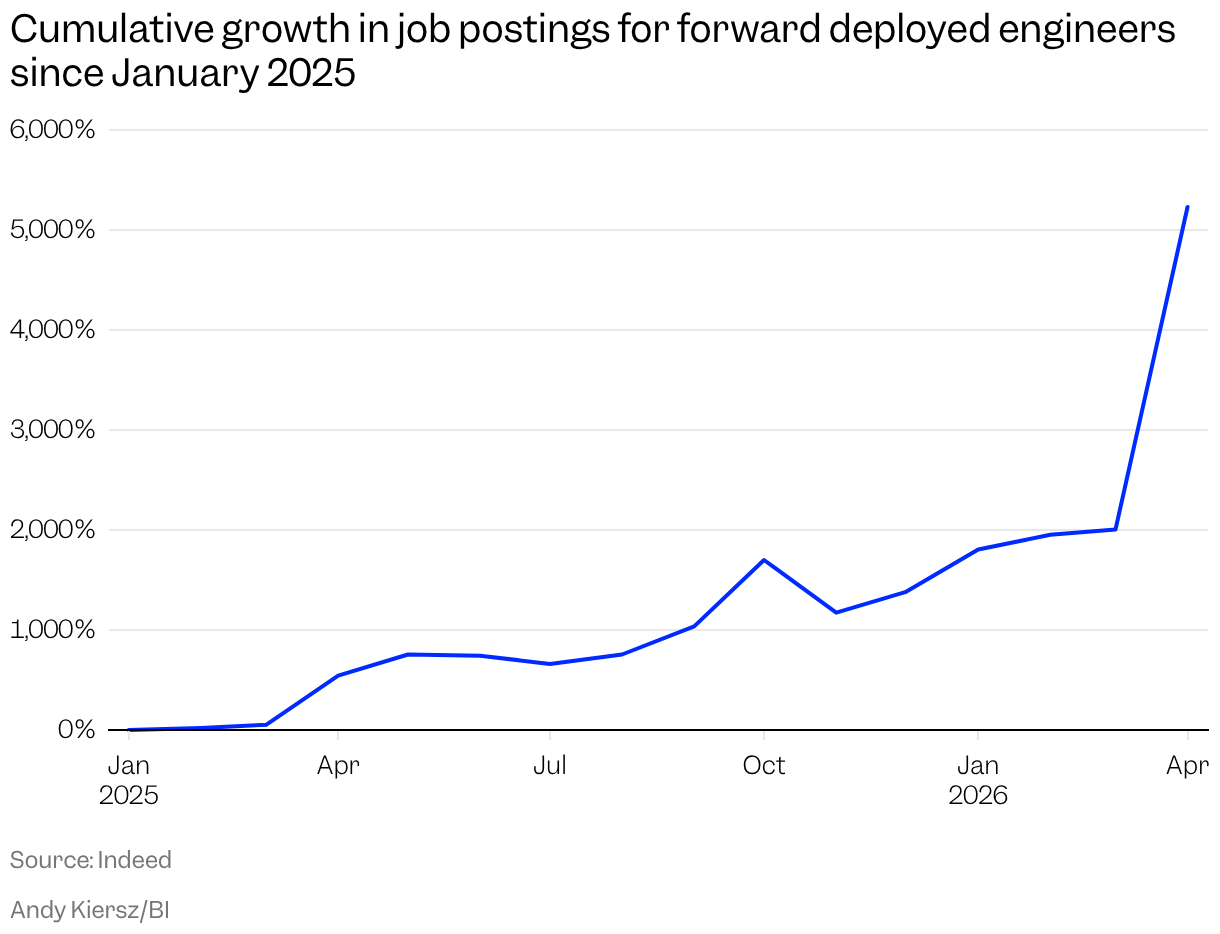
“Forward-deployed engineers, or roles that do the equivalent motion, are about to become one of the most in-demand jobs in tech. And one of the most important functions for AI rollouts,” Box CEO Aaron Levie said on LinkedIn this week.
The job listings data suggest he may be right.
In April of last year, there were 643 job postings for forward-deployed engineering roles on Indeed, according to data shared with Business Insider. By April 2026, that number had increased to 5,330 postings, which is about a 729% increase year over year.
Anthropic, OpenAI, Palantir, and Stripe are among the tech firms hiring forward-deployed engineering talent as demand for enterprise AI tools grows.
Earlier this week, Google Cloud CEO Thomas Kurian said on LinkedIn that the company was also ramping up hiring for the position, citing growing client and partner demand for the company’s AI products.
So what exactly do these tech workers do?
Forward-deployed engineers, or FDEs as they are known, work with companies to integrate AI into workflows and customize AI tools to make their work easier or more efficient.
The role was popularized by Palantir, which would embed engineers directly with customers to build software tailored to their needs.
According to Indeed data, pay for the role ranges from about $170,000 to over $200,000.
The consulting industry is also leaning on forward-deployed engineers. Consulting has become something of a distribution channel for Silicon Valley’s latest AI innovations as they help companies make sense of AI and integrate it into their work.
For firms like McKinsey & Company and Boston Consulting Group, the ideal consultant now must have technical skills.
A job posting for a “Principal Forward Deployment Engineer” at QuantumBlack says candidates should have more than eight years of hands-on experience in software, platform, or infrastructure engineering, as well as a bachelor’s or master’s degree in a technical field such as computer science, machine learning, applied statistics, mathematics, engineering, or artificial intelligence.
“What we want to be able to do is find those people that actually have a propensity to either be this great McKinsey consultant, and or a great technologist, and then groom them to be both,” Alex Singla, a senior partner at McKinsey who co-leads its AI arm, QuantumBlack, previously told Business Insider.
I have a trinket daughter, as mom influencers have been sharing on TikTok.
The collecting and arranging began when she was a toddler.
The fact that her collections cover every surface can get overwhelming sometimes.
Recently, I saw a TikTok video by a mom about her trinket daughter. She panned over her 5-year-old’s collections of tiny treasures all across her bedroom.
It could have been my daughter’s room. Or let’s be honest, my entire house right now. My daughter has been a collector (or hoarder, depending on how you look at it) of tiny treasures since she was a toddler.
The collecting of tiny objects began when she was a toddler
My daughter was only 1 when we noticed her propensity for collecting small items from around the house, sometimes toys, sometimes not, and then arranging them.
There was the play kitchen canister, topped by a swim diaper and crowned with a stuffed pineapple, which appeared on the coffee table. Or the lotion bottle she relocated to her bedroom windowsill, surrounded by Elmo, Ernie, and Cookie Monster, like it was some sort of shrine. My husband and I began taking pictures when we found them to document the hilarity.
The author says there’s no room in her daughter’s nightstand because of all the things she collects.
Courtesy fo the author
As she grew older, she also began to go beyond just collecting things left around the house to acquire her own favorite things. Some of her favorites include sensory toys, erasers, jewelry, mini characters, and stuffed animals. Every trip is a chance to beg for a trinket from the gift shop to add to her stash. She spends her allowance almost as quickly as she receives it on new additions.
With all the trinkets also comes the chaos
While it is an endearing trait that continues to provide amusement for my husband and me and the family photo thread, it can sometimes get to be a bit much. In her room, her dresser, desk, and nightstand are all covered in little trinkets, as well as hairclips, chapsticks, rocks, shells, and artwork. When she has a cold, there is no room for a box of tissues or a humidifier on her nightstand. One accidental knock and half a display goes flying across the room.
She also loves putting all her treasures in various other places in the house, including inside her collection of pouches, purses, bags, and boxes. Displays of items have shown up in our bedroom, on our windowsills, dressers, and bookcases. And sometimes she can’t remember where she has put (or hidden) items. Inevitably, a beloved item will go missing, and then we have to search through the entire house and inside each bag, box, and bundle to locate it. It has been the source of many tears when we can’t locate them or when something gets knocked over and broken.
It can get hard to clean and overwhelming when they crowd out the use of surfaces like her desk or art table. Because, like a lot of kids, she never wants to get rid of anything. Every couple of months, we go through things and cull the herd. Then I have to make a case for why we definitely do not need three identical Arby’s kids meal toys.
As the chief chaos wrangler in our household, I’ll admit there are times when I just want to take a trash bag and sweep it all into it. I don’t, but I definitely want to. Her trinket collections just seem to grow, and what she sees as beautiful displays of her favorite items can start to feel just like a mess to me. I think it may be time to invest in some floating shelves for her bedroom so she can display the special things she wants, and I can retain some of my sanity.